


The following was originally posted on the A Sound Day site as part of Turntable Talk:
Round #52 of Dave Ruch’s Turntable Talk has arrived! This month’s topic stems from an idea that was brought on by Max at the PowerPop Blog. Dave says, “Last time around, he told of how one Beatles album and one song (“It won’t be long”) suddenly made him interested in music and a lifetime fan. So that got me thinking …and our next topic will be ‘Feels like the First Time‘. Tell us about a “first” that really got you on the way to becoming the big music fan you are – maybe the first record you bought, the first song you remember hearing on radio that really made you sit up and tap along, first time you were drawn to the TV to see who was making that music…It should be interesting to get the old memories and how they affected you and what’s more, see if you still are that kind of fan.
For starters, let me say that my radio listening consisted of whatever my mom was listening to in the car or Casey Kasem’s American Top 40 while my dad did yard work or washed the car. Otherwise, it was music my dad had recorded on an 8-track. Most of my early music listening was done in my room on my little red turntable.
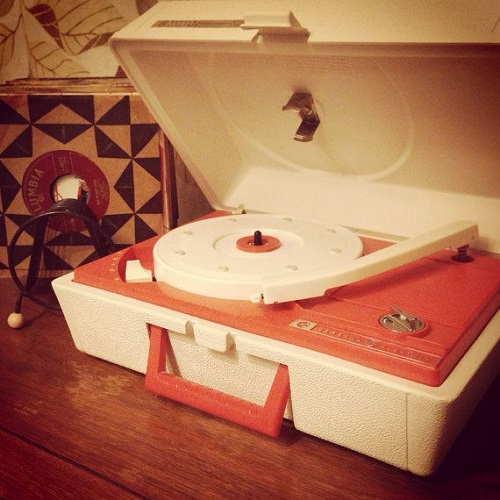
My love of music came VERY early. At age 9, I had as many 45’s as my dad. So when I think about what song got me on the way to becoming a music lover, there are 3-4 that come to mind. They would have been in my life between ages 5-7. The first couple were my first 45 purchases/gifts, and the last was an 8-track tune.
I was lucky enough to grow up during the pre-Elmo era of Sesame Street. My favorite characters were The Count and Ernie. I had an Ernie hand puppet that my grandma would take and make smoke cigarettes (which I hated). Ernie was one of two muppets who charted on the Hot 100 chart (The other would be Kermit with Rainbow Connection reaching #25).
Rubber Duckie debuted on February 25, 1970 when Ernie sang it on a Season 1 episode of Sesame Street. The segment was so popular that the song was issued as a single with the show’s theme song as the flip side. In September, it peaked at #16 on the Hot 100, and on November 16, it once again appeared on Sesame Street, this time in a Season 2 segment again with Ernie performing the song.
This was probably the first record I ever bought OR it was given to me with my record player, I cannot remember. However, I remember playing it a lot.
This part of my submission is brought to you by the letter “C.” C is for Coasters. Nice segue, huh?
When Charlie Brown and Yakety Yak were originally released as singles, they were not released on the same 45. When I bought it, it was on a reissue and they were on one 45.
Yakety Yak was released first. It was written by the songwriting team of Jerry Leiber and Mike Stoller. They wrote hits for many other artists, including Elvis. While the song almost songs like it is mainly a novelty, there is a lot in there. From Songfacts.com:
In the book The History of Rock, Bill Millar writes: “The Coasters were clearly irreverent and opposed institutions that white adults held in high esteem. Authority, parents, fidelity, hard work, piety and the suppression of risky pleasures were questioned with a blood and subversive wit. Jews (Leiber and Stoller) and Southern blacks (the Coasters) were expected to show gratitude towards the system. Instead they stood up and criticized it, a theme that can be recognized in almost all their songs.”
Mike Stoller was interviewed by songfacts.com and he said they had a lot of fun with The Coasters. “We would do these amusing songs and then The Coasters would go out on the road and they would choreograph themselves and work out how they’re going to perform it before an audience. Then they’d come back and do it for us, and we’d fall down on the floor laughing. Then we’d play them our new song and they’d fall down on the floor laughing. So it was always great fun.”
The story goes that Mike Stoller was fooling around on the piano and Leiber yelled from the kitchen, “Take out the papers and the trash!” – the rest is history!
Fun Fact: The legendary King Curtis can be heard on the saxophone solo.
The flipside (of the rerelease) was Charlie Brown, also written by Leiber and Stoller who made up the story of Charlie Brown, a kid who is always getting in trouble and wonders why everyone’s always picking on him. It has nothing to do with the character in the Peanuts comic strip, despite what many people think!
Fun Fact: The BBC banned this song because of the bad behavior Charlie Brown demonstrated, especially throwing spitballs.
This one particular 45 really helped my musical direction. I was listening to oldies while my friends were always listening to new music.
My final selection that comes from those early years of life really helped me to key in on music instrumentation. While a lot of times, we’d be dancing around like idiots to one of the songs on this album, when I listened alone, it was different. I noticed different percussion sounds. I noticed harmonies. I listened closely to the way each instrument sounded on different songs. This all happened with an 8-track tape of Herb Alpert and the Tijuana Brass’ Greatest Hits.
The album opened with The Lonely Bull, which starts with a cheering crowd and a typical Mexican sounding “fanfare.” I imagined a cartoon bullfight. This song is the one that led to Herb and the TJB’s success. According to songfacts.com: “Herb Alpert used the sound he found on this track to become one of the most successful artists of the 1960s. He kept the Tijuana imagery, recording as “Herb Alpert & the Tijuana Brass.” Over the next few years he had five #1 albums and finished the decade as the fourth best-selling albums artist, following Elvis Presley, The Beatles and Frank Sinatra.“
The Spanish Flea was used as the theme song for the Dating Game, A Taste of Honey always showed up in commercials for Honeybaked Ham, and Zorba the Greek was one that my brother and aunt danced around whatever room we were in when it played. Zorba starts fast and has a prominent bass drum accent that we’d always work into our dancing. Midway through the song, it stops and begins very slowly with a mournful trumpet solo. Our dance would slow to a walk/crawl. Then the song slowly increases speed until it is back to the original speed. Feel free to imagine a chubby 7 year old Keith running around to this!
Yeah, we’d wear ourselves out dancing to this song!
So there you have it, along with the Beatles, it was mariachi music, R&B songs and Sesame Street that led me to a lifelong love of music of all kinds!
Thanks again to Dave for hosting another great topic. See you next month!


Mine was listening to my dad, play his jazz albums on the weekend
LikeLiked by 1 person
You covered a lot of interesting ground here Keith! Sesame Street was probably a source of many first time impressions. The list of musical guests is beyond impressive. I think The Coasters never got as much credit as they deserved because of their novelty songs. But they were a talented bunch. Of course never hurts to have one of the greatest songwriting teams in history working with you!
LikeLiked by 1 person
thanks again Keith! 3 great picks! Who among us in our 50s wasn’t influenced by Sesame Street asa child? Ernie was my fave too
LikeLiked by 1 person