You may recall that I had a little trip to the ER recently. Well, after my week off I had a visit with my primary care doctor to follow up.
I was cleared to go back to work and I really have not had any issues. She ordered two tests for me – an angiogram and a stress test. Those will happen next week.
While at the hospital they ran the enzyme tests to see if I had a heart attack, but they were negative. However, the baby aspirin and nitro that the EMS crew gave me may have stopped something according to doctors.
My angiogram was scheduled on a day that I was supposed to speak in front of a class of EEG students. When I called the director to see if we could reschedule the talk, I explained what happened.
Her background is in cardiology. She told me that based on what happened, it could be something ischemic. If you are unfamiliar with that:
Ischemic heart disease (IHD), also known as coronary artery disease (CAD) or coronary heart disease (CHD), is a condition where the heart muscle doesn’t receive enough blood and oxygen. This typically happens due to plaque buildup (atherosclerosis) in the coronary arteries, which narrows them and restricts blood flow to the heart.
Dizziness and sweating are symptoms. I experienced both before going to the ER. Lightheadedness is also a symptom and I get that on occasion. So it makes sense.
From all I have read on an angiogram, if there is any type of blockage they will place a stent in during the same procedure. I have a feeling this may happen.
There is some cardiac history in my family. My maternal grandfather died of a heart attack and my father has a stent. During that procedure we found out he had actually had a couple small heart attacks and he didn’t even know he had them.
Either way, my stress test will happen a couple days after the angiogram. One way or another, they should be able to tell if there is an issue with my ticker.
To say that the incident was a wake up call is an understatement. The day after, I rejoined Weight Watchers. Something I should have done a while ago. I’m two weeks in and down 11 pounds. I really hope to stay focused and have better success this time around.
(This blog originally appeared on the A Sound Day blog as part of the Turntable Talk Series)
It is time once again for my monthly contribution to Turntable Talk for Dave at A Sound Day. The feature is in its 40th round this month! In the span of over three years Dave has presented us each month with a musically themed topic. Some of them have been easy to write about, while others were more difficult.
This month’s topic, however, is only difficult because there are hundreds of songs to choose from! As we are smack dab in the middle of the Dog Days of Summer, Dave’s instructions were:
“Pick your favorite ‘animal song’ and tell us about it. A song with an animal in the title. Could even be ‘Dog Days are Here Again’! Might be the ‘Year of the Cat’. ‘Eye of the Tiger’?that drowsy lion? Spiders , snakes, affectionate muskrats, ant music… possibilities seem endless as a ‘Hummingbird’ wingbeats.“
He couldn’t be more right! As soon as I read the topic, about 50 songs popped into my head. Along with those songs, I could guess which of the other contributors might pick for their piece.
There are Beatles fans among our group, so I Am The Walrus, Black Bird, Octopus’ Garden and Rocky Racoon are all possible choices for them. Then there are “rockers” and “metal heads” who might choose Black Dog, Cat Scratch Fever, Freebird or War Pigs. The 80’s fans could pick Hungry Like The Wolf, When Doves Cry, or Eye of the Tiger. Then there are the ones that every one I asked answered with – The Lion Sleeps Tonight, Cats in the Cradle, White Rabbit, and Brass Monkey.
Many of those were on my list of possible choices. I decided on one that I always loved to play on the oldies stations. I chose it because it is a snapshot of the early 60’s social scene.
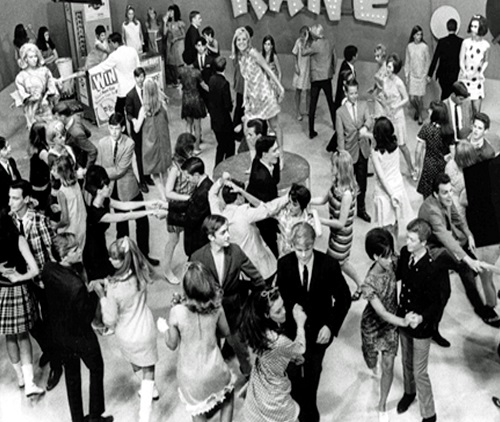
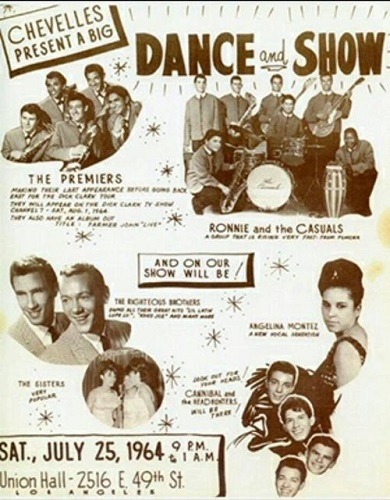
Union Hall Dances were big back then. They would usually have a large gym or dance floor where people would come to “let loose.” These dances were attended mostly by teenagers and young adults and mainly happened on Friday nights. They were a place to dance, socialize or just listen to music. Many of these dances had live bands that played music. The Union Hall Dances are mentioned in the first line of my animal song.
The 1960s was a decade known for various dance crazes, including “The Mashed Potato,” “The Frug,” “The Jerk,” “The Hully Gully” and “The Watusi”. Many of those songs would go straight to the top of the charts and were the inspiration for dance contests all over the country. There were many other dance crazes during that time including The Twist which was a massive phenomenon thanks to Chubby Checker.
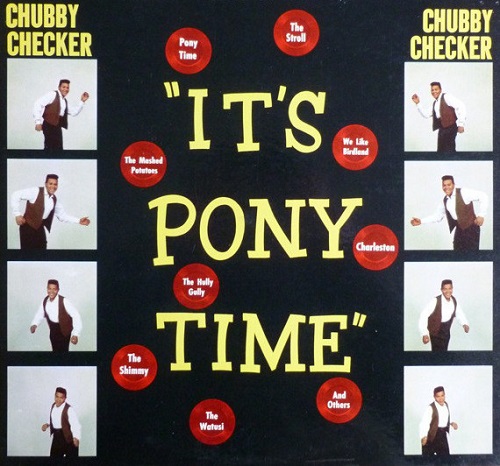
Chubby had great success providing songs – and dance crazes – that people could dance to. The Twist, Let’s Twist Again and other incarnations of the “twist” dance were his bread and butter. He also sang songs about other dance crazes like the Limbo (Limbo Rock), the Hucklebuck, and my animal song – the Pony.
I was surprised to find out that this was actually a cover song. According to songfacts.com: The soul singer Don Covay recorded the original version of “Pony Time” and released it as the first single with his group The Goodtimers in 1960. Checker’s version came out soon after and became the hit, as he was the big name. The Goodtimers’ rendition made it to #60 in March 1961, a month after Checker’s topped the chart.
Fun Fact: The Twist was a cover song, too. It was originally recorded by Hank Ballard and the Midnighters.
So what exactly is the Pony? This shouldn’t surprise you as the dancer tries to look as if they are riding a horse. According to one source, the dance is described this way: “In the dance the feet are kept comfortably together, while various arm and hand motions are possible. Movement around the dance floor may occur, but there is no line-of-dance. Couples generally face each other and do not touch.” You’ll get to see it before I am done.
Two things grab you as the song begins. First, that simple chord and Chubby’s announcement “It’s Pony Time! Get up!” It’s a call to attention. This is followed by that little drum kick and the “Boogety Boogety Shoos” which are a constant throughout the song. Ok, Chubby, you have my attention and I am ready to dance.
Fun Fact: The Boogety Shoo line was so popular, it is featured in Barry Mann’s Who Put the Bomp.
Chubby then sings, “Hey now everybody in the Union Hall ….” There is no doubt that this song was catered to be played at these venues. Much like the Twist, Checker calls out instructions on how to do that dance as the song plays. The calls are truly commands that were used by horsemen, but they are actually incorrect. The lyrics reverse the Gee and Haw commands. In use by horsemen for centuries, Gee was right and Haw was left.
So “let’s get it,” and give the hit version a listen:
The Dan Covay version with the Goodtimers is not too different from Chubby’s cover. Instead of yelling “It’s Pony Time,” the group actually harmonizes the line before the “Get Up!” Honestly, when I heard the original, I really liked it. It has more of an R&B feel to it. Chubby’s is truly all Rock and Roll. Give it a listen, it’s a shame this never gets airplay anymore…
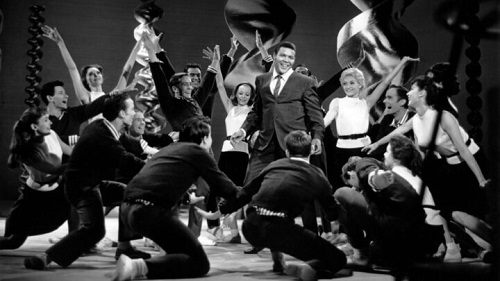
Before wrapping up, there is a video on YouTube that shows Chubby illustrating how to do the dance. For me, it is hard to watch, as the dancers just look ridiculous. Watching them, it doesn’t look like they are riding a horse at all…. The only saving grace of this video is they tend to focus on Chubby more than the dancers – which may or may not be intentional. Thankfully, the video is cut off early….
I cannot help by watch that and wonder “What in the world are they doing?” I am grateful that whenever I played the song on the radio or heard it in the car, it is just the audio!
I want to thank Dave for hosting this feature each month. As many of the other contributors have said in the past, it really is something I look forward to writing each month. The topics continue to be worth writing about. I cannot wait to see what the others write about and will wait for topic #41 soon.
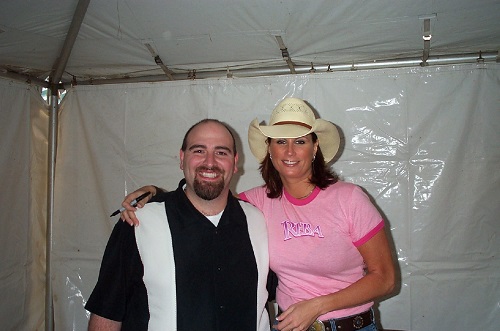
I have always loved her music. I’ve had the chance to meet her on a couple occasions as well as interview her on the air. She is witty and has a great sense of humor. She was a lot of fun to talk to.
I decided to go with a song that would probably be familiar to you. One of Terri’s early hits was a remake of “Poor Poor Pitiful Me”
Written and originally recorded by Warren Zevon, it first appeared on his self-titled album in 1976. It became a hit when Linda Ronstadt covered it the next year.
Ronstadt shared her thoughts on this song in a 1978 interview with Sounds: “To me that song seemed like the purest expression of male vanity. Step on you, be insensitive, be unkind and give you a hard time, saying can’t ya take it, can’t ya take it. Then if you tease men in the slightest bit, they’ll just walk off with their feelings hurt, stomp off in a corner and pout. I mean that’s the way men are, I swear. I thought the verse turned around to a female point of view was just perfect. The gender change works perfectly.”
Terri’s version was released in September 1996 as the lead single from her second album, 1996’s Just the Same. Clark told Billboard magazine that she heard Linda Ronstadt’s version of the song in a local gymnasium while she was exercising. She said “and I thought, what a cool song. What a great country record that could make. I started doing it live, and it worked.”
“Poor Poor Pitiful Me” debuted at number 47 on the U.S. Billboard Hot Country Singles & Tracks for the week of October 12, 1996. Clark’s version was a number one hit on the Canadian RPM country charts, and a number five hit on the country charts in the U.S.
The video comprises black-and-white tour footage interspersed with Clark being approached by a series of men while her car is being fixed at a full service gas station. Eventually, she realizes the man fixing her car is the one for her. She starts to drive off, before calling him over to get in. The two drive off together, leaving the other two co-workers at the shop surprised.
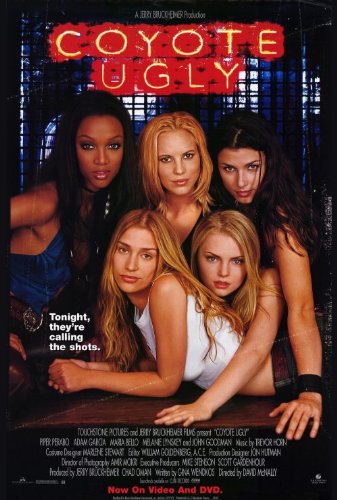
Honestly, I’ve never seen the movie Coyote Ugly. I did mention it on the radio a few times because we played songs from the soundtrack. The film premiered on this day in 2000.
“Can’t Fight The Moonlight” by LeAnn Rimes is the theme song to the movie. In the film Piper Perabo’s character plays a singer-songwriter from New Jersey who moves to New York City to pursue her music career. She ends up getting a job at a bar called the Coyote Ugly, where she makes enough money to buy a Mac that she uses to write and record this song. It earns her a showcase audition where she performs the song, wowing the crowd and earning a label deal.
“Can’t Fight The Moonlight” was a huge international hit, topping the charts in Australia, the UK, The Netherlands, New Zealand, and several other territories. In Australia, it was the best-selling single of 2001.
Believe it or not, the song didn’t do so well in America, where it only reached #71 in September 2001, It was released as the first single from the Coyote Ugly soundtrack. Seeing the international success, Rimes’ label, Curb, gave it another shot, re-releasing the song with a renewed promotional push. The re-release went to #11 in March 2002, long after the film had left theaters. Second time’s the charm apparently.
LeAnn provided the voice for Perabo’s singing in the film, and actually shows up to sing it in the film. The video is essentially an extended version of Rimes’ appearance in the film, showing her singing the song on the Coyote Ugly bar, intercut with other scenes from the movie.
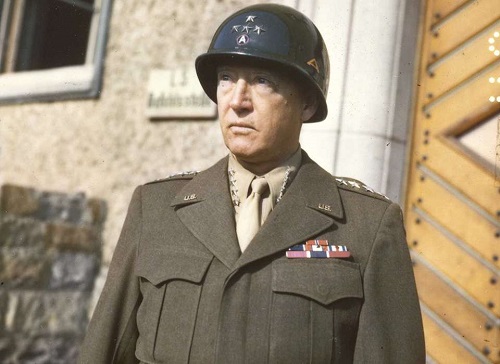
One of my favorite biographical films is Patton, which starred George C. Scott as General George Patton. It’s a great film and Scott was so good in the role that he won the Academy Award for Best Actor in 1971.
General Patton had developed a reputation in the U.S. Army as an effective, successful, and hard-driving commander, punishing subordinates for the slightest infractions but also rewarding them when they performed well. As a way to promote an image that inspired his troops, Patton created a larger-than-life personality. He became known for his flashy dress, highly polished helmet and boots, and no-nonsense demeanor. General Dwight D. Eisenhower, the commander of the 1943 Sicily operation and Patton’s friend and commanding officer, had long known of Patton’s colorful leadership style, and also knew that Patton was prone to impulsiveness and a lack of self-restraint.
The film is full of many powerful scenes. There was once scene in the film that really surprised me the first time I saw it. It is the depiction of the infamous “slapping” of a soldier. What I didn’t know, was that there were actually two slapping incidents one week apart from each other. The one in the film is the second incident.
The first one took place on this day in 1943. It involved Private Charles H. Kuhl. Patton approached Kuhl, who was sitting on a bed amongst the wounded. When Patton asked Kuhl where he was hurt, Kuhl reportedly shrugged and replied that he was “nervous” rather than wounded, adding, “I guess I can’t take it.” This set Patton off.
He slapped Kuhl across the chin with his gloves, then grabbed him by the collar and dragged him to the tent entrance. He shoved him out of the tent with a kick to his backside. Yelling “Don’t admit this son of a bitch.” The general demanded that Kuhl be sent back to the front, adding, “You hear me, you gutless bastard? You’re going back to the front.” That night, Patton recorded the incident in his diary: “[I met] the only errant coward I have ever seen in this Army. Companies should deal with such men, and if they shirk their duty, they should be tried for cowardice and shot.”
The second incident happened a week later on August 10, 1943. This time the soldier was 21 year old Private Paul G. Bennett. Records show he had no medical history until August 6, 1943, when a friend was wounded in combat. According to a report, he “could not sleep and was nervous.” A medical officer described Bennett’s condition:
“The shells going over him bothered him. The next day he was worried about his buddy and became more nervous. He was sent down to the rear echelon by a battery aid man and there the medical aid man gave him some tranquilizers that made him sleep, but still he was nervous and disturbed. On the next day the medical officer ordered him to be evacuated, although the boy begged not to be evacuated because he did not want to leave his unit.“
When the general entered the hospital tent, he saw Bennett. Patton approached him. He was huddled and shivering. Patten looked at him and asked what the trouble was. “It’s my nerves,” Bennett responded. “I can’t stand the shelling anymore.” Patton reportedly became enraged at him, slapping him across the face.
He began yelling: “Your nerves, Hell, you are just a goddamned coward. Shut up that goddamned crying. I won’t have these brave men who have been shot at seeing this yellow bastard sitting here crying.” Patton then reportedly slapped Bennett again, knocking his helmet liner off, and ordered the receiving officer not to admit him. Patton then threatened Bennett, “You’re going back to the front lines, and you may get shot and killed, but you’re going to fight. If you don’t, I’ll stand you up against a wall and have a firing squad kill you on purpose. In fact, I ought to shoot you myself, you goddamned whimpering coward.” Upon saying this, Patton pulled out his pistol threateningly, prompting the hospital’s commander, Colonel Donald E. Currier, to physically separate the two. Patton left the tent, yelling to medical officers to send Bennett back to the front lines.
Here is the scene from the film:
In August of 1943, General Eisenhower sent Patton a letter. He told him that he had been informed of the slapping incidents. He said he would not be opening a formal investigation into the matter, but his criticism of Patton was sharp. From that letter:
I clearly understand that firm and drastic measures are at times necessary in order to secure the desired objectives. But this does not excuse brutality, abuse of the sick, nor exhibition of uncontrollable temper in front of subordinates. … I feel that the personal services you have rendered the United States and the Allied cause during the past weeks are of incalculable value; but nevertheless if there is a very considerable element of truth in the allegations accompanying this letter, I must so seriously question your good judgment and your self-discipline as to raise serious doubts in my mind as to your future usefulness.
Patton apologized to the medical personnel that witnessed the events, and to each of the soldiers he slapped. Patton wrote in his diary that he loathed making the apologies, particularly when he was told by Bennett’s brigade commander, Brigadier General John A. Crane, that Bennett had gone AWOL and arrived at the hospital by “falsely representing his condition.”
If you’ve never seen the film or read a biography about Patton, I encourage you to do so. His life is full interesting things. His death was certainly not what you would expect for such a strong figure.
Sources: Wiki, Patton: A Biography, The Patton Papers
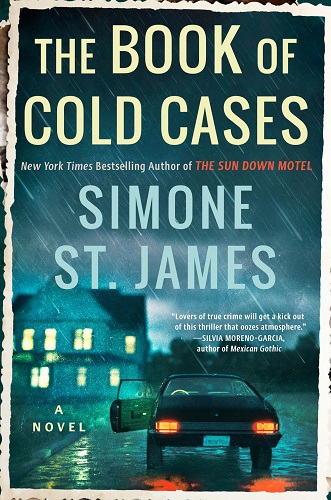
A friend of ours is always good about sharing books that she enjoyed with my wife and I. My wife actually read this one first, and I was able to read it this week. I went into this book only knowing the title and that it had a “true crime” aspect to it. The Book of Cold Cases by Simone St. James did not disappoint.
I’ve always loved shows that talked about cold cases. Back in the day it was Robert Stack talking about them on Unsolved Mysteries. There was also a series that aired from 2003-2010 called simply Cold Case. The most famous show was A&E’s Cold Case Files which has aired sporadically (1999-2002, 2005-2006, 2017, 2021-2022, 2024-2025). True crime is fascinating to me and many people, and I started reading this with those shows sort of on my mind.
Let’s look at the Goodreads synopsis:
A true crime blogger gets more than she bargained for while interviewing the woman acquitted of two cold case slayings in this chilling new novel from the New York Times bestselling author of The Sun Down Motel.
In 1977, Claire Lake, Oregon, was shaken by the Lady Killer Murders: Two men, seemingly randomly, were murdered with the same gun, with strange notes left behind. Beth Greer was the perfect suspect–a rich, eccentric twenty-three-year-old woman, seen fleeing one of the crimes. But she was acquitted, and she retreated to the isolation of her mansion.
Oregon, 2017. Shea Collins is a receptionist, but by night, she runs a true crime website, the Book of Cold Cases–a passion fueled by the attempted abduction she escaped as a child. When she meets Beth by chance, Shea asks her for an interview. To Shea’s surprise, Beth says yes.
They meet regularly at Beth’s mansion, though Shea is never comfortable there. Items move when she’s not looking, and she could swear she’s seen a girl outside the window. The allure of learning the truth about the case from the smart, charming Beth is too much to resist, but even as they grow closer, Shea senses something isn’t right. Is she making friends with a manipulative murderer, or are there other dangers lurking in the darkness of the Greer house?
This book was very good and kept me asking questions and on the edge of my seat at times. There were elements of the story I had not expected and at first I wasn’t sure about how to take them. In the end, however, those elements were what added the extra “suspense” for me.
As the summary states, the story bounces from the past to the present. There was no trouble keeping the characters straight. There were surprises and twists, too. I’m not sure I would categorize this as a mystery (which is what I thought it was), but I’d definitely call it a thriller. I found myself hating to have to stop reading at times. I wanted to know what happened next.
My high school band director was born on this day in 1935. He was a mentor and a friend. He was one of the most important influences in my life both in high school and after.
I have told this story before, but for new readers it is worth repeating. My junior year was a rough one for me and Mr. Shaner was always there with an ear to listen. He offered support, direction and advice. So when they planned the band banquet for that year, they wanted someone to do a speech about him. I volunteered.
I said that after you spend enough time with him, he begins to grow on you. I went behind the podium and put on a bald cap. (laughter) I then went behind the podium and came back with a baton and then imitated the way he’d look at it and such. (more laughter) I then went into a tirade of phrases and such that he often said in class like, “There is no way that you practiced this!” “The trumpets are way too loud again.” etc… (out of control laughter)
I had no idea how I was going to end the speech. I think I had just planned to say some nice things on behalf of our band. I ended up thanking him for all he did for me. It was an emotional and unscripted moment.
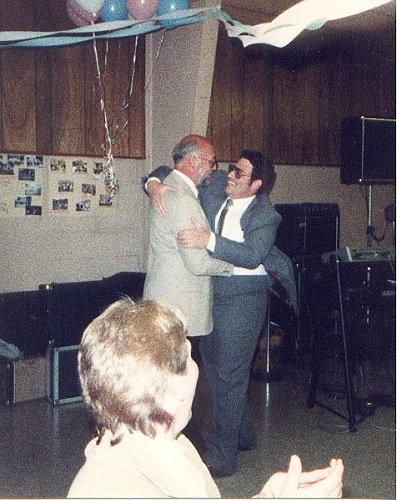
Afterward, he came up and wrapped me in a hug. He said to me, “That was the worst impression I have ever seen!” This brought more laughter and wound up being one of my favorite photos.
The following year, he got me back by doing a spot on impression of me which brought down the house! It was absolutely amazing!
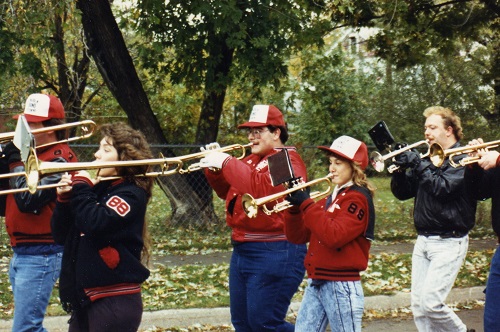
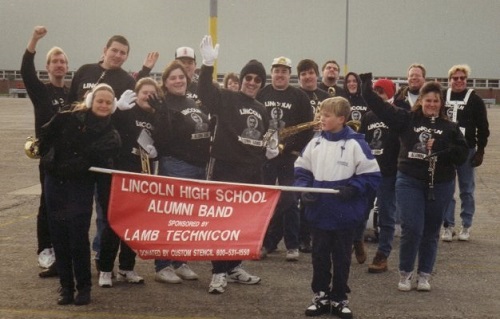
After graduation, I approached him about getting the alumni together to march in the homecoming parade. They used to have an alumni band, but it hadn’t performed for a while. He was totally open to the idea and even ran rehearsals for us.
We started out with a bunch of us old folks and had a blast!
The above picture is from the first year. The band was back together! Eventually, we even got sweatshirts printed up and we actually looked like we had a “uniform.”
The group continued to perform up until the year after Mr. Shaner retired. I remained in touch with him up until his passing in 2020. I think of him often and he is always on my mind on August 1st.
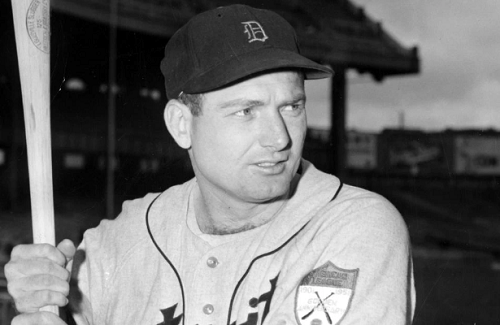
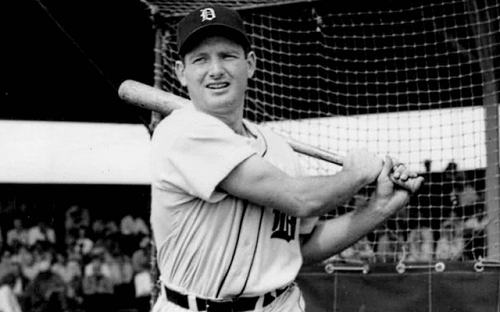
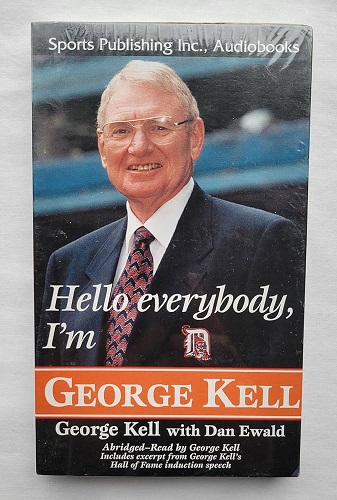
It was on this day in 1983 that George Kell was inducted into the Baseball Hall of Fame. Growing up, George was the broadcast partner of Al Kaline for the Detroit Tigers TV games from 1965-1996. He reminded me a lot of Ernie Harwell in that he always sounded friendly and had plenty of stories. He actually broadcast some radio games with Ernie. He had quite a career as a player, too.
He began his career with the Philadelphia Athletics in 1943. He moved to the Detroit Tigers in 1946 and went on to play for the Chicago White Sox, Boston Red Sox and the Baltimore Orioles. In his career, Kell batted .306, with 78 home runs and 870 RBI’s, 881 runs scored, 2054 hits, 385 doubles, 50 triples, 51 stolen bases, a .414 slugging average, and 621 walks for a .367 on-base percentage. He posted a career .971 fielding percentage. Kell played 1,795 games, but he never played for a team that made the postseason or the World Series.
Other highlights:
10-time All-Star (1947–54, 1956–57)
Eight consecutive .300 seasons (1946–53)
AL batting champion, led the majors in batting average (1949)
Holds record of the fewest strikeouts for a batting champion (13, in 1949)
Twice led the league in hits and doubles (1950–51)
Hit for the cycle (June 2, 1950)
Had 6 hits in a game (September 20, 1946)
Top 10 in AL MVP vote (1947, 1949, 1950)
One of my favorite George Kell quotes is “Never let yourself get fooled by the same pitcher on the same pitch on the same day.”
The other great quote came on this day in 1983. During his Hall of Fame Induction speech he said, “I have suspected for a long time that George Kell has taken more from this great game than he would ever be able to put back. And now today I know that I am more deeply in debt than ever before.”
Kell died at age 86 in his sleep in his hometown of Swifton, Arkansas, on March 24, 2009. His legend lives on here in Michigan. One of the greats!
Forgive me if I have mentioned this before. With all that I’ve had happen over the last week, I honestly cannot recall if I blogged about this.
My wife and I received a bill from the place that my daughter has physical/occupational therapy. The bill was for $2100. My insurance is the primary and my wife’s insurance is secondary. With both of them, all that we should have to pay is a co-pay.
My wife called to find out why we owed so much. Their response was that the primary insurance was out of network. This didn’t make any sense because there was no issue when my son was doing the same therapy there. So they asked for all the insurance info again and said they would rebill. The bills kept coming and we kept calling them. Each time we gave them all the info and were told they would rebill.
I had enough and called them again, but first I called the insurance company. They assured me that they were NOT out of network. They also told me that only visit they had been billed for was in April. The bill lists visits all the way back to November!
The therapist gave me an email for their customer satisfaction department. So I whipped off an e-mail giving all of the information (again) and explaining that my insurance was primary and not out of network. A few days later I got an email back that said “Sorry, you still owe this money!” They again said that my insurance was out of network and that we had to contact the secondary insurance to get the coordination of benefits right.
I responded with a strongly worded e-mail that said that I didn’t accept their decision. I told them that they are billing wrong. I explained that my insurance said they are not out of network and had never received a claim from them for any visits until April. I told them that it was obvious that they never billed them. I went on to explain that I had seen numerous comments about their poor billing department on the internet (Google reviews and such). I told them that I would be reporting them to the Better Business Bureau.
I filed a claim with the BBB and received a message back that my complaint was accepted. The next steps were that they would contact the therapy place and they would see exactly what I had written to them. Once they did that, they would get with me to see if any action was taken. Well, surprise surprise….they called my wife this morning.
“This should have never gotten this far!” “I am so sorry that you were put in this situation” Blah Blah Blah. My wife said that the woman who called couldn’t have been nicer. Naturally. The woman explained that after the first call the issue should have been brought to her department. She went on to say that she can see where the error was made and would be working to correct the problem.
And now for the kicker. The woman had the guts to say, “Now that we are fixing the problem, we would really appreciate it if you could rescind your complaint with the Better Business Bureau.” Seriously?! My wife said that if this issue had been taken care of after the first one or two calls, we wouldn’t have had to file the complaint. “Well, this could affect the way our business looks to others.” Not our issue. “This will lower our rating or standing with them.” Again, not our issue.
My wife firmly told them that we had no intention of rescinding that complaint. She also stated that if the BBB hadn’t reached out to them on our behalf, they would still be asking for $2100. Basically, she told them that it is a shame that they are more concerned with the way they look rather than making sure their clients are taken care of.
They wound up calling back later in the afternoon to tell us of their “progress” and once again asked us to reconsider taking back our complaint. They were once again told “no.”
I have never filed a complaint before. I didn’t even know if I had done it correctly. I am grateful to them for stepping in for us. It is just a shame that it had to go that far. Hopefully, the next bill we receive from them will be for the co-pays only.
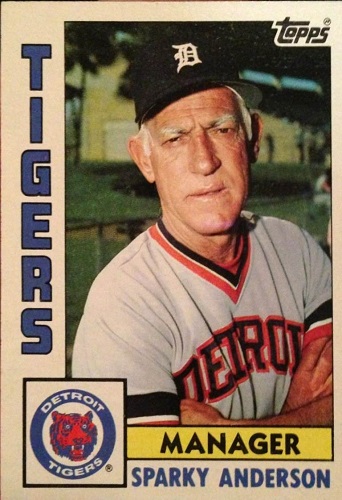
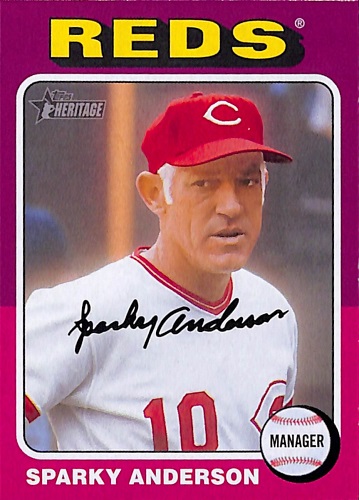
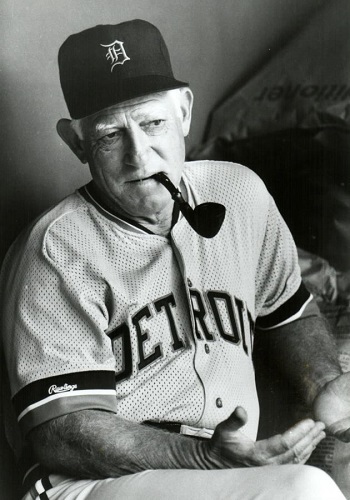
Sparky Anderson is the first and only manager in MLB history to win 600 games in both the National and American Leagues. This milestone was achieved on July 29, 1986, when his Detroit Tigers defeated the Milwaukee Brewers 9-5, according to the Baseball Hall of Fame and This Day in Baseball. He had previously won 600+ games with the Cincinnati Reds in the National League. He also holds the distinction of being the first manager to win the World Series in both leagues, having won with the Reds in 1975 and 1976, and with the Tigers in 1984.
On July 29, 1986:
Sparky Anderson wins number 600 in the American League.
As a player, Sparky Anderson wasn’t much. Anderson was signed by the Brooklyn Dodgers in 1953 as a second base prospect. Like most middle infield prospects, he was a pretty good fielder but a poor hitter. In the minors, he hit .263 with a .325 slugging percentage. Finally at age 25, he received his chance in the major leagues, but he didn’t do much. His glove couldn’t make up for a .218 average in over 500 at-bats when there was no pop (o HR, 9 2B). After that 1959 season, he was returned the minor leagues, where he would stay for four more seasons.
Fortunately while with the Toronto Maples Leafs (of the International League not the National Hockey League), Jack Kent Cooke saw Anderson’s leadership qualities and began trying to convince Anderson that his abilities would be best used in a managerial role. In 1964 and following several tough minor league seasons, Anderson relented and became the Leafs manager. Five years later, Anderson returned the major leagues but this time as a coach. He became an Angels coach in the following off-season, but the Cincinnati Reds called with a managerial position a few days later.
Anderson, of course, accepted the position, and the rest is history. In his first season, he won 102 games and an NL pennant. He and the Reds won 2 World Series titles in 1975 and 1976 as part of the Big Red Machine. In 1979, he left for the Detroit Tigers, and he became the first manager to win a World Series in both leagues in 1984. Two years after that and on July 29, 1986, he won his 600th game as a Detroit Tiger. Combined with the fact that he won over 600 in Cincinnati, Anderson became the first manager to win 600 games in each league.
Only five managers (John McGraw, Connie Mack, Tony LaRussa, Bobby Cox, and Joe Torre) have won more games than Anderson’s 2,194.
In honor of Sparky, here is a song that no one outside of Michigan will know. Our 1984 Tigers were magic. “Bless You Boys” became what everyone said that year. Sparky wrote a book with that title, and here is the cheesy song that played locally around ’84-85.
Sources: Wiki, This Day in Baseball, Baseball Hall of Fame









 Various Ramblings of a Nostalgic Italian