The Music of My Life – 2005

Welcome back to The Music of My Life, where I feature ten songs from each year of my life.  In most cases, the ten songs I choose will be ones I like personally (unless I explain otherwise). The songs will be selected from Billboard’s Year-end Hot 100 Chart, Acclaimed Music, and will all be released in the featured year.

I turned 35 in 2005. There was plenty going on in my personal life at this time. We were doing various therapies for my son, who had been diagnosed as being on the Autism spectrum. I had settled into my position at 94-5 The Moose in Saginaw as their afternoon guy and music director. I was certainly loving that. And at some point during the year, my mother’s cancer returned.

At the time, My Space was pretty popular. I was blogging a lot on there. Somewhere, I have a Word document with every one of those blogs. I had to contact them to get them. I had stopped posting there after joining Facebook, and at some point they moved content. I was thankful to get those blogs as they covered the time leading up to my wedding, the birth of my sons and the death of my mom.

I posted a lot about new songs we were playing on the radio, too. A few of them make this list. Let’s head into 2005:

The legendary Ray Charles passed away in 2004, but before he did, he recorded an amazing duets album. Genius Loves Company was the best selling recording of Charles’ more than 50-year career. It was a collection of duets with Norah Jones, Natalie Cole, Elton John, B.B. King, Gladys Knight, Diana Krall, Michael McDonald, Johnny Mathis, Van Morrison, Willie Nelson, Bonnie Raitt and James Taylor.

The album entered the Top 10 on the US album chart more than 40 years after Charles’ previous appearance on that same chart. This broke the record held by another act who also made his comeback with a duets album. In 1993 Frank Sinatra’s Duets reached the Top Ten 25 years after his previous Top 10 album.

Here We Go Again was a song that Ray had recorded in 1967. Then in 2004 he re-recorded this as a duet with Norah Jones for Genius Loves Company. She recalled collaborating with Charles on this song in a 2010 interview with Billboard magazine:

“I got a call from Ray asking if I’d be interested in singing on this duets record. I got on the next plane and I brought my mom. We went to his studio and did it live with the band. I sang it right next to Ray, watching his mouth for the phrasing. He was very sweet and put me at ease, which was great because I was petrified walking in there.”

This song won Grammy Award for Record of the Year and Best Pop Collaboration in 2005 eight months after Charles passed away. In addition Genius Loves Company was awarded Album of the Year among six other awards, as the American music industry paid lavish tribute to him.

Unlike Frank Sinatra and Willie Nelson, Ray Charles’ voice is as strong as ever on this recording. I felt Sinatra’s voice was weak on his duets albums. Willie is still putting out albums and at times he sounds like he’s just speaking the lyrics. Ray, however, sounds fantastic. I love the blending of these two voices.

Here We Go Again

The next song is an example of a song that I first heard in a polka. You read that right – a polka. Weird Al Yankovic has done quite a few polka medleys on his albums. The medley usually contains a verse or chorus from a pop song done as a polka. When I first heard Beverly Hills by Weezer on the radio, I found I liked it.

Weezer lead singer (Rivers Cuomo) explained in an interview with Rolling Stone magazine that this song is about how he could live in Beverly Hills, but he wouldn’t fit in. “I could live in Beverly Hills, sure,” he says, meaning he could afford it easily. “But I couldn’t belong there.'”

Songfacts explains:

The song comes off as satire, but that wasn’t what Rivers Cuomo had in mind when he wrote it. “I was at the opening of the new Hollywood Bowl and I flipped through the program and I saw a picture of Wilson Phillips,” he said. “And for some reason I just thought how nice it would be to marry, like, an ‘established’ celebrity and live in Beverly Hills and be part of that world. And it was a totally sincere desire. And then I wrote that song, ‘Beverly Hills.’ For some reason, by the time it came out and the video came out, it got twisted around into something that seemed sarcastic. But originally it wasn’t meant to be sarcastic at all.”

The music video was shot at the Playboy mansion. It included appearances by Playboy founder Hugh Hefner and some of the Playboy bunnies. Two of those bunnies were Holly Madison and Bridget Marquardt.

Beverly Hills

When I was music director at the Moose, I spoke with a lot of record people. One of the industry folks knew I loved music from the Rat Pack. She asked me if I had heard of Michael Buble’. I hadn’t. She sent me some MP3’s of his music and I was hooked.

The song could have been sung by just about any artist who tours. The lyrics sound as if they could be autobiographical. It is sung by someone who spends a lot of time on the road with great success. With that success, there is sacrifice. He is missing his home, particularly the woman he loves.

Despite the fact that Home only reached #72 on the Hot 100 chart, it was a breakthrough song for him. The song hit #1 on the Adult Contemporary survey in July 2005. Three years later Blake Shelton reached #1 on the Country chart with his cover of Bublé’s hit.

Bublé and Blake Shelton teamed up in 2012 to record a holiday version of this song for Shelton’s, Cheers, It’s Christmas album. The collaboration happened after Shelton sent Bublé an email saying he hoped to record a yuletide-themed rendering of the tune. “I had the idea of doing a Christmas version of ‘Home,'” he said.

This was the song that proved to folks that Michael was more than a cover artist. His original songs are just as good as the standards he records. He is also more than just a Christmas artist. It bugs me that people pigeon hole him and label him like that. He’s one of my favorites.

Home

My on air name was “Keith Allen.” As a music director, I got to hear all the new music before it went on the air. I popped Play Something Country by Brooks and Dunn in the CD player and loved it. On my first listen, I thought they said my name – Keith Allen. I suppose, in a way, they did. But the lyrics refer to Toby Keith and Alan Jackson:

Said, I’m a whiskey drinking, cowboy chasing, hell of a time
I like Kenny, Keith, Alan and Patsy Cline.

I have to tell you my favorite story about this song. When my program director and I first heard this, we said, “That’s a number one song!” We told our consultant that we wanted to add it. He said he didn’t feel like it was a hit. We were both shocked. We both told him that we felt it would be number one. He fought us.

He fought us for a few weeks on this one. He finally said that if we really felt it was a hit, we should add it. We wound up making a wager. I told him that if it didn’t go to number one, we’d buy him dinner. He said if it did hit number one, he would buy US dinner. The week it hit number one, he called us for our weekly music call. When we answered we started giving him restaurants we could go to!

His issue with the song? The “wolf-like” howl of the chorus.

Play Something Country

The next song is one that everyone jokes about on October 1st every year. “Someone needs to go wake up the guy from Green Day!”

This song reminds me of Fastball’s The Way. I say that because it starts with a simple acoustic guitar behind lead singer Billie Joe Armstrong. Then the song kicks in with drums and the rest of the instrumentation. I love the sound of that.

Green Day’s Billie Joe Armstrong wrote this song about his father, who died of cancer on September 1, 1982. At his father’s funeral, Billie cried, ran home and locked himself in his room. When his mother got home she knocked on the door to Billie’s room. Billie simply said, “Wake me up when September ends,” hence the title.

“My father died in September of ’82, and I purposely, up until that point, never went there,” Armstrong said in an interview. “I think really what I was doing was processing that loss that I had with this person that I never really knew. So I wrote that song for my father and about that loss and how 20 years had passed. I remember right after I wrote it, I felt this huge weight off my shoulders.”

Wake Me Up When September Ends

Another country newcomer makes my list this week. I have actually written about him, and the song. Here is that blog:

Must Be Doing Something Right

The next song is  one of the slowest chart climbers in history. It was on the American Hot 100 chart for 23 weeks before it entered the Top 40. KT Tunstall’s “Suddenly I See” was inspired by another artist, Patti Smith. Tunstall said, “The inspiration for the song was Robert Mapplethorpe’s photograph of Patti Smith on the cover of her album Horses. I was staring at it one day thinking it was incredible. It’s everything I love about music – mysterious, inviting, frightening.”

Suddenly I see
This is what I wanna be
Suddenly I see
Why the hell it means so much to me

“The chorus was me thinking, ‘that’s what I want to be,'” Tunstall told The Guardian. “Not a famous pop star with lots of money, but like this woman who’s living her life as an artist. I’d been trying for more than 10 years to be a professional musician. I was just exhausted from trying to persuade other people I was good enough.”

I remember hearing this song shortly after realizing that my first marriage was over. After all I learned and discovered through therapy, the title spoke to me. Suddenly, I saw just what was going on and I realized that I couldn’t do it anymore.

Suddenly I See

There were some really good country songs around this time. There were many new artists and some really distinct sounds that were on the radio. I was impressed with Josh Turner from the first time I heard him. I couldn’t believe the tone of his low voice.

Your Man is a song that I wish I could have written. Here is a guy who has been thinking about his woman all day long. He tells her to lock the door, turn the lights down low, and play some music.

I’ve been thinking about this all day long
Never felt a feeling quite this strong
I can’t believe how much it turns me on
Just to be your man

That’s LOVE right there!!

I love the entire feel of this song. It’s the perfect song to “sway” to.

Your Man

As the “Nostalgic Italian,” I think it is safe to say that I believe in the power of a photograph. The memories that can come from looking at an old picture just amazes me. My Friday Photo Flashback is always fun to do. I think that is because of the stuff that comes to mind with those old pictures.

I know there are plenty of people who hate Nickelback. However, Photograph is a song that I can relate to in so many ways. (From songfacts): This song is about reviewing the memories (missed and forgotten) from the band’s childhood in Hanna, Alberta. The lyrics are a chronicle of real events and personal landmarks lead singer Chad Kroeger recalled as he wrote it.

“It’s just nostalgia, growing up in a small town, and you can’t go back to your childhood. Saying goodbye to friends that you’ve drifted away from, where you grew up, where you went to school, who you hung out with and the dumb stuff you used to do as a kid, the first love – all of those things. Everyone has one or two of those memories that they are fond of, so this song is really just the bridge for all that.”

Someone once said, “If you don’t think photos are important, wait until they are all you have left.” I couldn’t agree more.

The photograph Kroeger is holding in the video is the one that inspired the song: It’s a shot of him and their producer, Joey Moi, at a New Year’s Eve party.

Photograph

We wrap up 2005 with a One Hit Wonder. Defining a “one hit wonder” isn’t really easy. Most feel it is when the artist fails to have their follow up released crack the Top 25. There are certainly many songs that fit into that category.

Daniel Powter’s album was released in America in 2006. Bad Day was released in the UK in 2005. In the fifth season of Americal Idol, the song was played over a video montage of the contestant that was being sent home that week. This helped the song gain popularity.

Powter is from British Columbia who later moved to Los Angeles. “Bad Day” was his first single released on a major label (Warner Bros.), and his only hit. He later described it as “a blessing and a curse.” Powter said:

“I was touring the world and performing for thousands of people, but I felt like the song was starting to define me. I actually found myself getting almost angry about it.”

This was the top-selling digital download of 2006. This was the star of people prefer downloading songs to buying CDs. It was part of a shift toward digital distribution of individual songs. In America, the album sold 500,000, but the single was digitally downloaded over 3 million times!

My mom was doing chemotherapy and radiation for her breast cancer at this time. She found the song to be inspiring. It basically says that even if you have a bad day once in a while, things will get better. My mom always tried to have a positive outlook. She battled cancer for 10 years and by this point she was tired.

My mom had the gift of gab. She was always on the phone. She assigned Bad Day to be the ringtone for her cell phone. I believe it was on there until she passed away. When I hear this song, I am taken back to those final weeks of her life.

Bad Day

What song from 2005 did I miss that was your favorite? Drop it in the comments.

Next week, we’ll focus on 2006. On my list is a song about a steeplechase runner, a song that became a hit because of Grey’s Anatomy, and a song that was a hit on the Adult Contemporary Chart and the Country charts. It also has a great Drifter’s cover song, one that took on a whole new meaning for me when my daughter was born, and a creative way to insinuate profanity without actually using it.

Thanks for reading and for listening! See you next week.

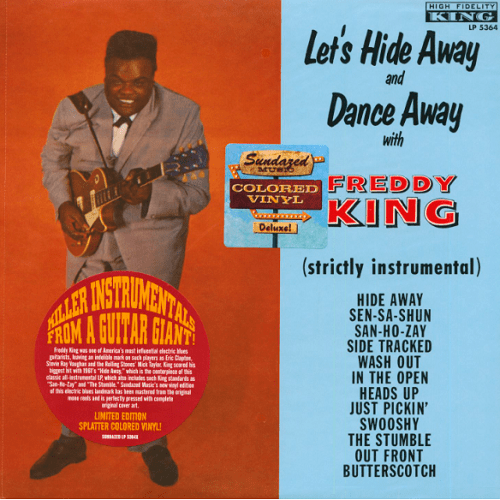
Tune Tuesday – Wash Out

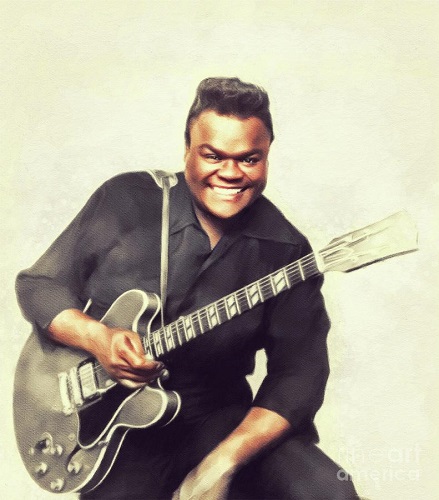
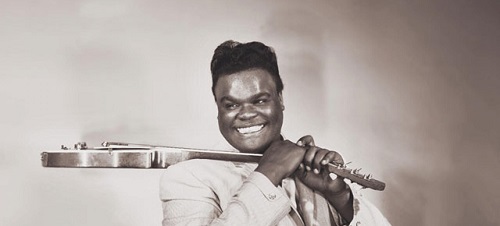
Today is the birthday of one of the “Three Kings of Blues Guitar.” The best known of these three is most likely B.B. King, followed closely by Albert King, and last but not least, the birthday boy, Freddie King. All three Kings – but no relation to each other. Freddie was born today in 1934.

Freddie was not just a great guitarist, he was also a songwriter and singer. His voice has been called “soulful and powerful,” but today I’ll focus on his guitar playing.

He was taught to play by his mother and uncle as child and eventually moved to Chicago. There he formed a band called the Every Hour Blues Boys. He tried many times to get a record deal at Chess Records (the home of Muddy Waters and Howlin’ Wolf), but was rejected every time. They told him that he “sounded too much like B.B. King.”

Persistence paid off for him as he finally landed a record deal with Federal Records in 1960. In August of 1960, he recorded his debut single, “Have You Ever Loved a Woman.” At that same session, he recorded an instrumental that has gone on to become a blues “standard,” “Hide Away.”

Hide Away reached number five on the R&B Chart and number 29 on the Pop Chart, an unprecedented accomplishment for a blues instrumental at a time when the genre was still largely unknown to white audiences.

While at Federal Records, Freddie became good friends with Sonny Thompson, a pianist, producer, and A&R man for Cincinnati’s King Records. Federal Records was a subsidiary of King Records. After the success of Hide Away, Thompson and Freddie recorded over 30 instrumentals (including today’s pick). Yes, they recorded vocal tracks throughout this period but often released the tunes as instrumentals on albums.

On the last day of local broadcasting at Honey Radio, my partner Rob Main and I were given 6 hours of the day to play whatever we wanted. We had decided to do have each hour focus on something different. Hour 1 was songs with Male names. Hour 2 was songs with Female names. Hour 3 had songs with body parts in the title. Hour 4 focused on instrumentals. That hour got a ton of requests for more and we did an extra hour of them.

Rob was a guitar player and he was the guy who introduced me to today’s Freddie King song. He had the “Let’s Hide Away and Dance Away” album his favorite cut was called Wash Out. I remember he told me he thought it had an “early Elvis” feel to it. The repeated guitar lick does remind me a bit of Elvis’ Blue Christmas.

He handed the song to me on a cart (what we played songs off of before CDs) and I played it on air without ever hearing it. We both sat with our headphones on listened. When it was done, we cracked the microphone and he asked me if I liked it. I remember telling him that it sounded like I was just listening to a couple guys sitting in a room jamming together. That’s what it felt like to me, improvising the blues.

Freddie was always out on the road. He toured with guys like Sam Cooke, James Brown, and Jackie Wilson. He was on the road almost 300 days out of the year. All the touring caught up with him. In 1976 he began suffering from stomach issues. Painful ulcers and acute pancreatitis led to failing health and he passed away just after Christmas in 1976 at the young age of 42.

In 2012, ZZ Top inducted him into the Rock and Roll Hall of Fame. A year later, Rolling Stone magazine ranked him 15th on their list of 100 Greatest Guitarists of All Time.

Happy Birthday to Freddie King!

Turntable Talk #24 – This Woman’s Work

For two solid years Dave Ruch from A Sound Day has been hosting a monthly feature called “Turntable Talk.” Each month he provides a topic to me and other musical bloggers to write about. I have been honored to have participated in every one of them. Each of the participants look forward to not only writing our piece, but anxiously await reading the other contributions.

As I stated in a previous blog, this month is International Women’s Month. Dave offered us an easy topic to write about this month. His instructions state “we’re going to turn our tables and sights to the women of music. Pick one you like and write about her. Whoever you want (that might sound creepier than I intended it), singer, songwriter, band member, the lady on the ‘Breakfast in America’ cover, whoever.”

I wrote a blog that teased this topic earlier in the week. In that post, I said, “I really struggled to pick one (female singer). I even posted on Facebook asking my friends to offer up their three favorite singers. I guess I hoped that they would offer up someone that I hadn’t considered (and they did). The results surprised me. The singers that came up the most were (1) Stevie Nicks, (2) Etta James, and (3 – tie) Pink and Karen Carpenter. Etta was the only one that was in my list of considerations. After looking at the list (and the suggestions) I finally chose who I am writing about and NO ONE mentioned her.

Along with Etta James, I featured a song from my other considerations: Ella Fitzgerald, Alison Krauss, Aretha Franklin, Billie Holiday, Dusty Springfield, Sarah Vaughn, Diana Krall, Norah Jones, Linda Ronstandt, Pat Benatar, Peggy Lee, Jewel, and Keely Smith in that blog. So how did I finally come up with my choice?

My friend, Dawn, from high school actually helped me make my decision. She said, “There are so many talented vocalists, I’d have a hard time picking. if you’re going to write an impactful piece, I think you have to go with somebody you admire because they knocked down boundaries or overcame obstacles. That’s how I’d pick my vocalist.” That really struck me. Now, I am not saying that the ladies I mentioned already did not knock down boundaries or overcome obstacles – heck, Jewel was living in her van before she made it big!

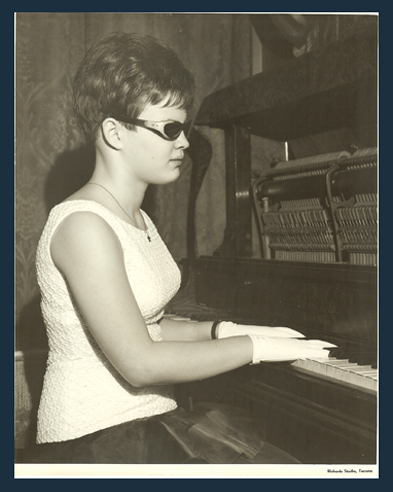
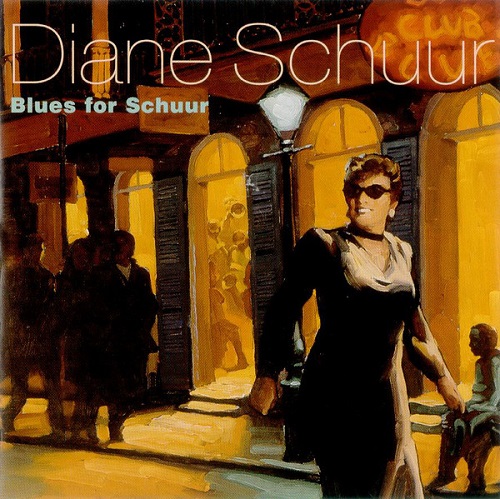
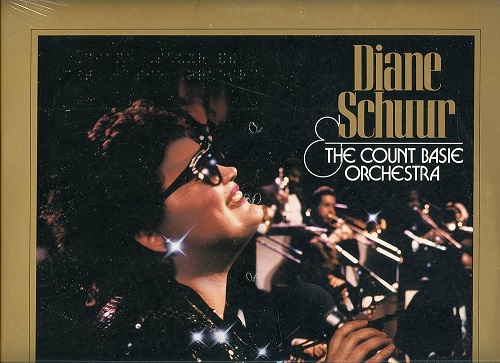
My featured female singer is a talented woman named Diane Schuur.

I was introduced to Diane Schuur back in the late 80’s. I was talking about music with a gal I was dating at the time. We started talking about jazz singers and she asked if I had ever heard of Schuur. I hadn’t. If memory serves me correct, she loaned me a cassette (or maybe a CD) with some songs on it and I really enjoyed it.

One of her biographies online says this: “Diane Schuur is as eclectic as she is brilliant.” In my opinion, this statement could not be more true. While many of her songs would fall into the jazz category, she could easily be filed in the blues or pop categories, too. While preparing to write this, I picked a playlist on YouTube and it was fun to hear the different sounds of each of the songs.

My friend Dawn said to pick someone who “overcame obstacles.” Diane certainly has done that! She was born prematurely in 1953. She has been blind since birth because of Retinopathy of Prematurity. This disorder affected premature newborns who received high-oxygen therapy during neonatal intensive care. This was a standard practice until 1954.

She learned to play piano by ear. She would listen to Dinah Washington songs and began to pound out the melodies at age 3. Dinah was a big influence to Diane as she began singing her songs as a toddler and worked on her own vocal style. She once stated, “As far back as I can remember, singing was in my blood. My parents loved music, and I loved to sing. I was scatting at an early age.” She scats right up there with Ella and Mel Torme’! She also has perfect pitch!

Blindness was not her only obstacle. When she was a young adult, she began drinking and struggled with alcoholism. She also battled an eating disorder. Those obstacles were so much that she actually contemplated and attempted suicide. Thankfully, her brother-in-law stopped her from jumping out a third-story window. She got help and has been sober for several decades.

Diane got her big break when she was 22 years old. She auditioned for drummer/bandleader Ed Shaughnessy (of the Tonight Show Band) after he finished a concert with Doc Severinsen. Ed said, “this young blind girl comes in and sits down at the Fender Rhodes keyboard and starts singing the blues. Well, my hair stood on end!”

He hired her to be the vocalist in his orchestra. This led many other musicians to hear her. Those included Dizzy Gillespie and the great Stan Getz. Stan was so impressed that he became an advisor and coach to her. She stated that it was Stan who taught her that “less is more.” This was important because she had many critics that said she often “oversang” when she first started out. Stan once said, “She’s just like Sarah (Vaughn) or Ella (Fitzgerald) to me. She’s taking from the tradition, and what comes out is her own conception and advancement of the tradition.”

In 1985, she met B.B. King at a music festival in Tokyo. The two really hit it off and later made an album together entitled “Heart to Heart.” It was released in 1994 and it entered the Billboard Jazz Charts at number one!

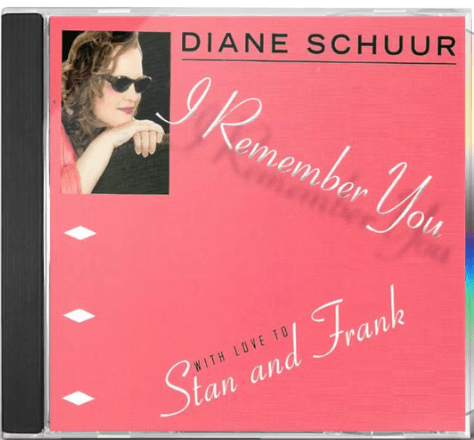
In 1988, Frank Sinatra asked her to sing with him at a benefit concert when Liza Minnelli was unable to perform. She was a guest at Sinatra’s home and also performed at a concert with him and Quincy Jones. Frank gave her an abstract oil painting that he had created for her afterwards. When Frank passed away, Schuur recorded a tribute album for her late friends (Frank and Stan).

Other inspirations to Schuur include George Shearing, Stevie Wonder and Ray Charles who are all blind as well. She has said that one of her fondest memories was performing with Ray Charles in 1998 for a PBS concert (some of which is available on YouTube).

Her career has brought her two Grammy awards – both for Best Jazz Vocal Performance (1986 & 1987). She is still recording and touring today. She says, “For the future I plan to continue my reading of American song, paying respect to celebrated writers and polishing the gems in the jazz tradition.”

I’ve never had the chance to see her in person, but there are some fantastic live albums available.

All About Jazz says, “Ms. Schuur surely is among the very best jazz vocalists, and she exemplifies, if not redefines the “diva” category with her warm, often humorous and relaxed interactions with the audience and the musicians. Her mere presence is enough to make for a memorable evening.” I hope to be able to see her perform one day.

I will include just a couple of my favorite cuts at the end of this blog, but before I do, I want to again thank Dave for hosting this monthly feature. I hope that you enjoy reading this as much as I did writing it. I love that with each topic, I am not only enjoying old favorites, but I am introduced to new songs and singers. Perhaps this blog is your introduction to Diane Schuur?

Here is a classic – Come Rain or Come Shine

Another favorite – All Right, OK, You Win!

I just love her take on Moonlight and Shadows

One more – Her swinging version of I Can’t Believe That You’re in Love With Me

Thanks for reading!

Turntable Talk – The First Time’s the Charm!

It is time for another round of Turntable Talk, hosted by Dave at A Sound Day. This is the 12th round that I have participated in and it has quickly become one of my favorite “features” to participate in. There has not been a topic that Dave has presented that has not been interesting for me to explore. This round is no exception. If you haven’t already, be sure to check out his site and read the contributions of other music lovers, too!

For this round, Dave’ says, “This time around I’m calling it “First Time’s The Charm.” Let’s look at an artist whose debut really impressed you. It can be one that just knocked you out first time you heard it when it was brand new, or one you went back & discovered later. As long as it showed a band or singer that hit the ground running.

In talking with one of the other participants this week, I mentioned that with each topic, one choice always seems to hit me immediately. Then I begin to think about other possibilities, and without fail I always seem to come back to the first choice. This time around, I decided not to consider anything else and go with the first thing that came to mind.

It is 1989. In our living room is the shelving unit that contains my dad’s stereo system. One shelf holds the receiver/amplifier while the cassette deck and Sony Mini-disc players sit on top of each other on the shelf above that. Two speakers sit on top of the unit. A turntable sits on a shelf that slides out on the top left of the unit. Under that, on a shelf all by itself is a Sony CD player.

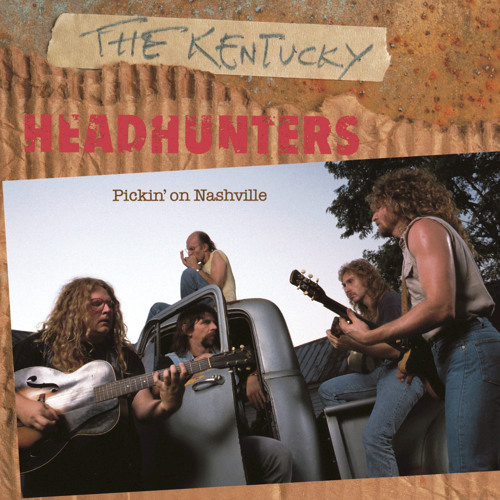
My dad calls me out to the living room and says, “Keith, you’ve gotta hear this!” My dad has certainly played a major role in sharing great music with me. The above phrase was spoken by him to me more times than I can count. Oh, the music he introduced me to! I would have to say that 9 times out of 10, it has always been something that I have really liked. The CD he popped in the player was the debut album from The Kentucky Headhunters.

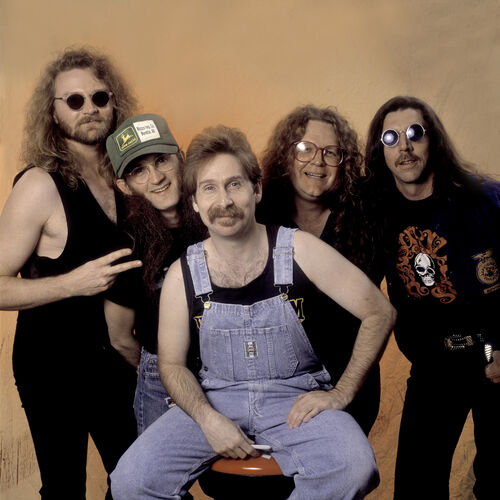
The group started back in the late 60’s and called themselves “Itchy Brother.” In 1980, the group was almost signed to a record deal at Swan Song Records, which was a small label founded by the band Led Zeppelin. However, Zeppelin drummer John Bonham died that year and the label folded. Itchy Brother disbanded in 1982. In 1985, there was an attempt to reunite the group. This attempt led to a few new members joining while some original members decided not to be a part of the group. Now missing some of the original members, a new name was chosen for the band – The Headhunters. It didn’t take long to find out that there was another band using that name, so “Kentucky” was added to the name.

The group decided to take out a loan to record a demo. That demo included some original songs and some cover songs. They had hoped to press copies of the demo to sell as merchandise at their live shows. It didn’t take long for that demo to get noticed by folks in Nashville. The group was not really interested in signing a record deal, but their manager suggested that they talk with producer Harold Shedd at Mercury Records. They were signed to their deal in 1989 and the demo was released as their debut album “Pickin’ on Nashville.

I hadn’t intended on listening to the whole album that day, but when my dad hit play, I really liked what I heard. While they certainly had a Southern rock sound, it wasn’t really completely Southern rock, if that even makes sense. It is kind of a mixture of country, Southern rock, a bit of blues, classic rock, a little rockabilly, and maybe even a little bit of metal. It was like nothing I had heard in some time. It was a very unique mix of various styles and types of music.

The first cut on the album was a cover of Bill Monroe’s Walk Softly on This Heart of Mine. Bill’s version has a very bluegrass feel to it. The Headhunters had me from the opening guitar lick. Then I was really digging the harmonies of the group. The guitar solo had a rock/B.B. King feel to it, which I just loved. The debut single reached number 25 on the Billboard Hot Country Singles Chart, the first of 4 Top 40 singles for the band.

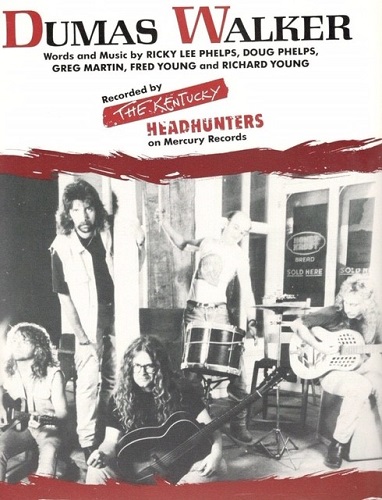
The second single from the album is probably their best known song, but not quite their biggest hit. It almost didn’t make the album, though. Dumas Walker is a song that is about a Kentucky hangout. The lyrics tell of hanging out there eating a “slawburger, fries, and a bottle of Ski.” Folks in Kentucky knew that a slawburger was a burger with cole slaw on it, and a bottle of Ski is a soda that is a lot like Mountain Dew. The record company wasn’t too keen on it, though.

Producer Harold Shedd felt that the song was too local. He felt like no one outside of Kentucky would connect with the song. He asked band member Richard Young if they would be willing to leave the song off the record. After much discussion, Young says that he convinced Shedd to keep it on the record. He said that Shedd was missing the point – that every place had their own “Dumas Walker’s and they can relate to that!” He was right. The song was a top 20 hit for the band in 1990.

Another thing that helped get the band recognition was CMT (Country Music Television), which was the country version of MTV. The early headhunter videos are a blast to watch. How could anyone possible turn off a video set in a bar with people playing marbles, the lead singer juggling bowling pins, and the drummer banging on his drum kit with no shirt and a coon skin cap on!? Incidentally, the video was nominated for the CMA video of the year in 1990.

Richard Young says that the group had a “magnetism that people just couldn’t resist” and compared it to watching the old Monkees TV show. He said, “People want to be entertained. If you can’t hold their eyes, they will wander.” Watch a few of their videos and you will certainly be entertained.

The third single from the album was another cover song. This time it was a cover of Don Gibson’s “Oh, Lonesome Me.” Gibson’s version is very typical 1960’s country. The Headhunters version kicks it up a notch with a driving beat and video that really fits the “Monkees” description above. This song peaked at number 8 and would be the band’s only Top 10 hit. The fourth and final single from the album was “Rock and Roll Angel,” which is mostly forgettable.

The band enjoyed great success in 1989/1990 because of their debut album. In 1990, they won the Academy of Country Music’s Top New Vocal Duo or Group Award , The Country Music Associations Vocal Group of the Year, and the CMA Album of the Year. They also won a Grammy for Best Country Performance by a Duo or Group that year.

Sadly, their follow up album Electric Barnyard was a major disappointment. It was certified gold, but the singles released to radio didn’t get much airplay. Citing creative differences, Ricky Lee Phelps and Doug Phelps left the group in 1992 to form their own band, Brother Phelps.

The band has continued to tour with a variety of different members and their last album was released in 2021. They never really enjoyed much success after that debut album. That being said, I believe their fresh sound really paved the way for (and had a big influence on) some of the more recent country singers who have a more “rock” sound.

One thing I think is important to mention is that the Kentucky Headhunters hit the scene at a very unique time in country music. In 1989, this new group stood out during a time that also saw country music’s amazing “Class of ’89” hit the scene. They were in the thick of things at the same time that Alan Jackson, Clint Black, Travis Tritt, and a dude by the name of Garth Brooks were getting their debut’s as well. The fact that they made waves amongst those guys is a testament to that first album.

It is hard to say what factored into the decline in popularity. Was it hard to get airplay with all of those other big names taking off? Was the music that followed just not good enough? Did the loss of the Phelps Brothers put the nail in the coffin for the band? Maybe it is a little bit of each of those things. The Kentucky Headhunters recorded 9 studio albums, but you really only need to get their debut, Pickin’ on Nashville. It is as good as it gets.