Today marks the 105th birthday of legendary singer Peggy Lee. She was discovered singing in a noisy club in Palm Springs. That noisy club played an important role in her sultry singing style. She said,
I knew I couldn’t sing over them, so I decided to sing under them. The more noise they made, the more softly I sang. When they discovered they couldn’t hear me, they began to look at me. Then, they began to listen. As I sang, I kept thinking, ‘softly with feeling’. The noise dropped to a hum; the hum gave way to silence. I had learned how to reach and hold my audience—softly, with feeling.
In 1941, she would go on to be the singer in Benny Goodman’s orchestra. She enjoyed a seven decade career which included songwriting and singing. She recorded over 1100 songs and of those co-wrote 270 of them.
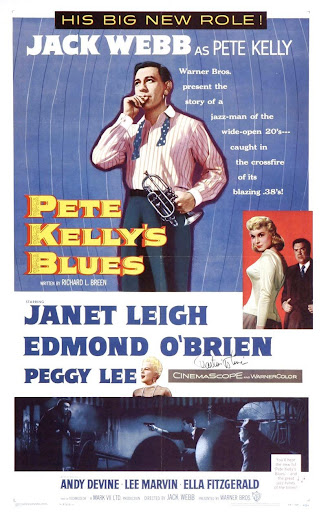
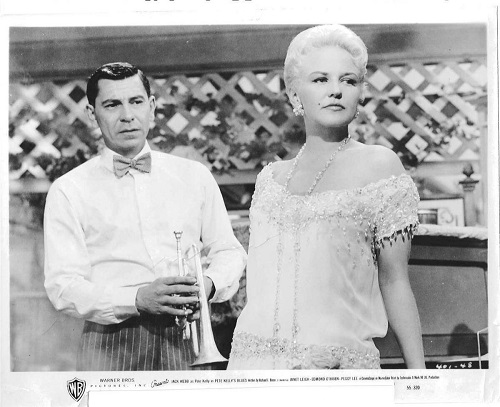
Her record label kept her very busy, but she did find time to do some acting. In 1955 she did some voice work for Disney’s The Lady and the Tramp and starred with Jack Webb in Pete Kelly’s Blues. She played an alcoholic blues singer in the film and her performance earned her a nomination for the Academy Award for Best Supporting Actress.
Peggy sang 9 songs in the film. One of which was Sugar.
Fun Fact: Peggy Lee was used as inspiration for the Miss Piggy character in 1974. Originally called Miss Piggy Lee, her name was shortened to Miss Piggy when the Muppets gained fame.
As a bonus, for Peggy’s birthday, I want to include one of my favorite Peggy Lee songs. I mentioned earlier her sultry voice. I can think of no better song to demonstrate her sexiness and sultriness than Big Spender.
In the song she has her eyes on a guy with a big money roll. He caught her eye as soon as he arrived and she wants him to spend some time with her. The arrangement of the song makes you picture her walking slowly and deliberately over to him. You can picture her staring him in the eyes and shifting her hips from side to side as she moves closer.
When I was in Jazz Band in high school we played this song. I remember the director asking us to picture a beautiful woman walking towards us slyly as we played. As silly as that sounds, it made the saxes play the melody with a bit more feeling, it made us trumpets really hit to “stab” notes, and the trombones really made their glissandos loud and sloppy.
Welcome to the first Turntable Talk of 2025, hosted by Dave of A Sound Day. This is the 34th round, if you are keeping track. If you are a new follower, let me fill you in on how it works. Dave Ruch offers up a musical topic to a group of us music fans each month. Each of the writers come up with a response to the topic and Dave runs each piece on his website.
We have had some fun and interesting topics, and this one is no exception. This time around, Dave asks, “What’s my scene?” Our instructions: Pick a sort of music “Scene” that either you would have liked to have been a part of or one that you think really created a lot of the music you love. Pick a general place and time and have fun….
My fellow music bloggers know my musical tastes pretty well by now. So, let’s see a show of hands – How many thought I’d pick The Rat Pack in Vegas? I almost did, but I know I have written on a live Rat Pack show in the past. Honestly, as awesome as that would be, the more I thought about it the more I leaned another way.
My scene certainly influenced the Rat Pack. Dean Martin cut an album called Swingin’ Down Yonder. Frank Sinatra recorded albums titled: Sinatra Swings, Songs for Swingin’ Lovers, Swing Easy, Sinatra’s Swingin’ Session, Sinatra and Swingin’ Brass, and A Swingin’ Affair! You know what the song says, “It don’t mean a thing, if it ain’t got that swing!”
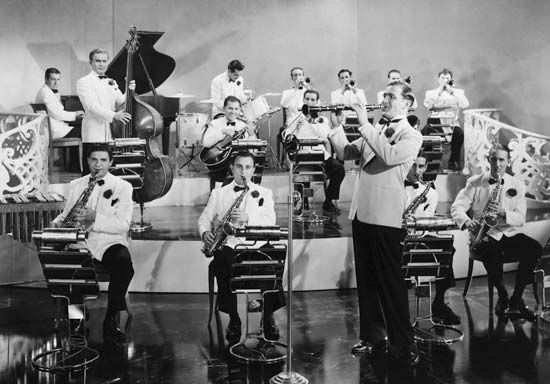
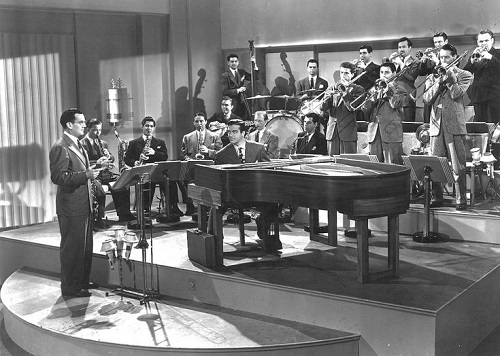
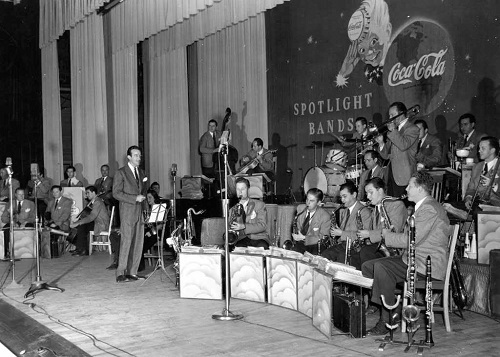
As a mediocre trumpet player, I have always loved Big Band/Swing music. Most folks would consider the Swing Era to be from the early 1930’s to around the mid 1940’s. Even though swing music was prominent in the early 1930’s, it was often ridiculed for its style and feel. Some went as far as to call it a menace (much like Rock and Roll when it gained popularity). After 1935, big bands rose to prominence playing swing music. They held a major role in defining swing as a distinctive style.
There were many big bands on the scene at this time. Each had a very distinct sound and feel to it. For example, Glenn Miller’s orchestra often used a clarinet lead. Count Basie’s sound has a relaxed feel to it. Benny Goodman used a driving and hard swing sound. Duke Ellington’s songs has a sophisticated sound to them.
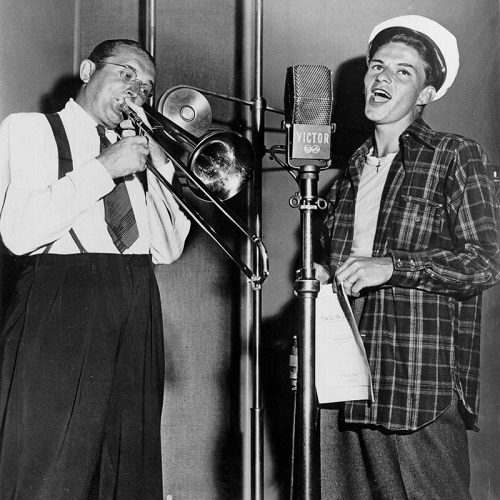
The band leaders often took the spotlight. They were amazing instrumentalists. Harry James and his trumpet, Benny Goodman and Artie Shaw on their clarinets, Gene Krupa on his drums, the trombones of Tommy Dorsey and Glenn Miller, and Lionel Hampton’s vibes. Along with those great leaders, there were plenty of talented musicians within those bands who went on to make a name for themselves.
Perhaps Sinatra recorded his many swing songs because he rose to fame alongside Tommy Dorsey. He was one of many singers who sang with those big bands. Others included the voices of Ella Fitzgerald, Billie Holiday, Kay Starr, Peggy Lee, Doris Day, Kitty Kallen, and Dick Haymes. While they all started with the big swing bands, they also went on to have prolific careers.
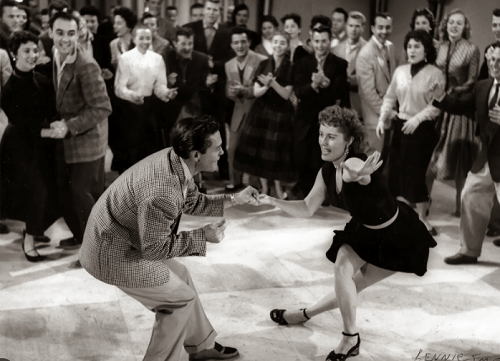
During the swing era, the big bands would often play at dance halls across the country. They appeared on the radio playing dance music. Some appeared in movies, and all of them made records. Their music had teenagers and young adults dancing until their feet hurt.
As years went on, the taste of music listeners changed. Swing began to fade away to make way for music that was less “danceable” like bebop. Many of the swing bands broke up, while other continued without their original leaders. The Glenn Miller Orchestra still tours today, for example.
When I put on headphones and listen to old big band recordings, I picture myself there listening. I picture myself in one of those great 1930’s suits with a stylish fedora.
Maybe it is in a dance hall or at a live concert. Maybe I am in the audience of a radio program where the band is playing. Wherever the music is being played, I am zoned in on it. I am listening to the drum beat of Sing, Sing, Sing and Benny Goodman. I can hear the vibrato of Tommy Dorsey’s trombone solo on I’m Getting Sentimental Over You. I marvel as I watch and listen to Harry James play his theme song, Ciribiribin.
Throughout the evening, I will study those great instrumentalists who improvise solos off the top of their head. Looking at nothing but chords and making up their own melodies. This is something I wish I could do as a trumpet player.
In all honesty, in my “scene,” I would be happy as a clam to just be in the audience. It would be the bees knees just watching those guys swing! Yeah, I can totally see myself swinging, singing, and dancing to the sounds of swing.
Thanks again, Dave for inviting me to take part in this feature. It is always fun to contribute and to read the other submissions. I’m already looking forward to next month’s topic!
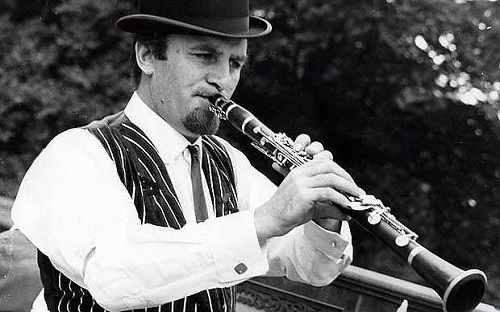
The clarinet celebrates birthday 335 today, and in honor of that, it is Clarinet Day!
January 14th is the day the clarinet was invented in Nuremberg, Germany in 1690. The instrument was created by German instrument maker Johann Christoph Denner, or possibly his son Jacob.
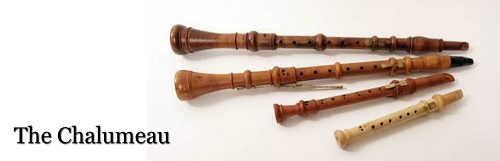
It had developed from much earlier reed instruments, going right back to Ancient Greece and Egypt. The chalumeauwas a Baroque single reed woodwind instrument originating in France where its use spread to Germany.
Denner developed the instrument. He equipped a chalumeau in the alto register with two keys, one of which enabled access to a higher register. This second register did not begin an octave above the first, as with other woodwind instruments. Instead, it started an octave and a perfect fifth higher than the first. A second key, at the top, extended the range of the first register to A4 and, together with the register key, to B♭4. Later, Denner lengthened the bell and provided it with a third key to extend the pitch range down to E3.
In the days of the Big Bands, there were plenty of well known clarinetists. Benny Goodman, Artie Shaw, and Woody Herman all played clarinet and had their own big bands. They also had hits that featured clarinet solos (Let’s Dance, Begin the Beguine, Woodchopper’s Ball).
As far as pop hits, there are a couple that spring to mind that feature the clarinet. The first was from Mr. Acker Bilk.
Bilk wrote Stranger on the Shore for his young daughter and originally named the song “Jenny” after her. The tune was written on a single scrap of paper by Bilk and handed over to arranger Leon Young. Young crafted the string arrangement, including the characteristic harmonic shifts at the very end.
The song was a number one in the UK and the biggest selling English single of 1962. In May of 1962 it became the first British recording to reach number one on the U.S Billboard Hot 100 Chart.
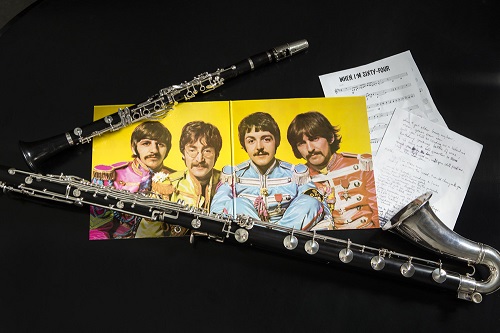
The other pop clarinet hit comes from the Fab Four. Paul McCartney wrote the melody for When I’m 64 when he was just 14 years old. It was one of the first songs he ever wrote.
The song features a clarinet trio – 2 B flat clarinets and a bass clarinet. The song was scored by George Martin, who said the clarinets were added at McCartney’s request. The reason for this was to “get around the lurking schmaltz factor” by using the clarinets “in a classical way.”
Paul McCartney suggested speeding up the track to raise the key by what musicians call a semitone. A semitone is about a half step. So speeding up the track took it from C major to D flat major. George Martin remembers that McCartney suggested this change to make his voice sound younger.
Musicologist Michael Hannon had this to say about the completed track:
“The rich timbres of the clarinets give the mix a fuller, fatter sound than many of the other tracks on the album.”
Welcome back to The Music of My Life, where I feature ten songs from each year of my life. In most cases, the ten songs I choose will be ones I like personally (unless I explain otherwise). The songs will be selected from Billboard’s Year-end Hot 100 Chart, Acclaimed Music, and will all be released in the featured year.
I have found it interesting to do this feature every week. First, I am reminded about the things that were going on in my life at the time. Second, I find it funny how an old song can apply to my future life events. This feature has been like therapy for me. I don’t always write down everything that these songs bring to mind, but I am made aware of them. I appreciate you letting me indulge myself by sharing these songs.
I would turn 27 in 1997. I had gone through a break up that hurt me bad. I was spending a lot of time at the karaoke bars and drinking much more than I should. I felt lost and alone. Alcohol numbed a lot of the pain. It was a very dark time.
When I wasn’t singing karaoke, I was hosting it or DJing a wedding or party. I enjoyed doing that because it was almost like being in radio again. There was interaction with people and that was something that I desperately needed.
1997 was a decent year for music. Many of the songs on my list were first heard while I was driving for EDS. I would play many of these songs while DJing. Some of them bring back memories of bad times, but most of them have a good memory attached to them.
I will stop rambling now and jump right into 1997 –
I like the next song because it was so different from what people were used to hearing from them. Green Day was known for some pretty heavy sounding songs that were “in your face.” So an acoustic song from them comes from out of left field. Believe it or not, the song could have been on their first album, but wasn’t.
Songfacts.com explains: “Billie Joe Armstrong wrote this song in 1993 and submitted it for the band’s first major-label album, Dookie, which was released in 1994. Both the band and their label felt it was a great song but didn’t fit on the album, which was loaded with punk blasters. The song was held back and didn’t make their next album, Insomniac (1995) either. It was finally included on the Nimrod album in 1997.
In 2010, Armstrong told Spin Magazine, “That was really the first time we attempted a ballad. The first time we ever played that song was during an encore in New Jersey – I had to pound a beer backstage to get up the courage. I knew we were gonna take a tomato to the face.” A very poignant song, this is quite popular at graduations and weddings despite the kiss-off title “Good Riddance.” Billie Joe Armstrong wrote it about a very specific event in his life, but he’s thrilled when others relate it to their own experience.
This song was played over a montage of clips in a “look back” Seinfeld special. The special aired before the finale of the show. I would have never expected that this song would work for something like that. But it certainly did.
This song is very poignant and gives me chills when I hear it. The blending of the guitar, the strings, and his voice is just beautiful to me.
Good Riddance
In Good Riddance, Green Day sings about the “photographs and still frames in your mind.” Believe it or not, that kind of fits how the next song was described by one of the members.
You either like or dislike Hanson. That like or dislike probably comes from the song MMMbop. Why? It is one of those songs that sticks in your head forever after you hear it. It is very catchy and the lyrics make you think. But just what in the world is this song all about?
Drummer Zac Hanson says, “What that song talks about is, you’ve got to hold on to the things that really matter. MMMBop represents a frame of time or the futility of life. Things are going to be gone, whether it’s your age and your youth, or maybe the money you have, and all that’s going to be left are the people you’ve nurtured and have really built to be your backbone and your support system.”
Zac tells the story of how the song happened, “That song started out as the background part for another song,” he said. “We were making our first independent album and we were trying to come up with a background part. We started singing a slightly different incarnation of what is now the chorus of ‘MMMBop.’ That sort of stuck in our heads but never really worked as a background part. Over a couple of years, we really crafted the rest of the song – the verses and bridge and so on. It was something we almost stumbled upon.”
Zac made me laugh when I read that because the song even got stuck in THEIR heads!
What is truly amazing to me is that the song was released as their first single in 1997. At the time, Isaac Hanson was 16 years old, Taylor was 13, and Zac was 11. The song quickly became a huge worldwide hit. It was getting constant airplay on radio stations and MTV, and going to #1 in 27 countries.
It is on my list because I was DJing a high school dance once and a student asked for it. He was very shy and didn’t dance much. He may have had autism, I am not sure. When I played it, this boy came out of his shell and danced like crazy! The students formed a circle around him as he danced. It was one of those things I will always remember.
Mmmbop
Before you listen to the next song, I need you to hear this. I had no idea that this song was sampled for the 1997 hit.
I had never heard of the Andrew Oldham Orchestra. I had no idea that there was an instrumental album of Rolling Stones songs. The Verve did, however, and sampled it for the song Bittersweet Symphony.
The Verve took the sample and added vocals, strings, guitar and percussion. This led to trouble. After a lawsuit by the Rolling Stones’ former manager, Allen Klein, the Verve had to relinquish all royalties from the song. Rolling Stones members Mick Jagger and Keith Richards were added to the songwriting credits. Things worked out in 2019. After Klein died, Jagger, Richards, and Klein’s son ceded the rights to the Verve songwriter, Richard Ashcroft.
If I had to put why I like this song into words, I would find it hard to do. There is something about it. It is mesmerizing to me. MTV’s Gil Kaufman wrote “Bitter Sweet Symphony” was “built on a slow-rolling fat beat, a pomp and circumstance violin loop. And (was like an) … elliptical, snake-swallowing-its-tail lyrics” Rolling Stone magazine wrote that it “intertwines baroque strings worthy of Pachelbel with sedated vocals and shimmering guitar lines”.
The song is built around one simple chord.
Bittersweet Symphony
Much like Bittersweet Symphony, I was hooked on the next song as soon as I heard the intro. Again, the intro was “borrowed” from another song. This time it was from Perrey and Kingley. They were considered pioneers of electronic music. They were together from 1965-1967. Smash Mouth interpolates the keyboard line from their 1966 single, Swan’s Splashdown. You don’t need to listen to but 15 seconds of the song to know the Smash Mouth song …
Smash Mouth’s guitar player Greg Camp wrote Walkin’ on the Sun. He said, “The song was basically a social and racial battle cry. It was a sort of ‘Can’t we all get along?’ song for the time when I wrote it. It was just about all the things that were going on around me as a young person. And I’m, like, God, what is going on? I don’t understand why this is happening. It’s like we might as well be walking around a planet on fire.”
The songs has a 1960’s sound to it, which made the song stick out on the radio. It was their first hit song. The song itself was never sold in stores as a single, so it never made the Hot 100 chart. However, it went to #1 on the Modern Rock chart and #2 on the Airplay chart. Because it was not released as a single, the album Fush Yu Mang sold over 2 million copies. The album was the only way to get it.
I was one of those 2 million people who bought the album.
Walking On the Sun
Kevin Sharp’s story is a moving one. He was born in 1970, the same year as me. In school, her performed in musicals and was an active musician. When he was 19, he started to feel tired and dizzy. This led to a diagnosis of a rare form of bone cancer. His chance of recovering was not good.
Through the Make-A-Wish Foundation, which grants wishes to children with life-threatening illnesses, Kevin met the record producer David Foster. They became friends fast. He went through two years of chemo and radiation therapy, which caused him to lose his hair permanently.
While in remission, he recorded a demo that wound up in the hands of his friend David Foster. Thanks to him, Kevin was signed to a record deal in 1996. His first album was Measure of a Man. The first single was a cover of Tony Rich’s Nobody Knows, which went to #1 on the Country Charts. His next two singles were both top ten hits for him.
He would go on to became a motivational speaker and spokesperson for the Make-A-Wish Foundation. He was awarded the foundation’s Wish Granter of the Year award, in 1997. Sharp wrote a book, Tragedy’s Gift, and published it in 2004. Despite releasing two more albums, he never ever matched the success of his first album. He died at age 43 of complications from stomach surgeries and digestive issues in 2014.
If You Love Somebody is one of his three top 10 songs. Deborah Evans Price, of Billboard magazine reviewed the song favorably. She said that the record grabs the listener immediately and doesn’t let go thanks to the “energetic percussion that opens this track and gives way to a spree of sassy fiddle lines.” She goes on to say that the song is a fine example of the “vibrancy and passion he can bring to a great uptempo cut.”
The song is a fun love song that speaks of all the things you would do because you love someone.
If You Love Somebody
In 1997, there were still music videos being made – and played on MTV. While I love the next song, it is the video that really stands out. More on that in a second.
The Backstreet Boys were very big in Europe. When they returned to the US, no one really knew them. In 1997, they released their first album in the states. Everybody (Backstreet’s Back) was the band’s choice for a single. However, because they had been in Europe, the record label felt that the song wouldn’t make sense to audiences and it wasn’t even on the US release.
The song was the first single from the international release. It started gaining steam on Canadian and nearby US stations. The label finally added the song to the US album after a million units had already been produced. It was released as the fourth single.
Joseph Kahn was approached to do the music video for the song. When he met with BSB and saw their smooth dance moves, he thought they were more like “little Michael Jacksons.” This led to him thinking about the Thriller video which had the singer leading a choreographed dance with zombies. Kahn developed a similar concept for the Backstreet Boys.
In the video, the boy band’s tour bus breaks down near a spooky mansion. It is where they’re forced to spend a harrowing night. The haunted manor has a transformative effect on the boys, and each one changes. (Brian Littrell changes into a werewolf; AJ McLean into Erik, The Phantom Of The Opera recluse; Kevin Richardson into the two-faced Dr. Jekyll & Hyde; Howie D into Dracula; and Nick Carter into a mummy.) They converge in the ballroom and bust out “Thriller”-esque moves with a group of dancers. At the end, they’re relieved to discover the whole experience was just a nightmare – that is until their driver turns out to be a monster. The driver? Antonio Fargas, who was known for his role as Huggy Bear on the ’70s cop show Starsky & Hutch.
Everybody (Backstreet’s Back)
Up next, a group who got its name from a story created by one of the members. In the story, the men were Chumbas and the women were Wambas. Tubthumping was the first single from Chumbawamba’s eighth album – Tubthumper.
I suppose it is important to point out a few “vocabulary” words here. In England, a tubthumper is a politician. Here in the US, tubthumping is like “campaigning.” “Pissing” has a very different meaning in the UK. “Pissing the night away” would translate to “Drinking alcoholic beverages all night.” To be pissed in England is to be drunk, while in the US it is to be angry.
Whenever we played this song DJing, we’d go out on the floor and do a dance that we made up. It was basically an easy thing that matched the lyrics. “I get knocked down (crouch down), but I get up again (jump up) you’re never gonna keep me down (stand shaking our heads and wagging our finger side to side). Easy and no instruction needed because of the lyrics.
We had empty booze bottles that we’d pretend to swig when the band said, “He takes a whiskey drink, he takes a vodka drink”. It was silly and stupid, but it always got a laugh from the crowd.
At 54, I doubt that I could crouch down and jump up again like I did when I was 27!
Tubthumping
The next song was the debut single for the group Everclear. Everything to Everyone is true of many of us. I remember when I was with my ex, that I would do things that I didn’t necessarily want to do because I wanted to please her. I spent a lot of time in my life trying to please people and never really standing up for myself. It’s like the Sheryl Crow song – “If it makes you happy….”
In an interview with Songfacts, lead singer Art Alexakis says:
“It’s kind of an angry song. That person is within everybody, I think everybody has this ability to try and be everything to everyone, to try to please. I think there are 2 aspects of it – there’s the pleaser, who doesn’t always show his true self, always plays nice and as time goes on shows more and more of himself, but there’s also the people who are everything to everyone who are manipulators and users.”
When asked if the song had “anything to do with the record business”, Alexakis replied, “Oh yeah. Anything in the entertainment business you’ll find people who are slimy.”
I believe that you will not only find them in the entertainment business, but in much more than that!
Everything to Everyone
You cannot say that country music doesn’t have some great song titles! Take the next song on my list. Did I Shave My Legs For This?
Deana Carter’s father was a songwriter. The legendary Dean Martin recorded one of his songs, and perhaps as a thank you, named her Deana. Another legend, Willie Nelson, heard one of her demo tapes and invited her to play Farm Aid in 1994. That same tape, led to her being signed to Capitol Records.
Did I Shave My Legs For This is also the title track of the album. The album gave Deana three #1 songs (Strawberry Wine, We Danced Anyway and How Do I Get There?). The title track was the fourth single released from the album. It didn’t fair as well as the previous songs as it only went to #25 on the Country Charts.
I have learned from DJing and hosting karaoke that just because a song wasn’t a hit, doesn’t mean it isn’t liked. I always got requests for this song and people were always singing it. At weddings or parties, groups of women would sing along at the top of their lungs to it. It reminded me of what people did when Friends in Low Places would play.
Back in the day, we used to play Karaoke Roulette. This was where a friend would pick a song for you to sing. You wouldn’t know what song until you got to the microphone. My friends always made me sing songs like “I Am Woman,” “I Touch Myself,” and such. This was one they gave me one night and I nailed it! I knew the song and hammed it up all the way through it.
Did I Shave My Legs For This?
My final song is one that brought back a genre of music that overtook the nation in the 1930’s and 1940’s. I grew up listening to Benny Goodman, Harry James, and other swing bands. It was almost mind blowing to hear swing music on the radio in 1997.
The 1996 movie Swingers and t he Cherry Poppin’ Daddies are credited with the “Swing Revival.” Other groups like Big Bad Voodoo Daddy and The Brian Setzer Orchestra had success in the genre, too. The BSO’s version of Jump, Jive and Wail turned the revival into what songfacts called “a full-fledged craze!”
Zoot Suit Riot was a song that was inspired by real events. Songfacts explains:
The Zoot Suit Riots began in Los Angeles in 1943, triggered by conflict between the American servicemen stationed in Southern California and the Los Angeles Mexican-American community. Tensions had been building since the 1942 murder of a Latino man named Jose Diaz, a case referred to as the Sleepy Lagoon murder case.
The riots took place when swing music was the hot sound and everyone was doing the jitterbug. Lead singer Steve Perry says, “I wrote it inspired by the Zoot Suit Riots. I guess it seemed like a Pachuco rallying cry that could double as a dance anthem for those of us interested in swing music and culture at a time when nobody else was. It was an expression of a proud marginalism. That’s not that deep, but there you go.”
It wasn’t odd around this time to have a bride and groom request a swing song as their first dance. Most had taken a dance class and had a routine for that dance. It was always cool to watch that.
One day, I hope to get around to seeing Setzer, Big Bad Voodoo Daddy, or any swing band live. I love the energy that they put out as they play.
Zoot Suit Riot
That’s it for 1997. There were many songs that didn’t make my cut, maybe your favorite is one of them? Let me know what your picks are in the comments.
1998 is on the horizon and we’ll check out my tunes from that year next week. They include a song that I almost picked for this month’s Turntable Talk Topic (songs based on historical events or people), a song that is often played as the last song of the night at DJ gigs, a song I mentioned in this week’s post, and a great song I can barely listen to anymore. Find out why next week
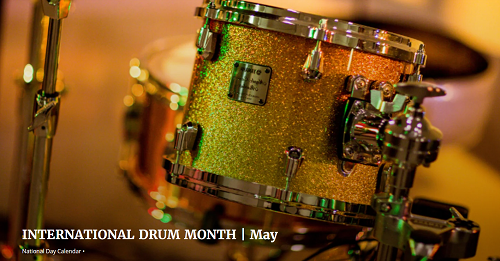
Welcome to May! Were you aware that May is International Drum Month? Cheers to the instrument that keeps the music in time.
Anyone who has played in a school band or any band really knows that there are plenty of jokes made about the percussionists and the percussion section:
What do you say to a drummer in a three-piece suit? “Will the defendant please rise?”
Hey, did you hear about the drummer who finished high school? Me neither.
What is the difference between a drummer and a savings bond? One will mature and make money.
What is the difference between a bad drummer and a vacuum cleaner? You have to plug one of them in before it sucks.
There are hundreds of jokes like that. Honestly, though, without the percussion section (or percussionist) the rest of the group would fight to keep time. I can’t imagine marching in a parade without a solid drum cadence and so many great bands had well known drummers.
So in honor of International Drum Month – I wanted to share some of my favorite drum songs, drum solos, and songs about drums.
First, let’s head back to 1936 and the fantastic song by Benny Goodman – Sing, Sing, Sing. The song was written by Louis Prima and became one of Benny’s signature songs.
In 1941, legendary drummer Gene Krupa had a hit with Drum Boogie (with Irene Day on the vocals). There are many videos of him performing this.
Instrumentals were big in the 50’s and 60’s. My dad introduced me to 1958’s Topsy Part 2 by Cozy Cole. He worked with great artists like Louis Armstrong and Cab Calloway.
Preston Epps learned how to play the bongos when he was in the Korean War. His big hit was Bongo Rock, but I liked 1960’s Bongo, Bongo, Bongo a bit better (Though it never broke the top 40). I often used this as background music when I was on the radio.
If you have ever heard To Know Him Is to Love Him (Teddy Bears), Alley Opp (Hollywood Argyles), or A Thousand Stars (Kathy Young and the Innocents), then you’ve heard Sandy Nelson. He was a session drummer and played on a lot of songs. He even had some solo hits, including 1961’s Let The Be Drums.
Johnny Smith recorded Walk, Don’t Run in 1954. Chet Atkins covered it in 1957 and when the Ventures heard it, they recorded their own version in 1960. While many consider it more of a guitar tune, the drums are a key part of the song.
Probably one of the most famous drum songs was from 1963. The Surfaris took Wipe Out! all the way to #2 on the Hot 100 chart. It is a song that continues to pop up on TV and in movies and has even made a few reentries on the charts because of that.
In 1967, Michael Nesmith of the Monkees penned a percussion tune for Linda Ronstadt and her group The Stone Poneys. Linda has a birthday coming up and I was going to feature this song on that day, but it fits better here. This was her first single and it reached #13 on the Billboard Hot 100 chart.
In 1969, The Beatles released Abbey Road, which contains a song that has a drum lick that famous drummers everywhere still talk about. It is often called “genius” and I couldn’t agree more. The drum line from Come Together is just an amazing thing to listen to. Atta Boy, Ringo!
In 1972, Gary Glitter had a hit with the B-side of Rock and Roll Part 1, which was appropriately called Rock and Roll Part 2. Most folks remember this one as simply, “The Hey Song.” This was his only top 10 hit in the US. It used to be big at sporting events, but it went away after some sexual crimes in the late 90’s and early 2000’s. It was featured in the recent Joker movie.
1972 also brought one of my favorite drum intros by way of Stevie Wonder. I’ve written about this one before, but you know I had to hear it again as I wrote this.
1977 brought another great drum tune that is still used at sporting events today. I couldn’t do a piece about drum songs without Queen’s We Will Rock You.
So many songs can be instantly recognized by the drum intros and the next one from 1980 is no exception. It is a classic rock and party staple. I am, of course, talking about AC/DC’s Back in Black.
When you talk about drums and drum solos, there seems to be one song that always comes up – In the Air Tonight by Phil Collins. It’s not my favorite song, but you can’t deny the very cool drum solo.
The next drum song has become sort of a Monday morning anthem for anyone who works for a living. Todd Rundgren’s 1983 Bang On The Drum All Day is unique in that he plays every instrument on the track.
I am sure I could feature many more songs, but I have decided to conclude with a song that was very unusual. It was unusual, because there are very few songs that begin with a 30 second drum solo. In 1984, Van Halen did just that. Alex Van Halen kicks off Hot for Teacher with an amazing double bass drum performance and a song remembered not only for his drum work, but a steamy video.
This month, I salute drummers like Ringo Starr, John Bonham, Keith Moon, Buddy Rich, Sheila E, Dave Grohl, Alex Van Halen, Phil Collins, Charlie Watts, Gene Krupa, Questlove, Hal Blaine, Max Weinberg, Lars Ulrich, Neil Peart, Levon Helm, Chad Smith, Ed Shaughnessy, and so many others!! Thanks for keeping the beat!
What songs do you remember for drum solos or great drum work?
One of my favorite commercials on TV right now is the “Spring Into Action” commercial from Kohl’s. There is something about the smile of the little girl as people “hop” by that tugs at the heart strings. It is a wonderful “feel good” commercial. If you haven’t seen it – take 30 seconds and enjoy:
Kohl’s Spring Into Action
While walking the neighborhood with Ella last week, I noticed a few chalk Hopscotch games on the sidewalk. Rest assured, if the child who had drawn it was out on the porch, I would have hopped along just like the folks in the commercial.
The ad itself is wonderful. I love the song choice in it, as well. The Sunny Side of the Street is a song that is over 90 years old! It was written in 1930 by Jimmy McHugh and Dorothy Fields (although, some say it was written by blues legend Fats Waller). It made its debut on Broadway in the show International Review. The song is considered a jazz/pop standard now and is part of the “Great American Songbook.” It has been recorded by Louis Armstrong, Billie Holiday, Bing Crosby, Benny Goodman, Ella Fitzgerald, Nat King Cole, Count Basie, The Pied Pipers, Doris Day, Keely Smith, Frank Sinatra, Willie Nelson, Tony Bennett, and so many more.
As I thought about this song, I thought about my life. This was me! It wasn’t until Sam and I got together that I began to walk on the Sunny Side of the Street! I crossed over from the “dark and shady” side. I have always loved this song – it’s one of my favorite cuts from Willie Nelson’s Stardust album. If I had to pick a favorite version it would probably be Willie’s version. It’s just so laid back and smooth….
If you want a more “swinging” version of it – try Keely Smith on for size….
Lyrics
Grab your coat and get your hat Leave your worries on the doorstep Just direct your feet On the sunny side of the street
Can’t you hear the pitter pat? And that happy tune is your step Life can be so sweet On the sunny side of the street
I used to walk in the shade With those blues on parade But I’m not afraid This rover crossed over
And if I never had a cent I’d be rich as Rockefeller Gold dust at my feet On the sunny side of the street
I used to walk in the shade With those blues on parade But I’m not afraid This rover crossed over
And if I never had a cent I’d be rich as Rockefeller Gold dust at my feet On the sunny side of the street
Life Lesson
When life has you down, take a stroll on the sunny side of the street!







 Various Ramblings of a Nostalgic Italian