Well, the Christmas season is officially underway. I can assure you that I have NO plans to go out shopping today. I’m just built for stress like that. Anyway, since it is official, I thought I would search for a Christmas themed photo to feature.
A while back, my brother put all of the digital Christmas photos in a folder marked “Christmas Through the Years.” One of the first photos to pop up was this one;
It is pretty much all of the girls in the family. From left to right on top: Mom, Grandma, Aunt Linda. Bottom left to right: Arin, Aunt Jodi, Melissa. It is one of the few pictures with all the gals from my mom’s side in one photo.
The photo is taken at my Aunt Linda’s house. This was probably around 1981, just after my grandpa passed away. We usually had Christmas at my grandma’s. Occasionally, it would be at my Aunt Linda’s or our house. When it was at my aunt’s house, my uncle’s parents would often be there. They were Italian, and I just loved talking to his mom about Italy and Italian food.
My Aunt Linda gave me my first Bible as a Christmas gift one year. I wish I’d took it a bit more seriously then. She wrote something on the inside cover that has always stuck with me and makes more sense now than it ever did. She said, “Remember that this book has ALL the answers.”
My brother and I don’t see my cousins enough. I’m going to have to ask him to let me know when he comes up next time well in advance. We are over due to be together.
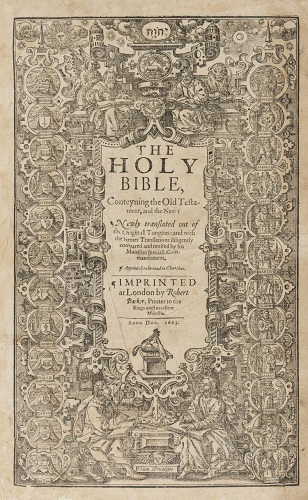
414 years ago today, the King James Bible was published for the first time in London, England. It was translated from the Majority Text (or Received Text), which was the text used by Bible believers for thousands of years.
The King James Version of 1611, also known as the Authorized Version of the Bible, “has been proven throughout history to be the greatest of all English translations.” The beautiful English prose contained in the King James Bible has had supreme influence in society, and is widely considered to be the greatest literary masterpiece known to man.
When King James the Sixth of Scotland succeeded Queen Elizabeth the First of England after her death, many different translations of the Bible were in existence, including the Bishop’s Bible, the Great Bible, and the Geneva Bible. To settle various religious grievances, King James called the Hampton Court Conference in January of 1604. During the Conference, Dr. John Reynolds, a Puritan leader and Oxford scholar, “moved his Majesty, that there might be a new translation of the Bible, because those which were allowed in the reigns of Henry the Eighth and Edward the Sixth were corrupt and not answerable to the truth of the Original.” King James then replied, “I wish some special pains were taken for an uniform translation, which should be done by the best learned men in both Universities, then reviewed by the Bishops, presented to the Privy Council, lastly ratified by the Royal authority, to be read in the whole Church, and none other.”
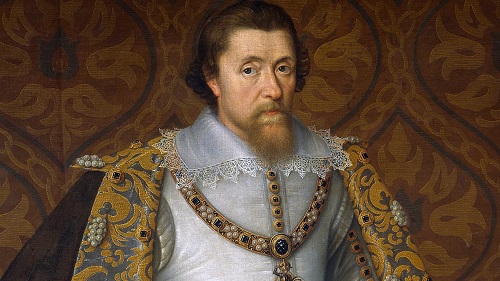
King James I of England
The king commissioned a new English translation to be made by 54 revisers representing the Puritans and Traditionalists. Due to death and other circumstances, 47 scholars and theologians wound up working on it. They took into consideration: the Tyndale New Testament, the Matthews Bible, the Great Bible and the Geneva Bible. The great revision of the Bible had begun.
From 1605 to 1606 the scholars engaged in private research. From 1607 to 1609 the work was assembled. In 1610 the work went to press, and in 1611 the first of the huge (16 inch tall) pulpit folios known today as “The 1611 King James Bible” came off the printing press.
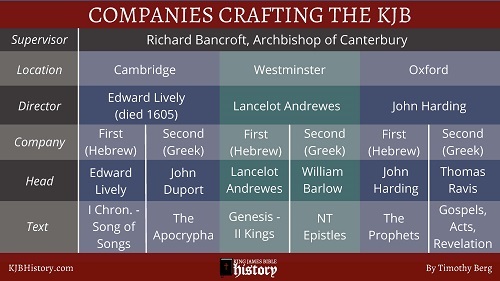
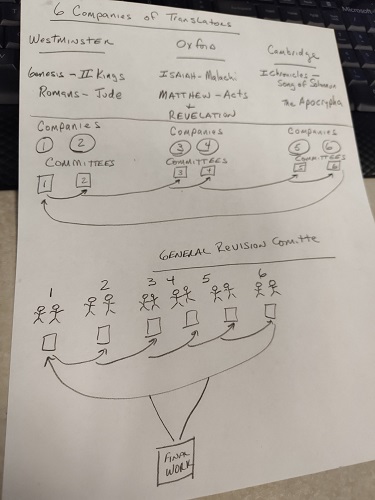
The process was a thorough one. These 47 men were organized into six Companies, two Companies at Cambridge, two Companies at Oxford and two Companies at Westminster. Each Company was given a portion of the scripture to translate. (Westminster was given Genesis – II Kings and Romans – Jude. Oxford was given Isaiah – Malachi, Matthew – Acts, and Revelation. Cambridge was given I Chronicles – Song of Solomon and the Apocrypha.)
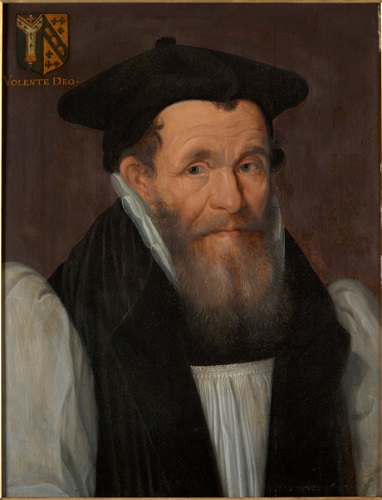
Richard Bancroft
Richard Bancroft came up with a set of rules that the translators were to follow. The process was guided by these rules. Rule #8 stated:
Every particular Man of each Company, to take the same Chapter or Chapters, and having translated or amended them severally by himself, where he thinketh good, all to meet together, confer what they have done, and agree for their Parts what shall stand.
First, each one of the men from the company took a certain part. Then, privately, each individual member would go home and study and develop a proposed translation. Then they would get together as a Company and would review each copy. I’d give you my copy, and you’d give me yours, and we’d review and compare them until that Company of men came to the conclusion that “here is what we want to do.“
Bancroft’s Rule #9:
If any one Company hath dispatched any one book in this Manner [in other words, when they get through], they shall send it to the rest, to be considered seriously and judiciously, for His Majesty is very careful in this Point.
Next, each of the Companies (two at Oxford, two at Cambridge and two at Westminster) would all go home and study. They would take the portion assigned to them and study it. Each man would take all these different versions, the Greek and the Hebrew, and then they would come together. For example, each man would say, “Here’s what I think Romans through Jude ought to look like.” Then they would all come together as a committee and compare what each one has done individually. In doing that they arrived at what the committee thought the translation ought to look like.
When these people finished with their section, they sent it to every other committee. Each of the committees reviewed what each of the other committees have done.
There are revisions, revisions, revisions, reviews, reviews, reviews. Everybody works independently and then everybody gets together, and they work together and hash out their differences. It is checked and checked again. The work isn’t done by just one or two guys. You’ve got a bunch of guys sitting there working – one looks at it, another looks at it, everybody looks at it until they feel they have it right.
Bancroft Rule #10:
If any Company, upon Review of the Book so sent, doubt or differ upon any Place, to send them Word thereof; note the Place and withal send the Reasons, to which if they Consent not, the Difference, then to be compounded at a General Meeting, which is to be of the chief Persons of each Company, at the end of the work.
The process is still not finished. Finally, from each company/committee two men were selected to represent their group. Two men from all 6 companies (12 men total) and form a General Revision Committee.
Basically what they are saying is, “Before we get through, we’re going to have one big meeting. Two men from each of these committees are going to bring their committee’s work to this General Revision Board. That General Revision Board is going to review and issue the final version.
In early 1610, the twelve-member critical Board of Review met at Stationer’s Hall in London. The work of this Committee of twelve men was the only time that anybody in this whole process ever got paid anything. None of these other men got paid for what they were doing. They only had the privilege of being involved in a tremendous undertaking. The men on the Revision Committee were paid for their work by those that published the translation.
Here is a poor drawing of the process:
The entire process was done openly and not in secret, as some want to say. The public even had a chance to be a part of the process if they were qualified. According to Bancroft’s rules:
Rule #11
When any Place of Special Obscurity is doubted of, Letters are to be directed, by Authority, to send to any Learned Man in the Land for his Judgment of such a Place.
In other words, when they had something they were arguing about, and they couldn’t figure it out, but there was somebody over on the other side of the country who might have the answer, they were to go ask that guy to give them the answer and get his input. What Rule Number 11 did was to provide that specific help was to be sought for. “If you guys have an argument about a difficult passage, you should go find out if anybody who is not on the Committee knows.” This thing is not a closed group. Anybody in England can help, and you guys are supposed to go out and get them.
Rule #12 states:
Letters are to be sent from every Bishop to the rest of his Clergy, admonishing them to this Translation in hand; and to move and charge as many as being skillful in the Tongues; and having taken Pains in that kind to send this particular Observation to the Company, either at Westminster, Cambridge or Oxford.
If you knew something about these things, you weren’t supposed to keep it to yourself. The King put out a proclamation to be read in all the churches. He sent a letter to every preacher in England, and he saidbasically, “If you have anybody in your church who’s a good Bible translator, send him our way if he’s got some information and send it down here! “ In essence, the whole country was getting involved.
Published in 1611, the King James Bible spread quickly throughout Europe. Because of the wealth of resources devoted to the project, it was the most faithful and scholarly translation to date—not to mention the most accessible.
“Printing had already been invented, and made copies relatively cheap compared to hand-done copies,” says Carol Meyers, a professor of religious studies at Duke University. “The translation into English, the language of the land, made it accessible to all those people who could read English, and who could afford a printed Bible.”
Whereas before, the Bible had been the sole property of the Church, now more and more people could read it themselves. Not only that, but the language they read in the King James Bible was English, unlike anything they had read before. 400+ years later, and it is still in the hands of believers.
Sources: Textus Receptus Bibles (website), Britannica (website), Grace School of the Bible (Personal notes)
I am a man of faith. I am not here to start a theological debate. I debated turning off the ability to comment on this post, but I didn’t. If you are a person of faith, too, you may enjoy a little history lesson.
Yesterday was Bring Your Bible Day. The idea is, that whether you were going to work or school, you have your Bible with you. I have my Bible in my cubby at work, so mine was already there. Coincidentally, today is another important biblical day.
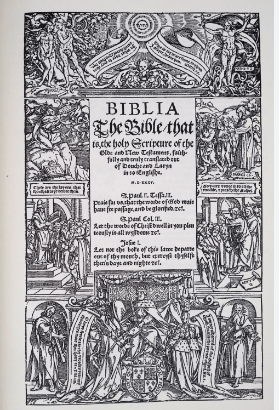
On this day in 1535, the first complete English language Bible (that included both Old and New Testaments) was printed. The Photo Flashback is the title page from that Bible.
The Coverdale Bible, as it became known, was translated by William Tyndale and Miles Coverdale. It is part of a line of Bibles referred to as the “Textus Receptus.” The phrase is Latin for the “Received Text.”
Here is a bit of history for you:
The Coverdale Bible, compiled by Myles Coverdale and published in 1535, was the first complete English translation of the Bible to contain both the Old and New Testament and translated from the original Hebrew and Greek. The later editions (folio and quarto) published in 1539 were the first complete Bibles printed in England. The 1539 folio edition carried the royal license and was, therefore, the first officially approved Bible translation in English.
Tyndale never had the satisfaction of completing his English Bible; but during his imprisonment, he may have learned that a complete translation, based largely upon his own, had actually been produced. The credit for this achievement, the first complete printed English Bible, is due to Miles Coverdale (1488-1569), afterward bishop of Exeter (1551-1553).
The details of its production are obscure. Coverdale met Tyndale in Hamburg, Germany in 1529, and is said to have assisted him in the translation of the Pentateuch. His own work was done under the patronage of Oliver Cromwell, who was anxious for the publication of an English Bible; and it was no doubt forwarded by the action of Convocation, which, under Archbishop Cranmer’s leading, had petitioned in 1534 for the undertaking of such a work.
Coverdale’s Bible was probably printed by Froschover in Zurich, Switzerland and was published at the end of 1535, with a dedication to Henry VIII. By this time, the conditions were more favorable to a Protestant Bible than they had been in 1525. Henry had finally broken with the Pope and had committed himself to the principle of an English Bible. Coverdale’s work was accordingly tolerated by authority, and when the second edition of it appeared in 1537 (printed by an English printer, Nycolson of Southwark), it bore on its title-page the words, “Set forth with the King’s most gracious license.” In licensing Coverdale’s translation, King Henry probably did not know how far he was sanctioning the work of Tyndale, which he had previously condemned.
In the New Testament, in particular, Tyndale’s version is the basis of Coverdale’s, and to a somewhat less extent this is also the case in the Pentateuch and Jonah; but Coverdale revised the work of his predecessor with the help of the Zurich German Bible of Zwingli and others (1524-1529), a Latin version by Pagninus, the Vulgate, and Luther. In his preface, he explicitly disclaims originality as a translator, and there is no sign that he made any noticeable use of the Greek and Hebrew; but he used the available Latin, German, and English versions with judgment. In the parts of the Old Testament which Tyndale had not published he appears to have translated mainly from the Zurich Bible. [Coverdale’s Bible of 1535 was reprinted by Bagster, 1838.]
In one respect Coverdale’s Bible was groundbreaking, namely, in the arrangement of the books of the. It is to Tyndale’s example, no doubt, that the action of Coverdale is due. His Bible is divided into six parts — (1) Pentateuch; (2) Joshua — Esther; (3) Job — “Solomon’s Balettes” (i.e. Canticles); (4) Prophets; (5) “Apocrypha, the books and treatises which among the fathers of old are not reckoned to be of like authority with the other books of the Bible, neither are they found in the canon of the Hebrew”; (6) the New Testament. This represents the view generally taken by the Reformers, both in Germany and in England, and so far as concerns the English Bible, Coverdale’s example was decisive.
One of the first classes I took in my Bible studies was a Manuscript Evidence class. Manuscript Evidence means you examine the manuscript for evidence about something. There is a line through history, down to the present time where God has preserved His Word. It looks like this:
HISTORY (After the Crucifixion)
100 AD
500-1000 AD
1000-1500 AD
1500-2000 AD
Original Text Written
Dark Ages
Dark Ages
Reformation
The Bible history and God’s preservation has a straight line flow through history:
The original text is written and collected;
The Bible is copied and sent out;
Bible Believers preach and teach from it.
This is called the Textus Receptus (TR), a Latin expression that is used around 1624 AD for this Greek Text, that goes back to 100 AD. TR means received text that is used commonly among the people. This text is written in Greek and most people do not speak Greek. Therefore in:
Syria there is a Syriac Bible Version made (150 AD)
Egypt there is a Coptic Bible Version made
Rome there is an Old Latin Bible Version made
This process has continued on throughout history whereby Bible versions were translated into the language of the various countries from the Greek Text, for the people.
Around 1522 AD Luther translates from the TR into German for the people he ministered to. After this came:
Tyndale 1525
Coverdale 1535
Matthews 1537
Great Bible 1539
Geneva Bible 1560
Bishop Bible 1568
After these, in 1611 you have the King James Bible. The various translations were gathered together from all the above versions and the final outcome was the King James Version.
My Manuscript Evidence class was a wealth of information and made my believe in God’s Word stronger.
It is hard to imagine the things that guys like Tyndale and Coverdale experienced as they worked. They wanted to get a Bible into the hands of anyone who wanted one. The quest to have a Bible written in the holders own language was very important to them. What did they get for their dedication? Torture. Ridicule. Prison. Death. What faith they must have had. I can only wish to have an ounce of that faith.
This came up in my Facebook memories this week and I thought it would be cool to share. In my Bible classes, the pastor/teacher always talks about how amazing the Bible is. The fact that it was preserved throughout history and we can hold it in our hands today and read those words in itself boggles my mind.
I’m a visual person. I am well aware of the various cross references throughout the whole of Scripture, but this image/chart really allows you to see just how many there are!
The Facebook post reads:
“This might be the most amazing data picture you see in a lifetime! It shows the 63,779 cross-references in the Bible. The white bars along the bottom represent each Bible chapter, Gen. 1 – Rev. 22. The line’s color shows the reference’s distance from the other. A cross-reference is a scripture that references another scripture. Had the Bible been written by one person or at one time this would still be amazing; however, the Bible was written by 40 authors over the span of 1500 years on 3 different continents.”
I don’t post this to start any kind of religious debate. As a matter of fact, I don’t post much about my faith on this blog. If matters of faith bother you, you may skip this blog entry. If you practice a particular religion or belong to a specific denomination, I am not here to diss on it. I am merely sharing what I found to clear up something.
As an Italian, I was born and raised Catholic. I guess I was around 15 or 16 when I began to question some of the things I was being taught in church. A buddy I worked with was going through the exact same thing and he would often share things he learned in his journey. Long story short, I no longer am a practicing Catholic. I believe in God and I believe in Jesus Christ as my Lord and Savior.
Reading my Bible opened up so many new things to me and also debunked many of the false truths that I had been led to believe. All that being said, Facebook, Instagram, and the internet were full of Good Friday photos and posts. In my Bible classes, the topic of Christ’s crucifixion was examined in great detail. So did Jesus Christ die on a Friday? Not according to Scripture. Here is a brief look at why Friday doesn’t work….
Was Jesus Christ really crucified on A Friday?
by Shawn Brasseaux
Did Jesus Christ really die on Good Friday? Or is that merely church tradition? While some may argue that this issue is insignificant, the fact is that anything that is not in the Bible is not of faith. “So then faith cometh by hearing, and hearing by the word of God” (Romans 10:17). What if God’s Word did tell us on what day Jesus died? Would we care to know what God says about the matter, or would we be content to merely believe what we presumed the Bible to teach?
In Matthew 12:40, the Lord Jesus Christ said, “For as Jonas was three days and three nights in the whale’s belly; so shall the Son of man be three days and three nights in the heart of the earth.” During the three days and three nights between Christ’s death and resurrection, His soul went to the heart of the earth. In Luke 23:43, Jesus called the place “paradise.” This is “Abraham’s bosom,” the same place mentioned earlier in Luke chapter 16. Jesus Christ never went to hell’s torments. Hanging on Calvary’s cross, Jesus declared, “It is finished,” so His suffering was complete before He died (John 19:30). After three days and three nights were accomplished, Christ arose on Sunday, victorious over sin and death.
Let us examine Luke chapter 24: “[13] And, behold, two of them went that same day to a village called Emmaus, which was from Jerusalem about threescore furlongs. [14] And they talked together of all these things which had happened. [15] And it came to pass, that, while they communed together and reasoned, Jesus himself drew near, and went with them. [16] But their eyes were holden that they should not know him. [17] And he said unto them, What manner of communications are these that ye have one to another, as ye walk, and are sad? [18] And the one of them, whose name was Cleopas, answering said unto him, Art thou only a stranger in Jerusalem, and hast not known the things which are come to pass there in these days? [19] And he said unto them, What things? And they said unto him, Concerning Jesus of Nazareth, which was a prophet mighty in deed and word before God and all the people: [20] And how the chief priests and our rulers delivered him to be condemned to death, and have crucified him. [21] But we trusted that it had been he which should have redeemed Israel: and beside all this, to day is the third day since these things were done.”
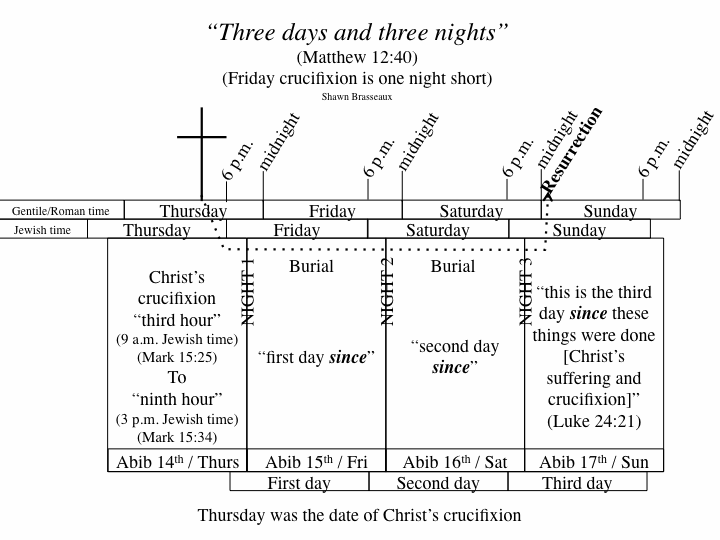
Notice in verse 21 that, on resurrection day, Sunday, it was said that that day “was the third day since these things happened [since Christ suffered and died].” If we go back, Saturday would be the second day since Christ died, and Friday would be the first day since He died. That would make Thursday the crucifixion day.
Another way to look at it is like this: Jesus Christ died around 3 p.m. (“the ninth hour;” Matthew 27:46,50; Mark 15:34,37; Luke 23:44-46). The Jews count days from evening to evening (6 p.m. to 6 p.m.), rather than the Roman/Gentile reckoning of time (midnight to midnight). The only way for Jesus to be dead three days and three nights and resurrect on “the third day” (1 Corinthians 15:3-4), Sunday, is to be crucified on Thursday. Thursday is the most plausible day of His crucifixion—a Friday crucifixion would be only two nights to Sunday, not three nights, and this would not fulfill the prophecy of Matthew 12:40. Furthermore, if we consider Jewish reckoning of time, Thursday evening and Friday morning were the first day, Friday evening and Saturday morning were the second day, and Saturday evening and Sunday morning were the third day, and Jesus rose Sunday morning. Three days and three nights from Sunday would be Thursday, and Sunday could only be the “third day” if it was a Thursday crucifixion. See diagram:
So, if the Bible indicates a Thursday crucifixion, why do many people talk about “Good Friday?” The main reason it is assumed that Jesus was crucified on Friday is that the Bible says that the day after Jesus’ crucifixion was the Sabbath day. John 19:31 says, “The Jews therefore, because it was the preparation, that the bodies should not remain upon the cross on the sabbath day, (for that sabbath day was an high day,) besought Pilate that their legs might be broken, and that they might be taken away.” However, the parenthetical statement says that that Sabbath day was not the weekly Sabbath (Saturday), but “that sabbath day was an high day.” It was a special Sabbath—“that sabbath”—not“the sabbath.” Israel did not have merely weekly Sabbaths (Saturdays) to observe, but Sabbaths (other days of rest) associated with feasts observed throughout the year as well (Leviticus 16:31; Leviticus 23:24,32,39). The Sabbath of John 19:31 was the first day of the Feast of Unleavened Bread, which immediately followed Passover.
My last blog was a “throwaway.” I’ve had a lot going on, yet I was struggling to find something to write about. I stepped away for a couple days and now I have a few things worth sharing.
We Have a Street!
They finally blacktopped the street this weekend! They finished the driveways and sidewalks a couple weeks ago. They were out yesterday laying the final coat.
Of course, every one of us now has that “hay” on our lawns in hopes that it will grow into grass by next spring. They better be back to lay our walkway bricks back down. They took them out to dig up our yard and they are still stacked next to our porch.
Puppy VS Table
Those who have been following this blog know that before Ella was born, we turned our dining room into her room. The huge dining room table was moved to the basement for a bit. We brought it up for a short time, but with all of the toys and such in the living room, we took it back downstairs.
The kids have a little picnic table they eat at. Well, the puppy can jump up and grab all their food, so I mentioned that the old table should come back upstairs so the pup couldn’t jump up there. Sam reminded me of how big that table was and how we hardly have room, so we went out and bought a smaller table, which works fine and doesn’t take as much room.
Putting that table together was project #1 this weekend. Naturally, it is all put together with those Allen wrenches. The instructions said not to use power tools to put the table and chairs together, but I did anyway! I cannot stand what those wrenches do to my hand!
It’s Beginning To Look A Lot Like ….
My wife decided that since Halloween was over, it was time to put up the Christmas tree. So I dug through the boxes and such in the basement and found the tree. I drug it upstairs and put it together. No ornaments yet, but I did string the lights.
With the puppy, the cats, and the kids, I had to find a way to keep them away from and out of the tree. Sam reminded me that her dad bought us this play pen type thing that is meant to keep babies in when you’re outside. The tree fits perfectly!
Book Ordered
Finally, Shemp Howard of the Three Stooges gets a book! My pal, Geoff Dale has completed it and it is now available. Larry, Moe, and Curly all have books, and I cannot wait to read this one. He was, as the title proclaims, much more than a stooge! He starred in many solo shorts and appeared in many Abbott and Costello movies. This should be a very interesting read!
Testing, Testing
I haven’t talked much about it because I’d been so busy with other things (a poor excuse), but I have been back in my Bible classes. Over the past week and a half, I worked on tests for two classes. I was so glad to see that I passed both of them. Just started a third test today, and will chip away at it over the next day or two. Praying for similar results. I won’t be but a couple more weeks and I move on to the next semester.
Upcoming
The next Turntable Talk topic has been selected and I will be participating in it again. I’m not quite sure what angle I am going to take, but hope to know soon.
I laid down to nap before work today and had some very vivid dreams. One of them has had me thinking since I woke up. It has got to mean something ….
Background
I guess to understand this dream, you need to know that every day I bring my bible to work. I try to get a few minutes with it each night. My lunch I tend to pack in plastic shopping bags, so I can just toss it in the fridge at work.
The Dream
I really don’t know where I am in the dream. It is almost like I am at a school or something. But then again, I have what I normally bring to work with me.
From what I remember I am climbing up these flights of stairs. I get to a floor, open the door and set my bags down for some reason. Then I hear a commotion in the stair well and people walking down the stairs. I am unsure why I follow them down.
At this point, I remember that I have set my stuff down on one of the higher floors. As I begin to climb the stairs, it becomes extremely hard to climb them. It physically hurts to try to climb each flight. I begin to feel like I am going to collapse because my knees hurt so bad. I start to think about what I left on the floor. I literally tell myself, “It’s just lunch. Just forget about it!”
I then remember that I left my bible in one of the bags. At that point I know that I have to go get it. I keep forcing myself up these stairs. I tell myself that it didn’t feel like this many flights the first time I walked up the stairs. Each step I take it seems harder and harder to walk up the stairs.
When I reach the floor, I walk through the door and my bags are gone. I begin to frantically look for them. I look for anybody who might be on the floor and can’t seem to find anyone. I finally see a light coming from a door and open it to find a woman I’ve never seen before. I explain that I left some bags on the floor just in front of the stairwell door.
She tells me that someone found them and brought them to her. I asked if she found my bible and she said she had. For some reason, even though it was my bible, there were all kinds of book marks and papers in it. I was just glad to have it back. She told me that it looked like “I read it a lot,” and I replied that I could still find more time to read it and study it.
At that point, I woke up.
What Does It Mean?
In the dream there was a huge sense of relief as I was handed the bible. So as I thought about it, I guess I am aware of an upward struggle. Does this represent something I am currently going through? Something I will go through? I don’t know. What hit me, though, is the that sense of relief when I was given the bible. Is this symbolic in some way? I don’t think God is talking to me in my dreams. He speaks to me through his Word. It is interesting to think that the sense of struggle and panic disappeared when I find the Bible.
I’ve never been one who puts a lot of faith into “dream interpretations” that you find on the internet, but did a search on “Dreams about stairs” just to see what they said. There are many sites, so I just looked at one. It said: “Dreams about climbing stairs are generally considered a good sign. This dream implies success and progress. It means you will successfully overcome all obstacles and get out troubles, if there are any. If you have difficulty climbing them, it means you are about to face situations that will drain your energy, but still you will be capable of conquering them.”
I’m not sure what to make of it all, but if there is difficulty ahead, I know that I’ll just trust that God will get me through it ….
I was notified by Word Press that this blog hit a milestone!! Had I been paying attention, I would have made Blog #500 something a bit more special. Instead, my last blog (#500) was about how tired I am!
Reflecting
As I sat down to write Blog #501, I thought on how far this blog has come. I never started this blog to gain hundreds of followers, however, I have. Originally, I started the blog as a way to write down my feelings and thoughts as I went through some troubling times. Then I thought it would be a good place to write some memories down so my kids could look back and read them. It has evolved into a place where I can write about personal things, and not so personal things.
I am glad that the details of how my wife and I came to be together are here. I am also glad that I have detailed blogs about the the birth of my son and daughter. There are also many memories of my mom, so that my kids who never had the chance to meet her, will be able to read about her. I hope that they will be able to come here to read about the special people in my life – my wife, my kids, my parents, my grandparents, my teachers, my co-workers and mentors, and my friends.
It’s also fun to look back at the special “events” I took part in. Recently, I took part in a song draft, which allowed me to feature 10 great songs. There was a bit more pressure than just picking a song and writing about it. It was hard to pick just 10! Blogging about TV shows and movies as part of blogathons has been fun, as well. I’m looking forward to a TV show draft, similar to the song draft, coming soon.
What Have I Learned?
So, just what have I learned after 500 blogs?
1. It’s not easy!
I read somewhere that most people who start a blog quit writing after a month. I am glad that I have continued to write, although finding stuff to write about is not always easy. There are many days where I sit and have nothing to write about. In those moments, I turn to Daily Writing Prompts. Sometimes they will be helpful, but many of them are worthless.
Some days are easier than others. Many times a song will bring about a memory I can share. Other times a conversation will spawn something worth writing about. My kids are a constant source of writing material and funny stories and for that I am grateful. I love bragging about them.
The key for me is to just keep writing. I plan to do just that.
2. I’ve met some really cool friends
When I created my blog, I started to search for blogs about music and movies. I started following some of them and by doing so, found there many people who share similar likes with me. I began to comment on their posts and they commented on mine. By doing so, I have really gained some neat friendships with people I have never seen face to face. I’m thankful for each of them
3. I often wonder if I make a difference
I guess I hope that someone who goes through my blog will find an occasional “nugget” that they can use in their daily life. It’s not easy to put your life out on the internet for everyone to see, but if someone can learn something from the challenges I faced and the issues I worked through, I will be happy with that.
More recently, I have blogged a little bit more about my faith. I was always told to not discuss religion and politics. I follow a few blogs who share my beliefs and I appreciate them. I know that not everyone is going to share my beliefs and that is ok. That being said, I am also not going to be afraid to post more about it and am always happy to discuss it with others.
4. I really enjoy blogging
I’m not sure I could ever be a reporter or a writer where there were deadlines for articles. I enjoy sitting and writing about my passions, my experiences, my family, and my life. I love being able to write down things that I can go back and reread and relive those moments.
I have put quite a bit of time into this blog, and don’t make a dime off it (Although, I hear that there are many bloggers who DO make money off theirs)! It has never been about making money. It has never been about having a blog republished. It has never been about having millions of followers. This blog is my little spot on the internet to save my thoughts and share them.
How about your feedback?
What do you like best about this blog? What would you like to see more of? Would you ever consider being a guest blogger on my site? Tell me your thoughts. I appreciate you being here and reading my blog and hope to keep posting things you find interesting.
So what is next? 500+ plus blogs I hope and I am excited to continue sharing “me” with you!
For 5 days, I have opened my blog with every intention of writing. I have stared at the blank page, not really knowing what to write. How do I begin to even tackle what has been on my mind? I mean, I didn’t even tell my wife about it until just a couple days ago. I guess I didn’t realize just how much I was thinking about it until a couple weeks of constant dreams and a discussion with my therapist.
Maybe it is the “rising Covid numbers.” Maybe it is the fact that I am now required by work to get vaccinated or lose my job. Maybe it is the fact that death just seems a whole lot more common on my Facebook news feed. I’m not sure, but it seems like I am thinking a lot about it.
I have sleep apnea and wear my CPAP every night. That should allow me to sleep through the night without waking up every couple hours due to apnea. I have checked the CPAP app on my phone and according to it, I am not having enough apneas to wake me up, so why am I up every hour? It’s bad enough to constantly wake up, but when you lay there and fight to go back to sleep, it can be aggravating.
Even trying to fall asleep, my mind will not shut off. My prayers are interrupted with random thoughts. As I close my eyes, I begin to have bizarre thoughts. I find myself screaming inside my head “STOP THINKING ABOUT THAT!” I have tried those apps that play music and “talk” you to sleep. I have tried to put myself in my “happy place,” but my mind just doesn’t want to shut off.
In the past year, I have seen too many people pass away. Not all of them had Covid, but some did. Heart attack, sepsis, old age, cancer, and other illnesses have claimed the lives of friends, former teachers, and former co-workers. Just this week a friend from high school lost her life to Covid.
There is that old quote that says something about the only two certainties in life are death and taxes. A pastor friend of mine always says that the “death rate is still one apiece.” In the Bible, it reads: “And as it is appointed unto men once to die, but after this the judgment” (Hebrews 9:27). In a book I was reading this week it said “You’re only one breath away from eternity.” All of those quotes are true.
I can’t even explain the uneasiness and anguish I have experienced over the past couple weeks. I’m not even sure why! Without getting theological or anything, I will say that I am not afraid of death, because I have settled that issue and know where I am going when I die. That may sound pompous, but I stand by my faith and trust that my Savior, Jesus Christ, died for me.
Despite the fact that I have peace with this, I have found myself laying in bed wondering about things. I have literally laid there with my eyes closed thinking about what I need to write down in a letter to my each of children should something happen or a love letter to my wife. What would I need to tell my dad or my brother? My mind races with these things for absolutely no reason.
As I look around at what is going on in the world, I see things happening that don’t sit well with me. I see such division. I see so much hate. I see (and feel) distrust for the government. There is way too much of the “I’m right! You’re wrong!” mentality. It makes me sad.
I have talked to people “for” and “against” the vaccine. So much uncertainty. I worry. I’m scared. I shouldn’t be, but I am. Is this where it all stems from? God only knows. God give me peace in the days and weeks ahead, please.
I have never read The First Law series, which is a series of graphic novels by Joe Ambercrombie. However, I came across a quote from Jezal dan Luthar (a character from that trilogy) that sets the stage for this blog:
“Just keep your mouth shut and smile. That’s always good advice”
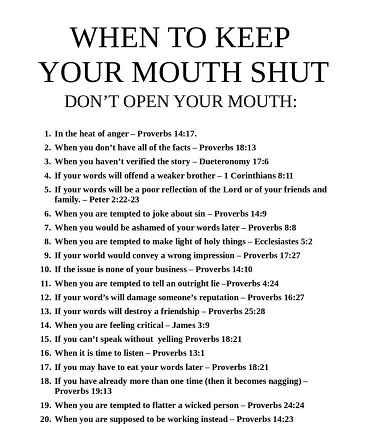
A book that I have read also has lots to say about when to be quiet – the Bible.
Proverbs 21:23 says: Whoso keepeth his mouth and his tongue keepeth his soul from troubles.
It’s not always easy to “hold your tongue,” especially when others are not. You sometimes feel that when they are ranting or complaining, it is an open door for you to do the same. I know, it happens often to me – probably too often.
The Bible actually has many verses about ‘keeping quiet” in certain situations. I found this hit home and thought I’d share.
Believe me, there are plenty of times where I just need to keep things to myself. We all need to vent, though. Sometimes when you vent, you don’t need advice or someone’s opinion. You just want to tell somebody, and you just want someone to listen. And when you listen, don’t go sharing with everyone and everyone. I learned this lesson from Goodfellas!
“Never rat on your friends and always keep your mouth shut.” -Jimmy Conway, Good Fellas.
This really is fantastic advice. If you don’t agree with your friend, take it up with them, but your job as a friend is to keep your mouth shut and be there for them. You don’t backstab them by running your mouth to others about their business. If I have learned anything about what a friend’s role is, it is to be supportive and to provide a safe haven. There are other plenty of other people to fill the judgmental roles…..
I guess what it all boils down to is what Mark Twain said ….





















 Various Ramblings of a Nostalgic Italian