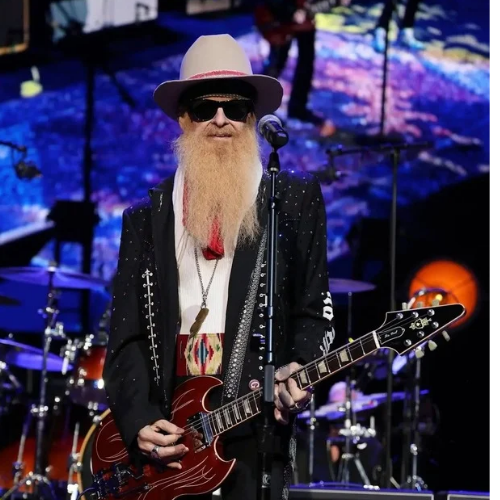
Billy was born outside of Houston, Texas. Music was a part of his life right from the start. His father was an orchestra leader and concert pianist.
When he was five, his mom took him to see Elvis Presley. Two years later, his dad took him to see BB King. Can you imagine the influence those two shows had on him?
In the late 60’s he formed the band Moving Sidewalks. In 1969, he formed ZZ Top by snagging two guys from the band American Blues (Dusty Hill and Frank Beard). They played together for a couple of years and they mastered their “sound,” a sort of bluesy Rock before recording their first album in 1971.
In 2015, he set off on a solo career with the album “Perfectamundo.” He followed that in 2018 with “The Big Bad Blues.” In 2021 he released his third album, “Hardware.”. He has also collaborated with artists like BB King, Jeff Beck, Brooks and Dunn, Kid Rock, and Sammy Hagar.
For Tune Tuesday, I could have picked from so many great ZZ Top songs. However, with Christmas right around the corner, how about a Christmas song from him?
Dig this. Here is Jingle Bell Blues. I just stumbled on it and I thought it was cool!!
Welcome back to The Music of My Life, where I feature ten songs from each year of my life. In most cases, the ten songs I choose will be ones I like personally (unless I explain otherwise). The songs will be selected from Billboard’s Year-end Hot 100 Chart, Acclaimed Music, and will all be released in the featured year.
A brand new decade has dawned and I will turn 20 in 1990. It was a time of change for me, as well. I had been working at WKSG for a little over 2 years. I truly believed that I’d have that job for years, but had yet to learn how unstable radio jobs were. When I was fired, I called my old boss (now at another station in Detroit) and cried like a baby. He brought me in part time at WMXD.
As I looked through the music from 1990 and 1991, there were many songs that I played while at WMXD. When I started there, the music was a mix of Adult Contemporary and Urban songs. Eventually, they would go all Urban Contemporary and I was let go again.
One of the songs I played, I wrote about recently, but it still makes my list here. If you want to know more about Elton John’s Club at the End of the Street, you can read the earlier post here:
Next on the list is a song that was released on my 20th birthday, May 15, 1990. “Vision Of Love” was Mariah Carey’s first single. The song debuted at #73 in America, but two months later, in August, spent four weeks at the #1 spot. I remember playing this one on WMXD, as well. It was a song that really showcased her outrageous vocal range! The first time I heard her belt out that high note, I couldn’t believe it!
The original demo of the song was described as a 1950’s shuffle, but that didn’t matter. The song was good enough. Songfacts says, The original version was included on Mariah’s demo tape for Columbia. It was one of the songs that caught the ear of Tommy Mottola, her future husband and, more importantly, the head of the label’s parent company, CBS Records. At the time, Mariah was working as a backup singer for Brenda K. Starr, who invited her to a label party in Manhattan where the demo tape made its way into Mottola’s hands. After listening to the tape in his limo on the way home, he went back to the party to track down the singer. Mariah had already left and no one knew who she was. Days later, she found a message on her answering machine inviting her to sign with the label. Mottola then sent her to Los Angeles to re-record “Vision Of Love.”
Let me be honest right here. After her second album, there were not too many songs by Mariah that I cared for. I don’t know this for sure, but I feel the “business” changed her. There were a couple of songs later that were good. I felt, however, her strongest stuff was on those first two albums.
Vision of Love
The Godfather trilogy will always be my number one, but my second favorite trilogy would be Back to the Future. In 1990, Back to the Future Part III was released in theaters. I couldn’t wait to see how it all wrapped up.
ZZ Top released their Recycler album in 1990. The lead single from the album was a song from Back to the Future Part III called Doubleback. The group made a cameo appearance in the movie playing an acoustic version. That version is on the soundtrack of the movie.
Doubleback
But wait, there’s more! Consider this a Double Shot of ZZ Top. From the same album, My Head’s In Mississippi sounded like classic ZZ Top to me. I just loved the shuffle and the vocals. Billy Gibbons said:
“My buddy Walter Baldwin spoke in the most poetic way. Every sentence was a visual awakening. His dad was the editor of the Houston Post. We grew up in a neighborhood where the last thing you would say is, ‘These teenagers know what blues is.’ But our appreciation dragged us in. Years later, we were sitting in a tavern in Memphis called Sleep Out Louie’s — you could see the Mississippi River. Walter said, ‘We didn’t grow up pickin’ cotton. We weren’t field hands in Mississippi. But my head’s there.’ Our platform, in ZZ Top, was we’d be the Salvador Dalí of the Delta. It was a surrealist take. This song was not a big radio hit. But we still play it live, even if it’s just the opening bit.”
In 2008, Gibbons stated, “‘My Head’s in Mississippi,’ which was one of the first completed tracks on the album, is a great example of how we mixed the new with the old. Initially, it was a straight-ahead boogie-woogie. Then Frank stepped in and threw in those highly gated electronic drum fills, which modernized the track.”
My Head’s in Mississippi
I have never owned a pair of parachute pants. They do look comfortable, however, and it looks like you have a lot of freedom in them.
As much as I didn’t really want to include this one, I did play it a lot while DJing. It always got folks out dancing, then again, so did Super Freak by Rick James. Believe it or not, James did NOT give Hammer permission to use the song.
Songfacts explains: Rick James tried to keep rappers from sampling his music, turning down any requests. According to James, his lawyers authorized the “Super Freak” sample without his permission. He heard about it when a friend told him about “U Can’t Touch This” and the song came on the radio they were listening to in the car. James said he was irate, but somewhat appeased when he found out how much money it was making for him. Still, he claimed he wouldn’t have done the deal if he was asked.
James had another beef as well: he wanted to be listed as a songwriter on “U Can’t Touch This.” He sued MC Hammer for credit. The case was settled out of court, with James getting listed as a co-writer on the track along with Hammer and Alonzo Miller. Miller was a disc jockey who wrote some lyrics on “Super Freak.”
He recorded the song at Capitol Records, where Frank Sinatra, Nat King Cole, and Dean Martin recorded, The label ran an innovative marketing campaign to promote this song. They mailed out free cassette singles of the track to 100,000 kids. The cassettes came with a letter from Hammer asking them to call MTV and request the video. The ploy worked, and the video became the most-played of 1990 on the network.
U Can’t Touch This
I don’t remember when my ex-girlfriend had sent this song to me. It was probably after we broke up the first time. I say that because I believe that this song is what led us to getting back together eventually. I remember being pretty messed up after the break up. I did end up dating someone else.
I don’t recall how my ex and I began chatting again, but it led to her giving me this song. I really loved and cared about my ex. I broke it off with the gal I had been dating to get back together with my ex. It was really unfair to her, but I was 20, almost 21, and didn’t really know any better.
While we enjoyed some very good times the second time around, it didn’t last. She broke up with me again, which led to me always wondering what I did to cause he to leave. Anyway, I tell you all that to play Cuts Both Ways.
Cuts Both Ways
In 1967, Otis Redding wrote and recorded his version of Hard to Handle. He wrote it with Allen Jones and Al Bell and the track was produced by the legendary Steve Cropper. It was released in 1968 (after his death) as the B-side to his song “Amen.”
The song was first covered in 1968 by Patti Drew. The Black Crowes covered the song on their debut album, Shake Your Money Maker. Two versions of the song exist. First, the original album version and the hit single remixed with an overdubbed brass section. The latter is available on the 30th Anniversary edition of Shake Your Money Maker.
Songfacts says: This was The Black Crowes’ third single, following “Twice As Hard” and “Jealous Again.” It made #45 in the US in December 1990, as the group was rapidly gaining momentum. After “She Talks To Angels” hit #30 in May 1991 – over a year after the album was released – “Hard To Handle” was reissued, this time going to #26 and becoming the highest-charting single for the band on the Hot 100.
This has always been a song that I love to crank up. It’s funky and fun!
Hard To Handle
My next song is another one that I played while at WMXD. I was familiar with James Ingram before I worked there and always liked his voice. I Don’t Have The Heart was his only solo number one song. The song won him a Grammy Award for Best Male Pop Vocal Performance in 1991.
The song was written by the duo of Allan Rich and Jud Friedman. It was the first song they wrote together. Speaking about Rich’s lyrics, Friedman told Songwriting Magazine, “Allan says he’s not a poetic lyricist, and he’s not a flowery lyricist. He is very conversational, but in a good way, and that has its own poetry. It’s the poetry of reality and the poetry of life and interactions. And the thing about I Don’t Have The Heart, among many brilliant things about Allan’s idea for the song, is it’s an example of taking a phrase that’s very well known, ‘I don’t have the heart,’ and flipping it. ‘I don’t have the heart to hurt you but I don’t have the heart to love you.’ He used it in two different ways, and that was poetic. We’ve all been there, sometimes wearing one of the shoes and sometimes wearing the other.”
That was the thing that caught me, too. The flip. I love when a lyric does that.
I Don’t Have the Heart
Whitney Houston hadn’t been on the radio since 1988. While she had her fair share of uptempo songs, but I feel like radio played more of her ballads. So the first time I played I’m Your Baby Tonight, I was wowed by it.
According to Songfacts:
By the time Houston released her third album, I’m Your Baby Tonight, she was coming off of a three-year hiatus. Prior to this, she had a record-breaking string of seven consecutive #1 singles on the Billboard Hot 100. The problem was, her record label felt she was losing touch with her black audience. Houston balked at the claim, telling USA Today, “I don’t sing music thinking this is black, or this is white… I sing songs that everybody’s going to like.”
But producers L.A. Reid and Babyface agreed with the assertion. Reid told Billboard: “We wanted to come up with something that was different than anything Whitney had sung. So we approached it from that angle. We wanted to give her a new direction, and pick up where we felt she was lacking. We felt like she needed more of a black base.”
It definitely was a fresh sound for her, but I don’t know hear it as “more black” or “more white.” To me, it is just a great song!
The Julien Temple-directed music video shows Houston in the guise of different pop culture figures. They include silver screen siren Marlene Dietrich, Audrey Hepburn, and all three of The Supremes.
I’m Your Baby Tonight
Allow me just one more song from my WMXD days. Let me set this up for you. When I was at WKSG, these two sweet old ladies always called to request songs. They were sisters named Virginia and Dorothy. They always seemed to call toward the end of my overnight shift.
Virginia suffered with respiratory issues, so it took her a bit to say what she wanted. She would get a couple words out and have to take a breath. She had emphysema and really struggled to breathe.
Dorothy, on the other hand, was always on the go. She was always talking about where she was over the weekend. She was always at a party or something, even though she didn’t drive. She took a bus or Your Ride where she needed to go.
When I told them that I was leaving the station, Dorothy gave me her address to keep in touch. When I moved to Ludington, she and Virginia wrote me often. Eventually, communication was over the phone. When I moved back home, we actually ran into each other at a Weight Watchers. meeting.
I was closer to Dorothy, and she would invite me to stop by for coffee. She always had some sort of baked good ready. She was born the same day as Frank Sinatra. She was such a sweet friend. I am sure that I lost touch with her after I married my ex, and was sad to hear that she (and her sister) had passed away.
She once told me that she didn’t like all of the music we played at WMXD. One song she loved was The First Time by Surface. This song went to number one on the Billboard Hot 100. Whenever I hear it, I think about my friend and am grateful to have known her.
The First Time
Robert Palmer’s Don’t Explain album was very different. It contains 18 tracks and a variety of styles. There is R&B, Rock, Jazz, and more. It also includes some cover songs. I love the track “Top 40” because it swings a bit with a great sax line. It, however, wasn’t released as a single.
The song that is closest to what he had success with in the 80’s is You’re Amazing. I love the guitar line in the song. Billboard said, “Palmer’s reliably strong soul stylings added to headbanger guitar riffs and sweet background harmonies proves to be a quirky, but potent, combination.”
I don’t know that I would call the guitars “headbangers,” but I suppose they are a bit harder than Palmer usually presents. Now, the background harmonies – yeah, I dig those!
You’re Amazing
1990 Bonus Song
I just can’t pass up one song. It is a song that my best friend, Jeff, and I still laugh about. I can’t be sure who heard this first, but I know we laughed about it for years. The idea of taking the voice from a 1970’s instructional dance record and incorporating it into this is brilliant. The Bingo Boys did just that!
It is this vocal part from that record that makes us laugh so much. I cannot even being to picture a couple in their living room trying to learn a dance to that guy! It is so absurd that after a few of his lines, Princessa jumps in to shut him up. “Act like the end of a record and fade out …” is the lyric. I think that’s an awesome line.
The Bingo Boys were a trio from Austria. The song was actually released in the US first. It was released in the UK in 1991. It went to number one on the Hot Dance Club Play chart and reached number 25 on the Hot 100.
The song borrows heavily from a number of earlier recordings, including “Dance, Dance, Dance (Yowsah, Yowsah, Yowsah)” by Chic, “Dance (Disco Heat) by Sylvester, “Kiss” by the Art of Noise and Tom Jones, the popular James Brown “Yeah! Woo!” sample loop, the bassline motif from Mantronix’s single “Got to Have Your Love”, and a synth motif from The Whispers’ “And The Beat Goes On”. See if you can catch them all ….
How To Dance
That’s a wrap on 1990. Next week, we’ll check out 1991. That was the year I turned 21 and moved out for the first time. What kind of surprises will pop up?
Did I miss any big 1990 songs from your list?? Drop them in the comments!
Welcome back to The Music of My Life, where I feature ten songs from each year of my life. In most cases, the ten songs I choose will be ones I like personally (unless I explain otherwise). The songs will be selected from Billboard’s Year-end Hot 100 Chart, Acclaimed Music, and will all be released in the featured year.
I turned 13 in 1983. I had a paper route and a weekly income because of it. I spent my money on toys, books and music. I loved going into Harmony House and buying 45’s or albums. As I get deeper into the 80’s, I’m seeing more and more songs that I “had” to have.
I am noticing something about a lot of the songs on my lists. There have been some that have not necessarily been meaningful to me the year they were released, but wound up being important later on in my life. That is the case of a few of them from this year. That being said, let’s check out my list….
When Lionel Richie left the Commodores, he had a number one song with “Truly.” The follow up song has always been one of my favorites. I can still see and hear my mother singing along the the chorus of “You Are.”
What I love about this is the fact that while it is a love song, it has some tempo to it. It also has a horn section. Future hit maker Richard Marx sang backup on this track. His first job in music was singing on the Lionel Richiealbum, and he proved himself on this track, which required some deft background vocals. Richard told songfacts.com: “Every session I ever did with Lionel, or for him, was a very fun atmosphere. I’ve been on so many sessions where it’s a downer, and you just try to get through it and nobody is having fun. Lionel is always having fun – no matter what.”
You Are
When I worked in country radio, I used to go to the Country Radio Seminar. It was a place where you got to hear various panels discussing programming, promotions and more. There were plenty of artists there (both old and new) to entertain. We’d often bring stuff for artists to sign so we could auction them off for St. Jude.
Every night there was always a show somewhere. Everyone had always talked about “the boat.” One record label would bring folks about the General Jackson Showboat and provide dinner and drinks. While us radio people would sit and eat, they would bring artists out on the stage to play for us. Many times it was familiar artists featuring their new songs or new artists that the label wanted to showcase.
One of the things about the boat was that there were always one or two surprise guests. You never knew who might show up. The year before my first boat ride, Huey Lewis had mad an appearance. The first time I was on the boat, they wheeled out this piano on the stage. Next, they brought out Ronnie Milsap and I was thrilled. I had always loved his music and he did not disappoint.
He came out laughing and joking and cranked out a few songs, including Stranger In My House. It was written by Mike Reid, who was a defensive tackle for the Cincinnati Bengals for five seasons and had a couple country hits of his own. The song was a country hit and also crossed over to the AC and Hot 100 charts.
The song is done in a minor key and from the opening chords, I was hooked.
Stranger In My House
Anyone who goes through a divorce or a break up knows that what follows can be a rough road. The next song is an example of a song that meant nothing to me at the time, but years later it did.
The fighting, the bickering, the pettiness, the blame, the suffering, the accusations and all the things that comes with a divorce is difficult enough. Once they hand you the final decree, it is important to start anew. I had a wonderful support system in place for me and as time passed, I looked back to see that I was making it. I had been through the war and I had made it to the victory.
Elton John’s I’m Still Standing was used in an animated movie called “Sing.” It was while watching that with the kids that I really heard and felt the lyrics. I can look in the mirror and know that I’m Still Standing and life is GOOD!
I’m Still Standing
Remember ELO’s song “Motor Factory?” Of course, you don’t. That’s because as the group was recording the song, it went through a bunch of changes. They lyrics were completely changed and it became Rock and Roll Is King. The song was released as a single from their Secret Messages album.
ELO’s Dave Morgan said in an interview, “I sang on quite a few tracks, I sang on ‘Rock ‘N’ Roll Is King’. I played on that one, but it wasn’t called that, it was something about something about working at Austin Longbridge! It was full of car plant sounds, you could hear it going clank, clank, clank, like somebody hitting a lathe with a hammer, and Jeff went away and made it into ‘Rock ‘n’ Roll Is King’, wiped off everything we’d done, no, there was still some backing left in there, It was much better how he finished it off than it was before.”
I remember recording this off the radio as a kid. I didn’t realize that there was (what we radio guys call) a “fake cold” ending. That’s where the song stops, you think it’s over, and they come back and sing again. The first time I recorded it off the radio I hit pause on the fake cold, only for ELO to start singing again. Urgh! I got smart after that and went and bought the single.
Rock and Roll Is King
Fleetwood Mac’s Lindsey Buckingham released a few solo albums in the 80’s. Despite some songs that were Top 40 hits, not many folks can recall them. There is, however, one song that folks know thanks to the misadventures of a family named Griswold.
Thanks to National Lampoon’s Vacation, Buckingham’s song Holiday Road had become his best known song. That’s really saying something for a song that never cracked the Top 40 and peaked at #82 when it was released. The song almost didn’t happen.
Actor/director Harold Ramis asked Buckingham to create two songs for his film National Lampoon’s Vacation. He was initially reluctant, believing that soundtrack work “wasn’t part of his discipline.” Thankfully, he decided to grant Ramis’s request, and wrote. Buckingham recorded “Holiday Road” without seeing the entire film. He figured that the movie “had to be somewhat uplifting and a little bit funny”. To keep in line with that, he added dog barks near the end of the song, unaware that the movie featured a scene where a dog is accidentally dragged to death from the bumper of a car.
It is one of those songs that makes you unconsciously press down a bit too much on the gas pedal if your driving while it is playing. I’m not sure I ever “got” the video for the song, though.
Holiday Road
ZZ Top’s Eliminator album was one of few albums that have sold over 10 million copies in America, earning Diamond certification. I helped it get there! This was an album that I remember buying and dropping the needle on for the first time. It had such a neat sound.
Billy Gibbons says that he got the idea for Sharp Dressed man when he saw a movie and a character was listed in the credits as “Sharp-Eyed Man.” According to songfacts.com, the song attracted a slew of new fans to ZZ Top when the video ran constantly on MTV. Their long beards made them instantly recognizable and the babes certainly helped, but the car was the real star.
Prior ZZ Top albums had a Tex-Mex vibe, but when it came time to sort out visuals for the album, the hot rod was finally ready – Gibbons had been working on it for years. It was good timing, giving them an MTV-friendly focal point just when they needed it. They had never made videos before and had no acting experience, but their videos provided everything MTV’s target audience craved: girls, rock and roll, and a really sweet ride.
The music video was the first that was a sequel. It picked up the story from the “Gimme All Your Loving” video of the down-on-his-luck gas station worker who is swept away by three beautiful women. In “Sharp Dressed Man,” he’s a valet, and he encounters the same three girls and is once again given the keys to the Eliminator, Billy Gibbons’ 1933 Ford Hot Rod.
Sharp Dressed Man
I had no idea in 1983 that I would be working as a sleep technologist. The next song is one that is based on a real sleep disorder – somniloquy (Sleep talking). “Talking In Your Sleep” is the biggest hit of The Romantics’ career. In fact, it’s their only Top 10 hit, and only one other song by them (“One in a Million”) even made it to the Top 40. Contrast that with the number of times you’ve heard their song, “What I Like About You,” which only made it to #49.
I love this story about the song: As usual, MTV helped boost The Romantics’ success right around this time with videos of their songs. In Greg Prato’s book MTV Ruled the World, Romantics’ lead singer Jimmy Marinos talks about this song: “That was the last song recorded for the album In Heat. All we had was a backtrack, the instrumental part of the song. And we realized it was too good a track to leave unfinished. So everybody put their heads together, and in a couple of days, we finished up the song melodically and lyrically.” Ha also mentions that the video was filmed at 8:00 in the morning in Detroit, surrounded by girls in their jammies, at what was deemed “not really rock ‘n’ roll hours.” So if they look like they just woke up, that’s because they did – and it works great!
Check out their hair in this video!!
Talking In Your Sleep
Two years ago, Dave Ruch invited a bunch of us to write a column for his Turntable Talk feature. The first topic was about why the Beatles are still relevant, the next song is an example of their influence.
When Genesis began to write That’s All, it was intended as an attempt to write a simple pop song with a melody in the style of The Beatles. Phil Collins even acknowledged in a subsequent interview that the song also features one of his attempts at a “Ringo Starr drum part.”
Genesis keyboard player Tony Banks was one of the first to use an Emulator, which was one of the first digital samplers (it was introduced in 1981). Banks would record his bandmate Mike Rutherford as he noodled around on his instruments, then play around with those samples to craft a track, which is how this song developed.
That’s All was the band’s first Top 10 hit in the US, setting the stage for their tremendous success the rest of the decade as they adapted their sound from progressive rock to tighter pop songs. The video certainly played a part in the success of the song, too. It depicts the band as homeless men taking shelter outside a disused factory. They perform the song, eat soup, play cards, and keep warm around an open fire. It was the first time Genesis used director Jim Yukich, who would direct the majority of their next videos as well as many of Collins’s solo videos.
That’s All
Remember the group Blue Angel? Me either. It was the group that Cyndi Lauper was in in 1981. It was her solo career and her first single, however, that made her famous. It is interesting to note that Girls Just Wanna Have Fun didn’t start out as the female anthem that Cyndi made it.
A Philadelphia singer/songwriter named Robert Hazard, who had a band called Robert Hazard and the Heroes, wrote it. He recorded a demo of it in 1979. Speaking with Rolling Stone, Lauper said that she had to alter the lyrics from Hazard’s original. “It was originally about how fortunate he was ’cause he was a guy around these girls that wanted to have ‘fun’ – with him”
Believe it or not, Cyndi didn’t want to record this song, but her producer, Rick Chertoff, was convinced it could become her anthem. The challenge for her was figuring out how to sing it. She ended up doing her vocal in the style of the ’50s hit “Let the Good Times Roll” by Shirley & Lee, which Shirley Goodman sings in a high-pitched voice. It obviously worked as the song went to number 2 on the Billboard Hot 100 chart.
MTV again played into the success of the song, as this was a very fun video to watch. The video, which ran constantly on MTV, features the wrestler Captain Lou Albano as Lauper’s father, and also Lauper’s real-life mother, who had no acting experience but did just fine. It won the first ever award for Best Female Video at the 1984 MTV Video Music Awards.
The song had a huge influence on how girls dressed in the 80’s. When I think of it, I can picture so many of my gal friends who dressed like Cyndi.
Girl’s Just Want To Have Fun
Everyone I grew up with had the 1984 album from Van Halen. The song actually was a bigger hit in 84, but it is on this list because it was released in December of 1983. Jump is just one of many songs that used synthesizers in the 80’s. The synthesizer intro for Van Halen’s Jump is iconic, but not everyone in the band wanted to use it.
The synthesizer was a point of contention in the band. Eddie wanted to use it, but lead singer David Lee Roth thought it would look like they were selling out to get more radio play. Eddie was classically trained on piano growing up – he didn’t start playing guitar until he was a teenager – so it wasn’t that far a stretch for him. Had the band brought in an outside keyboard player they probably would have gotten a lot of flak, but Eddie was held in such high esteem that fans were happy to hear him on another instrument.
Songfacts.com says: 1984 was David Lee Roth’s last album with Van Halen before he left the band in 1985; the video for “Jump” inflamed the tensions that led to his departure. The video was produced by Robert Lombard, who wanted to show the personal side of the band on stage. Roth, however, wanted the performance intercut with footage of him doing other things, so they shot him doing things like riding a motorcycle and getting arrested while wearing nothing but a towel. Lombard edited the video and used none of the extra Roth footage, taking it to Eddie and Alex for approval. Two days later, the band’s manager fired him for bypassing Roth. Lombard says he never received the award the video won from MTV.
Jump
Next week, we’ll look at songs from 1984. 1984 was a big year for me in a lot of ways. Musically, it was a big year for ballads. With a mix of country, R&B, and a song that led to me embarrassing myself on the air years later, it will be an interesting list!
Tell me about your favorite from 1983 that I may have missed in the comments and I will see you next week.
Welcome back to The Music of My Life, where I feature ten songs from each year of my life. In most cases, the ten songs I choose will be ones I like personally (unless I explain otherwise). The songs will be selected from Billboard’s Year-end Hot 100 Chart, Acclaimed Music, and will all be released in the featured year. I turned five in ’75, so let’s give a listen together…
Why not start off with a song that soared to number one? Shining Star was released by Earth, Wind and Fire in January of 1975. Maurice White was taking a late night walk while recording the album That’s the Way of the World and was inspired by the stars in the sky. He took the idea back to other members of the band and wrote the song.
The song was inducted into the Grammy Hall of Fame in 2008 and still sounds great today! One music critic called the song, “sweaty funk” … So let’s get funky!
Shining Star
Honestly, I wasn’t really into KISS when I was five. I suppose I was in my teens when I came to appreciate some of their songs. We played one or two at the first oldies station I worked at and I heard them a lot when me and my buddies would go play pool together. One that always played was Rock and Roll All Night.
Originally released on their Dresses to Kill album, the studio version only went to number 69 on the singles chart. Later, the live version would go all the way to number 12. I would guess that it has become their “theme” song. It has been the song that the group has used as a closing concert tune in almost every show since 1976.
The song was written by Paul Stanley and Gene Simmons in Los Angeles, but on January 26, 1976, Stanley told an audience at Cobo Hall in Detroit that the song was written in and for Detroit! I like that, so I’ll go with it…
Rock and Roll All Night
(Studio version)
(Live version)
Speaking of Detroit, the next song comes from hometown hero Bob Seger. Bob released his Beautiful Loser album in ’75 and Katmandu was a cut from it. Katmandu wasn’t a huge hit, but it has always been one of my favorite Seger tunes. It was later featured on his Live Bullet album.
Seger says that the song was written at a time in his life where he wasn’t sure if he was going to make it. He said, “It’s an exasperated song. It’s like: ‘I’m never gonna make it, I’m just gonna go to Katmandu.'”
He says that Glenn Frey and Don Henley pulled him aside and “told me that the Beautiful Loser album was the first little step in the right direction for me. Then the next step after that was Live Bullet, which was a huge step. And the next step was Night Moves, which was an even huger step. By 1980 both records were at six million, and they kept selling continuously. Beautiful Loser was a transitional album, and in the song “Katmandu” I still had some of that defeatist mentality and you can hear it in there.”
Katmandu
The next song was released one day before my fifth birthday. Low Rider appeared on War’s Why Can’t We Be Friends album.
From song facts.com:
The group’s sax player, Charles Miller, came up with the idea for the song. Harold Brown told Songfacts: “What happened on ‘Low Rider’ was in the studio, we were jamming, and I was supposed to have been on the downbeat. But all of the sudden I was on the upbeat. And I said, ‘Oh, boy. I got the beat turned around.’ I didn’t panic. I said, ‘Wait a minute. Stay there. Don’t change it. Stay.’ Because as long as you keep doing it over and over and over, it won’t be a mistake.
We were just messing around, you know. Then the next thing I know, Charles started just singing, ‘Low ri-der drives a little slower. The low…’ he was just pumping it. And then the next thing I know Lee’s over there putting that harmonica on, because Lee is a melody man all the time. And then – boom.
If you’d hear the original version of it, all with that jam, that would be worth a million right there. When we finished it, all of us looked at it, ‘That’s a hit.’ We didn’t know that it was going to be an icon.
Low Rider
In June of ’75, Bad Company released a classic. Did you know that Feel Like Makin’ Love is actually a combination of two separate songs?
Several years after Paul Rodgers wrote the song, he played it to Bad Company guitarist Mick Ralphs, who came up with some big chords for the chorus. Ralphs recalled:
“I came up with the riff, and I suggested we put the two together to create a song. I think that’s the feel of the song, the verses are very appealing to the ladies, probably more than the men; and then the riff comes in which is all bloody macho. It’s a big chorus and it worked out really well.”
It reached number 10 on the Hot 100 Chart.
Feel Like Makin’ Love
Despite being a song of their second album, Orleans scored their first Top 40 hit with “Dance With Me.” The song was released in July of ’75. It was written by group member John Hall and his then wife Johanna. John told Songfacts.com:
“I started playing it on acoustic guitar and developed it, just jamming by myself in the living room. The whole song – the verses, the bridge, the ending – was all complete coming out of my acoustic guitar. Johanna yelled from the other room, ‘That sounds like ‘Dance With Me.” And I went, ‘Can’t we come up with something a little bit more unusual than that?” And she said, “I don’t know, it really sounds like ‘Dance With Me.”
She couldn’t get past that and I couldn’t get past that any further, so I played the instrumental version for Larry Hoppen and he said, ‘Boy, you really need to finish that, that sounds like a hit song.’
So coming back from a show in Ithaca, New York, on the western part of the state, through the Woodstock area again, Johanna and I were riding in the car, and suddenly she says, ‘Pick the beat up and kick your feet up.’ She starts scribbling on another one of those envelopes, and by the time we got home, we had kicked the ideas back and forth and finished the lyric.
I love the guitar work and harmonies in it.
Dance With Me
I was probably about 4 years away from my introduction to Willie Nelson in 1975. When I was finally introduced to him, it was thanks to my dad and my grandfather. They had a cassette of Willie’s Stardust album and they played the heck out of it. It drove us kids crazy! After my grandfather passed away in 1981, I began to listen to more and more from Willie and came to really love his music.
Willie is a fantastic song writer, having written hits like “Crazy,” “Hello Walls,” and so many others, but he did NOT write Blue Eyes Crying in the Rain. It was written by Fred Rose in the late 1940’s. It was recorded by Roy Acuff, Hank Williams Sr., Ferlin Husky, Bill Anderson and Conway Twitty all before Willie recorded it in 1975 for his Red-Headed Stranger album.
In October 1975, the song became Willie’s first Number 1 hit as a singer, and at year’s end, was the third-biggest song of 1975 on the Billboard Hot Country Singles chart. It got Top 40 airplay, too, reaching number 21 on the Hot 100 Chart. At the 18th Annual Grammy Awards, the song won Willie a Grammy for Best Male Country Vocal Performance.
Fun (but sad) Fact: Elvis Presley recorded a version of the song in the Jungle Room at Graceland in 1976. The song would be the last one he played before he died. In the early morning of August 16, 1977, he played it on his piano in Graceland. Later that day, he died.
Blue Eyes Crying In The Rain
Earlier I mentioned playing pool with some my friends in my teens and many of the songs I mention will be ones that played on the jukebox while we were there. One of those songs was Tush by ZZ Top. Before the song’s release in 1975, they were well known in Texas, but Tush became their first nationwide hit.
According to Dusty Hill, the song was written in under ten minutes during a soundcheck in Alabama. Billy Gibbons said “We were in Florence, Alabama, playing in a rodeo arena with a dirt floor. We decided to play a bit in the afternoon. I hit that opening lick, and Dave Blayney, our lighting director, gave us the hand [twirls a finger in the air]: ‘Keep it going.’ I leaned over to Dusty and said, ‘Call it ‘Tush.’
So what does it mean? In a 1985 interview with Spin magazine, bass player Dusty Hill explained: “Tush, where I grew up, had two meanings. It meant what it means in New York. Tush is also like plush, very lavish, very luxurious. So it depended on how you used it. If somebody said, “That’s a tush car,’ you knew they weren’t talking about the rear and of the car. That’s like saying, ‘That’s a cherry short.’ But tush as in ‘That’s a nice tush on that girl,’ that’s definitely the same as the Yiddish word. I don’t know how we got it in Dallas. All it could have took was one guy moving down from New York.”
Tush
The next song is one that comes from my family’s infamous red 8 track tape. It was one of the first things I blogged about when I started this site. You can read that blog here:
Songfacts.com says: In the DVD Hell Freezes Over, the Eagles discussed this song’s origins. When they were a struggling band in Los Angeles, they saw a lot of beautiful women around Hollywood who were married to wealthy, successful men, and wondered if they were unhappy. One night they were drinking in a bar (their favorite watering hole: Dan Tana’s) when they spotted this stunning young woman; two steps behind her was a much older, fat, rich guy. As they were half laughing at them, Glenn Frey commented, “Look at her, she can’t even hide those lyin eyes!”
Realizing they had a song title, the band members began grabbing for cocktail napkins to write down lyrics to go with that great observation.
The song reached number 2 on the Hot 100 Chart.
Lyin’ Eyes
In 1975, Capitol Records couldn’t seem to make up their mind about which song to release first from Linda Ronstadt’s Heart Like a Wheel album. It was a toss up between You’re No Good and When Will I Be Loved and the prior won out. Linda’s Everly Brothers cover would be the second single, released in March of ’75.
Both the Everly’s and Linda had top ten hits with the song, but Linda’s went to number 2 while the Everly Bros peaked at number 8. Linda’s version also went to number 1 on the country chart. Singing with Linda on this single are Kenny Edwards (from her band the Stone Poneys) and Andrew Gold (Who later had success with Thank You For Being a Friend). I absolutely love the harmonies on this one.
And there are my picks for 1975! What did I miss?
Next week, I’m sure there will be a shiny disco ball hanging over the dance floor as we head to 1976! See you then.
Welcome back to The Music of My Life, where I feature ten songs from each year of my life. In most cases, the ten songs I choose will be ones I like personally (unless I explain otherwise). The songs will be selected from Billboard’s Year-end Hot 100 Chart, Acclaimed Music, and will all be released in the featured year. I turned three in 1973, so let’s see what music had some influence on me ….
In January of 1973, The Four Tops released their second song on the ABC label. They had left Motown the year before and this song became their biggest post-Motown hit. Ain’t No Woman (Like The One I’ve Got) was originally recorded by Hamilton, Joe Frank, and Reynolds in 1972. It’s hard for me to hear anyone else but Levi Stubbs on the vocal. It reached #4 on the Billboard Hot 100.
Ain’t No Woman (Like The One I’ve Got)
In March of 1973, Elvis released one of my favorite live cuts – Steamroller Blues. I did a piece on the song for Tune Tuesday a few months back. You can read that here:
Elvis added the song to his concert set list and this recording was from his Aloha From Hawaii show. It reached #17 on the charts.
Steamroller Blues
In April of 1973, Gerry Rafferty and Joe Egan’s song about a music industry party was released by their band The Stealer’s Wheel. “Well, I don’t know why I came here tonight” is the opening line of Stuck in the Middle and it makes you want to hear the rest of the story.
It was a top ten hit for the group, reaching #6 on the charts. The band was surprised at the success of the song, especially since Gerry’s vocal was meant to sound like a funny Bob Dylan. Many people thought it actually was Bob Dylan singing!
Stuck in the Middle
Also released in April of 1973, the last Top 40 hit for a singing barber. This song actually seems out of place on my list, but I have a reason it’s here.
Don McLean wrote And I Love You So for his debut album in 1970. It was the B-side of his single Castles in the Air. Crooner Perry Como used it as the title song for his 1973 album. It would peak at #29 on the charts.
I include it here because when my old morning show partner and I would go out and sing karaoke, he used to sing this one. I had never heard it before then and I loved the lyrics and melody.
And I Love You So
Another great opening line for a song was from Paul Simon. “When I think back on all the crap I learned in high school….” Kodachrome was released in May of 1973. The song was originally written as “Going Home,” but he didn’t think it worked. Kodachrome sounded similar and he went with that.
It has been said that the song is a sort of admiration for all the things that brighten the world. After his lamenting about high school, his world becomes alive with memories.
Kodachrome
Also released in May of 1973, a song that is based on real events and has one of the greatest opening riffs of all time. Smoke on the Water is the story of how Deep Purple was getting to record in a mobile studio they rented from the Rolling Stones. The night before they were set to record, someone fired a flare gun during Frank Zappa’s song King Kong and set the casino venue on fire that destroyed it. Deep Purple watched the fire from their hotel room and the smoke from the fire across the water led to the song’s title.
The opening riff which was written by guitarist Richie Blackmore, was inspired by “an interpretation of inversion” of Beethoven’s Fifth Symphony. That intro remains something I love hearing, especially in headphones. The guitar riff by itself, then the hi-hat cymbal, snare drum kicks, bass guitar and finally the vocal. SO cool.
Smoke on the Water
The next song has an interesting story. It has it’s origins in a song that I almost picked for my list. From Songfacts.com: In February 1973, Stevenson released the song “Shambala” which was written by the composer Daniel Moore. Two weeks later, Three Dog Night released their version of the song, which became the much bigger hit, charting at US #3 while Stevenson’s version stalled at #66. Stevenson and Moore then got together and re-wrote “Shambala” as “My Maria,” changing the lyrics so the song became an ode to a beautiful woman. The ploy worked, and Stevenson had by far his biggest hit. (It went to #9 on the Billboard Hot 100.)
Brooks and Dunn enjoyed a number one country song with their cover of the song in 1996.
My Maria
Another song that was inspired by real events was from Jim Croce. In 1970, Jim Croce wrote Time in a Bottle the night that he found out his wife, Ingrid, was pregnant. Songfacts.com says: The couple had been married for five years, and Ingrid found out she was pregnant when she went to a fertility specialist. She recalls a mix of terror and delight in Jim’s reaction when she told him the news. The child was a boy named Adrian, who grew up to become the singer-songwriter A.J. Croce.
The song was released in November of 1973, and it hit #1 in America 14 weeks after Croce was killed in a plane crash in September.
For the record, I have never been to a whorehouse. The next song is a classic rock standard about the aforementioned establishment. The boys of ZZ Top based La Grange on John Lee Hooker’s Boogie Chillin’, and there is even a vocal tribute to Hooker as Billy Gibbons sings “Ho Ho Ho Ho!”
Again from Songfacts.com: The place in this song is the subject of the 1982 movie The Best Little Whorehouse In Texas, starring Dolly Parton and Burt Reynolds, which was adapted from a 1978 Broadway play.In a 1985 interview with Spin magazine, ZZ Top bass player Dusty Hill explained: “Did you ever see the movie, The Best Little Whorehouse in Texas? That’s what it’s about. I went there when I was 13. A lot of boys in Texas, when it’s time to be a guy, went there and had it done. Fathers took their sons there.
La Grange
We wrap 1973 with another great classic rock song. “I was cutting a rug down at a place called the Jug with a girl named Linda Lou…” the story begins and right from the get go trouble is brewing! Lynyrd Skynyrd released Gimme Three Steps in November of 1973.
From Songfacts.com: This song is based on a true story. As Skynyrd guitarist Gary Rossington tells it, lead singer Ronnie Van Zant, who was about 18 at the time, used a fake ID to get in a bar while his younger bandmates Rossington and Allen Collins waited for him in a truck. Van Zant danced with a girl named Linda, whose boyfriend, who was not too happy about it, came up to Ronnie and reached for something in his boot. Figuring he was going for a gun, Van Zant told him: “If you’re going to shoot me it’s going to be in the ass or the elbows… just gimme a few steps and I’ll be gone.” He ran to the truck, and he, Rossington, and Collins wrote this song that night.
This was one of the few songs Skynyrd released as a single. It was their first major-label release, and it didn’t chart, which simply amazes me. It is a song that has truly become a party classic. I think I got more requests for this one than Sweet Home Alabama at weddings. Maybe it wasn’t a hit, but I have certainly heard this a lot throughout my life, and I always sing along!
Gimme Three Steps
That wraps up 1973 for me. Did you have any favorites from that year? Next week, we move on to 1974. See you there!



 Various Ramblings of a Nostalgic Italian