There was no shortage of possibilities to feature today on Tune Tuesday. Musical birthdays include Bo Diddley (1928), Skeeter Davis (1931), Paul Stookey (1937), Mike Nesmith (1942), Davy Jones (1945), Jeff Lynne (1947), and Ellie Goulding (1986). However, I have decided to focus today on a Hometown Hero.
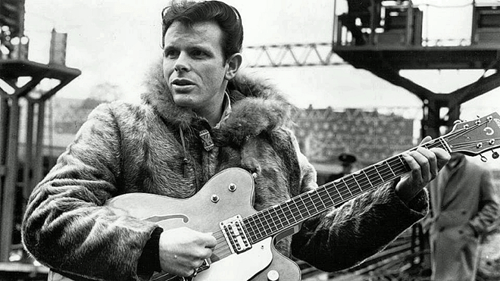
Born today in 1934 in Coopersville, Michigan – Del Shannon.
Del had hits with Runaway, Keep Searchin’, Little Town Flirt, and in 1963 he actually released the Lennon/McCartney song Love Me Do! After his success with Runaway, he released his second single Hats Off To Larry.
The story goes that while on tour with Dion, Del wrote “Hats Off To Larry” in the dressing room that night. Dion and fellow rock ‘n’ roller Bobby Vee were present at the time.
Songfacts.com says:
The slow intro features Shannon woefully explaining the details of his breakup before he launches into an upbeat rock and roll number, reflecting his joy over his ex’s comeuppance. His label, Bigtop, thought a fast-paced intro would be better to hook listeners, but Shannon was adamant. He recalled to interviewer Ted Yates: “I had to fight for about two hours to get that the way I wanted it. They didn’t want to listen to me. I was just the singer.”
Welcome back to The Music of My Life, where I feature ten songs from each year of my life. In most cases, the ten songs I choose will be ones I like personally (unless I explain otherwise). The songs will be selected from Billboard’s Year-end Hot 100 Chart, Acclaimed Music, and will all be released in the featured year.
This week we enter a new decade – the 80’s! As the final years of the 70’s ticked away, you could already start to hear the “eighties sound” creeping in. As we move through the decade that sound will change even more. What is also interesting is the amount of crossover hits in the years ahead. 40% of my list for 1980 has roots in country music.
So what was my 10 year old self listening to in 1980?
I did not know that the first song would perhaps unknowingly influence my career choice at 10 years old, but it may have. Released in February in the US, Charlie Dore reached number 13 on the Hot 100 charts with her ode to the radio DJ, Pilot of the Airwaves.
The lyrics are from the point of view of a woman who frequently listens, late at night, to a radio disc jockey whom she calls a “pilot of the airwaves”, keeping what has often been called the “dawn patrol”. She admits that she has few real-life friends and that the DJ keeps her as much company as she believes she needs, describing her life and the feelings she has2 surrounding the fact that she considers the radio DJ her only true friend. The DJ does not need to play the selection she has requested; she does hope the DJ will do his best along those lines, adding:
I’ve been listening to your show on the radio, And you seem like a friend to me.
Looking back on this song now, I can tell you that the one thing I learned was most important about being on the air was to have the listener feel as though they were just hanging out with a friend. That was always my goal – speaking one on one and keeping my listener company.
The song played a role in an early relationship, too. Two gals used to call the station all the time and one of them always wanted to hear this song. They decided to bring me coffee one night and I hit really hit it off with one of them. We dated for a while, and when an ex of mine called to ask me to take her back, I did. Ah, young love …. it really gets messy
Pilot of the Airwaves
A songwriter and producer named Steven Greenburg wrote a song when he became bored with Minneapolis and wanted to move to New York, which he called “Funkytown.” Lipps Inc. (pronounced “Lip Synch”) was formed especially for this song. The vocals were done by Cynthia Johnson, who was Miss Black Minnesota 1976. The song reached number one on the charts and stayed there for four weeks!
The group continued to record until 1985 with a changing lineup, but they failed to see the success they’d had with their first hit. Steven Greenburg, however, went on to have great success. He became A&R Vice President for Mercury Records, signing Hanson, among other acts. Later he headed the S-Curve Records label, signing the Baha Men and Joss Stone.
This song shows up in a lot of movies (Shrek 2, History of the World Part 1, Selena) and TV shows (Everybody Loves Raymond, Will and Grace, Malcolm in the Middle, and Friends) and VH1 ranked the song at #37 in the Top 100 One Hit Wonders.
Funkytown
It’s Still Rock and Roll to Me from Billy Joel’s Glass Houses album was one of Joel’s most popular songs and was his first #1 hit on the Hot 100, spending two weeks at the top spot in July 1980. The song spent 11 weeks in the top 10 and was the 7th biggest hit of 1980. It was released on May 12, 1980 – 3 days before my 10th birthday.
In this song, Billy Joel was making a comment on musical styles and trends. At the end of the disco era, the music press began touting the “New Wave” sound, which included bands like The Police and The Cars. Joel thought that this new sound was just a variation on power-pop that had been around since the ’60s. He didn’t have a problem with the music, just the way it was being categorized. “I like it, but it’s not particularly new,” he said.
He said in a Rolling Stone interview that “new wave songs, it seems, can only be about two and a half minutes long… only a certain number of instruments can be played on the record – usually a very few… only a certain amount of production is allowed or can be heard… the sound has to be limited to what you can hear in a garage… a return to that sound is all that’s going on now.”
It’s Still Rock and Roll To Me
Despite the next song being a huge hit in 1980, it is interesting that it goes all the way back to 1959 and has ties to Buddy Holly and the Beatles.
More Than I Can Say was originally written and recorded by Sonny Curtis and Jerry Allison in 1959. Curtis and Allison were both members of Buddy Holly’s band, the Crickets. They recorded it in 1959 soon after Holly’s death and released it in 1960 on their album In Style With The Crickets. The hook was left unfinished at the time, and at the time of recording, the hook was left this way with no lyrics, only the “wo-wo yay-yay,” which became a memorable part of the song. The single went on to become a minor hit in the UK. Curtis considers this song to be one of his most enduring, looking back at the success subsequent artists have had performing it.
It was also covered by Bobby Vee in 1961. Bobby, you may recall, was one of the artists who was chosen to play the remainder of the tour that Buddy Holly, The Big Bopper, and Richie Valens were doing when they died. Bobby’s version never cracked the Top 40 in the US, but was a Top 5 song in the UK.
From Wiki: According to author Mark Lewisohn in The Complete Beatles Chronicle, The Beatles performed “More Than I Can Say” live in 1961 and 1962 (in Hamburg and Liverpool and elsewhere). Author Allen J. Weiner in The Beatles: The Ultimate Recording Guide confirms this, noting that it came from a setlist made at the time by George Harrison. It is unclear who sang the lead vocals and no recording is known to survive.
The best known version of the song was by Leo Sayer. Sayer was looking for an “oldie” for his 1980 album Living in a Fantasy. He saw a television commercial for a greatest hits collection by Bobby Vee and chose the song on the spot: “We went into a record store that afternoon, bought the record and had the song recorded that night.” It spent five weeks at #2 on the Billboard pop chart in December 1980 and January 1981.
What I remember most about this song is that my dad’s wedding band used to play this in the set. My brother and I often heard it over and over as they rehearsed it.
More Than I Can Say
I will always see a dancing gopher whenever I hear the next song. “I’m Alright” is the theme to the movie Caddyshack, and plays at the beginning and end of the film. Kenny Loggins saw a rough cut of the movie before he wrote the song. He used the character Danny Noonan, who was a caddy with hopes for a brighter future, as inspiration.
Loggins told the St. Petersburg Times: “The character was trying to figure out where he fit. But at the same time he wanted people to leave him alone and let him find his own way. So I wanted to grab him and summarize that character, and that’s what ‘I’m Alright’ is doing.”
Do you recognize a familiar voice in the song? Eddie Money was recording in a nearby studio, and Loggins convinced him to sing a line on this song. That’s him in the background singing, “You make me feel good!” Money was unhappy that he never got credit for his contribution. “I’m not a fan of Kenny Loggins to tell you the truth,” he told Cincinnati morning show host Kidd Chris of WEBN in 2014. “I sang the bridge in that. We were label mates, you know.”
Fun Fact: When Loggins launches back into the chorus partway through the song, he stutters on the lyric, singing, “I- I’m Alright,” which was a happy accident. “I actually misjudged the entrance. In the arrangement, I delayed that entrance but I forgot when I was doing the lead vocal.” They decided to leave it in the song.
I’m Alright
Urban Cowboy was released in 1980 and country music was big. There were many country songs that crossed over to the pop charts. The next song, however, makes my list because I loved watching the Dukes of Hazzard every week. The first autograph I ever received was a postcard from James Best ( Sheriff Roscoe P. Coltrane)!
Waylon Jennings was the narrator in the 1975 movie Moonrunners, where he was credited as “The Balladeer.” When CBS created a TV show based on the movie, they asked Jennings to reprise his role as narrator (again credited as “The Balladeer”) and write the theme song. He came up with an outlaw-Country theme that fit the story of Bo and Luke Duke, who were good-hearted rebels from the fictional Hazzard county in The Dukes of Hazzard. Jennings appeared in all 121 episodes of the show until it ended in 1985.
Waylon recorded two versions of the song. The commercially available version receiving radio airplay contains a musical bridge which follows the first verse and chorus. Also, following the commercial version’s second chorus, Jennings makes a tongue-in-cheek reference to his faceless appearance in the credits by singing, “I’m a good ol’ boy, you know my mama loves me, but she don’t understand, they keep-a showin’ my hands and not my face on TV” (a statement referring to the opening shot in the television theme version where Jennings is only shown below the neck playing guitar). This version was a #1 Country hit.
Personally, I think the TV version is the superior version. One of the reasons is that it features Larry McNeely’s banjo work which the commercially available version does not. That banjo really makes a difference! Additionally, the television version’s third verse contains the lyric, “Fightin’ the system like two modern-day Robin Hoods”, which is accompanied by a “Yee-haw!” said by characters, Bo & Luke Duke (John Schneider and Tom Wopat. Fun Fact: The “Yee-haw is Schneider’s vocal used twice.
Here are both versions.
Theme from The Dukes of Hazzard
Another country themed movie from 1980 starred Willie Nelson, Honeysuckle Rose.
On The Road Again was written on the spur of the moment on an air sickness bag when Nelson was on a plane with Jerry Schatzberg, the director of the movie Honeysuckle Rose and its executive producer Sydney Pollack. He recalled to Uncut magazine: “They were looking for songs for the movie and they asked me if I had any idea. I said, ‘What do you want the song to say?’ and Sydney said, ‘Can it be something about being on the road?’ It just started to click. I said ‘You mean like, On the road again, I can’t wait to get on the road again?; They said, ‘That’s great. What’s the melody?’ I said, ‘I don’t know yet.'”
Willie put off writing the melody for months until the day before he went to the studio to cut the song. “I saw no reason to put a melody to something I wasn’t ready to record,” he explained in his 1988 autobiography, Willie. “I knew I wouldn’t have any problem pulling the melody out of the air.”
This was a #1 Country hit for Willie Nelson, and also one of his biggest crossovers, reaching #20 on the Hot 100, his highest placing at the time. It also won him a Grammy Award for Best Country Song in 1981.
On The Road Again
Hit Me With Your Best Shot was the first Top 10 record for Pat Benatar. It was the second single from her Crimes of Passion album. The song was written by guitarist Eddie Schwartz. His inspiration? A pillow.
Eddie says, “I was in a kind of weird therapy when I was in my mid-20s, it was called bio-energetics, I believe. One of the things we did was punch pillows, I guess it had something to do with getting out hostility. I went to a session where we punched the pillows for a while. It all seemed kind of strange, but I remember walking outside of this therapy session and standing on the doorstep of the building I’d been in, this small house in Toronto, and the title just came to me, ‘Hit Me With Your Best Shot.’ I haven’t been to therapy before or since. Maybe I should go back.”
The song can be interpreted as a song about a one-night-stand, but that’s not what its writer had in mind. Schwartz says, “The song is laden with sexual innuendo, but at the core is a song about self confidence. It’s a song saying ‘no matter what you throw at me, I can handle it, I can play in your league.'”
Pat Benatar retired “Hit Me With Your Best Shot” from her live sets in 2022 when she deemed the lyrics inappropriate in the light of a spate of mass shootings in the United States. “We’re not doing ‘Hit Me With Your Best Shot’ and fans are having a heart attack and I’m like, ‘I’m sorry, in deference to the victims of the families of these mass shootings, I’m not singing it.’ I tell them, if you want to hear the song, go home and listen to it,” she told USA Today.
Benatar added that though the title is tongue-in-cheek, she had to draw the line. “I can’t say those words out loud with a smile on my face, I just can’t,” she said. “I’m not going to go on stage and soapbox – I go to my legislators – but that’s my small contribution to protesting. I’m not going to sing it. Tough.”
Hit Me With Your Best Shot
I guess I would call the next song one of my forgotten favorites. You don’t hear it too often anymore, and it was really Terri Gibbs only bonified hit. I’ve always loved the sound of it and remember hearing it a lot on the radio growing up. Somebody’s Knockin’ was released in October of 1980.
When Terri was only six months old, she was diagnosed with retrolental fibroplasia and declared blind. She began playing the piano when she was three. When she was seventeen, she opened up for country legend Bill Anderson. It was another country legend who told her to move to Nashville and pursue a music career – Chet Atkins. She did just that when she was eighteen, but had no luck getting a record deal.
She moved back to Georgia and toured with a trio. She made a demo tape and sent it to record producer Ed Penney of MCA Records who signed her to the label in 1980. Penney was a former Boston disc jockey and a long-time songwriter. He liked her voice on her demo, but he felt she needed stronger material. So he co-wrote “Somebody’s Knockin'” for her and also produced the song. He also became her manager.
This song was a crossover hit upon its 1980 release, reaching No. 8 on the U.S. country charts, No. 13 on the Billboard Hot 100 and No. 3 on the Adult Contemporary charts. Her debut album won her the Academy of Country Music’s Top New Female Vocalist award. She was also the first winner of the Country Music Association’s Horizon Award (which is awarded to emerging artists), and was nominated for a Grammy Award for Best Country Song and Best Female Country Vocal Performance for the song.
In 1987, after struggling to have another country hit, she switched her focus to Contemporary Christian music. Her last album was released in 2017.
Somebody’s Knockin’
It is probably just a coincidence that I am writing this during a Michigan thunderstorm, but it is the appropriate background noise to accompany my last entry of 1980. Eddie Rabbitt was a country singer and songwriter who had a fair share of country and crossover hits. Here is another example of real life inspiring a song.
Eddie first got the idea for the song I Love a Rainy Night in the ’60s when he was sitting in his small apartment on a rainy night. He sang, “I love a rainy night, I love a rainy night” into a tape recorder, but didn’t complete the song until 1980, when he discovered the tape in his basement. He finished the song with the help of fellow songwriters Even Stevens and David Malloy.
The one thing I truly remember about this song was the intro. The song has a very distinctive feature – its rhythmic pattern of alternating finger snaps and hand claps. The snaps and claps were included with the help of percussionist Farrell Morris, who, according to The Billboard Book of Number One Country Hits, mixed two tracks of each to complete the record. I am sure this is what they intended, but I always picture the windshield wipers going back and forth in that rhythm (just like Eddie sings).
This song was a huge crossover hit! Eddie had great success with the song going to #1 on the Pop, Adult Contemporary and Country charts.
I Love A Rainy Night
So that brings my list for 1980 to an end. As I continue to listen to the thunder, I’ll ponder a bit on what is to come next week as we look at 1981. That was another important year for me and the influence of radio in my future. Why? Because I discovered a show that featured one of the best on air personalities to ever grace the airwaves …..
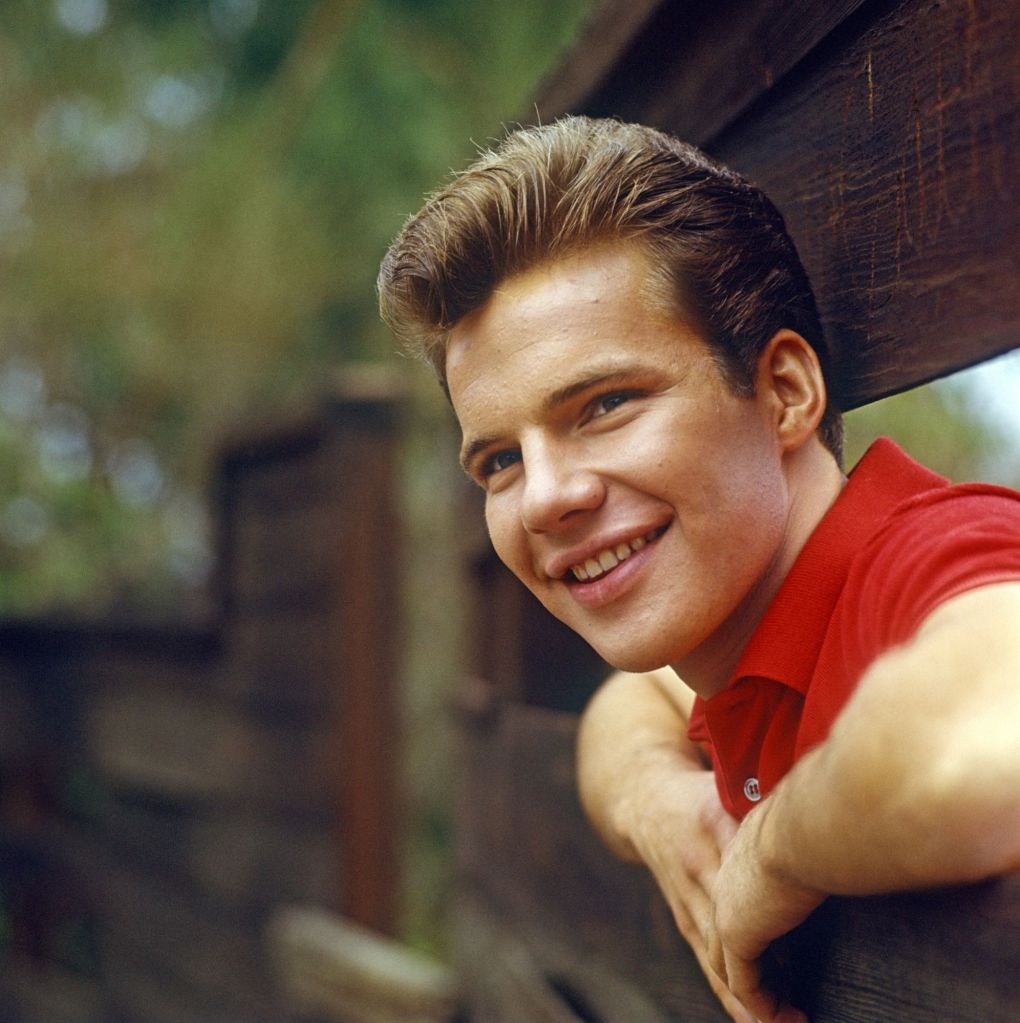
Bobby Vee was born on this day in 1943. In his career he had quite a few hits under his belt, but had it not been for a tragedy, the world may never have known him.
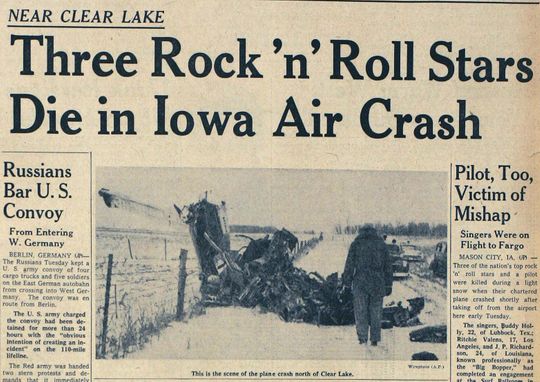
Anyone familiar with “The Day the Music Died,” remembers that on February 3, 1959, three of the four main headliners of the touring “Winter Dance Party” were killed in an airplane crash. Those three singers were Buddy Holly, Richie Valens, and The Big Bopper. Dion, the fourth headliner, chose not to travel by plane to the next city on the tour. That city was Moorhead, Minnesota.
The show in Moorhead went on as scheduled, but organizers searched for a musical act to fill in for Buddy Holly. Bobby Vee (who was 15 at the time) gathered up some musicians from Fargo (which includes his brother) and they performed that night. This was the jumpstart of his career.
A couple years later, Bobby recorded a tribute album to Buddy. In the liner notes, he recalled Holly’s influence on him and the events surrounding Holly’s death, describing how he had looked forward to attending the concert, how the local radio station put out a call for local talent to fill in after the disaster, and how Vee’s recently organized group, modeled on Holly’s style, had to make up a name (the Shadows) on the spot.
In 1963 Bobby was signed by American Bandstand to headline a tour called Dick Clark’s Caravan of Stars national U.S. tour, scheduled to perform its 15th show on the night of November 22, 1963, at the Memorial Auditorium in Dallas, Texas. The event, however, was cancelled after U.S. President John F. Kennedy was assassinated that afternoon while riding in his motorcade through downtown Dallas.
In 2012, Bobby announced publicly that he had been diagnosed with Alzheimer’s and sadly would have to withdraw from the music business. Four years later, on October 24, 2016, Vee died from complications of the disease at the age of 73.
He had hits with Devil or Angel, Run to Him, Rubber Ball, and hit #1 with Take Good Care of My Baby. My favorite Bobby Vee song is The Night Has a Thousand Eyes. The song came out in December of 1962 and went to #3 on the charts.
I have always liked this song melodically and for all of the little musical things that are happening in the background. Those little string licks that play off his vocal, the drummer’s cymbal rhythm during the chorus, and the syncopated lines at the end of the chorus always sound so good to me!
The Night Has a Thousand Eyes
They say that you’re a runaround lover Though you say it isn’t so But if you put me down for another I’ll know, believe me, I’ll know
Cause the night has a thousand eyes And a thousand eyes can’t help but see if you are true to me So remember when you tell those little white lies That the night has a thousand eyes
You say that you’re at home when you phone me And how much you really care Though you keep telling me that you’re lonely I’ll know if someone is there
Cause the night has a thousand eyes And a thousand eyes can’t help but see if you are true to me So remember when you tell those little white lies That the night has a thousand eyes
One of these days you’re gonna be sorry Cause your game I’m gonna play And you’ll find out without really tryin’ Each time that my kisses stray
Cause the night has a thousand eyes And a thousand eyes will see me too And no matter what I do I could never disguise all my little white lies Cause the night has a thousand eyes
So remember when you tell those little white lies That the night has a thousand eyes
There are some days I sit down and wonder what I am going to write about, today is not one of those days. Today is the “day the music died” – 60 years ago. The phrase comes from the classic Don McLean song “American Pie.”
The Winter Dance Party Tour
In January of 1959, Buddy Holly, Richie Valens, The Big Bopper, and Dion and the Belmonts set out to do a tour of 24 Mid-West cities in 24 days. The first problem was that no one had really thought out the tour stops and instead of circling from town to town, the tour was zig-zagging from state to state and sometimes the travel between cities was over 400 miles!
What made this even more difficult was that almost all of the travel was done on buses and there were break downs, and some didn’t have heat. The artists and band members were the ones loading and unloading the buses. Due to the cold, The Big Bopper and Richie Valens were starting to feel ill, complaining of flu-like symptoms. After driving 350+ miles from Green Bay, Wisconsin, the tour arrived at Clear Lake, Iowa on February 2 to play the Surf Ballroom.
When they arrived it became clear that Buddy Holly was over all of the bus issues. After the Surf Ballroom show, the next stop was over 350 miles away in Minnesota. Because of the poor planning of tour stops, this meant that the buses would have to pass through towns they had already played. Buddy decided that he needed some rest and so he chartered a plane to take him and his band (which included Waylon Jennings, Tommy Allsup, and Carl Bunch) to Fargo, North Dakota. They would rest there and get picked up by the buses when they came through town on their way to the gig.
There are a few versions of what happened next, but the widely accepted story is this: The Big Bopper, who was feeling the effects of the flu, asked Waylon Jennings for his seat on the plane. Waylon agreed to let him have the seat. (Some say that Waylon gave him his seat voluntarily.) One story says that when Buddy found out that Waylon was taking the bus instead of flying, he said “I hope your old bus freezes up” to which Waylon replied, “Well, I hope your old plane crashes”. In an interview later, Waylon said that even though the response was meant as a joke, his words still haunted him.
Richie Valens asked guitar player Tommy Allsup if he could have his seat aboard the plane. (There is some question as to whether Valens or the Big Bopper was the one with the flu.) It was decided that they would flip a coin to see who would get to go on the plane. A radio DJ who was working the show that night flipped a coin in a room off the stage and Richie Valens won the coin toss – and the seat. Ironically, Richie, at one time had a fear of flying.
The Flight
After the show, the manager from the Surf Ballroom drove Holly, Valens, and the Big Bopper to the airport. At the time the plane took off, there was light snow falling. The weather was supposed to get worse along the planned flight path. At 12:55 am, the plane took off from the airport. At 1:00, pilot Roger Peterson was supposed to radio to the airport to check in, but didn’t. The airport continued to try to reach him, but there was no answer.
In the morning, Hubert Dwyer, the owner of the flying service and the plane, took off in his own plane to retrace the path of the plane carrying Holly and the others. At about 9:30, less than 6 miles from the airport, he spotted the wreckage of the plane carrying the singers and pilot. The sheriff’s office was immediately dispatched to the cornfield where the plane had crashed, in Clear Lake, Iowa.
It is estimated that the plane hit the ground at almost 200 mph and did cartwheels before coming to a stop. The bodies of Buddy Holly and Richie Valens were thrown from the plane and were close to the crash site. The Big Bopper was ejected and thrown over a fence into a cornfield. The pilot’s body was wrapped up in the wreckage of the plane.
Afterward
When this happened, there was no protocol for withholding names of victims before notifying their family. Because of this, Buddy Holly’s widow found out about her husband’s death from a TV news story about the crash. They had only been married 6 months at the time of his death, and she was pregnant. She suffered a miscarriage shortly after because of “psychological trauma”. She did not attend her husband’s funeral and has never visited his gravesite. She blames herself for him getting on the plane, stating that if she had been with him, he would not have got on the plane.
An investigation into the crash found that despite the fact that the pilot had passed his written flight test, and had flown many hours, he was not prepared to fly in situations where he must rely solely on instruments (Which he would have had to do on this flight because of weather conditions). Another possible factor is the older equipment on the plane may have cause the pilot to believe he was ascending, but instead was descending. He was also not properly briefed on the weather conditions that he was flying into.
The tour continued for a couple weeks afterward with Waylon Jennings taking on the role of lead singer. Bobby Vee came to national attention due to the crash, because he was brought onto the tour because he basically knew all the words to the songs.
The Legends
22-year-old Buddy Holly left behind some songs that, despite his short career, have become rock and roll classics. Peggy Sue, Every Day, That’ll Be the Day, Rave On, True Love Ways, Raining In My Heart, and “I Guess It Doesn’t Matter Any More” remain on the play lists of oldies stations across the country. The Royal Philharmonic Orchestra has released an album of his music with his original vocals with a more orchestral background (they have done this with Elvis, Aretha Franklin, and Roy Orbison), giving the songs a fresh new sound.
The Big Boppper, AKA JP Richardson, will forever be remembered for his classic hits Chantilly Lace and The Big Bopper’s Wedding. He had a career as a radio DJ and also had great success as a songwriter. He wrote George Jones number one song “White Lightening” and Johnny Preston’s “Running Bear.” He was only 28 at the time of his death
Richie Valens was a mere 17 years old when he perished in the crash. His career was only just beginning, having begun just eight months earlier. He left behind three songs that remain fixtures in the first decade of rock and roll: Come One Let’s Go, Oh Donna, and, of course, La Bamba.
Like Elvis Presley, Otis Redding, Sam Cooke, Marvin Gaye, Jim Croce, John Lennon, and Stevie Ray Vaughn – all who left this world too young – we can only sit back and ponder how the face of music would have changed if they hadn’t died so young. Each of their careers cut short by a tragedy. Three voices silenced by fate.
Remembering Them
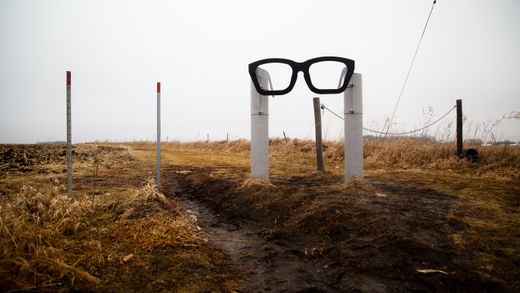
Every year, there is a memorial concert held at the Surf Ballroom to honor the memory of these three rock and roll icons. Outside the venue is a four-foot tall monument that had the names of the pilot and the three singing legends. This was placed there in 1988. At the crash site, there is a large steel structure which looks like a pair of glasses (much like the ones Holly wore), which stands as a memorial.
The most popular tribute is Don McLean’s 1971 American Pie. The song refers to the date of the crash as “the day the music died”. While some take this song to be about Buddy Holly, McLean insists that while the crash is referenced in the song, it is not really about Holly – it’s “about America.” He states, “Buddy Holly’s death is what I used to try to write the biggest possible song I could write about America. And not a ‘This Land Is Your Land’ or America, the Beautiful” or something like that. I wanted to write a song that was completely brand new in its perspective.”
The song will no doubt be played many times on radio stations across the country today.
Final thoughts
60 years later, artists such as The Beatles, Elton John, and Bob Dylan have all cited Buddy Holly as a musical influence. His songs have been covered by numerous artists including Linda Ronstadt, James Taylor, Bruce Springsteen and Martina McBride. There have been movies made surrounding the lives of Buddy Holly and Richie Valens. And the Royal Philharmonic Orchestra album with Holly’s original vocals is available now, too.
So has the music really died? I don’t think so. Today, as we remember the 60th anniversary of their tragic deaths, we must also look back and remember their music and the mark that they left on musical history. Their voices may now be silent, but their influence continues to trickle down through music today. Rave On!





 Various Ramblings of a Nostalgic Italian