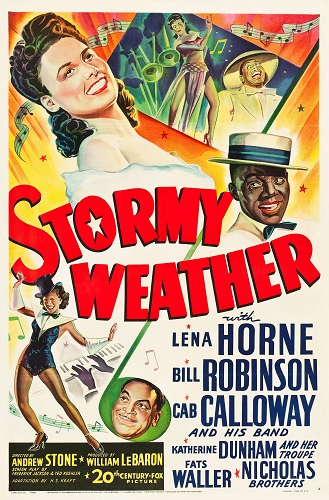
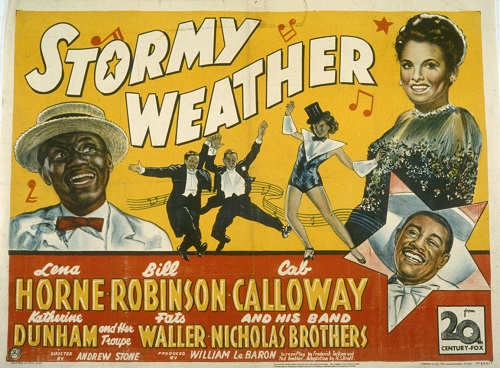
It was 82 years ago today that the musical Stormy Weather premiered in the US.
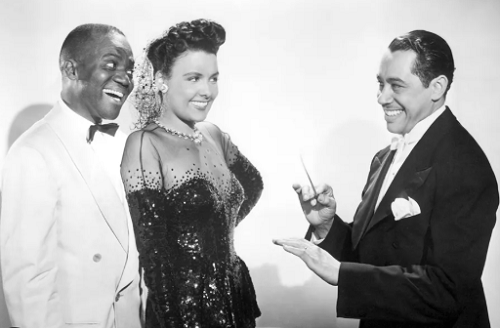
The movie starred the beautiful Lena Horne, Bill “Bojangles” Robinson, and Cab Calloway. Also making appearances were Fats Waller and Dooley Wilson (who was the piano player in Casablanca). The movie is loosely based on Robinson’s life. It would be Robinson’s last film (he passed away in 1949).
Wiki says: “Stormy Weather is a primary showcase of some of the leading African American performers of the day, during an era when African American actors and singers rarely appeared in lead roles in mainstream Hollywood productions.” The entire movie is only about 75 minutes long, yet it is full of music! 20 songs to be exact.
The soundtrack is full of great songs like Ain’t Misbehavin’ from Fats Waller, Cab Calloway and his band offer up a few numbers including Jumpin’ Jive and then there is the title track performed by Lena Horne. While she is remembered for her version of the song, she also performs in several dance numbers with Robinson. It was one of her few non-MGM film appearances, and one of only two films from the 1930s-1940s in which she played a substantial role.
It was first sung by Ethel Waters under the title of “Stormy Weather (Keeps Rainin’ All The Time)” at the Cotton Club in Harlem. “When I got out there in the middle of the Cotton Club floor,” Waters recalled. “I was singing the story of my misery and confusion … the story of the wrongs and outrages done to me by people I had loved and trusted … I sang ‘Stormy Weather’ from the depths of my private hell in which I was being crushed and suffocated.”
Lena Horne’s version of the song is probably the best-known recording of this standard and became her signature tune. She originally sang it in 1941 for RCA Victor, but it was re-recorded in 1943 for the soundtrack. Noteworthy cover versions have been recorded by Judy Garland, Ella Fitzgerald, Frank Sinatra and Billie Holiday, among many others.
Fun Fact: Lena Horne’s version of the song was inducted into the Grammy Hall of Fame in 2000 and Ethel Waters’ recording three years later.
Here is the version from the film:
Here is the 1943 recording:
I have always loved the bluesy Jackie Wilson version:
Most people have never heard the “doo wop” version that the Spaniels (who sang Goodnight Sweetheart) did. I just love everything about this version:
I could play so many other versions of the song, but instead I will encourage you to search up the great covers on YouTube. It is just such an amazing song, it’s hard to have a bad version of it.
We go back to one of my favorite movie soundtracks today for Movie Music Monday.
There were many pop and soul singers who made cameos in The Blues Brothers! They include Aretha Franklin, John Lee Hooker, James Brown, and Ray Charles. It also includes a man who had been making music since the 1930’s! I’m talking, of course, about the legendary Cab Calloway.
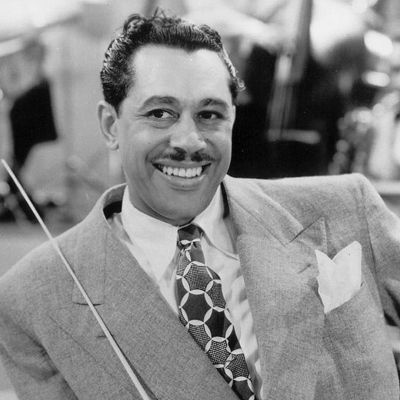
Cab was a regular performer at the Cotton Club in Harlem. He was an amazing scat singer and led his own band. His career spanned over 65 years!
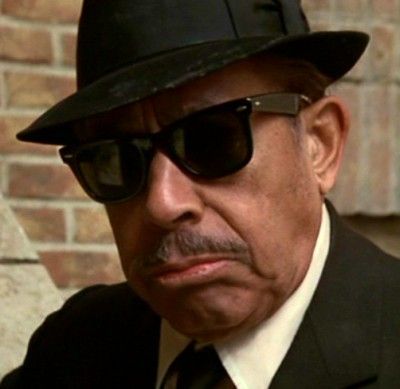
In the film, Cab plays Curtis, a friend of Jake and Elwood Blues. He lives in the basement of the orphanage that the Blues Brothers were raised in. When they need to raise money for the orphanage, they hold huge concert. It is here that Cab gets to shine on stage.
It was on this day in 1931 that Cab and his band recorded the song that would forever be connected with him – Minnie The Moocher. He performed this song in the Blues Brothers.
From wiki:
The lyrics describe the story of a woman known as “Minnie the Moocher”, a “moocher” being American slang for a person who constantly asks others for money or who takes unfair advantage of generosity. She is described as a performer of the sexually-suggestive Hoochie Coochie dance. The lyrics are heavily laden with drug references, and describe Minnie’s vivid dreams after drug use. The character “Smokey” is described as “cokey”, meaning a user of cocaine; the phrase “kick the gong around” was a slang reference to smoking opium. The song ends with Calloway wailing “Poor Min!” insinuating an untimely end for the protagonist. The “hi-de-ho” scat lyrics came about when Calloway forgot the lyrics to the song one night during a live radio concert.
First, here is the original:
And from the Blues Brothers, featuring Mr. Fabulous, Alan Rubin on Trumpet:
Welcome back to The Music of My Life, where I feature ten songs from each year of my life. In most cases, the ten songs I choose will be ones I like personally (unless I explain otherwise). The songs will be selected from Billboard’s Year-end Hot 100 Chart, Acclaimed Music, and will all be released in the featured year.
In 1992, I turned 22 and would land a radio gig at WHND, Honey Radio. It was through my old radio partner that I would become all too familiar with karaoke bars. We spent a lot of time pretending to be singers at them. Believe it or not, it was listening to people try to sing that introduced me to many songs. Many of those songs, were ones I normally would have been unfamiliar with.
Let’s jump right into 1992!
The Spin Doctors are often referred to as an alternative band. I tend to think of them as a rock band, though. Two Princes sounds more like a rock song to me. I could easily hear the Stones covering it.
A buddy of mine used to sing this song all the time. From the opening drum kick and guitar lick, I was hooked. The content of the song was influenced by some classic literature. Chris Barron, said:
“I loved The Lord of the Rings and The Hobbit and Sir Gawain and the Green Knight. I was really into fantasy fiction and stuff like that. I wrote that song when I was 19, so I was still coming out of childhood, and as a child I loved wizards and kings and queens and princess and princesses and stuff like that. And I loved Shakespeare – I already was way into Shakespeare. So I gravitated towards that kind of imagery just because I liked books and poems from that period of time.”
Drummer Aaron Comess said that the song was almost a lot faster. “There are certain songs when you find the right tempo, all of a sudden the lyrics come out, it feels right and I think with ‘Two Princes’ we really lucked out. It’s one of those things, we got in the studio, found a good tempo, we recorded it, everything just really came together. It’s very simple, there’s not a lot of stuff on it, somehow the sound and feel we got, we just lucked out and found the perfect thing.”
Songfacts pointed out that it was songs like this one that were in high demand on radio in 1992-1993. There was an onslaught of hip-hop songs at the time and it was this “sound” that began pushing it back a bit.
Two Princes
Here is another example of how I came to learn of the original because of a parody. I was familiar with the cover of their Nevermind album, but unfamiliar with a lot of their songs. Enter once again, Weird Al.
When Al first heard Nirvana, he was very impressed but thought they wouldn’t catch on. He was thrilled when “Teen Spirit” became a huge hit, since that made the group a parody target.
Al is famous for asking for permission before doing any type of parody. He got permission from Nirvana’s lead singer Kurt Cobain while he was doing an episode of Saturday Night Live. Kurt initially thought the song would be about food. Instead, it was poking fun at how hard it was to understand their lyrics.
The video is a very close parody of Nirvana’s, and got almost as much airplay. For example, the same janitor used in Nirvana’s video also makes an appearance in Weird Al’s. This time donning a tutu and playing a tuba. Al dresses just as Cobain did, complete with wig. He plays a fake blowup guitar and makes fun of the hard-to-understand lyrics by gargling water and singing with marbles in his mouth.
FYI – Dick Van Patten was not in the Nirvana video.
This song is probably the one that really solidified my opinion of Weird Al as a musical genius!
Smells Like Nirvana
For comparison – the original video:
Ok, I admit that the next song was far from a hit. It only peaked at #92 in the US, however in the UK it hit #27. The original, of course, was a number one hit for Elvis Presley in 1957. Personally, I really like Billy Joel’s version of All Shook Up. I think it should have done better on the charts.
The song is one of many Elvis covers from the soundtrack to Honeymoon in Vegas. The movie starred Nicolas Cage, James Caan, and Sarah Jessica Parker. It also featured a whole lot of Elvis impersonators.
What I love about Billy’s version is that it retains the feel of the original, but there is enough “Billy” to make it his song. When I was DJing, I used to put on a cape, an Elvis Wig, Elvis glasses, and grab some random gal out of the audience and “lip synch” this to her. It was ridiculous, but it always got a laugh from the crowd (along with a lot of photos).
All Shook Up
Next, we have the only song that I will fast dance to. I say this, because I believe there is no real dancing necessary. Songfacts explains this perfectly:
House of Pain’s Jump Around earned relentless airplay on MTV and pop radio, and became a huge crowd pleaser in bars and dance clubs. It was great for getting people on the dance floor, as no real dancing is involved – just jumping around.
Exactly. I jump like a fool when this one is on! It’s hard to look bad. It brings the bounce with a steady, throbbing rhythm along with explicit instructions on when to jump. You can’t mess this one up!
Erik “Everlast” Schrody wrote the song. Songfacts explains that the lyrics on this track are very aggressive. It contains lines like “I bust him in the eye, and then I’ll take the punk’s ho.” Everlast was surprised when the song crossed over to a pop audience. He thought it was “too hardcore” to do so. The “pugnacious” lyrics, however, are tempered with comic relief. Listen for lines like “I got more rhymes than there’s cops at a Dunkin’ Donuts shop. ” They make it a lot less threatening.
If the horn flourish that opens this song sounds familiar, it is because it comes from Bob and Earl’s song, “Harlem Shuffle”.
Jump Around
Next a movie song that never made the movie’s soundtrack. In A League of Their Own, Madonna starred with Tom Hanks, Geena Davis and Rosie O’Donnell. The film was based on the true story of an all-women baseball team that was popular during World War II.
The song is about a woman who can’t and let go of her past, with the implication that her present circumstances aren’t so good. The lyrics fit well with the film’s premise, as the now-elderly women reunite and recall their glory days as baseball stars.
To a degree, I can relate to this as I tend to live in my nostalgia and memories, however, my present circumstances are actually good. I find myself thinking of those summers playing ball at our old elementary when I hear this song.
This made me laugh: The video for this song, which shows Madonna singing from the pages of a photo album, bears a strong resemblance to Boy George’s video for his 1987 song “To Be Reborn.” The similarities were not lost on the Culture Club singer, who angrily dubbed it “This Used to Be My Video” in his autobiography.
This Used To Be My Playground
What I love about country music is the honesty of it. There are a handful of songs that I can say really hit home for me. One of them is from Travis Tritt’s third album. For me, I could relate to the lyrics of Lord Have Mercy on the Working Man. After all, I was working on a DJ’s salary!
Truth be told, it doesn’t matter what job you hold, these lyrics hit home. While primarily focusing on the economical injustice to blue collar workers, it fits anyone who struggles financially.
Uncle Sam’s got his hands in my pockets And he helps himself each time he needs a dime
Why’s the rich man busy dancing While the poor man pays the band Oh they’re billing me for killing me Lord have mercy on the working man
The final verse features Tritt’s friends joining in. Listen for Brooks and Dunn, George Jones, Little Texas, Tanya Tucker, T. Graham Brown and Porter Wagoner.
Lord Have Mercy On The Workin’ Man
MTV’s Unplugged had been around since 1989. It featured Joe Walsh, The Cure, Paul McCartney, Sting, and Mariah Carey. Eric Clapton recorded an Unplugged performance at Bray Studios in London. He rearranged many of his classic songs for the acoustic context.
The resulting Unplugged album went on to become the best selling Unplugged album in the U.S. and worldwide with sales of 10 million in the U.S. and 26 million worldwide. He earned six Grammy Awards for the album. He earned Grammys for Record of the Year, Album of the Year, Song of the Year, Best Male Pop Vocal Performance, Best Rock Male Vocal Performance and Best Rock Song.
I have been a fan of acoustic shows for a long time. I loved when artists came in and played acoustically for us. It is raw and you really feel the song. When I heard the Unplugged version of Layla, I couldn’t get enough of it. I loved the entirely different feel to the song! It was so much more bluesy.
The Unplugged version also helped Eric do his vocal. According to Songfacts, “playing the “Layla” riff while singing is like juggling on a unicycle, so Clapton tries to avoid it. When he does the rock version live, he’ll play the riff until his vocals come in, then let one of his band members take over the riff.” With the slower version, it was a lot easier for him.
Layla (Unplugged)
When it comes to Disney, you cannot deny the amazing songs that have been featured in their films. It is truly hard to picture anyone other than Robin Williams as the Genie in Aladdin. He was just perfect. There were hours of audio that were not used in the film from Robin. If it were ever released to the public, I’d buy it in a heartbeat!
Prior to having children, I was not one to run out and watch a Disney movie. However, knowing that Williams was the Genie in this one, I had to go see it. I was not disappointed.
The Genie’s song, Friend Like Me was written by the amazing composer Alan Menken and lyricist Howard Ashman. Menken and Ashman didn’t write this with Robin Williams in mind, but the actor would make the number his own. Menken told Entertainment Weekly:
“We didn’t know who was going to play the genie when we wrote the song. We were looking at the character as black, a hipster, and I suggested a Fats Waller, Harlem stride-piano style from the ’40s. When Robin Williams was suggested, my first thought was, ‘Can he sing like Fats Waller?’ Robin learned every note. He was working on Hook at the time, and he would come in after being stuck in a harness all day and sit at the piano and learn. When we went into the studio, we got exactly the Fats Waller performance we wanted, and then everyone said, ‘Okay, but now can we let Robin do his thing?’ He was amazing. That trumpet wah-wah-wah was supposed to be from an instrument, and he made it vocal. He took ahold of the creative process, both on that and ‘Prince Ali’ especially. My God, he went crazy on ‘Prince Ali.’ He was doing the Thanksgiving Day Parade, Arab-style.”
One source says that the song was originally written as a Cab Calloway style big band number. Some elements of this concept remain (for instance, when the Genie scats, in typical Calloway moves), but after Robin Williams was cast it was expanded as a more comedic, pop-culture-filled song.
I miss Robin Williams. He could do comedy and drama and do them both well. This is what makes a great actor, in my opinion. He was truly one of the best ad-libbers and I always loved watching him on late night shows.
When we were picking songs for our alumni band one year, I picked this song for us. Not the best song to march to in a parade, but it was fun to play.
Friend Like Me
I was disappointed in the soundtrack version, as it seems like Robin’s vocals are a bit buried.
I just realized that my list has two Elvis covers on it. Technically, they are both movie songs, too.
When ZZ Top released their Greatest Hits album, they included a remake of Viva Las Vegas. ZZ Top took it up a notch. They took Elvis’ song and modernized it and gave it a real driving rock sound.
I remember my dad bringing home the 12 inch single of it and saying, “Keith, you’ve got to hear this!” He put it on the turntable and there was a downward swishy sound effect followed by Elvis saying, “Y’all still want me to come with ya?” Once the guitars kick in, it just jams!
It’s one of my guilty pleasure songs.
Viva Las Vegas
I had a meeting with a bride and groom once. We were going over songs for their wedding. When I asked them what their wedding song was, they told me “If I Had $1,000,000 by Barenaked Ladies.” I must have looked like an idiot. I thought they were joking. “Barenaked Ladies?! Really?!” I had never heard of them.
I had no idea what to expect when I went searching for the song. I’ve had my share of weird songs to play for the bridal dance, so I was ready for anything. I was finally able to get a copy of it, but it wasn’t easy. The couple enjoyed their dance and the crowd loved every second of it.
Even though it’s one of the group’s most popular songs, it was never a hit single in America. It wasn’t a hit in the UK either. A lot of it was timing: The group didn’t break through outside of their native Canada until their 1998 album Stunt. The song was even re-released in 1996, but didn’t chart then either.
This is a very important song for Barenaked Ladies. They have performed it at nearly every live show since 1988. Frontman Ed Robertson told Songfacts:
“It has become its own thing and people sing along and it represents a time and a place for so many people. It’s oddly a song I don’t get bored of. It brings such joy to the room that it’s hard to not enjoy it.”
He goes on to say, “That song, it was about being in love and being maybe a little bit extravagant but not losing hold of what’s important.” Ultimately it’s just about celebrating your good fortune with someone else, and I think I’ve stayed pretty true to that.”
The song was my introduction to the group. I have come to enjoy many of their future songs, too. Perhaps one or two may show up in the years to come.
If I Had $1,000,000
That’s a wrap on 1992. Did I miss one of your favorites? Drop it in the comments.
Next week, as we head to 1993, a few ballads with a lot of personal meaning to me, a couple fun dance songs, a spelling lesson, and more stories behind the songs.
Once again, Dave Ruch from A Sound Day has offered up a gem of a topic for his monthly Turntable Talk feature! This month it is a topic that I have been hoping he’d get around to. Per his instructions:
“This time around, let’s look for THE SOUNDTRACK OF OUR LIVES ! Pick a great movie soundtrack and talk a bit about it. It can be from a great movie or a dog of one (or anything in between), one made specifically for the film or one assembled from existing tunes as long as it’s one that works for you!“
There are certainly many fantastic soundtracks to choose from. Movies that are known for being a great film and also their great soundtracks include American Graffiti, Smokey and the Bandit, The Wedding Singer, The Sting, and Forrest Gump. Those aren’t even considered “musicals!” When I think about musicals, wow, that list is a long one.
Plenty of movie (and TV) soundtracks can be found in my collection. When I worked in radio, I would often buy soundtracks so I could uses some instrumental tracks as voiceover beds (music that plays underneath your voice as you are doing a bit or talking to a listener). I used a variety of cuts from Napoleon Dynamite, Stripes, The Three Amigos, Dragnet, and movies that were box office bombs! My pick comes from a movie that was far from a bomb. It was one of the biggest films of the 1980’s.
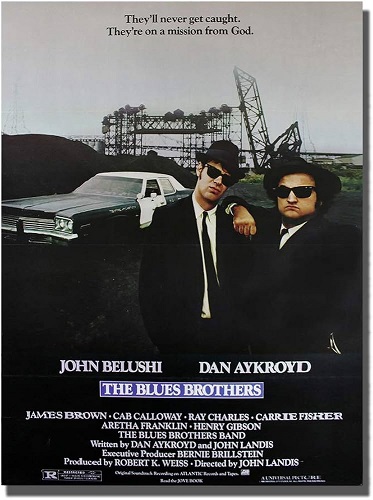
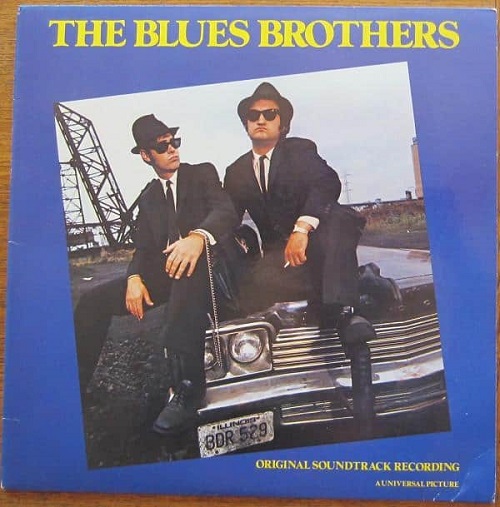
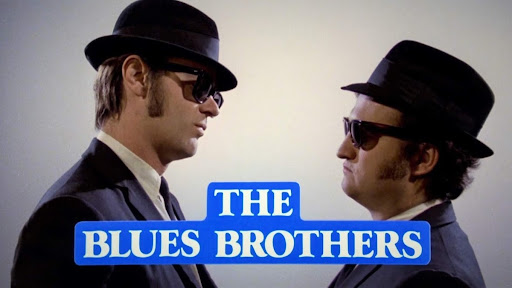
The one soundtrack that has always been a favorite for me (and it doesn’t even contain all the songs featured in the film) is The Blues Brothers. It has some fantastic cuts from Belushi and Aykroyd as well as musical legends like Ray Charles, Aretha Franklin, and Cab Calloway.
I had this soundtrack on vinyl and I played the heck out of it. Many of the songs were featured on my “driving mix tapes” when I had my first car! While the album contains 11 great tracks, the film included many other classics that I wound up searching for to add to my collection. The music doesn’t follow their chronological appearance in the film for some reason.
She Caught the Katy
The album opens with this Taj Mahal song. The Blues Brothers version has a lot more sound to it. It is so much fuller with the horns and guitars of the band. It is the song that the starring credits roll under. The opening guitar lick leads to the first big horn stab (and we see Belushi) then you have another horn stab (and we see Aykroyd) and the third big horn stab hits as we see the movie’s title card.
Belushi’s vocal on this is perfect. I like his vocal on this cut more than any other song on the album.
Peter Gunn Theme
This is the first of two TV themes on the album. This instrumental plays as the Blues Brothers are driving back to Elwood’s place. There are some really great shots of the city of Chicago in this scene. As you listen to this one, you can hear the talents of Tom “Bones” Malone, “Blue” Lou Marini, and “Mr. Fabulous” Alan Rubin. If I had a dollar for every time I used this as background music to introduce a wedding party I could fly to Italy!
Gimme Some Lovin’
Best known for being a hit for the Spencer Davis Group (and a young Steve Winwood), the soundtrack features the full song. In the film, the band begins to play this song at Bob’s Country Bunker (a country bar) and the owner shuts the lights off on them. If I had to choose between the two, I’d pick the Spencer Davis version over this one, but it is still a great jam.
Shake a Tail Feather
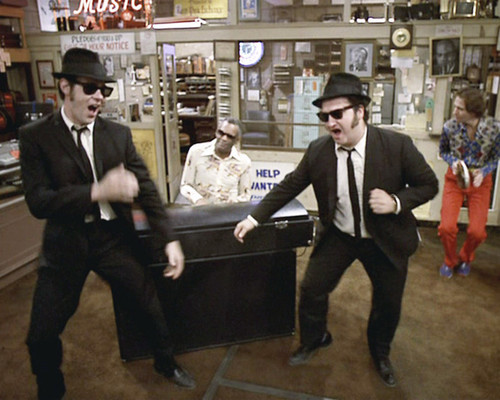
Originally done by the Five Du-Tones of Chicago in 1963, James and Bobby Purify had a bigger hit with it in 1967. This version tops them because of one man – the great Ray Charles. In the film, he owns a music shop and the band is buying new instruments. Ray is asked about a keyboard and Murphy Dunn tells him that the “action” of the keys is not that great. Ray sits down and says, “I don’t see anything wrong with the action on this piano” and launches into this song.
As Ray plays, a crowd gathers outside the store and dances along with the song doing all the dances mentioned in it (the monkey, the jerk, the boogaloo, etc…). This song is fantastic.
Everybody Needs Somebody To Love
The song was written by Solomon Burke and recorded by him in 1964. Wilson Pickett’s 1966 cover is probably the best known version. This song is featured at the Blues Brothers’ big concert toward the end of the film. Over the intro, Elwood (Aykroyd) speaks to the audience and thanks “the members of Illinois law enforcement” who are present and waiting to arrest them. We get to hear a big more of Aykroyd on this track.
The Old Landmark
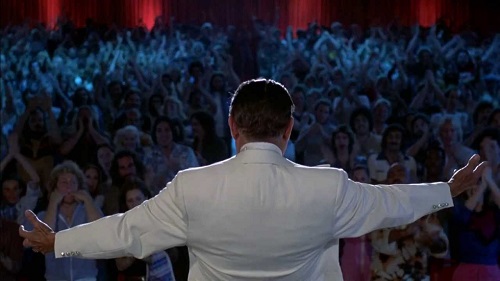
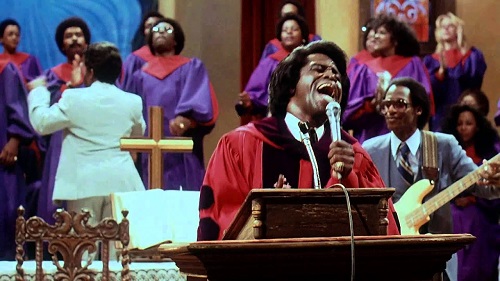
When you mention the Blues Brothers to someone, they will often quote “We’re on a mission from God.” This song is performed by the Godfather of Soul, James Brown who plays a preacher. Jake and Elwood are attending this church service and it is a pivotal moment in the film (and what sets them off on their “mission from God.”
The Old Landmark is a gospel song written by Dr. William Herbert Brewster Sr. back in 1949. It has been recorded by the Staple Singers, Aretha Franklin, Dionne Warwick and many others. James Brown takes this to a whole new level. It’s hard to imagine anyone performing this. He performed/recorded this one live on set.
Think
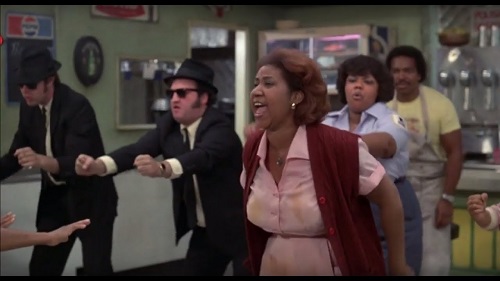
The Queen of Soul, Aretha Franklin, performs this one as she is telling off her husband Matt “Guitar” Murphy. The song was a hit for Aretha in 1968. For the film, they bump up the tempo and add some dancers. This track is SO good! ”Blue” Lou Marini grabs his sax midway through the number and really jams through the end.
This was one of the harder songs to do in the film. Aretha had recorded the song and found it difficult to lip synch to her vocals as they filmed. It was a scene that needed many takes to do. This version is far superior to her original version.
Theme From Rawhide
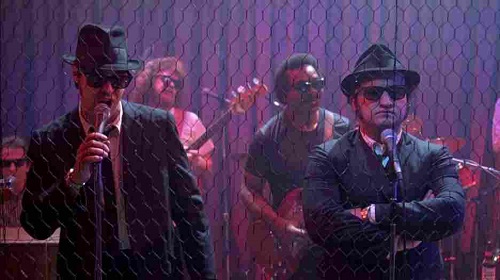
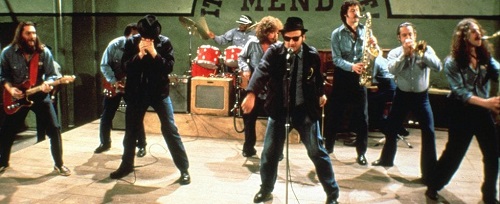
The second TV theme on the album takes place in that country bar. After the lights go out they band has to figure out something that the audience will like. They wind up performing this one. Aykroyd’s vocal is just awesome here not to mention the “call and answer” between him and Belushi. Add in a whip and you have a real country hit on your hands!
This scene always makes me laugh because they perform on a stage surrounded by chicken wire. Why? Because the crowd gets so excited they throw beer bottles at them!
Minnie The Moocher
This was a song that Cab Calloway had been singing for decades! He was the “Hi-De-Ho Man.” I just love this version of the song. The rumor is that Cab wanted to do the disco version of the song that he had recorded in the past. They insisted that it needed to be the jazz/big band sound.
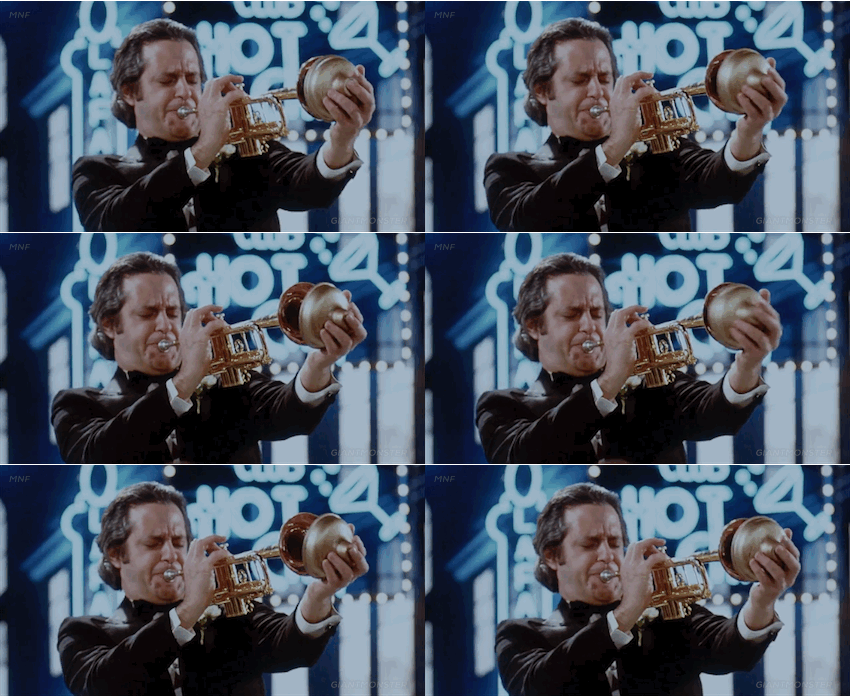
The song itself send you right back to the 1940’s. The full sound of the band, the horn section, and the amazing trumpet solos by Alan Rubin. Without a visual, it is still fantastic. Watching it in the film only enhances the experience.
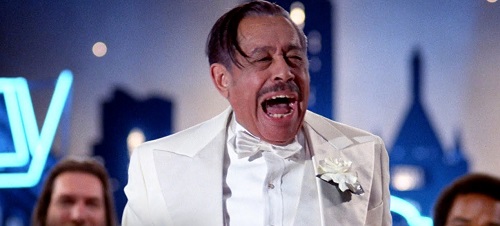
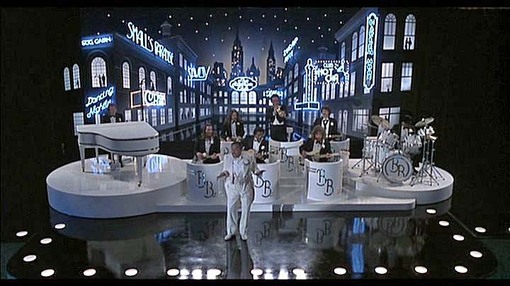
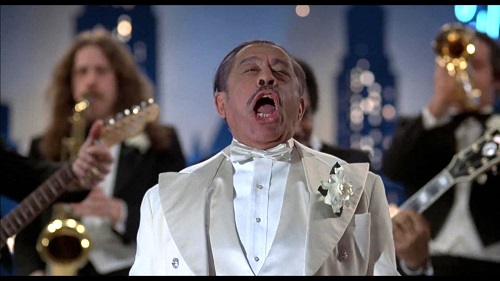
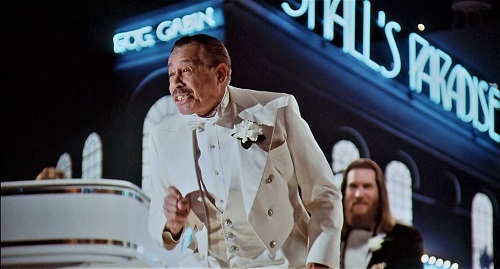
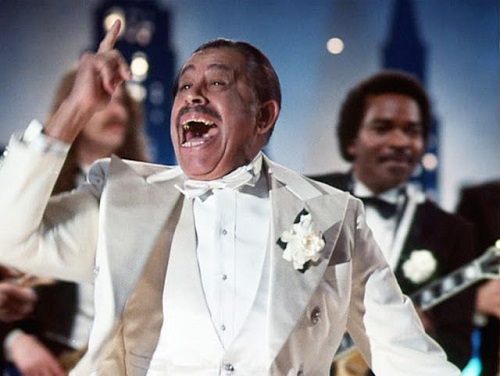
They band is on stage waiting for Jake and Elwood to arrive. The crowd is getting antsy. The band is dressed in street clothes and look sort of shabby. Cab asks if they know the song and the band says they do. He yells, “Hit it!” and the curtain opens. Out struts Cab in a white tuxedo backed by the band, wearing black tuxes and looking sharp. The stage now has an backdrop of famous 40’s places with neon signs and a sweet looking band stand.
As a trumpet player, I can’t NOT mention the spectacular trumpet playing of Alan Rubin on this one!
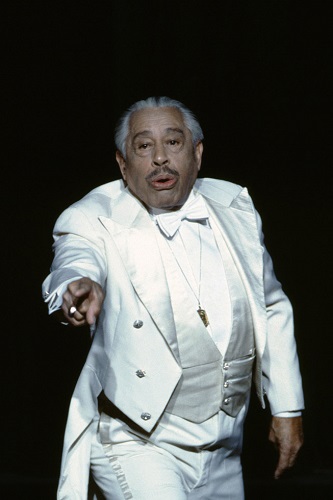
Cab was a scat singer and his call and answer with the audience is just priceless. I’m not sure how old he was here, but his vocals are right on! He was a legend!
Sweet Home Chicago
This is the longest track on the soundtrack. The original version was done by Robert Johnson in 1936. This is the second song the band plays at their big concert (and the one where they make their escape, hence the long instrumental ending). As they intro it, they dedicate it to the late, great Magic Sam (who was from Chicago) who recorded it in 1967.
This is such a fun song to listen to and to watch in the film. The looks that they give John Candy’s character and the other folks who have been chasing them always make me smile. The song serves as the background music as we transition from night to day and the ultimate finale of the movie.
Jailhouse Rock
Movie Spoiler: The entire Blues Brothers Band gets arrested at the end of the movie. Naturally, the final song of the movie is Jailhouse Rock, originally done by Elvis Presley. Trivia: In the film, the first “prisoner” to jump up on the tables and dance is Joe Walsh!
On the soundtrack, the song is a bit different than in the film. You have a complete cut on the album, while in the movie each band member has a little solo as their name appears in the credits. In the film version you also get a line or two sung by James Brown, Cab Calloway, Aretha Franklin, Ray Charles and more. It’s a perfect capstone to wrap the soundtrack.
I have played the songs on this album over and over again on vinyl, cassette, on my iPod, and YouTube. It remains one of my favorite soundtracks of all time! What disappoints me is the many songs that were featured in the film that didn’t make the soundtrack. They are worth finding and checking out!
Of course, I can’t tease those without listing them, so here goes:
Somebody Loan Me a Dime – Fenton Robinson (Plays while Jake is escorted from his prison cell)
Shake Your Moneymaker – Elmore James (Plays while Jake and Elwood visit with Curtis at the orphanage)
Soothe Me/Hold On, I’m Comin’ – Sam and Dave (Plays on the 8 track in the Bluesmobile while Jake and Elwood are driving and get pulled over)
I Can’t Turn You Loose – The Blues Brothers – Originally done by Otis Redding (Plays while they drive through the mall and as they take the stage at the Palace Hotel Ballroom concert)
Let the Good Times Roll – Louis Jordan (Plays on the record player in Elwood’s place)
Anema e core (Until) – Ezio Pinza (The piece is playing the apartment that Tom Malone and Lou Marini used to stay – the “Are you the police?” scene)
Quando, Quando, Quando – Murph and the Magictones (Plays in the Holiday Inn scene)
Just the Way You Are – Muzak version of the Billy Joel song. (Plays in the Holiday Inn scene)
Die Romantiker (The waltz that plays at the Chez Paul restaurant)
Boom Boom – John Lee Hooker (Plays as the Blues Brothers are going to meet Matt “Guitar” Murphy)
Mama Lawdy/Boogie Chillen – John Lee Hooker (Plays when Jake calls Maury Sline and on the way to Bob’s Country Bunker)
Your Cheatin’ Heart – Kitty Wells (Plays as the Blues Brothers enter Bob’s Country Bunker)
Stand By Your Man – The Blues Brothers (Plays at Bob’s Country Bunker)
I’m Walkin’ – Fat’s Domino (Plays as Jake and Elwood and the orphans promote the concert)
Ride of the Valkyries – Richard Wagner (Plays as the Nazis are chasing the Blues Brothers toward the end of the movie)
The Girl from Impanema – Muzak version (Plays, naturally, in an elevator as the Blues Brothers go up the 11th floor with the tax money)
The Blues Brothers may or may not have been the first movie of “mine” that I made my wife watch with me. I’m sure that she made me watch one of her tear jerking chick flicks to get back at me afterward. To me, this movie remains a classic. As far as the sequel – not so much. It did have a decent soundtrack, but that is about it.
I have been wanting to write about this album for a long time and am glad that Dave finally gave me a reason to indulge myself with this blog. I am also excited to see what the rest of the bloggers have chosen for their soundtrack.
I’m already looking forward to next month’s topic! Thanks for reading!
Slang: a type of language that consists of words and phrases that are regarded as very informal, are more common in speech than writing, and are typically restricted to a particular context or group of people.
I have always loved watching old movies and listening to old radio shows. I have always chuckled at some of the conversations and the slang of the day that is used by the characters. Just recently, a Facebook memory came up from my friend Johnny. He posted a quote from the Jimmy Stewart movie Harvey: “One more peep outta you, weisenheimer, and I’ll butter your necktie.” That cracked me up!
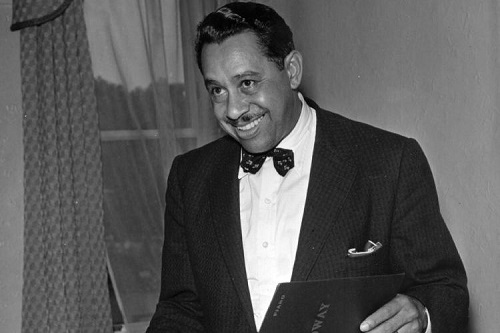
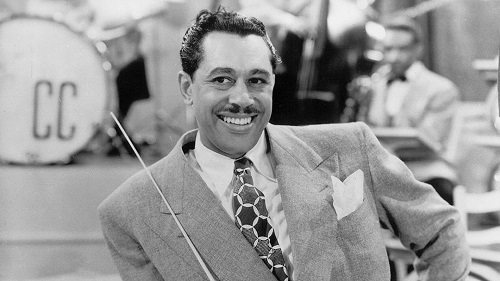
The great Cab Calloway was introduced to me when I saw him in The Blues Brothers. In the film he does his signature song, “Minnie the Moocher.”
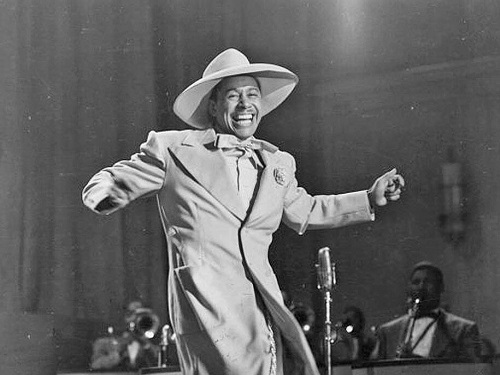
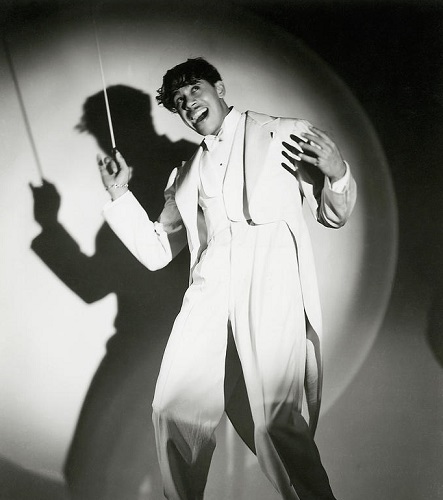
Back in the day, he was a band leader who wore Zoot Suits and spoke in “jive.” Today, when people think about “jive,” they think about the movie Airplane! and these two guys…
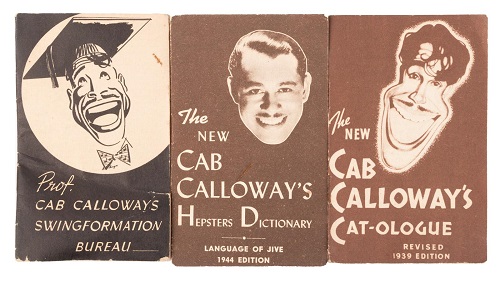
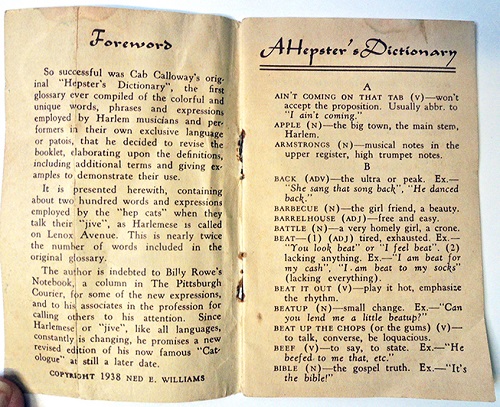
I learned something today that I was completely unaware of. In 1938, Cab wrote “Cab Calloway’s Hepster’s Dictionary which is an introduction to the slang of musicians working in New York’s Harlem! I learned that Cab was not only a great singer, musician and actor – he was also an author. According to Flashbak: “Cab Calloway’s Hepster’s Dictionary holds the honour of being the first dictionary penned by an African-American. The book became the official reference book of jive slang in the New York Public Library. With this pioneering dictionary, anyone could get ‘hep to the jive’.”
In the 1944 Edition of the book, the forward reads:
Some six years ago I compiled the first glossary of words, expressions, and the general patois employed by musicians and entertainers in New York’s teeming Harlem. That the general public agreed with me is amply evidenced by the fact that the present issue is the sixth edition since 1938 and is the official jive language reference book of the New York Public Library.
“Jive talk” is now an everyday part of the English language. Its usage is now accepted in the movies, on the stage, and in the song products of Tin Pan Alley. It is reasonable to assume that jive will find new avenues in such hitherto remote places as Australia, the South Pacific, North Africa, China, Italy, France, Sicily, and inevitably Germany and wherever our Armed Forces may serve.
I don’t want to lend the impression here that the many words contained in this edition are the figments of my imagination. They were gathered from every conceivable source. Many first saw the light of printer’s ink in Billy Rowe’s widely read column “The Notebook,” in the Pittsburgh Courier.
To the many persons who have contributed to this and the other editions, this volume is respectfully and gratefully dedicated.– Cab Calloway
Do a google search for the dictionary and you can find them for sale – at the hefty price of $4000 a piece!! Dig a little deeper and you can find some sites that list many of the terms. For your enjoyment …. and mine …. here are some of the ones that stood out to me. Notice that some of them are still in use today:
From Cab’s Jive Dictionary
A hummer (n.): exceptionally good. Ex., “Man, that boy is a hummer.”
Beat (adj.): (1) tired, exhausted. Ex., “You look beat” or “I feel beat.” (2) lacking anything. Ex, “I am beat for my cash”, “I am beat to my socks” (lacking everything).
Beat up the chops (or the gums) (v.): to talk, converse, be loquacious.
Bible (n.): the gospel truth. Ex., “It’s the bible!”
Blew their wigs (adj.): excited with enthusiasm, gone crazy.
Blip (n.): something very good. Ex., “That’s a blip”; “She’s a blip.”
Bust your conk (v.): apply yourself diligently, break your neck.
Canary (n.): girl vocalist.
Cat (n.): musician in swing band.
Chime (n.): hour. Ex., “I got in at six chimes.”
Clambake (n.): ad lib session, every man for himself, a jam session not in the groove.
Comes on like gangbusters (or like test pilot) (v.): plays, sings, or dances in a terrific manner, par excellence in any department. Sometimes abbr. to “That singer really comes on!”
Crumb crushers (n.): teeth.
Cut out (v.): to leave, to depart. Ex., “It’s time to cut out”; “I cut out from the joint in early bright.”
Dig (v.): (1) meet. Ex., “I’ll plant you now and dig you later.” (2) look, see. Ex., “Dig the chick on your left duke.” (3) comprehend, understand. Ex., “Do you dig this jive?”
Drape (or Dry Goods) (n.): suit of clothes, dress, costume.
Freeby (n.): no charge, gratis. Ex., “The meal was a freeby.”
Frisking the whiskers (v.): what the cats do when they are warming up for a swing session.
Gabriels (n.): trumpet players.
Gasser (n, adj.): sensational. Ex., “When it comes to dancing, she’s a gasser.”
Got your boots on: you know what it is all about, you are a hep cat, you are wise.
Got your glasses on: you are ritzy or snooty, you fail to recognize your friends, you are up-stage.
Ground grippers (n.): new shoes.
Guzzlin’ foam (v.): drinking beer.
Hard (adj.): fine, good. Ex., “That’s a hard tie you’re wearing.”
Hep cat (n.): a guy who knows all the answers, understands jive.
Hide-beater (n.): a drummer (see skin-beater).
Hip (adj.): wise, sophisticated, anyone with boots on. Ex., “She’s a hip chick.”
Hot (adj.): musically torrid; before swing, tunes were hot or bands were hot.
In the groove (adj.): perfect, no deviation, down the alley.
Jack (n.): name for all male friends (also gate; pops).
Jam ((1)n, (2)v.): (1) improvised swing music. Ex., “That’s swell jam.” (2) to play such music. Ex., “That cat surely can jam.”
Jelly (n.): anything free, on the house.
Jitterbug (n.): a swing fan.
Jive (n.): Harlemese speech.
Joint is jumping: the place is lively, the club is leaping with fun.
Knock (v.): give. Ex., “Knock me a kiss.”
Kopasetic (adj.): absolutely okay, the tops.
Lay your racket (v.): to jive, to sell an idea, to promote a proposition.
Licks (n.): hot musical phrases.
Line (n.): cost, price, money. Ex., “What is the line on this drape” (how much does this suit cost)? “Have you got the line in the mouse” (do you have the cash in your pocket)? Also, in replying, all figures are doubled. Ex., “This drape is line forty” (this suit costs twenty dollars).
Lock up: to acquire something exclusively. Ex., “He’s got that chick locked up”; “I’m gonna lock up that deal.”
Main on the hitch (n.): husband.
Main queen (n.): favorite girl friend, sweetheart.
Mess (n.): something good. Ex., “That last drink was a mess.”
Mezz (n.): anything supreme, genuine. Ex., “this is really the mezz.”
Mitt pounding (n.): applause.
Muggin’ (v.): making ’em laugh, putting on the jive. “Muggin’ lightly,” light staccato swing; “muggin’ heavy,” heavy staccato swing.
Nix out (v.): to eliminate, get rid of. Ex., “I nixed that chick out last week”; “I nixed my garments” (undressed).
Pigeon (n.): a young girl.
Pounders (n.): policemen.
Ride (v.): to swing, to keep perfect tempo in playing or singing.
Riff (n.): hot lick, musical phrase.
Righteous (adj.): splendid, okay. Ex., “That was a righteous queen I dug you with.”
Rug cutter (n.): a very good dancer, an active jitterbug.
Salty (adj.): angry, ill-tempered.
Send (v.): to arouse the emotions. (joyful). Ex., “That sends me!”
Sharp (adj.): neat, smart, tricky. Ex., “That hat is sharp as a tack.”
Skin-beater (n.): drummer (see hide-beater).
So help me: it’s the truth, that’s a fact.
Square (n.): an unhep person.
The man (n.): the law.
Threads (n.): suit, dress or costume (see drape; dry-goods).
Tick (n.): minute, moment. Ex., “I’ll dig you in a few ticks.”
Too much (adj.): term of highest praise. Ex., “You are too much!”
Truck (v.): to go somewhere. Ex., “I think I’ll truck on down to the ginmill (bar).”
What’s your story?: What do you want? What have you got to say for yourself? How are tricks? What excuse can you offer? Ex., “I don’t know what his story is.”
Wrong riff: the wrong thing said or done. Ex., “You’re coming up on the wrong riff.”
Yarddog (n.): uncouth, badly attired, unattractive male or female.
Yeah, man: an exclamation of assent.
Zoot (adj.): exaggerated
Zoot suit (n.): the ultimate in clothes. The only totally and truly American civilian suit.
Thanks for the music and the vocabulary lesson, Cab!




 Various Ramblings of a Nostalgic Italian