Note: This blog is about my personal experience and is not intended to bash anyone’s religious beliefs. I am more than happy to share my faith with those who ask, but I also know that everyone has a right to what they believe. That being said, I will proceed.
I was born and raised Catholic. Isn’t that what all Italians are? When I was about 16 one of my coworkers and I were talking and he brought up the Bible. He was also raised Catholic. He questioned a lot of things in our shared religious background.
This led to more conversations. Over the course of the next few weeks we talked more and more about things that didn’t necessarily line up with what the Bible says. I already had questions about some things, and many of them were answered by our studies.
In the end, I found that I had enough information that I left the Catholic faith. I began to read my Bible more and found a lot of great studies online from a few pastors that helped clarify a lot of the confusion I was experiencing.
When I moved to the Flint area, I was searching for something in a local Christian book store. As I was looking through some commentaries, from the back of the store I thought I heard the voice of a pastor I was familiar with. It wasn’t him in person, but a recording of him.
I went to the cashier at the front of the store and asked about it. This led to being introduced to Al, a guy who shared my beliefs. He was also attending the same Bible School as I am in now (where the pastor I heard teaches). He would go on to graduate the school and become pastor of our local assembly.
Initially, we met in one of the classrooms at the Bible store. Over time we were able to buy a building, which he remodeled and became our meeting place. He really worked hard on it. I want to say that the building used to be a bank. He had done a ton of drywall work and when he was done we had a room for the main gathering place, a nursery, bathroom, and a small kitchen.
When we began our services there, Al asked me to teach the Sunday morning Sunday School class. At first I spoke on different topics every week. Then I began to do some series, which the members of our church really enjoyed. One of the series was on Manuscript Evidence and how the Bible came to be. That was a lot of fun to teach.
I tell you all of that because it leads me to today’s Photo Flashback.
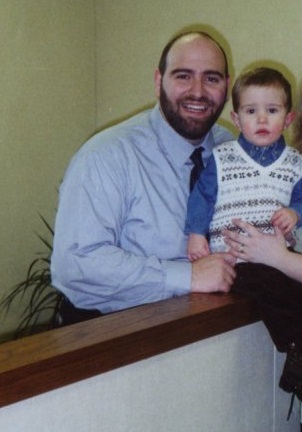
The above picture is of me and my oldest son. It was taken in between Sunday School and Sunday Service. I would guess that this is around 2004. It very well may have been as Easter service because he is kind of dressed up.
He didn’t always stay still in the nursery and was often very loud. We had probably just gotten the diagnosis of Developmental Delay around this time. It wasn’t odd for him to walk up to me while I was teaching Sunday School. When he did that, I usually picked him up and continued teaching.
My ex (who is cropped out of this picture) had gotten to the point where she didn’t want to go anymore. I wound up going alone and teaching for a while. Then, my ex would plan things that made it hard for me to keep teaching. On top of that, I was working Saturday overnights and it was difficult to work 12 hours, drive an hour home, wait an hour or two before heading to church.
They stream online now, so I can watch him or other pastors all over the country from the comfort of my couch. The kids are not to the point where they will sit still long enough to listen, so they watch Paw Patrol or whatever while I listen to a message. I miss being there live and I certainly miss teaching. I’m hoping that I’ll be able to do that again soon.
It’s time once again for another submission of Dave Ruch’s Turntable Talk hosted by A Sound Day. Every month he presents our musical blogging community with a musical topic and I have been lucky enough to have participated in every one of them.
This month’s topic was difficult for me, because there were just SO many songs I could choose from. Our instructions for A Novel Idea for a Song were to “pick a novelty record you like. Or else one you love to hate if you don’t have any favorites. I’ll let you decide what exactly is a “novelty” record but I look forward to seeing your picks and maybe having a laugh or two. And maybe a cringe or two as well!“
I want to say that the first novelty song I remember hearing as a kid was Ahab, the Arab by Ray Stevens. This led to the discovery of an album that had all kinds of silly songs on it. The tracks included Mr. Custer, I’m a Nut, Hello Muddah Hello Faddah, and more. What kid doesn’t love a silly song? I began to search for more silly songs. During my search I was introduced to Stan Freberg and his amazing satires, Weird Al Yankovic and various other novelty song collections.
In the late 1980’s, the Doctor Demento Show aired on a local radio station and he played many novelty songs that were completely new to me. The songs he played were recorded anywhere from the 1920’s to the present. I had no idea that novelty songs were something that went back that far. The Dr. Demento show was where I heard Monty Python for the first time and where I was introduced to another artist – Tom Lehrer.
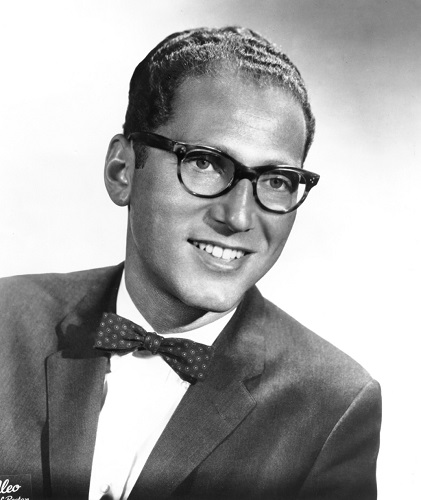
I read where Tom celebrated his 96th birthday this week (April 9), and that is what led me to my song for Turntable Talk. All in all he only recorded about 50 or so songs, and I could have picked one that may not be so …. controversial, however, of all his songs, it was THE one that stuck out to me. More on that in a minute, but first, here’s a bit about him.
According to Wiki, Tom is “an American musician, singer-songwriter, satirist and mathematician, who later taught mathematics and musical theater. He recorded pithy and humorous songs that became popular in the 1950s and 1960s. His songs often parodied popular musical forms, though they usually had original melodies.” His early stuff featured songs that were kind of dark like “Poisoning Pigeons in the Park” and “I Hold Your Hand In Mine.” His later material was a little more topical.
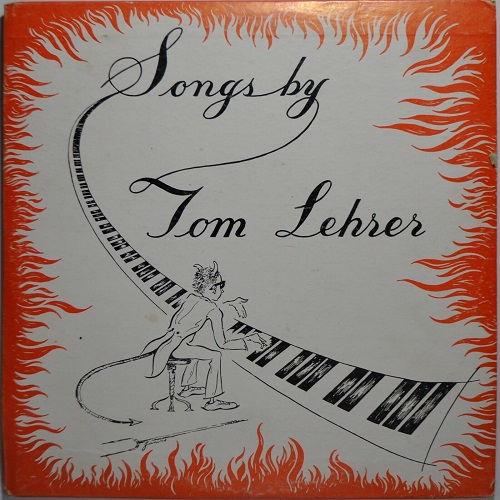
So what led Tom to record this dark and humorous songs? The story goes that Tom had been playing some of these songs for friends and was convinced to record them. According to Wiki, “he paid $15 (equivalent to $171 in 2023) for some studio time in 1953 to record Songs by Tom Lehrer. The initial pressing was 400 copies. Radio stations would not air his songs because of his controversial subjects, so he sold the album on campus at Harvard for $3 (equivalent to $34 in 2023) while “several stores near the Harvard campus sold it for $3.50, taking only a minimal markup as a kind of community service. Newsstands on campus sold it for the same price.”
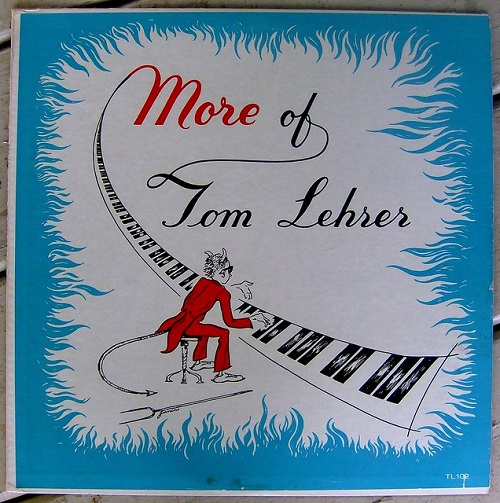
This was followed by “More by Tom Lehrer” and a live concert version of those songs on a album called “An Evening Wasted with Tom Lehrer.
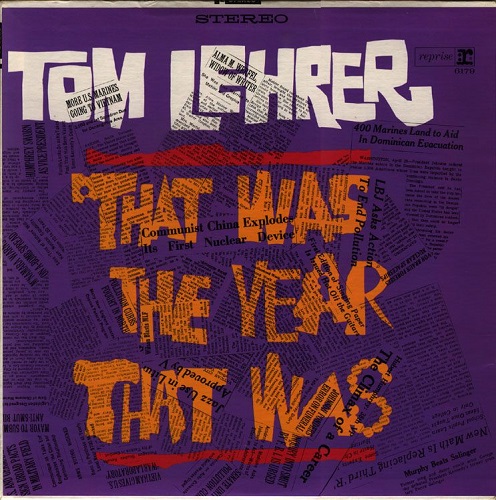
In 1960, he basically retired from touring in the US, but he was employed as the resident songwriter for the U.S. edition of That Was The Week That Was. TWTWTW was a satirical TV show and he was responsible for a song per show.
For the show (and the album of the same name), he wrote songs about political and topical events. There were songs about education (New Math), race relations (National Brotherhood Week), the ecology (Pollution), and the military (Send the Marines). What are the two things people aren’t supposed to talk about – politics and religion, right? Naturally, Tom had a funny take on a religious news event.
The Second Vatican Council took place in the early to mid-1960’s. A spoken introduction describes The Vatican Rag as a response to the “Vatican II” council—which, among other things, broadened the range of music that could be used in services. Tom humorously proposes this “rag” as a more accessible alternative to traditional liturgical music of the mass.
Before I go on, I want to say that I was born and raised Catholic. I am a Christian who no longer practices Catholicism (my choice). I did not pick this particular song as one to offend, but it may very well do so. Humor, they say, is subjective. That being said, while the song mocks some of the Catholic rituals (confession, the rosary, and more), it is the fact that it is a rag that makes it so ridiculous. You can imagine, howeverm that many people of that faith considered it blasphemous at the time.
Lehrer never submitted the song to the show That Was the Week That Was, as he felt they would edit all the satire out of the song. Instead, he debuted the song at a California nightclub called the Hungry I. At one performance, actor Ricardo Montalban was in the audience and it is said that he approached Lehrer and told him “I love my religion. I would die for my religion.” Lehrer reportedly responded, “Hey, no problem, as long as you don’t fight for your religion.”
At this point there are a couple of Tom Lehrer quotes I want to share with you before you listen to the song:
“You can’t be satirical and not be offensive to somebody.”
“The people who came to hear me perform or to buy my records were not the type who would be offended (by the song The Vatican Rag). But I gather that there were other people who were offended.”
About the song, he says, “Well, I wasn’t really attacking the religious beliefs, I was attacking the formality of the rituals of the Catholic church; however, people took it wrongly.”
With all of that being said, I hope this one song I picked doesn’t stop you from checking out some of his other stuff. For example, The Elements is a fantastic song that literally just lists all the elements. It is a fan favorite. Lehrer fan Daniel Ratcliff (Harry Potter) actually sang it on The Graham Norton talk show from memory (this is what led Weird Al Yankovic to pursue Ratcliff to play him in his recent movie).
Tom Lehrer’s fans consider The Vatican Rag to be one of his best compositions. So without any further ado, pull up a pew and give it a listen.
Lehrer has said, jokingly, of his musical career: “If, after hearing my songs, just one human being is inspired to say something nasty to a friend, or perhaps to strike a loved one, it will all have been worth the while.” In October 2020, Lehrer transferred the music and lyrics for all songs he had ever written into the public domain. In November 2022, he formally relinquished the copyright and performing/recording rights on his songs, making all music and lyrics composed by him free for anyone to use, and established a website (https://tomlehrersongs.com) from which all of his recordings and printable copies of all of his songs could be downloaded. His statement releasing all his works into the public domain concludes with this note: “This website will be shut down at some date in the not too distant future, so if you want to download anything, don’t wait too long.”
Thanks again to Dave from A Sound Day for a great Turntable Talk Topic. Hopefully, after my choice, he will invite me back next month. Maybe I should have just went with The Curly Shuffle, instead?
I don’t post this to start any kind of religious debate. As a matter of fact, I don’t post much about my faith on this blog. If matters of faith bother you, you may skip this blog entry. If you practice a particular religion or belong to a specific denomination, I am not here to diss on it. I am merely sharing what I found to clear up something.
As an Italian, I was born and raised Catholic. I guess I was around 15 or 16 when I began to question some of the things I was being taught in church. A buddy I worked with was going through the exact same thing and he would often share things he learned in his journey. Long story short, I no longer am a practicing Catholic. I believe in God and I believe in Jesus Christ as my Lord and Savior.
Reading my Bible opened up so many new things to me and also debunked many of the false truths that I had been led to believe. All that being said, Facebook, Instagram, and the internet were full of Good Friday photos and posts. In my Bible classes, the topic of Christ’s crucifixion was examined in great detail. So did Jesus Christ die on a Friday? Not according to Scripture. Here is a brief look at why Friday doesn’t work….
Was Jesus Christ really crucified on A Friday?
by Shawn Brasseaux
Did Jesus Christ really die on Good Friday? Or is that merely church tradition? While some may argue that this issue is insignificant, the fact is that anything that is not in the Bible is not of faith. “So then faith cometh by hearing, and hearing by the word of God” (Romans 10:17). What if God’s Word did tell us on what day Jesus died? Would we care to know what God says about the matter, or would we be content to merely believe what we presumed the Bible to teach?
In Matthew 12:40, the Lord Jesus Christ said, “For as Jonas was three days and three nights in the whale’s belly; so shall the Son of man be three days and three nights in the heart of the earth.” During the three days and three nights between Christ’s death and resurrection, His soul went to the heart of the earth. In Luke 23:43, Jesus called the place “paradise.” This is “Abraham’s bosom,” the same place mentioned earlier in Luke chapter 16. Jesus Christ never went to hell’s torments. Hanging on Calvary’s cross, Jesus declared, “It is finished,” so His suffering was complete before He died (John 19:30). After three days and three nights were accomplished, Christ arose on Sunday, victorious over sin and death.
Let us examine Luke chapter 24: “[13] And, behold, two of them went that same day to a village called Emmaus, which was from Jerusalem about threescore furlongs. [14] And they talked together of all these things which had happened. [15] And it came to pass, that, while they communed together and reasoned, Jesus himself drew near, and went with them. [16] But their eyes were holden that they should not know him. [17] And he said unto them, What manner of communications are these that ye have one to another, as ye walk, and are sad? [18] And the one of them, whose name was Cleopas, answering said unto him, Art thou only a stranger in Jerusalem, and hast not known the things which are come to pass there in these days? [19] And he said unto them, What things? And they said unto him, Concerning Jesus of Nazareth, which was a prophet mighty in deed and word before God and all the people: [20] And how the chief priests and our rulers delivered him to be condemned to death, and have crucified him. [21] But we trusted that it had been he which should have redeemed Israel: and beside all this, to day is the third day since these things were done.”
Notice in verse 21 that, on resurrection day, Sunday, it was said that that day “was the third day since these things happened [since Christ suffered and died].” If we go back, Saturday would be the second day since Christ died, and Friday would be the first day since He died. That would make Thursday the crucifixion day.
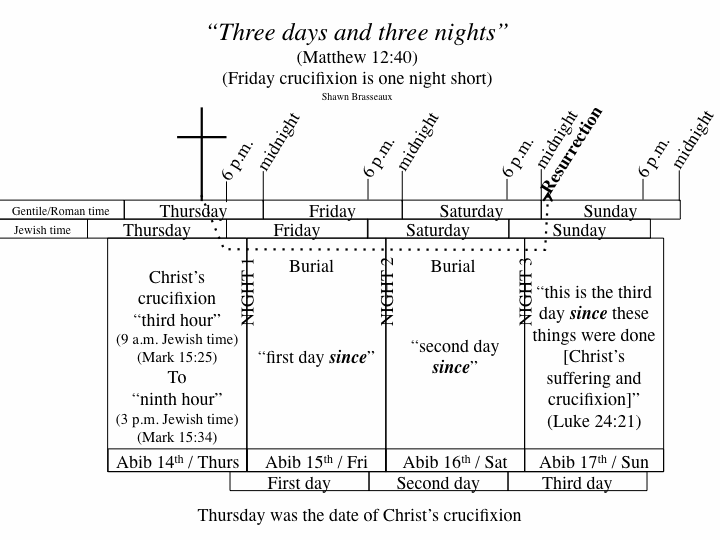
Another way to look at it is like this: Jesus Christ died around 3 p.m. (“the ninth hour;” Matthew 27:46,50; Mark 15:34,37; Luke 23:44-46). The Jews count days from evening to evening (6 p.m. to 6 p.m.), rather than the Roman/Gentile reckoning of time (midnight to midnight). The only way for Jesus to be dead three days and three nights and resurrect on “the third day” (1 Corinthians 15:3-4), Sunday, is to be crucified on Thursday. Thursday is the most plausible day of His crucifixion—a Friday crucifixion would be only two nights to Sunday, not three nights, and this would not fulfill the prophecy of Matthew 12:40. Furthermore, if we consider Jewish reckoning of time, Thursday evening and Friday morning were the first day, Friday evening and Saturday morning were the second day, and Saturday evening and Sunday morning were the third day, and Jesus rose Sunday morning. Three days and three nights from Sunday would be Thursday, and Sunday could only be the “third day” if it was a Thursday crucifixion. See diagram:
So, if the Bible indicates a Thursday crucifixion, why do many people talk about “Good Friday?” The main reason it is assumed that Jesus was crucified on Friday is that the Bible says that the day after Jesus’ crucifixion was the Sabbath day. John 19:31 says, “The Jews therefore, because it was the preparation, that the bodies should not remain upon the cross on the sabbath day, (for that sabbath day was an high day,) besought Pilate that their legs might be broken, and that they might be taken away.” However, the parenthetical statement says that that Sabbath day was not the weekly Sabbath (Saturday), but “that sabbath day was an high day.” It was a special Sabbath—“that sabbath”—not“the sabbath.” Israel did not have merely weekly Sabbaths (Saturdays) to observe, but Sabbaths (other days of rest) associated with feasts observed throughout the year as well (Leviticus 16:31; Leviticus 23:24,32,39). The Sabbath of John 19:31 was the first day of the Feast of Unleavened Bread, which immediately followed Passover.





 Various Ramblings of a Nostalgic Italian