Share Your Nostalgia – Round 3

A while back, I asked some blogger friends if they’d want to write a piece for my Share Your Nostalgia feature. In the past we have looked at Favorite Childhood Toy and Favorite Childhood Book. We continue to visit Saturday mornings. This was when we sat in front of the TV with our favorite cereal and watched hours of cartoons. So I asked my guests to write about their favorite cartoon or cartoon character growing up.

My next guest blogger is my pal, Christian from Christian’s Music Musings. Christian features music from every era on his site. My favorite feature is his “Sunday Six,” where he features six random songs. The songs are often a mix of various genres and various eras. He grew up in Germany, so let’s see if that has any influence over his choice….

Childhood Nostalgia: My Favorite Animated Show
Share Your Nostalgia hosted by fellow blogger Keith (Nostalgic Italian) is in its third round, and I’m happy to be back with another contribution. This time, the ask was to write about our favorite animated show or favorite animated character while growing up.

While I loved watching Peanuts cartoons on TV while growing up back in Germany, I figured it might be more interesting to talk about a German animated program: Die Sendung mit der Maus (“the showing starring the mouse”), one of the most successful German children’s programs. In fact, after some 54 years and more than 2,500 episodes, it’s still on!

Launched in 1971, the program airs on Sunday mornings. The subtitle is Lach- und Sachgeschichten (“funny stories and educational stories”), which are presented in the form of short cartoons and short educational films.

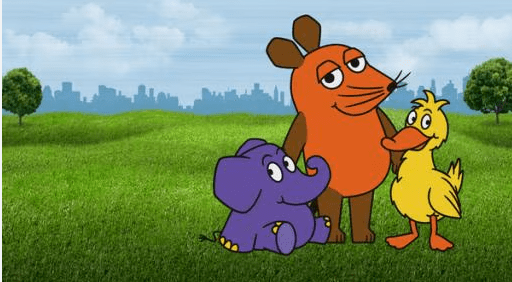
The key protagonist of the cartoons is the mouse. To solve problems the mouse encounters, she has some supernatural powers, e.g., open her belly to grab a tool or rip off her tail to use it as a rope.

Die Sending mit der Maus also features a blue elephant who is smaller than the mouse. He is portrayed as curious, pretty strong, spontaneous and loyal, and likes to laugh when the mouse has a mishap.

There is also a yellow duck, which is smaller than the mouse but bigger than the elephant. She is mischievous and generally causes some chaos when showing up, which happens more rarely than the elephant.

Seeing is believing. Here’s a clip of a short funny cartoon starring the mouse and the elephant.

And here’s a clip of a short educational film around the essential question whether ducks get cold feet when walking on ice! 😊

While as a small kid admittedly I mainly enjoyed the cartoons with the mouse and her two friends, looking at program footage today, I find combining short funny cartoons with educational films a great concept for kids to learn.

Since I’m a music blogger, I’d be amiss not to mention there is a song about the mouse titled Hier kommt die Maus (“Here comes the mouse”). Written and produced by German TV entertainer Stefan Raab, together with Hans Posegga and Lars Dietrich, Hier kommt die Maus was released in February 1996 to coincide with the show’s 25th anniversary.

And, yes, Hier kommt die Maus even enjoyed some chart success. In Germany, it peaked at no. 2 for one week and remained in the charts for 19 weeks. The song was also popular in Switzerland, climbing to no. 12 and remaining in the charts there for 12 weeks.

In case you’d like to see more of the lovely mouse, I’m leaving you with a longer clip. And don’t feel funny. While the target audience for the show is kids in kindergarten and elementary school, Wikipedia notes the average viewer age is about 40 years, since parents and grandparents oftentimes join children in front of the TV – who could blame them!

Sources: Wikipedia; YouTube
Share Your Nostalgia – Round 2

Back in November, I did a feature I called “Share Your Nostalgia.” I asked some of my blogger friends to write up a piece that focused on their favorite toy from childhood. The response was positive and it was suggested to do another round. So this time around, I asked for them to tell us about their Favorite Childhood Book.

Their book could be something that was read to them by their parents or grandparents. It could also be a book that was read to them in school at story time. I also suggested that their book might be one that they read to their own children. I wanted each of them to have as much freedom as necessary.

We’ll kick things off with my pal, Christian from Christian’s Music Musings. Christian features music from every era on his site. My favorite feature is his “Sunday Six,” where he features six random songs. It’s always a good mix.

Christian was raised in Germany. Perhaps he’ll get us started with a German author? Let’s find out!

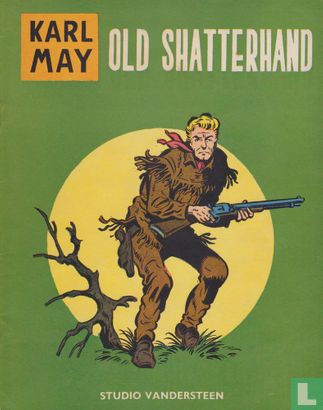
My Childhood Admiration of Karl May’s Winnetou and Old Shatterhand 

A few weeks ago, Keith (Nostalgic Italian) put out another call to fellow bloggers to contribute to his new recurring feature Share Your Nostalgia. This time, he asked participants to write about their favorite book from childhood. 

The topic reminded me that sadly I haven’t read a book in ages. My lame excuse is I do a lot of reading as part of my job, so I don’t want to spend my spare time doing the same thing. I hate to admit it, I think my real problem is short attention span. I no longer have the patience to read an entire book. That said, ironically, my blogging involves quite a bit of background reading, though I’m relying on Wikipedia and other Internet sources, not books. 

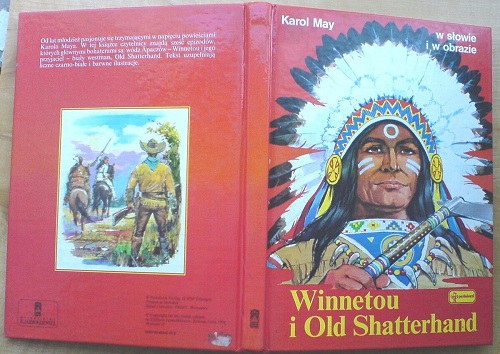
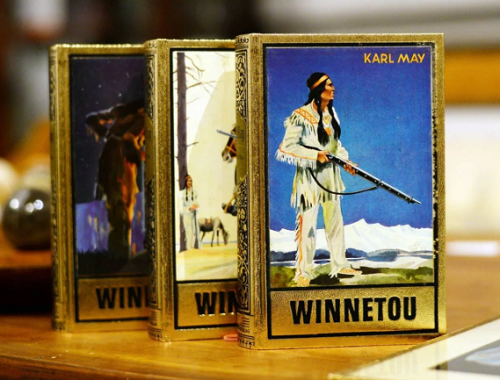
A short attention span or lack of patience, however, never prevented me from reading books when I was a child. Perhaps, there were fewer distractions back then while I was growing up in Germany. Usually, I read in the evening in bed prior to sleeping. Among my favorite books were the Western novels by Karl May, featuring the characters of Winnetou, the Apache, and his friend and blood brother Old Shatterhand. 

At age 8 or 9, I didn’t question May’s distorted portrayal of the American West and representation of Native Americans. It wasn’t until 1908 the German author took his only trip to America, visiting New York, Albany, Buffalo, Lawrence and Boston. At that time, he had already published many of his famous novels featuring Winnetou and Old Shatterhand. Despite all of this, May is one of the best-selling German writers of all time, with about 200,000,000 copies sold worldwide, according to Wikipedia

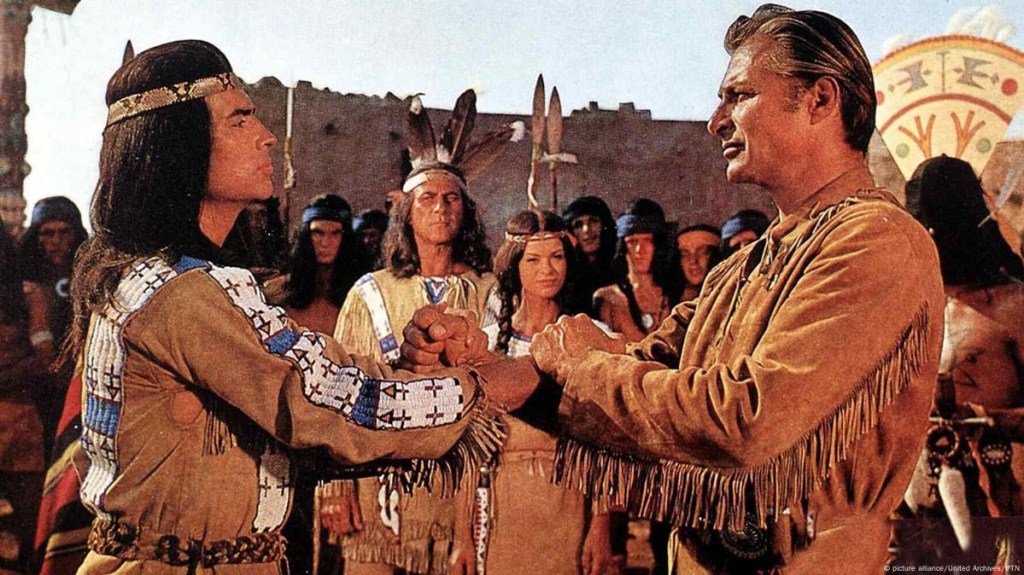
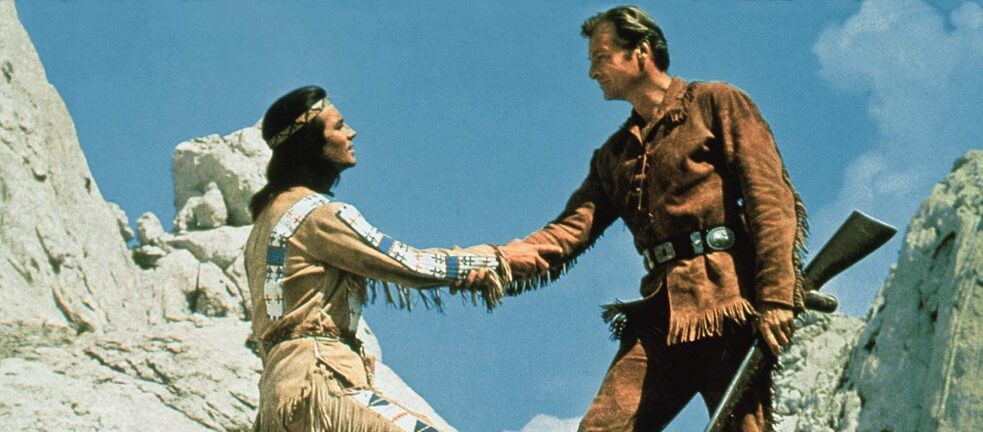
Winnetou and Old Shatterhand, as depicted by actors Pierre Brice and 
Lex Barker in a popular German movie series 

While I still recall titles of some May novels I read as a child, such as Winnetou I, Winnetou II, Winnetou III and Der Schatz im Silbersee (“The Treasure of the Silver Lake”), the details are gone. In a nutshell, Old Shatterhand was a young German who had come to America and initially was working as a surveyor for a railroad company expanding across the American West. He first meets Winnetou under hostile circumstances, but the two men not only become friends but also blood brothers. Together, they fight for justice and against villains who often seek to exploit tensions between settlers of the American West and Native Americans. Eventually and tragically, Winnetou is killed.  

At the time I was reading Karl May novels, his stories and characters were pretty popular in Germany. I loved watching movie adaptations that featured Winnetou, Old Shatterhand and other recurring characters in the novels. There were also Karl May theatrical open air festivals in various German towns like Bad Segeberg and Elspe, which continue to this day. I’ve never been to any of the performances. In 1985, German scholar Hartmut Lutz came up with a term to describe the fascination in German popular culture with the Indigenous peoples of North America: Deutsche Indianertümelei (“German Indian Enthusiasm”). 

In the aforementioned movies, Winnetou was portrayed by French actor Pierre Brice, while Old Shatterhand was played by American actor Lex Barker. Not surprisingly, they were among my favorite actors as a child. These movies were produced during the 1960s in Germany and largely filmed in the former Yugoslavia, which not only offered cost-effective locations but spectacular landscapes that had some resemblance of the American West.  

The characters of Winnetou and Old Shatterhand were also part of daily playing with my best friend. I was Winnetou and he was Old Shatterhand. Every day, we came up with our own stories and amazingly never got bored. At some point, we even had toy versions of their rifles, Winnetou’s Silberbüchse (“The Silver Gun”) and Old Shatterhand’s Bärentöter (“Bear Killer”) and Henrystutzen (“Henry carbine”), and ran around in costumes.  

I’m leaving you with a short clip of the intro to the film Der Schatz im Silbersee. Unfortunately, it’s in German, but I guess you can still get an idea why an 8-year-old would be excited about it!😊 The clip also features the main musical theme written by German composer Martin Böttcher, which I loved at the time. Admittedly, writing the above, as well as watching and listening the clip gives me nostalgic feelings about my childhood. I guess this means mission accomplished! 

Share Your Nostalgia

We continue with my trial run of Share Your Nostalgia, an idea suggested to me by some fellow bloggers. The topic for this feature is “The Toy of Your Life.” Was there one toy that you considered the “best?” When you think of yourself as a child, what is the toy that immediately pops into your mind? What was the toy that you brought to Show and Tell or took with you everywhere?

Today, we shine the spotlight on Christian. Christian is another one of the great music lovers I’ve connected with here on WordPress. His blog is loaded with all kinds of musical writings. He has a love for 1960’s and 1970’s music, but his blog is far from just those decades. You can check him out at Christian’s Music Musings: https://christiansmusicmusings.wordpress.com/

Take it away, Christian –

When fellow blogger Keith (Nostalgic Italian) reached out to me the other day to see whether I’d like to participate in his call for contributions about the “Toy of Your Life,” I immediately accepted. Then I thought, ‘oh, oh, what am I going to write about?’ After all, I really can’t point to one specific object that was THE toy. As such, I decided to take a bit of liberty and write about my (childhood) obsession with toy cars.

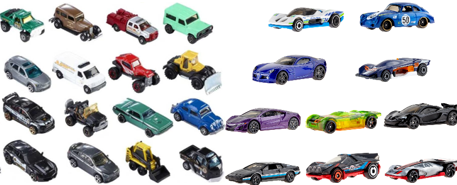
I remember my mom often told me that when I was a toddler back in Germany, I would always walk around carrying stuff in my hands. This included all kinds of pens in different colors and a Tonka-type plastic toy truck. At some point, I guess by the time of first grade, I had discovered Hot Wheels and Matchbox cars. I couldn’t get enough of them. And I found an ingenious way to increase my supply!

During much of my early childhood, I had blood anemia and needed to take iron in liquid form – yuck, not a medicine I can recommend! The condition also required frequent blood

monitoring. This meant my mom had to take me our primary care doctor where they always stuck my finger to collect blood.

I was very afraid of the little needles the assistant used to take my blood and always made a big scene. On one such occasion, out of despair, my mom once told me if I would be brave, she would reward me with a Matchbox car after the doctor’s visit. While I still dreaded the needles, that sounded good to me!

And so I began accumulating Matchbox and Hot Wheels cars. I played with them all the time, alone and with my best friend who I met in second grade and who I’m still fortunate to call my best friend to this day. At some point, we began building roads in the sandbox that was in the backyard of his house and taking our cars there – safe to assume a few of them got buried forever!

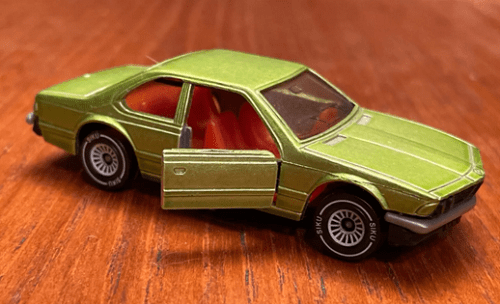
At some point as I grew bigger, so did the toy cars. Matchbox and Hot Wheels were out, and I started collecting cars that were about twice the size of a Matchbox car. I remember one of the brands was called Siku. One of the cars was a BMW 630CSI like the one pictured below, though I believe mine was silver.

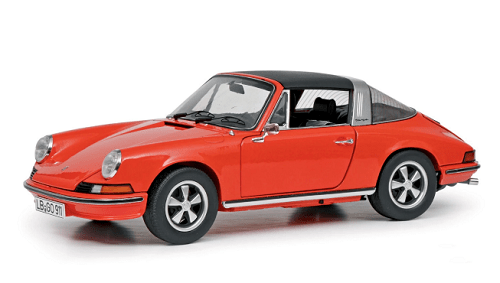
During my early teenage years, I started collecting even bigger toy cars (1:18 scale) by Schuco and other toy car makers. Those cars had many more details and looked way more sophisticated. One, a red Mercedes 280SL convertible even had a working steering wheel. I also had a red Porsche 911 (still my favorite sports car to this day!) that looked similar to the below model, though it wasn’t a Targa.

While I kept my bigger cars on display in my room well into my late teens, once I started getting my first guitar and taking lessons, guitars became my new toy of interest, and the toy cars on the shelves started collecting dust.

While I’m older now (at least on paper!), I will say my fascination for toy cars has never entirely disappeared. When my son was a toddler and the Pixar movie Cars came out, it didn’t take much to convince papi (as he usually called me) to start collecting die-cast models of Lightning McQueen, Tow Mater, Doc Hudson or Sally Carrera. In fact, oftentimes it felt papi was more excited than his son!

Even to this day when I happen to spot toy cars in the pharmacy, I sometimes stop and glance to see what kind of makes and models they have. If I were a kid, I’m sure I’d like some them, especially muscle cars.

Since I’m a music blogger, I can’t wrap up this post without some music. As such, I’m leaving you with three car/driving songs, including one titled Matchbox Cars, though it’s not about toy cars but real cars looking like Matchbox cars from the 52nd floor of a skyscraper – but, hey, close enough!

Deep Purple/Highway Star (1972) – perhaps the ultimate driving song!

Golden Earring/Radar Love (1973) – another contender for best driving song!

Coot/Matchbox Cars (2012) – from the eponymous debut album of this New Orleans-based rock band who are completely new to me – I guess they passed the audition!