I played trumpet in high school. I played it off and on after high school, but I probably couldn’t play more than 5-10 minutes now. That being said, I do love to listen to the professionals who have mastered the instrument. I love listening to Maynard Ferguson, Clark Terry, Harry James, and Doc Severinsen.
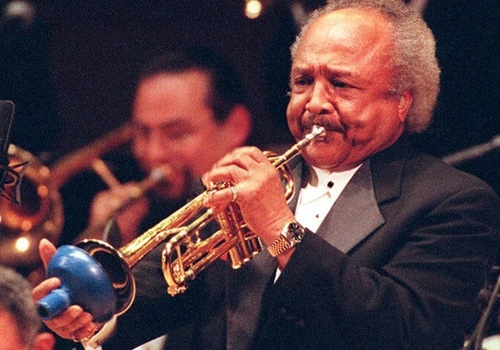
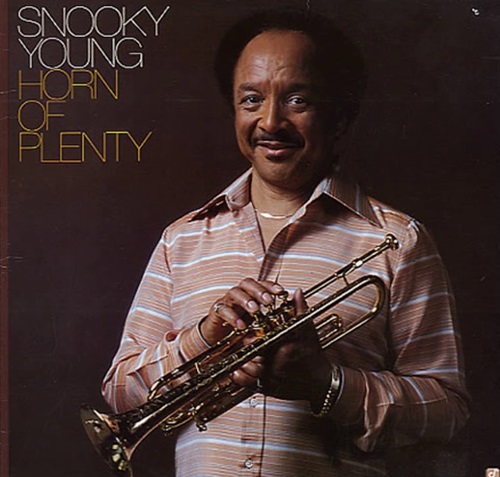
The members of the Tonight Show Band were really something. They were TIGHT! I am always amazed to hear that band and how they really cook. One of the other trumpet players I love was a member of the Tonight Show Band – Eugene “Snooky” Young.
Snooky was born on this day in 1919. Not only could he play, but he was a master of the “plunger mute” (It’s exactly what you are picturing.) with which he was able to create a wide range of sounds. Sometimes folks will call it a “whah whah” mute because that’s sort of the sound you can produce with it.
Snooky played with greats like Count Basie and Lionel Hampton. He recorded three solo albums from 1971 to 1979.
He also performed on albums with Ray Charles, Quincy Jones, Lalo Schifrin, The Mills Brothers, George Benson, Tony Bennett, The Band, Steely Dan, BB King, Neil Diamond, and Tracy Chapman.
In the late ’80’s, Doc and the Tonight Show Band went into the studio to record two albums. They are a must for folks who love a swingin’ big band. Snooky plays a solo on almost every cut on the album. One of my favorite cuts is their version of Lionel Hampton’s Flying Home. The saxophones are locked in and sound so good together. Listen for Doc (unmuted) and Snooky (Plunger muted) solos that are simply amazing.
First, the album cut –
The band live on the show (with an intro from Johnny Carson)
Here’s a fun clip of Snooky singing and playing.
Snooky passed away at the ripe age of 92 in May of 2011.
Welcome to the first Turntable Talk of 2025, hosted by Dave of A Sound Day. This is the 34th round, if you are keeping track. If you are a new follower, let me fill you in on how it works. Dave Ruch offers up a musical topic to a group of us music fans each month. Each of the writers come up with a response to the topic and Dave runs each piece on his website.
We have had some fun and interesting topics, and this one is no exception. This time around, Dave asks, “What’s my scene?” Our instructions: Pick a sort of music “Scene” that either you would have liked to have been a part of or one that you think really created a lot of the music you love. Pick a general place and time and have fun….
My fellow music bloggers know my musical tastes pretty well by now. So, let’s see a show of hands – How many thought I’d pick The Rat Pack in Vegas? I almost did, but I know I have written on a live Rat Pack show in the past. Honestly, as awesome as that would be, the more I thought about it the more I leaned another way.
My scene certainly influenced the Rat Pack. Dean Martin cut an album called Swingin’ Down Yonder. Frank Sinatra recorded albums titled: Sinatra Swings, Songs for Swingin’ Lovers, Swing Easy, Sinatra’s Swingin’ Session, Sinatra and Swingin’ Brass, and A Swingin’ Affair! You know what the song says, “It don’t mean a thing, if it ain’t got that swing!”
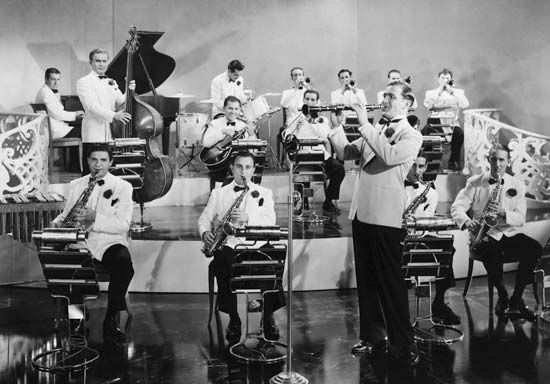
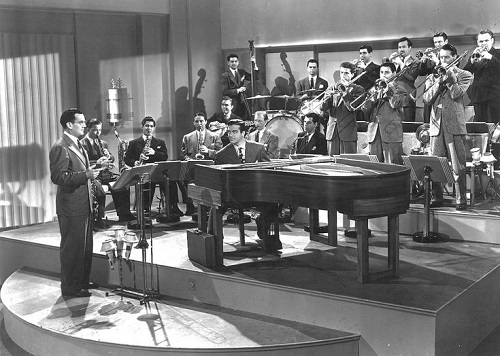
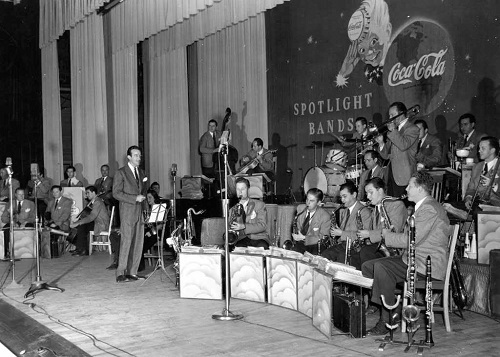
As a mediocre trumpet player, I have always loved Big Band/Swing music. Most folks would consider the Swing Era to be from the early 1930’s to around the mid 1940’s. Even though swing music was prominent in the early 1930’s, it was often ridiculed for its style and feel. Some went as far as to call it a menace (much like Rock and Roll when it gained popularity). After 1935, big bands rose to prominence playing swing music. They held a major role in defining swing as a distinctive style.
There were many big bands on the scene at this time. Each had a very distinct sound and feel to it. For example, Glenn Miller’s orchestra often used a clarinet lead. Count Basie’s sound has a relaxed feel to it. Benny Goodman used a driving and hard swing sound. Duke Ellington’s songs has a sophisticated sound to them.
The band leaders often took the spotlight. They were amazing instrumentalists. Harry James and his trumpet, Benny Goodman and Artie Shaw on their clarinets, Gene Krupa on his drums, the trombones of Tommy Dorsey and Glenn Miller, and Lionel Hampton’s vibes. Along with those great leaders, there were plenty of talented musicians within those bands who went on to make a name for themselves.
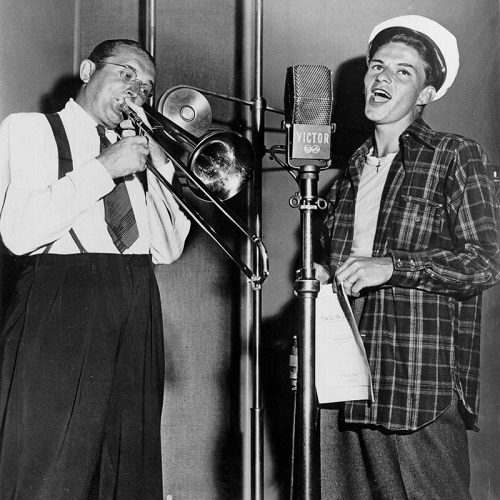
Perhaps Sinatra recorded his many swing songs because he rose to fame alongside Tommy Dorsey. He was one of many singers who sang with those big bands. Others included the voices of Ella Fitzgerald, Billie Holiday, Kay Starr, Peggy Lee, Doris Day, Kitty Kallen, and Dick Haymes. While they all started with the big swing bands, they also went on to have prolific careers.
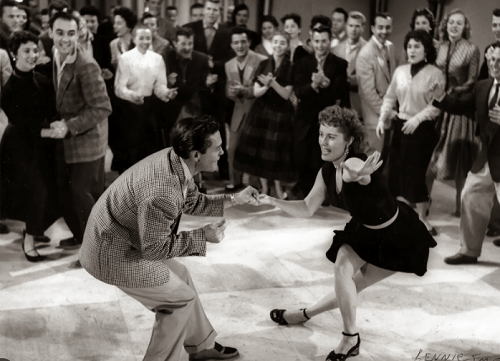
During the swing era, the big bands would often play at dance halls across the country. They appeared on the radio playing dance music. Some appeared in movies, and all of them made records. Their music had teenagers and young adults dancing until their feet hurt.
As years went on, the taste of music listeners changed. Swing began to fade away to make way for music that was less “danceable” like bebop. Many of the swing bands broke up, while other continued without their original leaders. The Glenn Miller Orchestra still tours today, for example.
When I put on headphones and listen to old big band recordings, I picture myself there listening. I picture myself in one of those great 1930’s suits with a stylish fedora.
Maybe it is in a dance hall or at a live concert. Maybe I am in the audience of a radio program where the band is playing. Wherever the music is being played, I am zoned in on it. I am listening to the drum beat of Sing, Sing, Sing and Benny Goodman. I can hear the vibrato of Tommy Dorsey’s trombone solo on I’m Getting Sentimental Over You. I marvel as I watch and listen to Harry James play his theme song, Ciribiribin.
Throughout the evening, I will study those great instrumentalists who improvise solos off the top of their head. Looking at nothing but chords and making up their own melodies. This is something I wish I could do as a trumpet player.
In all honesty, in my “scene,” I would be happy as a clam to just be in the audience. It would be the bees knees just watching those guys swing! Yeah, I can totally see myself swinging, singing, and dancing to the sounds of swing.
Thanks again, Dave for inviting me to take part in this feature. It is always fun to contribute and to read the other submissions. I’m already looking forward to next month’s topic!
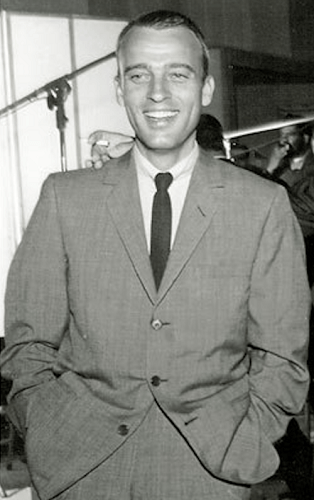
The amazing Neal Hefti was born today in 1922. Neal may not be a name that you recognize, but I bet that you recognize at least one of the songs that he has composed.
He was a jazz trumpet player, arranger, and composer. He began arranging songs in his teens and went on to arrange songs for Woody Herman and his band, including the famous Woodchopper’s Ball. After leaving Herman’s band he did freelance work for Buddy Rich, Billy Butterfield and Harry James.
In 1950, he began to arrange charts for Count Basie. He was a key factor in the “Basie sound.” Basie liked his stuff so much, Basie had him arrange some charts for Basie and Frank Sinatra. When Frank and Basie recorded together, they recorded standard songs that Frank had recorded before, however, Hefti’s arrangements were done so that the band complimented Sinatra’s singing.
Hefti led his own band in the 50’s and did so until moving back to California in 1960. When he returned, he began to do work for the film industry. He enjoyed a lot of success writing movie and television music. His film music included songs for The Odd Couple, Sex and the Single Girl, and Barefoot in the Park.
The music for the Odd Couple movie led to him writing music for the television series. He wrote the theme song and background music for the Odd Couple and a little super hero show that took the nation by storm in 1966 – Batman.
He received three Grammy nominations for his television work and received one award for his Batman television score. The Batman Theme was “a simple cyclic twelve-bar blues-based theme” that became a Top 10 single for The Marketts (and also for himself).
My brother and I watched Batman in syndication and we love the campiness of it to this day. The them is iconic (and easy to sing along with). Happy 102nd Birthday, Mr. Hefti!
Today is World Pianist Day, so I thought I’d share a guilty pleasure piano song with you.
The Piano has been an instrument that has provided music and melodies for centuries. It has figured prominently in all genres of music and some very talented people have been known for the instrument.
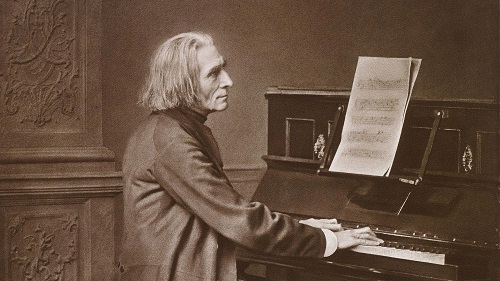
Frederic Chopin, Ludwig Von Beethoven, Wolfgang Amadeus Mozart, and Franz Liszt are all well known classical pianists.
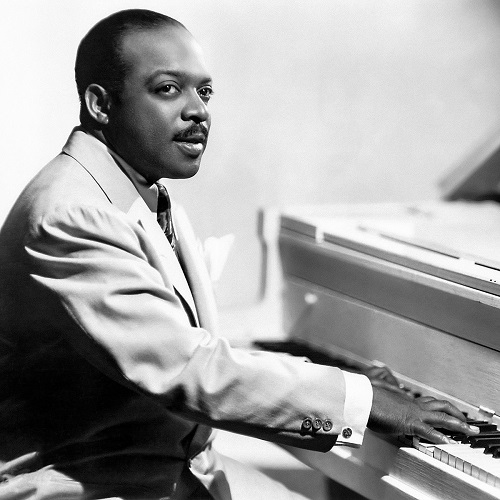
Duke Ellington, Oscar Peterson, Nat King Cole, and Count Basie are all well known jazz pianists.
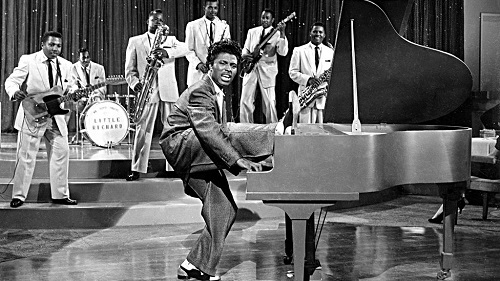
Fats Domino, Little Richard, Billy Joel, Elton John, Stevie Wonder, Carole King, and Freddie Mercury were all well known pop/rock pianists.
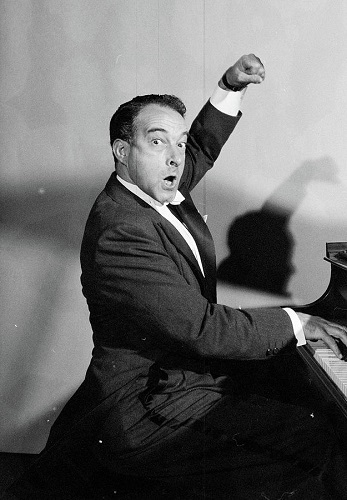
PDQ Bach, Tom Lehrer, and Victor Borge were all known for incorporating the piano into their comedy.
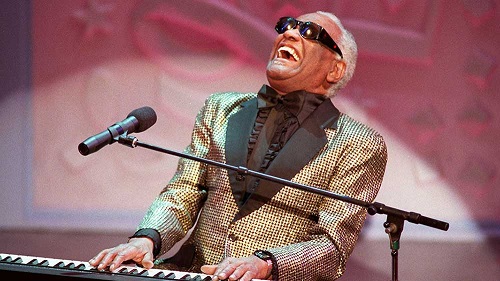
Otis Spann, Billy Preston, Charles Brown, Dr. John, and Ray Charles all offered up some great blues piano tunes.
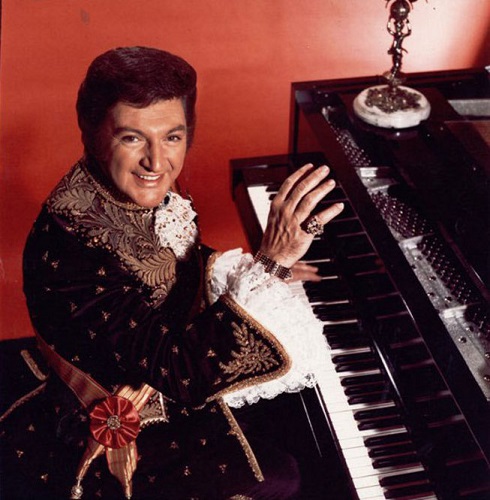
Then, of course, there was Liberace … who played everything.
When I was young, I learned how to play the Hammond Organ. I wish I had learned how to play piano, though. Over the years, I have come to appreciate how talented piano players are. I can’t imagine playing one riff with one hand and a melody on the other.
The guilty pleasure song I wanted to share today features the piano and is played by a guy who I have written about before. TV and movie star Hugh Laurie had an album out a few years back called “Let Them Talk.” On this album, he plays the song Swanee River. The song was written by the great Stephen Foster back in 1851!
Hugh’s version is an amazing boogie woogie romp that you cannot help but tap your toes to. It is one of those “pick me up” songs. I find myself listening to it when I am feeling down. So for World Pianist Day, I apologize to the legendary pianists I mentioned early on, and offer up – Mr. Hugh Laurie.
Today is the 99th birthday of WIlliam “Count” Basie. He was one of many legendary jazz pianists, and big band leaders. He formed the Count Basie Orchestra in 1935 and led the group for almost 50 years. He is noted for creating innovations like the use of two “split” tenor saxophones, emphasizing the rhythm section, riffing with a big band, using arrangers to broaden their sound, and others. So many musicians came to prominence under his direction.
He worked with many well known singers including Tony Bennett, Jackie Wilson, and Frank Sinatra. His list of accomplishments and recordings would take forever to write about. Instead, I’d like to share a couple of my favorite Basie tunes by Basie and some covers.
One O’clock Jump
Amazing cover by Doc and the Tonight Show Band
April In Paris
Again, Doc and the Tonight Show Band
Fly Me To The Moon – With Frank
Please Be Kind – With Frank
With Plenty of Money and You – With Tony Bennett
Chain Gang – With Jackie Wilson
It is said that one of Basie’s biggest regrets was never recording with the great Louis Armstrong.
There is a neat album that has been referenced as the “concert that never happened.”
This is concert vocals from Ray Charles and members of the Basie Band mixed together for a unique album.
Georgia on My Mind
Busted
Ok, a couple quick movie clips that feature Basie just because …
First a classic pantomime by Jerry Lewis in The Errand Boy. He uses Basie’s “Blues in Hoss’ Flat” as the basis for this gem.
…and finally, the Count and his orchestra’s cameo appearance in Blazing Saddles (using April in Paris)!
One of my favorite commercials on TV right now is the “Spring Into Action” commercial from Kohl’s. There is something about the smile of the little girl as people “hop” by that tugs at the heart strings. It is a wonderful “feel good” commercial. If you haven’t seen it – take 30 seconds and enjoy:
Kohl’s Spring Into Action
While walking the neighborhood with Ella last week, I noticed a few chalk Hopscotch games on the sidewalk. Rest assured, if the child who had drawn it was out on the porch, I would have hopped along just like the folks in the commercial.
The ad itself is wonderful. I love the song choice in it, as well. The Sunny Side of the Street is a song that is over 90 years old! It was written in 1930 by Jimmy McHugh and Dorothy Fields (although, some say it was written by blues legend Fats Waller). It made its debut on Broadway in the show International Review. The song is considered a jazz/pop standard now and is part of the “Great American Songbook.” It has been recorded by Louis Armstrong, Billie Holiday, Bing Crosby, Benny Goodman, Ella Fitzgerald, Nat King Cole, Count Basie, The Pied Pipers, Doris Day, Keely Smith, Frank Sinatra, Willie Nelson, Tony Bennett, and so many more.
As I thought about this song, I thought about my life. This was me! It wasn’t until Sam and I got together that I began to walk on the Sunny Side of the Street! I crossed over from the “dark and shady” side. I have always loved this song – it’s one of my favorite cuts from Willie Nelson’s Stardust album. If I had to pick a favorite version it would probably be Willie’s version. It’s just so laid back and smooth….
If you want a more “swinging” version of it – try Keely Smith on for size….
Lyrics
Grab your coat and get your hat Leave your worries on the doorstep Just direct your feet On the sunny side of the street
Can’t you hear the pitter pat? And that happy tune is your step Life can be so sweet On the sunny side of the street
I used to walk in the shade With those blues on parade But I’m not afraid This rover crossed over
And if I never had a cent I’d be rich as Rockefeller Gold dust at my feet On the sunny side of the street
I used to walk in the shade With those blues on parade But I’m not afraid This rover crossed over
And if I never had a cent I’d be rich as Rockefeller Gold dust at my feet On the sunny side of the street
Life Lesson
When life has you down, take a stroll on the sunny side of the street!







 Various Ramblings of a Nostalgic Italian