

This piece was originally published on the A Sound Day website as a part of the feature: Turntable Talk.
My thanks to Dave from A Sound Day for inviting me to take part in his monthly feature, Turntable Talk. This is the 47th round of the feature and once again he has given us a great topic. This time around he is calling it “Baby Come Back!”
Dave’s instructions this month: “I’d just like you to pick an artist you enjoy that had a great comeback; whether it’s one you have come across historically or one that you loved in real time, thought had disappeared but happily – boing! – they were back and great again.”
When Dave reached out to us, I had just written about the passing of Neil Sedaka. He certainly falls into this category. I didn’t want to feel repetitive, so I opted not to write about him again. Instead, I chose someone who I have written about a few times and definitely saw his career take off – stall – and then have a resurgence. Today, I shift the spotlight to “The Big O,” Roy Orbison.
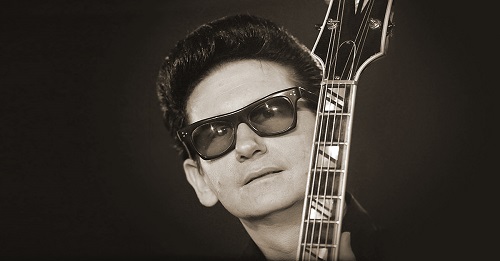
Roy Orbison is a rock and roll legend. I refuse to debate this. It is a fact. The Beatles and Elvis Presley (both legends in their own right) have stated on record that Roy was a major influence on their music. Roy’s music was different – it had its own style and a certain darkness to it. My first exposure to Roy Orbison was when I was about 4 or 5 years old.
I distinctively remember my dad having an album of Roy’s Greatest Hits. My favorite song as a kid was Dream Baby. I didn’t know that was the name of it at the time. I do know, however, that when I asked him to play it, I would ask for it by singing the opening bass line: “Daddy, play ‘boom boom boom, bum bum boom.’” I remember the first song on the album was Candy Man, which started with a harmonica. Coincidentally, that is the instrument Roy asked his parents for as a kid.
When asked he wanted for his sixth birthday, Roy told his parents he wanted a harmonica. Luckily for the music industry, his father bought him a guitar instead. While some stories differ, most biographies claim that Roy learned how to play from his father Orbie Lee Orbison. Some sources say that he learned from his Uncle Charlie, Orbie’s brother. Either way, he was taught how to play by family.
After graduating from high school in 1954, Roy enrolled at North Texas State College. His original plan was to study geology so he could secure work in the oil fields if music didn’t pan out. In his first year, he became bored with the course and switched to history and English.
While in college, Roy played music with fellow students Billy Pat Ellis, Dick Penner, and Wade Moore. They called themselves the Wink Westerners. Penner and Moore had written a simple, catchy rockabilly song, called “Ooby Dooby.” The song impressed Orbison, and he started looking into how he could make a recording of it. He heard that his schoolmate Pat Boon had been signed to a record deal, and it further strengthened his resolve to become a professional musician.
While playing a New Year’s Eve dance in 1954, Roy and the Wink Westerners had mostly played country and western swing music throughout the night. A decision was made to end the night by playing Bill Haley & The Comets’ song, “Shake, Rattle and Roll.” This would be the thing that caused the band to switch to rock and roll music.
The band began playing “Ooby Dooby” in their shows and because of their success, they got their own radio show on station KMID. In 1955, the band got their own TV show and artists came to play and sing on it. Among them, Elvis Presley and Johnny Cash.
Roy pulled Johnny aside and asked for advice. He wanted to know how to get a record released on the radio. Johnny suggested that he call Sam Phillips over at Sun Records in Memphis. Johnny gave Roy the number and sure enough Roy called. I am sure he was not expecting what happened. Sam Phillips answered the phone and after a brief conversation, Sam hung up on him, but not before telling Roy, “Johnny Cash doesn’t run my record company!”
In an ironic twist of fate, Roy eventually found a place to record and recorded “Ooby Dooby” with his band, now called the Teen Kings. The song was released in 1956 and Roy took it to a well known record dealer named Cecil “Poppa” Hollifield. He heard the song and immediately called a “connection” he had in Memphis and played him the record over the phone. His connection asked for a copy of the record, and three days later he called Poppa up to tell him he wanted the Teen Kings in Memphis in three days to record in his studio. That connection was none other than Sam Phillips of Sun Records!
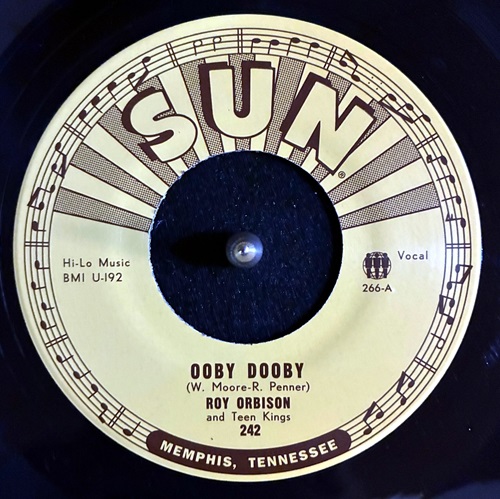
His record deal put him out on tour with the likes of Johnny Cash, Faron Young, Carl Perkins, and Johnny Horton among others. In 1958, Roy was asked to tour with the Everly Brothers. During the tour, the Everly Brothers told Roy they needed a new single and asked if he had any songs. He picked up his guitar and sang the song Claudette. They liked it, and asked him to write down the words and chords. The song was the B-side of All I Have To Do Is Dream. Roy had some of his other songs recorded by artists like Jerry Lee Lewis, Buddy Holly, and even Ricky Nelson.
In 1959, Roy was signed to an independent label called Monument. It was on this label that so many of Roy’s big hits were released, starting with Uptown. That was followed by Only The Lonely (which reached #2), Blue Angel, and I’m Hurtin’. What followed was Roy’s first #1 song, Running Scared.
Roy had hoped to change up the “pop” sound and try something different. They recorded the song twice and he was disappointed with the two takes, so they cut it again. Instead of using a falsetto voice, Roy sang the high natural A and nailed it. The accompanying musicians were awestruck and had never heard anything like it. Producer Fred Foster said “Nobody had ever hear anything like it before!”
What followed was four solid years of top 40 hits. Those hits included Crying, Candy Man, Dream Baby, Working for the Man, In Dreams, Pretty Paper, Leah, Blue Bayou, Mean Woman Blues, and Its Over. His success got him a spot opening up for some concerts in England. He was the opening act for a few guys who were known as The Beatles (they had yet to become a big thing in the US). The tour sold out in minutes, and on the first night of the show, they say that Roy played 14 encores before the Beatles ever got on stage!
In 1964, Roy recorded what is probably his biggest hit, Oh Pretty Woman. It would be his last big hit while at Monument records. How it came about is a story in itself. Touring hurt his personal life, and his wife Claudette began having an affair. One day while writing with songwriter Bill Dees, Claudette entered the room and said that she was going to Nashville. Roy asked her if she had any money, and Dee’s replied, “A pretty woman never needs any money.” With that phrase, and about 40 minutes, they wrote Oh, Pretty Woman, which went to number 1 in almost every country in the world.
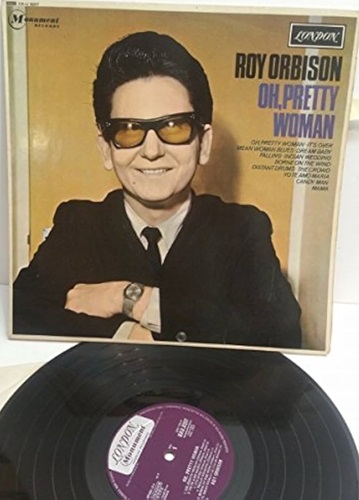
The success of Oh, Pretty Woman was followed by a string of tragedies. In 1966, Claudette was killed when a pickup truck pulled out in front of her and she hit the door. She died instantly. Two years later, Roy was on a tour in England and he received a call that his home had burned down. As if that wasn’t enough bad news, he was also told that his two oldest sons were killed in the fire. He tried to cope by keeping himself busy with work. He starred in the film The Fastest Guitar Alive, which ended up being his only lead role. After that, Roy seemed to slip away from the spotlight.
Despite all that was going on in his life, Roy continued to make music in the 1970’s. It was during this time that his career really slowed. It was around this time that he started to wear his hair straight, instead of combing it back. He would wear it like this for the rest of his life. He did see some success when his single “Penny Arcade” was number one in Australia for many weeks and “Too Soon to Know” reached number three in England.
He continued to tour, but played to mostly empty auditoriums. This was the case with the concert at Cincinnati Gardens that he played on his 40th birthday in April 1976. This was a new low for Roy. In his book, Roy Orbison: Invention Of An Alternative Rock Masculinity, Peter Lehman stated that Orbison’s absence was a part of the mystery of his persona: “Since it was never clear where he had come from, no one seemed to pay much mind to where he had gone; he was just gone.”
In 1977, Roy was not feeling well, so he decided to spend the winter in Hawaii. Once there, he checked in to a hospital where testing discovered that he had severely obstructed coronary arteries and was lucky to be still alive. He underwent open-heart surgery on January 18, 1978. His medical history stated that he had suffered from duodenal ulcers since 1960 and had been a heavy smoker since he was young. The surgery was a success and Roy said that he felt great. His weight would continue to fluctuate, however, for the rest of his life. He also continued to smoke cigarettes, despite the advice of his doctor.
A decade later, in 1987, he was inducted into the Rock and Roll Hall of Fame. Bruce Springsteen was there to do the induction honors. Bruce concluded his speech with a reference to his own album Born to Run: “I wanted a record with words like Bob Dylan that sounded like Phil Spector—but, most of all, I wanted to sing like Roy Orbison. Now, everyone knows that no one sings like Roy Orbison.” Roy was so touched by the speech, he asked Springsteen for a copy of it. He would go on to say of his induction that he felt “validated” by the honor. After the awards, Orbison signed with Virgin Records and began preparing to record an album of new songs.
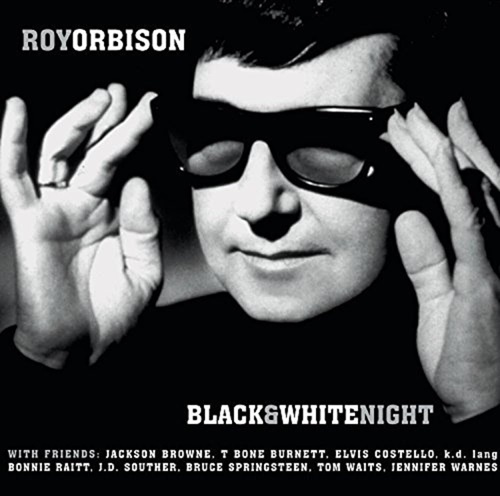
Following his Rock and Roll Hall of Fame induction, Roy recorded a concert that would go air on television as a special. He had always wanted to do one and this special included some powerful special guests: Elvis Costello, k.d.Lang, Tom Waits, Bonny Raitt, Jennifer Warrens, Jackson Brown, and, of course, Bruce Springsteen. The special was called Roy Orbison and Friends – A Black and White Night Live. It was aired on cable and released on video and became one of Roy’s greatest concerts.
Roy had begun working with Jeff Lynne of ELO, who would produce his next album. Lynne had just completed production work on George Harrison’s Cloud Nine album. The three of them ate lunch together one day when Orbison accepted an invitation to sing on Harrison’s new single. They subsequently contacted Bob Dylan, who, in turn, allowed them to use a recording studio in his home. Along the way, Harrison made a quick visit to Tom Petty’s House to get his guitar; Petty and his band had backed Dylan on his last tour. By that evening, the group had written “Handle With Care.” The song and all that went into it led to the idea of recording an entire album together. They called themselves the Traveling Wilburys.
When Jeff Lynne described the recording sessions, he said, “Everybody just sat there going, ‘Wow, it’s Roy Orbison!’ … Even though he’s become your pal and you’re hanging out and having a laugh and going to dinner, as soon as he gets behind that [mic] and he’s doing his business, suddenly it’s shudder time.”
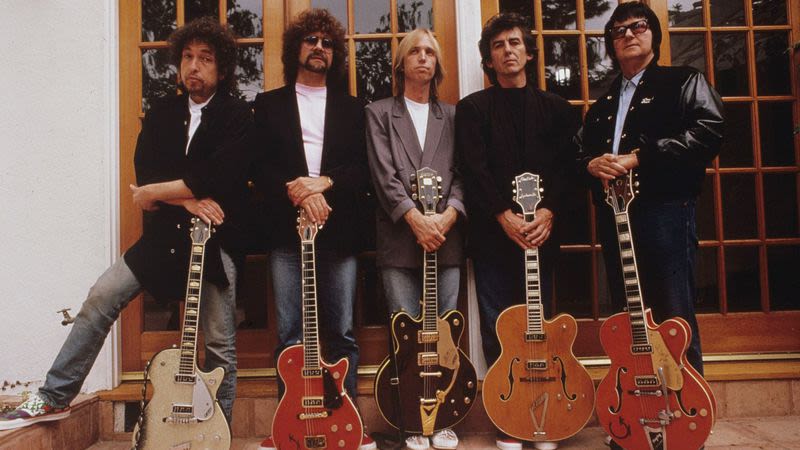
For the Wilburys album, Roy was given a solo track. The song was “Not Alone Anymore.” In reviews of the album, Roy’s contributions were highly praised by critics and fans alike. Because of this, he decided to pursue his second chance at stardom. He expressed amazement at his success: “It’s very nice to be wanted again, but I still can’t quite believe it.” He lost some weight to fit his new image and the constant demand of touring, as well as the newer demands of making videos.
In November of 1988, Roy put the finishing touches on the Mystery Girl album. It was co-produced by Jeff Lynne. It was set for release in 1989. This would be the “Return of Orbison!” There was to be a world tour to support the project. No one could have known that Roy would not be around to enjoy his comeback.
On December 6, 1988, Roy went to his mother’s house and chatted with his son Wesley. He went to the bathroom but did not return for 30 minutes. He was found collapsed on the bathroom floor and rushed to the hospital by ambulance. Roy never regained consciousness and passed away at age 52 of a heart attack.
I was still a senior in high school and I was going to WKSG to rip news and type up stories for the news director. I would stay till 6am and then head to school. I remember going to the Associated Press wire and seeing the “URGENT” breaking news that Roy had died. We were an oldies station and this was big news. I can still remember when we broke the news. It is one of those moments I will never forget.
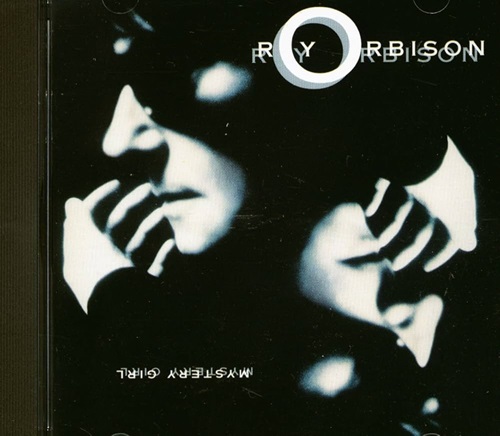
You Got It (from the Mystery Girl album) was released after Roy’s death and reached the top 10. One of the coolest tributes to Roy was when the Traveling Wilburys released the song End of the Line. In the video, the group is on a train singing. When Roy’s vocal comes on, the camera is on a rocking chair in which Roy’s guitar is sitting. Next to it, is a framed photo of Roy. That scene will always give me chills.
One can only wonder what might have happened if Roy hadn’t passed away. Would the world tour have led to further chart success? Numerous new albums and singles? Perhaps another #1 record? The world will never know. However, Roy never really was forgotten.
- On April 8, 1989, Orbison became the first deceased musician since Elvis Presley to have two albums in the US top five at the same time, with Traveling Wilburys Vol. 1 at number four and his own Mystery Girl at number five.
- In the early 1990s, Rodney Crowell and Roy’s friend and occasional songwriting partner Will Jennings wrote the lyrics to a recording of a melody that Orbison had made before his death. They titled the resulting song, which was recorded by Crowell and released in 1992, “What Kind of Love.”
- In 2014, a demo recording of Orbison’s “The Way Is Love” was released as part of the 25th-anniversary deluxe edition of Mystery Girl. The song was originally recorded on a stereo cassette player around 1986. Roy’s sons contributed instrumentation on the track along with Orbison’s vocals.
- On December 4, 2015, the studio album One of the Lonely Ones, recorded by Orbison in 1969, was posthumously released. The album, which Orbison recorded surreptitiously in the aftermath of his first wife Claudette’s death in a motorcycle accident and the death of their two sons in a house fire 2 years later, was long believed lost.
One of my favorite posthumous Orbison recording were released in 2017 and 2018. In 2017, the album A Love So Beautiful was released. It features archival vocal recordings of Orbison accompanied by new orchestral arrangements by the Royal Philharmonic Orchestra. I believe that these “new” recordings only add to the beauty of these hit songs. The addition of strings to In Dreams, Crying, It’s Over, Running Scared and Love Hurts only deepens the meaning and emotions of the songs. The addition of a horn section to Dream Baby and Mean Woman Blues only makes them sound more vibrant and full. A second album, Unchained Melodies, with the Royal Philharmonic was released in 2018.
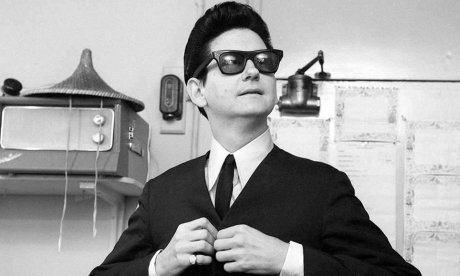
To me, Roy Orbison will always be a legend. His music was one of a kind. Colin Escott wrote an introduction to Orbison’s biography published in a CD box set: “Orbison was the master of compression. Working the singles era, he could relate a short story, or establish a mood in under three minutes. If you think that’s easy—try it. His greatest recordings were quite simply perfect; not a word or note surplus to intention.” His style was like no one else. In the 60’s he said, “I’m not a super personality—on stage or off....People come to hear my music, my songs. That’s what I have to give them.” His vocals were indescribably beautiful, haunting, and amazing. Elvis Presley stated Orbison’s voice was the “greatest and most distinctive he had ever heard.” I would have to agree.
Thanks again to Dave for hosting another great round of Turntable Talk. I cannot wait to hear what we’re writing about next month. Thanks for reading!


 Various Ramblings of a Nostalgic Italian