
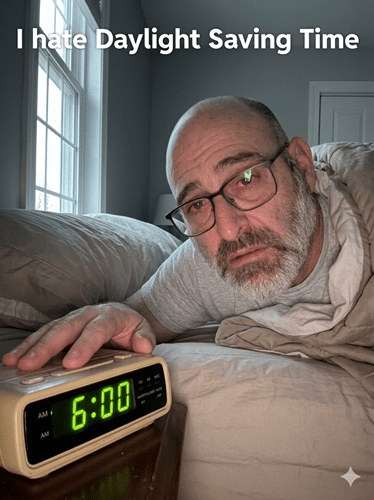
Tonight is the night. At 2am tonight many of us will “spring forward” to “save daylight.”
While Benjamin Franklin did not invent Daylight Saving Time (DST), he certainly planted the idea. Back in 1784 he jokingly suggested Parisians wake up earlier to save on candles. CANDLES!
It began as a fuel-saving measure during World War I. It was first implemented by Germany in 1916 and adopted by the U.S. in 1918. It was designed to maximize daylight hours for industrial production and reduce artificial lighting needs. The policy was popularized by William Willett, who sought more evening light for recreation.
There has been plenty of talk about ending DST all together. The “spring forward” transition has been linked to a 6% increase in fatal traffic accidents and higher risks of heart attacks and strokes. DST also causes an increase in mood disturbances and hospital admissions.
The thought is that DST helps conserve energy because we won’t use electric lights. As society has evolved, however, lighting accounts for less overall energy consumption. Rather, extending the use of daylight hours encourages people to use more air conditioning and heating. Yep, we actually use more energy!
Then there is the camp that believes additional daylight in the evening hours during spring and summer are beneficial to the mental health of those who work during the day. This was proven to be wrong in a 2020 study. It showed that the time change exacerbates mood disorders, depression, anxiety, and substance abuse.
The time change can also mess with our body clock (the circadian rhythm) which is controlled by light. People say it’s great to have more time for outdoor activities in the evening, but in truth exposure to more light closer to bedtime makes it harder to fall asleep at our usual bedtime, and can reduce the amount of sleep we’re able to get each night.
It also messes with adolescents, who don’t get a lot of sleep to begin with. The time change will often cause them to have behavioral, learning, and attention issues, as well as an increased risk of accidents, injuries, high blood pressure, obesity, diabetes, and mental health problems. Studies by the Journal of Clinical Sleep Medicine show that during school days after the time change, students were sleepier, had slower reaction times, and were less attentive.
Despite all the facts that show the disadvantages of DST, it continues.
So, don’t forget to Spring Ahead tonight … and be careful tomorrow and Monday!

 Various Ramblings of a Nostalgic Italian