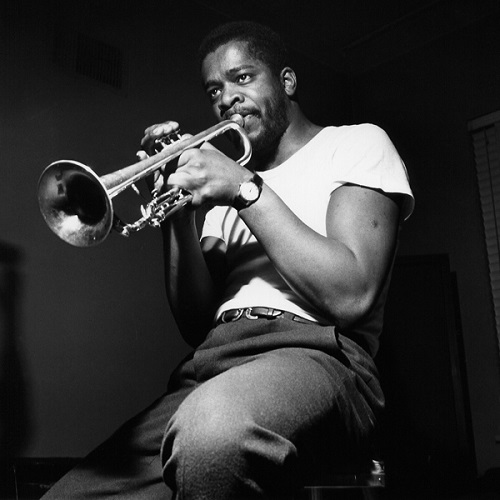
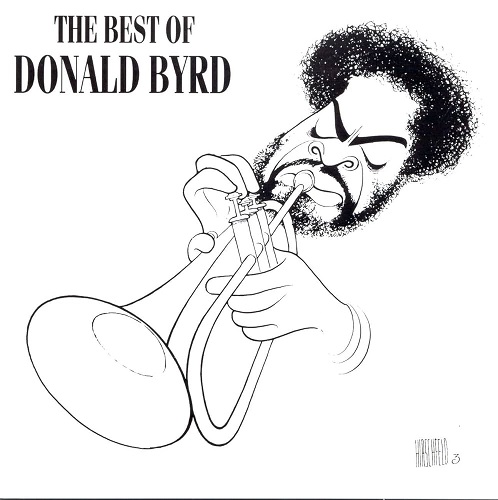
Today, we shine the light on another hometown hero. Donaldson Toussaint L’Ouverture Byrd II, better known to the music world as Donald Byrd, was born on this day in 1932.
He was born in Detroit, Michigan. His mother introduced him to jazz music, and his uncle gave him his first trumpet. He attended Cass technical high school. Byrd played in a military band while in the US air force, took a music degree at Wayne State University in Michigan and then studied music education at the Manhattan School of Music in New York. He joined the Jazz Messengers in the mid-1950s. Byrd’s trumpet predecessors in Blakey’s company had already included the graceful, glossy-toned Clifford Brown and the Dizzy Gillespie-influenced Kenny Dorham, but the newcomer with his polished phrasing and luxurious tone was recognised as a technical master equal to both. He was even heralded as the new guiding light in jazz trumpet.
He was prolifically active in the late 1950s, in demand for sessions on the Savoy, Riverside, Fortune, and Blue Note labels. At the end of the decade he was also leading or co-leading his own ensembles. He was mostly operating in the laconically pyrotechnical, blues-inflected hard-bop style.
He formed the Blackbyrds, a soul and funk band, from a pool of his Howard University student. In the early 70’s his music ventured into dancefloor jazz and fusion. In 1973, his album Black Byrd was a million seller and brought Blue Note label more income than it had ever generated from any release before.
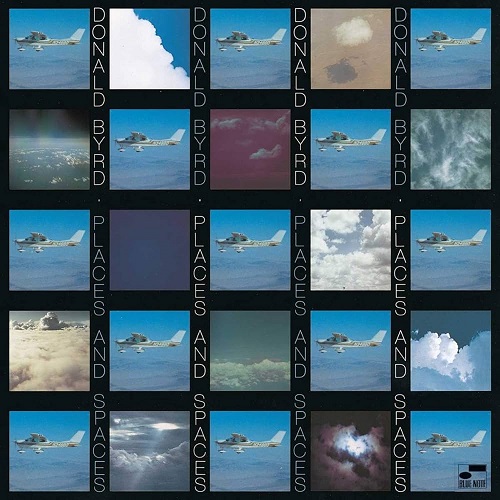
In 1975, he released the album Places and Spaces. Allmusic awarded the album with 4 stars and its review by Stephen Thomas Erlewine states: “Boasting sweeping string arrangements, sultry rhythm guitars, rubbery bass, murmuring flügelhorns, and punchy horn charts, the music falls halfway between the cinematic neo-funk of Street Lady and the proto-disco soul of Earth, Wind & Fire.”
In the late 80’s, when I worked at WKSG, Kiss-FM, we had a regular listener who would call and ask for Donald Byrd, even though we were an oldies station. He called every station in town and it wasn’t odd to be listening to another station and hearing him on the air. His name was Joe. He always asked for the same song, “Wind Parade.”
On one occasion, my pal Johnny Molson and I were talking with Joe, and he has some funky jazz playing in the background. We asked him what he was listening to and found out it was Byrd. So we did to him what he did to us, we requested he play Wind Parade. Neither of us had ever heard the song before. I think we were both genuinely interested to hear it.
As the song begins, there is a piano and syncopated cymbal beat. The a guitar riff plays along with the established beat. What Johnny and I did not expect was Joe belting out the words and singing along to the song. I cannot even describe what it sounded like, but John and I immediately collapsed in laughter.
As we laughed at this unexpected solo, the music continued. At some point he stopped singing and asked, “How do you like it, Johnny?” He had barely caught his breath long enough to say, “That’s great, Joe” only to continue laughing more.
And that is how I discovered Donald Byrd. One day, while shopping at a local record store, I couldn’t believe it when I found his greatest hits CD. I picked it up without hesitation and gave it a listen. There is no doubt, he could play the trumpet well, and there were some neat tracks on the CD. It was “Wind Parade” that got the most play. Every time the vocal hit in the song, I could hear Joe singing along!
He passed away in 2013. One obituary said, “Byrd’s real legacy is his contribution to music education in a culture that spawned jazz but then neglected it – a role he pursued from the unique vantage point of having been a leading player in the idiom. His work has been sampled by pop and hip-hop artists including Public Enemy and Ice Cube, and many young musicians at work today owe their education, and the widespread acceptance of their art, to his tireless pursuit of stature and respect for jazz.”
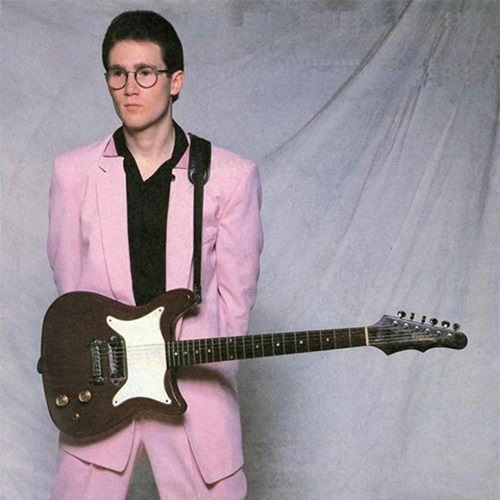
I hope you don’t mind if I focus on a hometown hero that often gets overlooked. Today Marshall Crenshaw celebrates birthday 72. He was born in Detroit, Michigan and was raised in the suburb of Berkley. A radio buddy of mine went to high school with him.
He had hit songs with “Cynical Girl” and “Whenever You’re On My Mind” in the early 80’s. He has said that Buddy Holly was an influence, and early on he was often said to look like him. Perhaps that is why he was cast as Buddy Holly in the movie La Bamba?
Crenshaw was also co-writer of one of the Gin Blossom’s big hits, “Til I Hear It From You.”
Robert Gordon recorded one of his songs in 1981 – “Someday, Someway.” His version went to number 76 on the chart. Crenshaw recorded the song himself in 1982. He released it and it reached number 36 on the Billboard Top 40 Hit chart. It would be his only Top 40 song. Both versions saw early success on New York radio, though Crenshaw’s rendition saw greater success nationally.
Crenshaw wrote the song while he was in New York where he played John Lennon in the musical Beatlemania. He says, “I wrote ‘Someday, Someway’ and five or six of the other tunes on my first album. I wrote those in my hotel room. That was my next move in life, to be a recording artist. I actually had a sense of artistic direction and off I went.”
Someday, Someway was inspired by Gene Vincent’s song “Lotta Lovin’.” Crenshaw said, “I wanted to take the beat and atmosphere of a 1950s Rock and Roll record that I loved … and build something around that. I came up with the music first for ‘Someday’ and dug that it was kind of hypnotic, very spare and succinct.”
Let’s celebrate his birthday with his biggest song –
Charles Edwin Hatcher was born on this day in 1942. You and I know him better as Edwin Starr. He was born in Nashville, moved to Cleveland and eventually to Detroit.
In 1957, he formed the Doo Woo group, the Future Tones. Soon after, he was called to serve in the US Army. He spent most of his time in Europe. When he was discharged, he decided that he wanted his career to be in music.
He joined up with Bill Doggett’s group. Bill was known for his hit Honky Tonk Part 2. Starr’s stage name was suggested to him by Doggett’s manager, as he didn’t think Charles Hatcher would catch on.
In 1965, Edwin made his solo debut with his first single for Ric-Tic Records. The James Bond series was quite popular at the time. Starr’s first single was a play on that entitled Agent Double-O-Soul.
Songfacts says that instead of being a spy, Edwin is “a sophisticated cat that brings soul music to the masses. He doesn’t have to go undercover!” I think that is a perfect description!
When I first started in radio back in 1988, it was at an oldies station. My dad gave me a list of songs that he asked me to look for. Most of them were songs he grew up loving. Many were also big hits by local artists in Detroit. Agent Double-O-Soul was on that list.
Thanks to that list, I was introduced to songs that I was unfamiliar with. Those songs have since become some of my favorites.
When Ric-Tic Records went out of business, they sold Starr’s contract to their much larger rival, Motown. His first few singles there flopped. But in 1969 he scored with “Twenty-Five Miles” and in 1970 he had a #1 hit with”War.” He ended up leaving Motown in the mid-’70s. In 1983 he moved to the UK, where he performed until 2003, when he died of a heart attack at 61.
Tuesday was National Radio Day! This is not to be confused with World Radio Day which is celebrated on February 13th every year. On Facebook, many of my radio friends posted old photos and listed the call letters of all the stations that they worked at. I did the same, but neglected to do an entire blog about it. I think the reason for that is that I have written a lot of blogs about radio, radio mentors, radio friends, and radio listeners. If you are new to this blog, I will share a link or two after today’s photo, which ties into “radio.”
I have never really grasped just how lucky I was to land my first few radio jobs in a major market. I spent a lot of time on the airwaves in Detroit. One of those stops was at WWWW-FM (W4 Country). Many remember that this was the station Howard Stern worked at in the early 80’s. It played rock at the time, but so did a few other stations in the market, so they switched format to Country. They actually wanted to call him “Hopalong Howie!” You know the rest of that story.
When I worked there, I was there in a part time capacity and had a lot of fun.
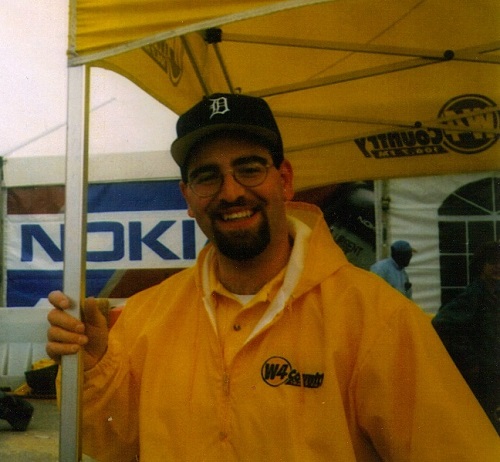
The above picture was taken while I was out at a station appearance. I believe one of my listener friends took this photo of me. This must have been taken around 1997. I was still wearing glasses, so I had yet to have my Lasik surgery. I am also much skinnier!
I loved the station apparel we got to wear. The station logo on that yellow always seemed to “pop” to me. I wish that I had thought like some of my other radio friends and saved something from every station I worked at (logo items). I think some stuff got lost in a move or went to Goodwill. I may still have station coffee mugs somewhere!
I don’t want to sound egotistical, but this is one of my favorite radio pictures. I don’t recall if this was an a concert (which it probably was) or at some type of remote broadcast, but I like it. I haven’t had a goatee since I got married to Sam. She loves my full beard (and I love that I don’t have to shave every day). The beard here is much darker than it is today. There’s a whole lotta grey in there now!
The baseball cap is one that I bought at the ballpark. It was the only one that I ever owned that was fitted. What a difference between those and the ones with the snappy things on the back. It fit SO good. I loved that hat.
I can’t help but laugh at the size of my eyebrows! I once told a joke on the air that my eyebrows had their own Facebook page! I did create one (Keith Allen’s Eyebrows), but deleted it some time later after it had brought about as many laughs as I could milk out of it.
I also have to laugh at the “Nokia” banner behind me. Why? Because at the time, me and half the world had THAT Nokia phone!
Even though Covid forced me into “radio retirement,” I still look back at those days with many memories. You can read more of those memories below. First a compilation of a few radio blogs here:
Finally, after many blogs praising one of my favorite bosses and mentors, I was shocked to hear of the passing of one of them. Here was my tribute to Richard D.
I suppose this was a lot for a simple “Photo Flashback,” but radio is and will always be in my blood. It is something that I love to talk about and always brings about so many memories…..
Welcome back to The Music of My Life, where I feature ten songs from each year of my life. In most cases, the ten songs I choose will be ones I like personally (unless I explain otherwise). The songs will be selected from Billboard’s Year-end Hot 100 Chart, Acclaimed Music, and will all be released in the featured year.
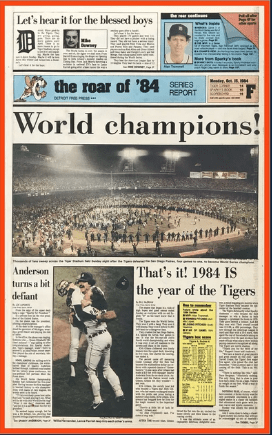
1984 was a big year for me. It was a year of change as I started high school that year. It was also the year that the Detroit Tigers won the World Series! What an amazing year!
Musically, it was the year of Michael Jackson’s Thriller, Weird Al’s Eat It, and Prince had a few hits, too. As I looked over the list from ’84, there are a lot of “staple” 80’s hits from this year. Alas, not too many of those made my list. I apologize to fans of A-ha.
My first pick is one of a few songs that I could feature on my Music Movie Monday feature because it comes from a great soundtrack. Beverly Hills Cop was huge here in Michigan because Eddie Murphy plays a Detroit cop. But there is another Detroit connection as well…
According to songfacts.com: “The Heat Is On” was written for the film by Harold Faltermeyer (who also wrote Axel F for the film) and Keith Forsey, and they needed a popular artist to sing it. The Beverly Hills Cop soundtrack album was on MCA Records, which Glenn Frey recently signed with. MCA asked several of their male rock singers to audition for the lead vocal for the song. At first Frey thought this wasn’t something “rock stars” did, but he decided to go along, just for fun, never thinking they’d pick him. Harold Faltermeyer was impressed by Frey’s vocal (the instrumental tracks were already recorded) and shocked Frey by using his version. It was Frey’s biggest solo hit, reaching #2 in the US.
The other Detroit connection? Glenn Frey was born and raised in Detroit where he played in bands with names like The Mushrooms and Subterraneans before heading to Los Angeles and joining the Eagles.
The Heat Is On
I have already mentioned Thriller by Michael Jackson. Spoiler Alert: It isn’t on my list. However, you gotta admit that the video was pretty darn good, right? I mean it was all over MTV and people still copy the dance for it at weddings and such. But would you believe that it did NOT win the first-ever Video of the Year award at MTV’s Video Music Awards? So what video did?
That honor went to You Might Think by The Cars! Today a video like this would be pretty easy to make, however, the video was very advanced for the time and was one of the first to use computerized effects. Singer/guitarist Ric Ocasek’s image appeared in various animated scenes – he would show up as a fly, climbing the Empire State Building, just about anywhere to get the attention of the girl. (The object of his affection was played by model Susan Gallagher.) When the video was first aired, it was done so without the fly – because technically, the video’s effects were not done.
The song was released in February 1984, as the first single from their Heartbeat City album. “You Might Think” peaked at number seven in the United States. This is one of those videos that I always got a laugh out of. It seemed so silly to me. It was directed by Jeff Stein (who was famous for other videos). He thought The Cars were a boring live band so he used digital trickery to get around that. I think it worked.
You Might Think
The next song is the “love theme” from the movie Footloose. You may remember in one of my past posts about Footloose that Dean Pitchford not only wrote the screenplay for the movie, but he wrote all the lyrics to all the songs (some with co-writers). He wrote Almost Paradise with Eric Carmen.
The Footloose producers wanted it to be a duet. They knew that they wanted Heart’s Ann Wilson for their female voice. They contacted Wilson, and asked her for a list of preferred duet partners. Her list included Paul Rodgers and Lou Gramm, but it was Mike Reno (the lead singer for Loverboy) – not on the list – who was chosen.
They recorded the song together at a session in Chicago with Keith Olsen, who had worked on Heart’s Passionworks album and also the 1975 Fleetwood Macalbum, producing. At the time, Ann was nursing a broken wrist, but stayed off her painkillers so she wouldn’t be compromised during the session. They put their vocals down over the track that had already been recorded, then went their separate ways. She thought it was a great song, but was still surprised it was released as a single. She was even more surprised when it became a staple of proms and weddings.
That is the reason the song is on my list. I was a junior in high school and was dating a senior. She asked me to go to her prom, which was titled “Almost Paradise.” I think it was their class song, I don’t know for sure. I remember this would have been in 1987, so the song was a few years old by then. With every ticket, the student received a wine glass with the Almost Paradise logo on it. LOL – it didn’t take long for the school to stop giving away wine glasses!
Almost Paradise
Huey Lewis was a big part of my high school days! My buddy Steve and I loved cruising around and listening to Huey’s albums. This was one I loved the minute I heard it. As a lover of oldies and the Rock and Roll greats, I heard it as a “hat tip” to them and their influence on music.
In a 2013 Billboard interview, Huey said they song found its roots in Cleveland. “‘The Heart of Rock & Roll’ was written driving out of Cleveland. We’d heard that Cleveland was this great rock and roll town, and we’re from San Francisco – how can Cleveland be anything? We went to play the Agora Ballroom and had this amazing gig. On the bus out of town I was looking at the skyline of Cleveland and I said, ‘You know what boys? The heart of rock and roll really is in Cleveland. Hey, that’s a pretty good song title. Later I thought it through and went, ‘The heart of rock and roll is still beating’.The idea is that, although the music business is in New York and LA, good rock and roll is where you find it.”
Sports was one of my favorite albums back then. I had it on vinyl to play at home and on cassette to play in the car. The Heart of Rock and Roll the third of five singles from Sports, the third Huey Lewis & the News album. All of the singles were hits, and the album went on to sell over 7 million copies in America, putting the band of firm financial footing for the first time, which was very important to them – these guys were all in their 30s and had been working in music since the early ’70s.
The Heart of Rock and Roll
My dad was really involved in the local Vietnam Veteran’s chapter when I was in high school. As we got older, me and some of the guys would go up to their events. They often had cook outs, holiday dances, and fund raisers. I met so many great people at these events and came to love hanging out with them. My dad would spin records for the group.
Along with many oldies he would play songs like “Some Gave All,” “Goodnight, Saigon,” and “The Ballad of the Green Berets.” But it was always at the end of the night that my dad would play God Bless the USA. The first time I witnessed this, I choked up. Everyone in the building gathered on the dance floor and held hands. They would sing this song at the top of their lungs and raise their hands in the air. It was truly moving.
This song holds a special place in my heart for those friends.
God Bless The U.S.A.
The videos of many songs will forever be what I think of when I hear them. We’re Not Gonna Take It is a great example. I remember thinking it was cool that “the guy who played Niedermeyer in Animal House” was the dad in this video!
According to Dee Snider, he started writing this song in 1980, two years before Twisted Sister released their first album, Under the Blade. He had the hook, but couldn’t come up with a verse melody. After Def Leppard released their Pyromania album in 1983, Snider came up with a plan. “In studying some of Mutt Lange’s work with Def Leppard, I saw that a number of their songs were using variations on the chorus as a verse. That gave me the information I needed to come up with the rest of ‘We’re Not Gonna Take It.'”
Songfacts.com perfectly describes the song this way: “This is the mighty anthem for anyone lashing out at an authority figure and ready to put up a fight. The song is short on specifics, so it can apply to just about any situation where “we” are battling “the powers that be.” This all-purpose approach was intentional and gave the song a timeless quality.“
We’re Not Gonna Take It
When I first moved to Mid-Michigan, I discovered that there was a local hockey team. The Flint Generals played in a sports arena that held like 3000 people. There wasn’t a bad seat in the place. I loved being able to see these guys slam up against the glass. It was great!!
When the Generals disbanded, the public hoped for hockey to continue. They would up bringing in a hockey team that was made up of college aged kids and the team was called The Michigan Warriors.
The hockey was a bit less violent, but it was still hockey. I always loved a night out at the games. When they would introduce the members of the team (and at the end of each game) they always played Scandal’s The Warrior.
The Warrior
The next song is one that I always liked because the hook is catchy and it had a cool sax part. Sadly, it is also the subject of one of the biggest flubs I ever did on the air.
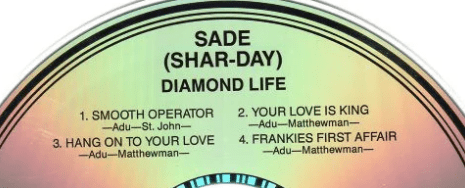
Released in August of 1984, “Smooth Operator” was the breakout hit in America for Sade, who were based in England. Their debut album, Diamond Life, was first issued in 1984 in the UK, where “Smooth Operator” was the third charting single. In the US, the album was released in 1985, with “Hang On To Your Love” as the first single. It went nowhere, but the next single, “Smooth Operator,” rose to #5 and earned the group a reputation as an exotic soulful act with a captivating frontwoman.
One night I was working at WMXD and I came out of the song and realized that I had never known who sang it. I looked at the music log and read, “Sade.” So that’s what I called her – “Sade” (Say-d). The phones lit up and people were either making fun of me or asking why I was playing songs when I couldn’t even pronounce the name of the artist! I was embarrassed. I had no idea until I pulled the CD out of the player and saw the writing ….
What a dope!!
Smooth Operator
Sea of Love was a song that I heard often on the oldies station. Phil Phillips had recorded it in 1959 and it was a top 5 hit. The song was covered by Robert Plant’s Honeydrippers in 1984. They truly were a rock and roll supergroup – Robert Plant, Jeff Beck, Jimmy Page, Paul Schaffer, Nile Rogers and other greats appeared in the group.
They only released one EP, The Honeydrippers: Volume One. Sea of Love took their remake all the way up to number 3 on the Billboard Hot 100 Chart. I love the orchestration of this version so much. The EP is worth a listen – Rockin’ At Midnight would go to #25. The success of the songs led Plant to say that a full album would be released, but it never came to be.
Sea of Love
My final pick is one that is really embarrassing. So why is it here? Because the minute I saw it as a released single, the chorus became an ear worm and stuck in my head. If I have to walk around singing it over and over, you may as well, too!
My 14 year old self loved novelty records. I had Spike Jones, Weird Al, and many more in my collection. When I first heard this “rap” song, I laughed like hell. When I ran to the store to get the single, I remember thinking how cool it was that I got the 12 inch vinyl record. It had the single, an extended mix, and on the B-side an instrumental.
As I listened to this before adding it officially to my list, I thought, “What in the world did I like about this song?! It really is kinda dumb.” At the same time, all these years later, there are still people I know who will break into a chorus of “Duh Ha, Duh Ha! Duh Ha Ha Ha Ha Ha..”
Yep, that gives it away. I was a fan of the Rappin’ Duke by Shawn Brown. Do I really need to go into any history on this one? Probably not. Forgive me for the earworm….
Rappin’ Duke
Next week I’ll take a look at 1985 and how some of those songs connect to my life. Movie music will be in there for sure, a tribute to some legends, the first slow song I remember dancing to, and maybe a song I have featured once before on this blog. See you next week!
Welcome back to The Music of My Life, where I feature ten songs from each year of my life. In most cases, the ten songs I choose will be ones I like personally (unless I explain otherwise). The songs will be selected from Billboard’s Year-end Hot 100 Chart, Acclaimed Music, and will all be released in the featured year.
Let’s jump right into 1982. We start with a song that was released in January of ’82 in the United States. Believe it or not, this song would go on to have a special meaning for me and many others from my high school. More on that in a minute.
The Go-Go’s were one of those bands who wrote most of their own songs. “We Got The Beat” was written by guitarist Charlotte Caffey, who drew inspiration from some Motown beats, specifically one that mentioned the name of her group. She explains, “I thought it would be very clever to do ‘Going to a Go Go’ (by the Miracles). I thought, Well, let’s try working this out as a cover song. Which is really funny when I think about it. I was listening to it a lot one day, and later that night, the song came to me within five minutes. I don’t even know if it has anything to do with listening to that song, but this whole idea came to me. It was one of those things that just went right through me and came out my hand; I wrote it down, recorded it a little bit, and then brought it into rehearsal a few days later.”
The Go-Go’s released an early version of “We Got The Beat” in the UK as their first single. It was issued on Stiff Records, which was home to The Specials and Madness, both groups The Go-Go’s toured with in England to promote it. Sadly, it flopped, but the group fared far better in America, where they were signed to IRS Records by Miles Copeland, who managed The Police. In the US, “Our Lips Are Sealed” was released as their first single in the summer of 1981, followed by a new version of “We Got The Beat” in January 1982. This release was The Go-Go’s biggest hit, spending three weeks at #2. (I’ll include both versions below)
Band Camp – Summer 1985. We Got the Beat was a favorite of my high school marching band. I have no idea how long they had been playing it prior to my first year, but it was always played at pep assemblies and when our team won. It was a staple in the marching band music folder. It was the one song that we could play and just have fun. We danced, we jumped, we acted the fool while playing it. It was a celebratory song.
Our band director would say, “Let’s do the little Italian number” during rehearsals. We all knew what he was talking about because he’d often call it, “We Gotta Da Beat.” I want to say our alumni band was around for at least 10 or 12 years after I graduated and they were still playing it. We always joined it because we all had it memorized. I haven’t played my trumpet in years, but I can assure you that if I were to pick it up today, I could still play this song!
We Got the Beat
Real life once again inspired another big hit. Songwriter Wayne Carson, who wrote The Box Tops’ 1967 #1 hit “The Letter,” came up with “Always On My Mind” when he was working at a recording studio in Memphis. He lived with his wife in Springfield, Missouri, and the trip to Memphis had gone 10 days longer than expected.
When he called the missus to tell her he would be there even longer, she let him have it. He tried to assuage her by telling her that was thinking about her all the time – she was “always on my mind.” “It just struck me like someone had hit me with a hammer,” he told the LA Times, “I told her real fast I had to hang up because I had to put that into a song.”
Willie had never heard the song before the song’s co-writer, Johnny Christopher, brought it to him and Merle Haggard, who were busy recording the album Pancho & Lefty (Christopher was playing guitar on the session). “‘Always On My Mind,’ bowled me over the moment I heard it, which is one of the ways I pick songs to record,” Nelson recalled in his 1988 autobiography, Willie. “There are beautifully sad songs that bowl me over… haunting melodies you can’t get out of your mind, with lines that really stick.”
Nelson figured he and Haggard would do the song together, but Haggard didn’t care for it. After they finished recording their album, Nelson stayed in the studio and recorded the ballad solo, just to see what it would sound like. Of course, it sounded like a hit, but Nelson wondered, “We’ll never know what would have happened if Merle had really heard the song right.”
You may remember that Willie Nelson played a big part in my childhood. His Stardust album was played all the time by my grandfather. My grandfather passed away in 1981. Any song by Willie reminded me of my grandpa. My mom really struggled with his passing and I remember being in the car with her when Always on My Mind came on the radio. She had to pull over because it really hit her hard.
It hit me the same way. I know that it is far fetched to believe that grandpa sent a message from beyond the grave, but it felt that way. From Stardust to Always on My Mind and every Willie album that followed, there always seemed to be one song that fit into something that was going on in my life. This one helped me cope with the first death I ever experienced, even though it was more of a love/apology song.
Always on My Mind
One of the things that I noticed as I scanned over the list of singles released in the early eighties was the prominent use of the synthesizer. Rock bands like ZZ Top, Van Halen, and Yes added synthesizers to their mix in the ’80s and scored huge hits by adapting what songfacts.com called “the sound of the decade.” The Steve Miller Band started out as a blues band in the ’60s, evolving into a rock outfit in the ’70s. They often sprinkled electronic effects into their songs, so the keyboards and synth stabs in this song weren’t out of character.
“Abracadabra” was the last US Top 40 hit for the Steve Miller Band, and their third #1. The song was written by Miller and the lyrics were inspired by Diana Ross and the Supremes, whom he had met while performing together on NBC’s Hullabaloo in 1966. “‘Abracadabra’ started off as a great piece of music with really atrocious lyrics,” Miller explained to The Dallas Morning News. “One day I was out skiing in Sun Valley and, lo and behold, who did I see on the mountain but Diana Ross. I skied down off the mountain to go have lunch. I started thinking about the Supremes and I wrote the lyrics to ‘Abracadabra’ in 15 minutes.”
Honestly, I’m really not sure how the Supremes led to the song, but I remember it being a song that really stood out to me on the radio. I rushed out to buy the 45 and it was always a song that wound up on my “driving music” tapes.
Abracadabra
1981 was the year that many were introduced to Men at Work. Their debut single, “Who Can It Be Now” shot straight to #1 on the charts. The group started as an acoustic duo with singer Colin Hay and guitarist Ron Strykert. After a few years playing pubs in Australia, they were discovered by an American who worked for CBS records and signed them.
Colin Hay wrote the song and explained how it came about:
“I was up in the bush in Southern New South Wales with my girlfriend, just sitting outside at night. We had this little tree hut in the middle of the bush. It was a great place to kill the time, mess around with ideas. It was just an idea that popped out, it took about half and hour to write that song. I was living in St. Kilda in Melbourne, which is a great part of Melbourne. At that particular time it was a very interesting area, it was frequented by everybody from the high Jewish population, punks, drug movers, all kinds of different people. It was about six or seven hours drive away, sitting in the middle of the bush in New South Wales and that song just popped out. My girlfriend at the time said, ‘that will be your first hit, that song,’ and she was right.”
Their Business as Usual album was one that I played often.
Fun Fact: The famous saxophone part originally didn’t come in until the middle of the song, which suited when the band played it in bars. When they recorded it, producer Peter McIan identified the sax as a hook and moved it to the beginning of the song, also making it more prominent throughout. This opening sax riff made the song instantly identifiable.
Who Can It Be Now
Juice Newton had a few big hits between Queen of Hearts and Love’s Been a Little Bit Hard On Me. The latter is one of those fun sounding songs, even though it is about the hardships of a relationship. The song was released exactly one week after my 12th birthday.
Juice reminds me of Carlene Carter who had some jumpy, fun songs like this one. Even though she channels Neil Sedaka and sings harmony with herself on the song, that’s one of the reasons I love it. It’s nothing fancy, but it is just good harmony and it blends so well.
One of the things I have enjoyed while picking songs for this year was seeing the videos that were made for certain songs. Wiki describes the music video for this one perfectly. It says that it comically plays off the emotional hurt of love by showing Juice Newton being physically injured by her lover in a series of accidents. The final shot is of Newton singing in the hospital in a full-body cast with her broken leg in the air. The video was awarded Video of the Year by the American Video Association in 1982.
Love’s Been a Little Bit Hard On Me
There is an outdoor amphitheater in the Detroit area that packs in some fantastic shows every summer. I cannot tell you how many shows I have seen at Pine Knob (For some time DTE Energy paid to have the name and even though shows were at “DTE Energy Music Theater,” everyone still called it Pine Knob!). I’ve seen rock shows, comedy shows, country shows, and more there.
For many years, Eddie Money was ALWAYS the guy who played the first show there. He kicked off the summer concert season annually and it became a tradition. One year, I had the opportunity to interview Eddie on the air. It was the easiest interview in the world! Why? You never had to ask questions after he got on the phone. “Hey, Eddie! How are you?” Then Eddie would roll – he’d promote the show, promote an album, share some funny story, talk about the venue, and more. The “Money Man” was great!
I dated in high school who loved Eddie Money’s Music. She had the No Control album on cassette and we’d listen to it in the car. Think I’m in Love was on that album and I remember the first time I saw the video on MTV. Again, these early videos are fun to watch. Eddie plays a sort of vampire character in it. It was a very popular video.
Think I’m In Love
Growing up I listened to Elvis, Bill Haley, Carl Perkins, Eddie Cochran and other artists who played some rockabilly music. So when I heard the Stray Cats in 1982, it was like hearing stuff I was already familiar with. The Built For Speed album was one I played over and over.
Brian Setzer was born in New York and was exposed to a lot of genres of music. He learned to play the guitar at a young age, and when he was a teen, he formed a trio he called the Tomcats, That group would later change their name to the Stray Cats. They were influenced by all those artists I just mentioned and their group developed a fairly large following in the underground punk scene of New York City during the late ’70s. Their fan base expanded so quickly that they found themselves being courted by no less than a half dozen record labels in 1980.
Brian Setzer opted to record and produce the Stray Cats’ debut album in the UK Rock This Town was released there over a year before it was released in the US. Rock This Town was a Top 10 hit for the band. It’s crazy to watch the video and see Brian. He looks like a baby in it. Hard to believe he was only 23 when this video was shot.
Rock This Town
My dad and my uncle used to play old blues music on records and on the guitar. At my graduation party, they played stuff from Jimmy Reed, Bo Diddley, and other blues legends. Because of that, I’ve always loved the blues. Because of that, I was naturally a fan of George Thorogood.
Bad to the Bone is based on the Bo Diddley blues song “I’m a Man.” Bo Diddley was one of George’s heroes. His “version” has a much heavier guitar sound, which replaces the harmonica in Diddley’s recording. Songfacts.com says that “both songs are full of swagger, with the singers exuding lots of testosterone.”
Songfacts.com goes on to say, “With MTV coming on the air in 1981, Thorogood picked a good time to release a memorable video. The clip shows Thorogood playing pool against Bo Diddley in a place where there is no chance of a dance sequence breaking out. Pool champion Willie Mosconi also appears in the clip, which introduced Thorogood – and to some extent, Diddley – to the younger MTV crowd. Among the British New Wave acts that dominated MTV’s playlist at the time, Thorogood certainly stood out, and he created an image of a bad man. While Thorogood is a disciple of the blues, he was raised in a Delaware suburb and by most accounts is actually a pretty nice guy, despite what he claims in this song.”
I love the fact that Diddley is in this video! The song is one that has a life of it’s own. It is used as intro music for wrestlers, it has been used during the removal of the bride’s garter at weddings, and has been used in both movies and television in seriousness and for comedic effect. It is a classic.
Bad to the Bone
I love a great intro. Sometimes a great guitar riff or a neat drum thing is all it takes to hook me. The intro to Everybody Wants You was one of those intros. It appeared as the opening track of his multi-Platinum 1982 album Emotions in Motion.
The song itself didn’t do that great on the Hot 100 chart, as it only went to number 32. However, it was around this time that one of the radio formats that was big was called AOR – Album Oriented Rock. It had great success on these and rock stations. It reached number one on Billboard’s Top Rock Tracks chart. Naturally, the video did well on MTV, too. It remained in heavy rotation for quite some time.
The minute I hear this one, I think back to those nights of shooting pool with my buddies. It was always on the jukebox.
Everybody Wants You
The next song is one that is still applicable today. Perhaps even more so. What exactly is “news” today? Turn on any local news channel or entertainment news show – it is chock full of stories like the ones referenced in Don Henley’s first Top 40 hit as a solo artist – Dirty Laundry.
Again, the intro of this really stood out for me. The lyrics take it to an entirely new level. They are so good and perhaps that is because Henley had plenty of real life to draw from. This song is about unscrupulous news people doing anything for a story. Henley values his privacy, and hates it when reporters pry into his personal life. He had to deal with increased press attention when his girlfriend at the time, Maren Jensen, came down with Epstein-Barr Syndrome. She recovered, but they broke up soon after.
Songfacts.com states: “Henley sings from the standpoint of a news anchorman who “could have been an actor, but I wound up here”. The song’s theme is that TV news coverage focuses too much on negative and sensationalist news; in particular, deaths, disasters, and scandals, with little regard to the consequences or for what is important (“We all know that crap is king”). The song was inspired by the intrusive press coverage surrounding the deaths of John Belushi and Natalie Wood. It was also inspired by Henley’s own arrest in 1980 when he was charged with contributing to the delinquency of a minor and possession of marijuana, cocaine, and Quaaludes after a 16-year-old girl overdosed at his Los Angeles home”
While Don’s version is the best, Lisa Marie Presley (who had to deal with a lot of press intrusions on her personal life) also does a really neat version of Dirty Laundry.
Dirty Laundry
There were plenty of great songs in 1982, I’m sorry if I missed one of your favorites. Next week, we’ll move ahead to 1983 where there will be a good mix of rock, country, pop, soul and a movie song that will forever be associated with summer vacations ….
Welcome to my submission for A Sound Day’s monthly feature – Turntable Talk, hosted by Dave Ruch. This is the 28th installment of this feature and I’ve had the pleasure of writing since for it since the beginning. His topics each month are always something that I look forward to writing about.
This month his instructions were to “unfold the Musical Road Map! The idea is to pick a song with a specific location in its title and write about it. Pick a song you like, even if it’s not a place that is high on your list of dream destinations. It could be a city, a country , a state or province, even some magical mystical place living in the imagination.”
As I thought about this topic, plenty of songs entered my head. The challenge I seem to face every month is to try to pick something that one of the other contributors hasn’t already picked. There were many hits that jumped right out at me (Sweet Home Alabama, I Left My Heart in San Francisco, Houston, etc…), so I started thinking about songs that would not be something too popular.
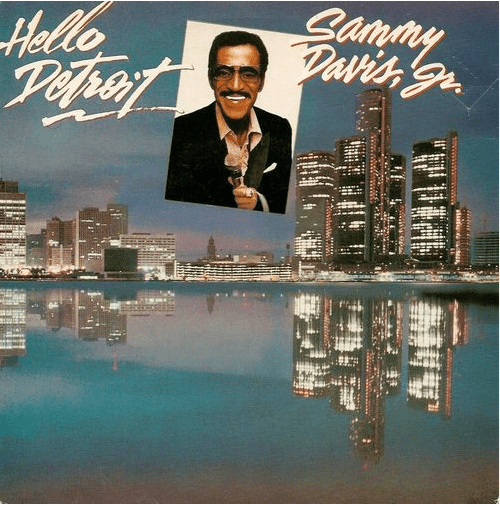
Arrivederci Roma and On An Evening in Roma, both by Dean Martin were the first songs to come to mind. Dean made me think of Frank Sinatra and New York, New York. Frank then got me thinking about Sammy Davis Jr. and I knew that the song I was going to write about would not only be something that the other bloggers wouldn’t pick, but a song that not many people have ever heard before.
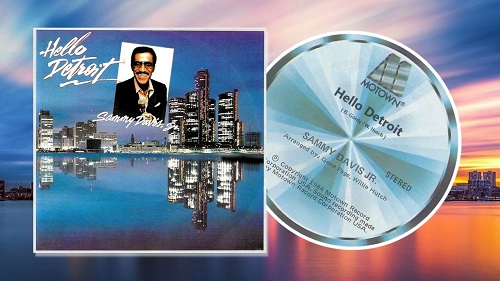
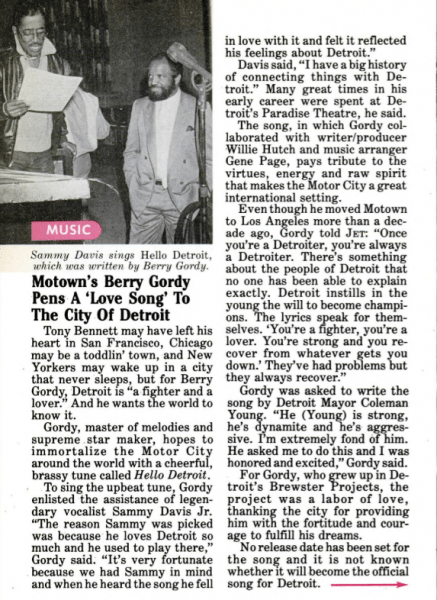
Yesterday, the City of Detroit celebrated its 323rd birthday! Back in 1984, Detroit’s Mayor (Coleman Young) reached out to Berry Gordy Jr. of Motown Records to write an anthem for the city. Berry wrote “Hello, Detroit” with Sammy Davis Jr. in mind to record it. When he showed Sammy the song, Gordy says that he “fell in love with it and felt it reflected his feelings on Detroit.”
“Hello, Detroit” is certainly not the best song to come out of Motown, and it wasn’t as big as Frank Sinatra or Tony Bennett’s love letters to their respected cities. However, you cannot help but hear the love for the city as Sammy begins to sing:
You’re a fighter, you’re a lover You’re strong and you recover From whatever gets you down
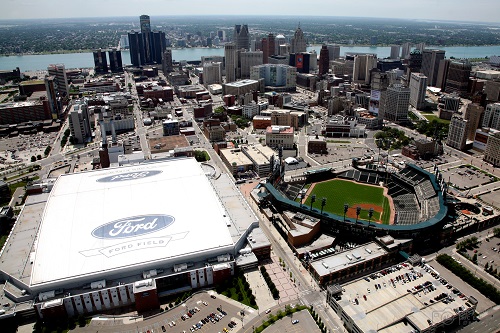
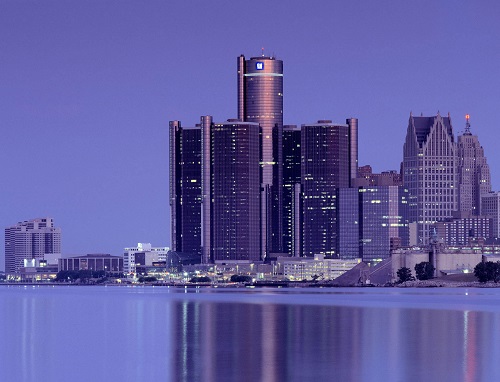
Those words certain have a lot of truth to them. The city of Detroit has really turned around over the past decade or so. Downtown is thriving. Ford Field (Lions) and Comerica Park (Tigers) are right across the street from each other, and from the street you can see that amazing Detroit skyline.
Comerica Park and Ford Field with The Downtown Detroit Skyline in the Background
There is so much more happening in the growing city, but as with any “dated” song, things change.
Hello Detroit, you’ve won my heart Your renaissance, and waterfronts Give you a flare of your own
The Renaissance Center has been a staple for years, but General Motors will move out next year and, looking to the future, CEO Mary Barra doesn’t rule out the demolition of the building. The company announced the move earlier this year — pulling out of the iconic skyline staple after 28 years in the name of downsizing.
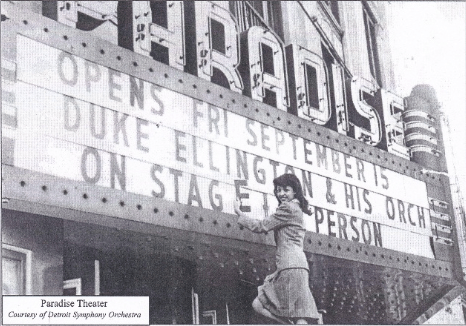
Sammy Davis Jr. said, “My home has always been show business” and Detroit was always hospitable. He said that he had “a big history of connecting things with Detroit,” as he often played the Paradise Theater in Detroit early in his career.
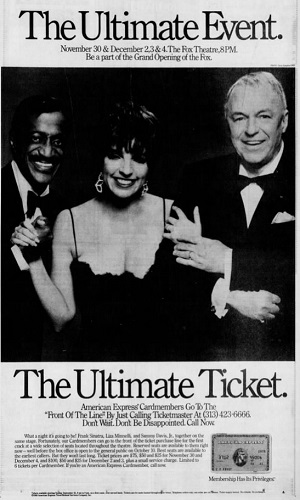
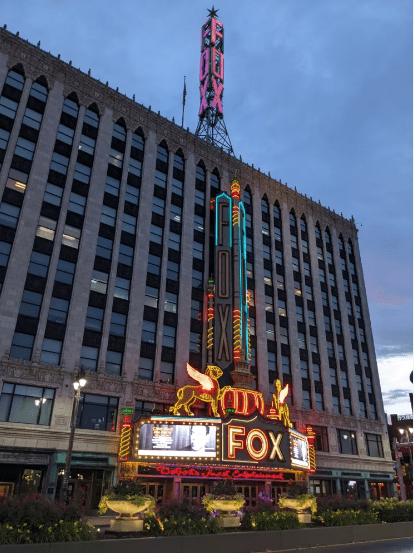
Toward the end of his career, he would take the stage at another theater. Sammy was there for the rebirth of the Fox Theater, along with Frank Sinatra and Liza Minelli.
Their five-night stand, complete with a 30-piece orchestra, kicked off a new era for the Fox Theatre. This kind of brought things full circle for Sammy. The Fox originally opened in 1928, and it was the same year a 3-year-old Sammy Davis Jr. performed for the first time.
Sammy performed “Hello, Detroit” on opening night at the Grand Reopening of the Fox Theater. The concert rebroadcast may have been the most dignified three hours of content to air on Showtime in all of 1989.
I remember the first time I heard “Hello, Detroit.” It gave me chills. I wish that I could perfectly sum up in my own words what the song means to me and the many folks who call Michigan home, but every time I wrote something, I wound up deleting it. Why? Because I found something online that truly expresses it better than I ever could. This is copied from lyricslayers.com:
Sammy Davis Jr.’s song ‘Hello Detroit’ is a heartfelt tribute to the city of Detroit, capturing its spirit, resilience, and unique charm. The lyrics paint a vivid picture of a city that has faced numerous challenges but continues to thrive and inspire. Davis Jr. describes Detroit as a ‘fighter’ and a ‘lover,’ emphasizing its strength and ability to recover from adversity. This portrayal resonates with the city’s history of economic struggles and its ongoing efforts to reinvent itself.
The song highlights various aspects of Detroit that make it special, from its renaissance and waterfronts to iconic locations like Belle Isle Park and Greektown. These references not only celebrate the city’s physical beauty but also its cultural and social vibrancy. The mention of Detroit’s influence on the young, encouraging them to become ‘stars and champions,’ underscores the city’s role in nurturing talent and ambition, particularly in the realms of music and sports.
Davis Jr.’s repeated affirmations of care and prayer for Detroit reflect a deep emotional connection and a sense of loyalty to the city. The song’s affectionate tone and personal touch make it more than just a tribute; it’s a love letter to a place that has profoundly impacted the artist. The references to ‘Big D,’ ‘Motor City,’ and the ‘Motown sound’ further anchor the song in Detroit’s rich musical heritage, celebrating its contributions to the world of music and its enduring legacy.
‘Hello Detroit’ is a celebration of the city’s indomitable spirit, its cultural richness, and its ability to inspire and uplift. Through his soulful performance, Sammy Davis Jr. captures the essence of Detroit, making listeners feel the same admiration and affection he holds for this remarkable city.
That sums up the song perfectly! It was used in countless promotional ads for television and radio for a few years. Some morning radio shows would play it at the beginning of their shifts every day. Sadly, it faded away and doesn’t get much play any more. That is reason enough for me to feature it here on Turntable Talk.
Hello Detroit
You’re a fighter, you’re a lover You’re strong and you recover From whatever gets you down And there’s so many, many reasons Any time, any season Is the right time to be with you
Hello, Detroit! You’ve won my heart Your renaissance and waterfronts Give you a flair of your own
Irresistible you Hug and kissable you You’re alive with so much feeling And I will always be there for you I will say a little prayer for you And I will always care for you Hello
Hello, Detroit! You’ve touched my soul Thanks for the memories I can reach so Winter, spring, summer and fall You’ve got it all Hello, hello, hello!
Hello, Detroit!
I must go through Belle Isle Park Greet town after dark You’re in still in the young of will To become stars and champions
Hello, my friend! How have you been? It’s every air It’s everywhere The magical touch of you
Irresistible you Hug and kissable you You’re alive with so much feeling And I will always be there for you I will say a little prayer for you And I will always care for you
Hello A big deep The motor city And the Motown song that’s got the whole world singing
And I will always be there for you I will always say a little prayer for you (I will say a little prayer for you) And I will always care for you Hello!
(Hello, Detroit!) (Detroit!)
(Irresistible you) (Hug and kissable you) (You’re alive with so much feeling) (And I will always be there for you) (I will say a little prayer for you) (And I will always care for you) (Hello!)
Hello, Detroit!
Thanks to Dave for allowing me to participate once again! I not only look forward to reading the other contributions, but to next month’s topic.
Welcome back to The Music of My Life, where I feature ten songs from each year of my life. In most cases, the ten songs I choose will be ones I like personally (unless I explain otherwise). The songs will be selected from Billboard’s Year-end Hot 100 Chart, Acclaimed Music, and will all be released in the featured year. In the final year of the 70’s, I turned 9 years old.
1979 is a year where I was surprised to find many of the songs that wound up on my mom’s ballad 8-track tape. I could easily have posted all of those songs in this blog, but then you would fall asleep listening to them, just like my brother and I did on our way up north. Instead, I will list them at the end of this blog, and if you wish, you can search them on YouTube.
So let’s begin with the first of two “out of place” or “odd” songs….
The first song is part of the soundtrack of my summer of 1979. The song seemed to be playing in a very hot rotation and was always on the radio when we were up at my grandparents place.
Frank Mills wrote and recorded “Music Box Dancer” in 1974, but it did not become a Canadian single until December 1978. By Christmas of that year, it was in the top ten of many European and Asian pop music charts. It was released as a single in the United States in January 1979 and got up to number three on the Billboard Hot 100 Chart.
In 1974, Mills released an album that featured the song, but it was not initially a hit. When he re-signed with Polydor Records Canada in 1978, the label released a new song as a single, with “Music Box Dancer” on the B-side. Because of a mistake, a single of “Music Box Dancer” found its way into the hands of a pop station in Ottawa – the single was only supposed to go out to adult contemporary stations. The station’s program director listened to the A-side and wondered why it was sent to him. He played the B-side and liked what he heard anyway and began airing it in rotation. Next thing you know, the album’s gone gold in Canada.
Music Box Dancer
The next song makes the list because it was on the iPod of my ex. My oldest son used to take it and listen to it all the time and I can still hear him in his toddler voice singing the chorus of this one.
Hot Stuff is a single that was on Donna Summer’s 7th studio album, Bad Girls. The song is unique in that while many consider it disco, many others consider it rock. As a matter of fact, when the Best Female Rock Vocal Performance category was added at the Grammy Awards in 1980, Donna Summer won for “Hot Stuff.”
The song has ties to other music as well. It was written by Pete Bellotte, Harold Faltermeyer and Keith Forsey. Bellotte co-wrote a few other hits for Summer, including “Love To Love You Baby” and ” Heaven Knows.” Faltermeyer had a solo hit in 1984 with the theme from Beverly Hills Cop, “Axel F” and Forsey’s credits include “Don’t You Forget About Me” for Simple Minds and “Shakedown” for Bob Seger.
This was Summer’s second #1 hit on the Hot 100; her first was her disco cover of “MacArthur Park.”
Hot Stuff
Here is a song that is missing one of the things the band is known for. Don’t Bring Me Down was the first ELO song that did not use strings. According to Songfacts, after recording it, they fired their string section, leaving four members in the band.
ELO leader Jeff Lynne wrote this song late in the sessions for the “Discovery” album. He came up with the track by looping the drums from a song he recorded earlier in the session, then coming up with more music on the piano. The words came last, as Lynne put together some lyrics about a girl who thinks she’s too good for the guy she’s with.
Here’s a fun fact: Wanna know why Jeff Lynne repeatedly sings the word “groose” after the song’s title line? Apparently it was a made-up place-keeper word to fill a gap in the vocals when he was improvising the lyrics. When the German engineer Reinhold Mack heard the ELO frontman’s demo, he asked Lynne how he knew “gruss” means “greetings” in his country’s language. Upon learning the German meaning, Lynne decided to leave it in.
Don’t Bring Me Down
“Hey Ringo, play something hot!”
Those are the words that Rodney Dangerfield’s character in Caddyshack says to the band at the snobbish country club as he throws money at them. As the money falls, the band plays the opening 5 note stings from Boogie Wonderland from Earth Wind and Fire (With the Emotions). I’ve always loved that song because of the movie connection.
The song, while it is upbeat and happy sounding, it really isn’t. Songfacts calls it one of the more complex and misinterpreted songs of the disco era. Written by Jon Lind and Allee Willis, it was inspired by the movie Looking For Mr. Goodbar, which stars Diane Keaton as a lost soul who goes to clubs every night to dance away her misery.
Willis says, “When I saw Mr. Goodbar, I got kind of fascinated with people who did go to clubs every night, whose life was kind of falling apart, but they lived for the night life, though it didn’t seem to be advancing them as humans in the end. So if you really look at the lyrics of ‘Boogie Wonderland,’ unlike ‘September,’ it’s not a happy song at all. It’s really about someone on the brink of self destruction who goes to these clubs to try and find more, but is at least aware of the fact that if there’s something like true love, that is something that could kind of drag them out of the abyss. So ‘Boogie Wonderland’ for us was this state of mind that you entered when you were around music and when you danced, but hopefully it was an aware enough state of mind that you would want to feel as good during the day as you did at night.”
Boogie Wonderland
The second “out of place” or “odd” song is also a movie song. It may seem like a very simple kid song, but if you listen to what the songwriter says about it, the song is deeper than you can imagine.
This was written by songwriters Paul Williams and Kenny Ascher for The Muppet Movie, which came out in 1979. In the film, it is sung by Kermit The Frog as the Muppets set out to find adventure. In a interview Williams said: “Rainbow Connection was the first number in The Muppet Movie. It’s the one that establishes the lead character. We find Kermit sitting in the middle of the swamp. Kenny Ascher and I sat down to write these songs, and we thought… Kermit, he’s like ‘every frog.’ He’s the Jimmy Stewart of frogs. So how do we show that he’s a thinking frog, and that he has an introspective soul, and all that good stuff? We looked at his environment, and his environment is water and air – and light. And it just seemed like it would be a place where he would see a rainbow. But we also wanted to show that he would be on this spiritual path, examining life, and the meaning of life.
It tells you that he’s been exposed to culture: ‘Why are there so many songs about rainbows?’ Which means, obviously, he’s heard a lot of songs. This is a frog that’s been exposed to culture, whether it’s movies, or records, or whatever. And I also like the fact that it starts out with the negative: ‘Rainbows are only illusions, rainbows have nothing to hide.’ So the song actually starts out as if he’s going to pooh-pooh the whole idea, and then it turns: ‘So we’ve been told, and some choose to believe it. I know they’re wrong, wait and see.’ And again, he doesn’t have the answer: ‘Someday we’ll find it.'”
Now, with that in mind, give this masterpiece a listen!
Rainbow Connection
Next is my “go-to” Karaoke song. I’ve always loved the line, “You had me down 21 to zip, the smile of Judas on your lip.” What a great line. Bad Case of Loving you was written by Moon Martin who released the original version on his 1978 album Shots From a Cold Nightmare. Martin is a singer/guitarist/songwriter with his band Southwind. When the group broke up in 1971, he took on studio work. He paired up with Linda Ronstadt, and played on her self-titled album. He nearly joined some of Ronstadt’s other backing musicians in a little band called the Eagles, but ended up a solo artist and signed a deal with Capitol Records.
Martin’s album got some good reviews but went nowhere on the charts. A song called “Hot Nite In Dallas” was chosen as a single, but “Bad Case Of Loving You” was only given limited release in Europe. Enter Robert Palmer. He heard the song when he was being driven to one of his shows by a rep from his label, who played it for him. Palmer included it in his set and got a great response, so he recorded it for his Secrets album.
Bad Case of Loving You (Doctor, Doctor)
In 1989, Palmer released a remix of this song for his Addictions: Volume 1 greatest hits album. “Looking back at the 1978 original the performance was there but someone was asleep at the mixing desk,” he wrote in the liner notes. “The original mix in comparison sounded like a band rehearsing in a garage and this sounds like the finished song.” I can’t listen to the original cut much anymore. The remix is SO MUCH better!
I LOVE good harmonies. This song kicks right off with a cold open and the amazing a cappella harmony of The Little River Band. Most of the band’s hits were written by founding members Graham Goble, Beeb Birtles or Glenn Shorrock, but “Lonesome Loser” was written by guitarist David Briggs, who joined in 1976 after the band’s second album.
The lyric uses a lot of gambling imagery to tell the story of the lonesome loser, who staked his heart and lost. His adversary is the “Queen of Hearts,” who will always win this game of love. The same year this song was released (1979), Dave Edmunds had a UK hit with a song called “Queen of Hearts” that used the same metaphor. That song, of course, became an American hit when Juice Newton covered it in 1981.
Lonesome Loser
Speaking of great harmonies and the Eagles, the next song features both. Heartache Tonight was written by Don Henley and Glenn Frey with Bob Seger and J.D. Souther. Songfacts says: When Frey was a 19-year-old in Detroit, Seger took him under his wing and got his music career started. Souther, who is sometimes considered an “Unofficial Eagle,” was the first person Frey met when he moved to Los Angeles in the late-’60s. J.D. Souther, told us how this song started: “Glenn Frey and I had been listening to Sam Cooke records at my house. So we were just walking around clapping our hands and snapping fingers and singing the verses to those songs. The melody sounds very much like those Sam Cooke shuffles. There’s not much to it. I mean, it’s really just two long verses. But it felt really good.”
Bob Seger’s contribution to this song was the chorus. JD Souther says, “We didn’t get to a chorus that we liked within the first few days, and I think Glenn was on the phone with Seger, and he said, ‘I wanna run something by you,’ and sang it to him, and Seger just came right in with the chorus, just sang it and it was so good. Glen called me and said, ‘Is four writers okay on this?’ And I said, ‘Sure, if it’s good.’ And he said, ‘Yeah, it’s great. Seger just sang this to me,’ and he sang it to me and I said, ‘That’s fantastic.'”
According to Seger, he was in the room with Glenn Frey when he came up with the chorus. He told Entertainment Weekly: “Glenn had the verse: ‘Somebody’s gonna hurt someone before the night is through.’ We hadn’t been sitting down for more that five minutes and I just blurted out, ‘There’s gonna be a heartache tonight!’ His eyes lit up huge.”
Heartache Tonight
The next song is one that I used to hear on the way home from elementary school. I had a buddy who got a ride home every day and his mom would often give me a lift, too. Keep in mind the ride home was 5 to 7 minutes tops, but it always seemed to be on the radio when we were in the car.
Freddie Mercury wrote Crazy Little Thing Called Love while Queen was recording The Game in Germany. He wrote it while taking a bubble bath in his room at the Munich Hilton. Peter Hince, the head of Queen’s road crew, recalled to Mojo magazine September 2009: “The idea for the song came to him while he was in the bath. He emerged, wrapped in a towel, I handed him the guitar and he worked out the chords there and then. Fred had this knack of knowing a great pop song.”
Freddie acknowledged that perhaps his limited talent on the guitar helped shape the song:
On stage, this was an important part of the show. Brian May often used three different guitars during the song: the first verse was played by Freddie alone with his guitar, then Brian joined with another Ovation Acoustic; before the third verse he had already switched to a Telecaster on which he performed the solo. During the singalong part (famous for its “ready Freddie” line) Brian again changed instruments to his homemade Red Special. From 1984 onwards Mercury replaced the acoustic with another Telecaster.
Crazy Little Thing Called Love
The final selection comes from a band who was formed on Valentines Day of 1977 in Detroit. That is what inspired their name – the Romantics.
Believe it or not, the band have only two US Top 40 hits, and “What I Like About You,” now their best-known song, isn’t one of them. ( Their two Top 40 hits were “Talking In Your Sleep” and “One In A Million”). It attracted little attention and was only a minor hit when first released in 1980 on their debut album. This song’s resurgence had a lot to do with MTV. The band made a simple performance video for the song that MTV put in rotation when they launched in 1981. It fit the criteria the network was looking for: American band, rock, catchy song, acceptable production quality. Since few American artists made videos at the time, MTV made do with lots of European imports when they started.
Since then the song has also become a fixture at sporting events, bars and nightclubs, and parties and celebrations of all kinds, and has taken its place as one of the most popular rock anthems of all time. It’s nice to wrap up the last year of the decade with an uptempo, fun song!
What I Like About You
I’m sure I have missed a few favorites, and the more I look ahead, the more I wonder if I need to expand to more than ten songs. I’ll tackle that issue if I have to later on.
Next week, we ring in a new decade – 1980! The 80’s sound certainly can be heard in some of these late 70’s songs and from here on out, the sound progresses quickly!
Welcome back to The Music of My Life, where I feature ten songs from each year of my life. In most cases, the ten songs I choose will be ones I like personally (unless I explain otherwise). The songs will be selected from Billboard’s Year-end Hot 100 Chart, Acclaimed Music, and will all be released in the featured year. I turned five in ’75, so let’s give a listen together…
Why not start off with a song that soared to number one? Shining Star was released by Earth, Wind and Fire in January of 1975. Maurice White was taking a late night walk while recording the album That’s the Way of the World and was inspired by the stars in the sky. He took the idea back to other members of the band and wrote the song.
The song was inducted into the Grammy Hall of Fame in 2008 and still sounds great today! One music critic called the song, “sweaty funk” … So let’s get funky!
Shining Star
Honestly, I wasn’t really into KISS when I was five. I suppose I was in my teens when I came to appreciate some of their songs. We played one or two at the first oldies station I worked at and I heard them a lot when me and my buddies would go play pool together. One that always played was Rock and Roll All Night.
Originally released on their Dresses to Kill album, the studio version only went to number 69 on the singles chart. Later, the live version would go all the way to number 12. I would guess that it has become their “theme” song. It has been the song that the group has used as a closing concert tune in almost every show since 1976.
The song was written by Paul Stanley and Gene Simmons in Los Angeles, but on January 26, 1976, Stanley told an audience at Cobo Hall in Detroit that the song was written in and for Detroit! I like that, so I’ll go with it…
Rock and Roll All Night
(Studio version)
(Live version)
Speaking of Detroit, the next song comes from hometown hero Bob Seger. Bob released his Beautiful Loser album in ’75 and Katmandu was a cut from it. Katmandu wasn’t a huge hit, but it has always been one of my favorite Seger tunes. It was later featured on his Live Bullet album.
Seger says that the song was written at a time in his life where he wasn’t sure if he was going to make it. He said, “It’s an exasperated song. It’s like: ‘I’m never gonna make it, I’m just gonna go to Katmandu.'”
He says that Glenn Frey and Don Henley pulled him aside and “told me that the Beautiful Loser album was the first little step in the right direction for me. Then the next step after that was Live Bullet, which was a huge step. And the next step was Night Moves, which was an even huger step. By 1980 both records were at six million, and they kept selling continuously. Beautiful Loser was a transitional album, and in the song “Katmandu” I still had some of that defeatist mentality and you can hear it in there.”
Katmandu
The next song was released one day before my fifth birthday. Low Rider appeared on War’s Why Can’t We Be Friends album.
From song facts.com:
The group’s sax player, Charles Miller, came up with the idea for the song. Harold Brown told Songfacts: “What happened on ‘Low Rider’ was in the studio, we were jamming, and I was supposed to have been on the downbeat. But all of the sudden I was on the upbeat. And I said, ‘Oh, boy. I got the beat turned around.’ I didn’t panic. I said, ‘Wait a minute. Stay there. Don’t change it. Stay.’ Because as long as you keep doing it over and over and over, it won’t be a mistake.
We were just messing around, you know. Then the next thing I know, Charles started just singing, ‘Low ri-der drives a little slower. The low…’ he was just pumping it. And then the next thing I know Lee’s over there putting that harmonica on, because Lee is a melody man all the time. And then – boom.
If you’d hear the original version of it, all with that jam, that would be worth a million right there. When we finished it, all of us looked at it, ‘That’s a hit.’ We didn’t know that it was going to be an icon.
Low Rider
In June of ’75, Bad Company released a classic. Did you know that Feel Like Makin’ Love is actually a combination of two separate songs?
Several years after Paul Rodgers wrote the song, he played it to Bad Company guitarist Mick Ralphs, who came up with some big chords for the chorus. Ralphs recalled:
“I came up with the riff, and I suggested we put the two together to create a song. I think that’s the feel of the song, the verses are very appealing to the ladies, probably more than the men; and then the riff comes in which is all bloody macho. It’s a big chorus and it worked out really well.”
It reached number 10 on the Hot 100 Chart.
Feel Like Makin’ Love
Despite being a song of their second album, Orleans scored their first Top 40 hit with “Dance With Me.” The song was released in July of ’75. It was written by group member John Hall and his then wife Johanna. John told Songfacts.com:
“I started playing it on acoustic guitar and developed it, just jamming by myself in the living room. The whole song – the verses, the bridge, the ending – was all complete coming out of my acoustic guitar. Johanna yelled from the other room, ‘That sounds like ‘Dance With Me.” And I went, ‘Can’t we come up with something a little bit more unusual than that?” And she said, “I don’t know, it really sounds like ‘Dance With Me.”
She couldn’t get past that and I couldn’t get past that any further, so I played the instrumental version for Larry Hoppen and he said, ‘Boy, you really need to finish that, that sounds like a hit song.’
So coming back from a show in Ithaca, New York, on the western part of the state, through the Woodstock area again, Johanna and I were riding in the car, and suddenly she says, ‘Pick the beat up and kick your feet up.’ She starts scribbling on another one of those envelopes, and by the time we got home, we had kicked the ideas back and forth and finished the lyric.
I love the guitar work and harmonies in it.
Dance With Me
I was probably about 4 years away from my introduction to Willie Nelson in 1975. When I was finally introduced to him, it was thanks to my dad and my grandfather. They had a cassette of Willie’s Stardust album and they played the heck out of it. It drove us kids crazy! After my grandfather passed away in 1981, I began to listen to more and more from Willie and came to really love his music.
Willie is a fantastic song writer, having written hits like “Crazy,” “Hello Walls,” and so many others, but he did NOT write Blue Eyes Crying in the Rain. It was written by Fred Rose in the late 1940’s. It was recorded by Roy Acuff, Hank Williams Sr., Ferlin Husky, Bill Anderson and Conway Twitty all before Willie recorded it in 1975 for his Red-Headed Stranger album.
In October 1975, the song became Willie’s first Number 1 hit as a singer, and at year’s end, was the third-biggest song of 1975 on the Billboard Hot Country Singles chart. It got Top 40 airplay, too, reaching number 21 on the Hot 100 Chart. At the 18th Annual Grammy Awards, the song won Willie a Grammy for Best Male Country Vocal Performance.
Fun (but sad) Fact: Elvis Presley recorded a version of the song in the Jungle Room at Graceland in 1976. The song would be the last one he played before he died. In the early morning of August 16, 1977, he played it on his piano in Graceland. Later that day, he died.
Blue Eyes Crying In The Rain
Earlier I mentioned playing pool with some my friends in my teens and many of the songs I mention will be ones that played on the jukebox while we were there. One of those songs was Tush by ZZ Top. Before the song’s release in 1975, they were well known in Texas, but Tush became their first nationwide hit.
According to Dusty Hill, the song was written in under ten minutes during a soundcheck in Alabama. Billy Gibbons said “We were in Florence, Alabama, playing in a rodeo arena with a dirt floor. We decided to play a bit in the afternoon. I hit that opening lick, and Dave Blayney, our lighting director, gave us the hand [twirls a finger in the air]: ‘Keep it going.’ I leaned over to Dusty and said, ‘Call it ‘Tush.’
So what does it mean? In a 1985 interview with Spin magazine, bass player Dusty Hill explained: “Tush, where I grew up, had two meanings. It meant what it means in New York. Tush is also like plush, very lavish, very luxurious. So it depended on how you used it. If somebody said, “That’s a tush car,’ you knew they weren’t talking about the rear and of the car. That’s like saying, ‘That’s a cherry short.’ But tush as in ‘That’s a nice tush on that girl,’ that’s definitely the same as the Yiddish word. I don’t know how we got it in Dallas. All it could have took was one guy moving down from New York.”
Tush
The next song is one that comes from my family’s infamous red 8 track tape. It was one of the first things I blogged about when I started this site. You can read that blog here:
Songfacts.com says: In the DVD Hell Freezes Over, the Eagles discussed this song’s origins. When they were a struggling band in Los Angeles, they saw a lot of beautiful women around Hollywood who were married to wealthy, successful men, and wondered if they were unhappy. One night they were drinking in a bar (their favorite watering hole: Dan Tana’s) when they spotted this stunning young woman; two steps behind her was a much older, fat, rich guy. As they were half laughing at them, Glenn Frey commented, “Look at her, she can’t even hide those lyin eyes!”
Realizing they had a song title, the band members began grabbing for cocktail napkins to write down lyrics to go with that great observation.
The song reached number 2 on the Hot 100 Chart.
Lyin’ Eyes
In 1975, Capitol Records couldn’t seem to make up their mind about which song to release first from Linda Ronstadt’s Heart Like a Wheel album. It was a toss up between You’re No Good and When Will I Be Loved and the prior won out. Linda’s Everly Brothers cover would be the second single, released in March of ’75.
Both the Everly’s and Linda had top ten hits with the song, but Linda’s went to number 2 while the Everly Bros peaked at number 8. Linda’s version also went to number 1 on the country chart. Singing with Linda on this single are Kenny Edwards (from her band the Stone Poneys) and Andrew Gold (Who later had success with Thank You For Being a Friend). I absolutely love the harmonies on this one.
And there are my picks for 1975! What did I miss?
Next week, I’m sure there will be a shiny disco ball hanging over the dance floor as we head to 1976! See you then.
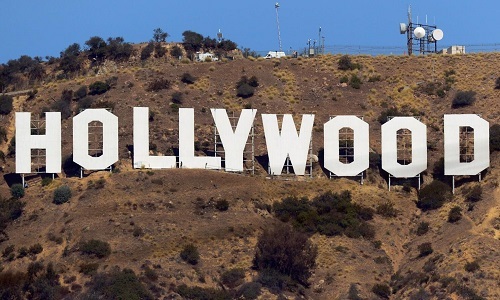
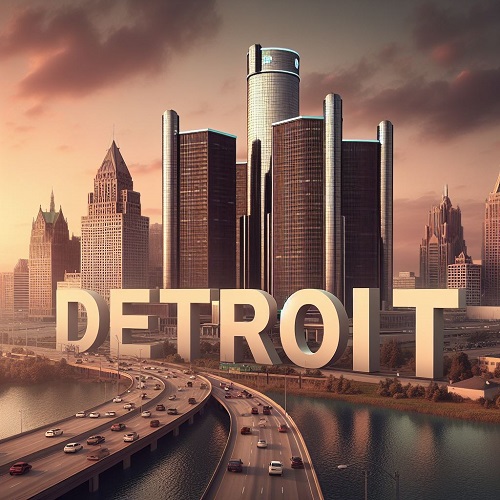
Here is a local story that has been the punchline of many jokes this week. I can’t recall when they mentioned it, but it was pretty big news. Along one of the freeways Detroit was going to get a sign “like the Hollywood sign.”
It was promoted with many mock photos (probably done with AI). They really made the sign look pretty awesome!
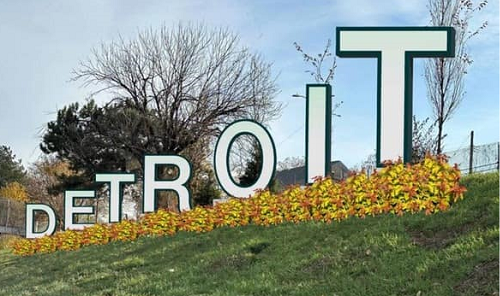
It wasn’t until the revealed the sign this week that the jokes began.
This caused quite a bit of social media posts about this new “eyesore.” I would say of the comments I read (or saw on local news) about 8 out of 10 were negative. The funniest post I saw on Facebook summed up what many of the people were saying.
After looking at many pictures of the sign, I admit it is less than spectacular. There was only one photo I saw that made the new sign look decent, and it was all because of the angle.
I appreciate all that the city is trying to do to bring about a new image, however, I wonder how much time and money was spent on this when there were so many other things that needed the money.
I will be honest with you. I can’t help but feel like many of the people who spouted off opinions on the sign who asked, “Which letter will be stolen or defaced first?” I hope that isn’t the case, but we shall see.










 Various Ramblings of a Nostalgic Italian