The Music of My Life – 1973

Welcome back to The Music of My Life, where I feature ten songs from each year of my life.  In most cases, the ten songs I choose will be ones I like personally (unless I explain otherwise). The songs will be selected from Billboard’s Year-end Hot 100 Chart, Acclaimed Music, and will all be released in the featured year.  I turned three in 1973, so let’s see what music had some influence on me ….

In January of 1973, The Four Tops released their second song on the ABC label.  They had left Motown the year before and this song became their biggest post-Motown hit.  Ain’t No Woman (Like The One I’ve Got) was originally recorded by Hamilton, Joe Frank, and Reynolds in 1972. It’s hard for me to hear anyone else but Levi Stubbs on the vocal.  It reached #4 on the Billboard Hot 100.

Ain’t No Woman (Like The One I’ve Got)

In March of 1973, Elvis released one of my favorite live cuts – Steamroller Blues.  I did a piece on the song for Tune Tuesday a few months back.  You can read that here:

https://nostalgicitalian.com/2024/03/12/tune-tuesday-steamroller/

Elvis added the song to his concert set list and this recording was from his Aloha From Hawaii show. It reached #17 on the charts.

Steamroller Blues

In April of 1973, Gerry Rafferty and Joe Egan’s song about a music industry party was released by their band The Stealer’s Wheel. “Well, I don’t know why I came here tonight” is the opening line of Stuck in the Middle and it makes you want to hear the rest of the story. 

It was a top ten hit for the group, reaching #6 on the charts.  The band was surprised at the success of the song, especially since Gerry’s vocal was meant to sound like a funny Bob Dylan. Many people thought it actually was Bob Dylan singing!

Stuck in the Middle

Also released in April of 1973, the last Top 40 hit for a singing barber.  This song actually seems out of place on my list, but I have a reason it’s here.

Don McLean wrote And I Love You So for his debut album in 1970.  It was the B-side of his single Castles in the Air. Crooner Perry Como used it as the title song for his 1973 album. It would peak at #29 on the charts.

I include it here because when my old morning show partner and I would go out and sing karaoke, he used to sing this one.  I had never heard it before then and I loved the lyrics and melody.

And I Love You So

Another great opening line for a song was from Paul Simon.  “When I think back on all the crap I learned in high school….” Kodachrome was released in May of 1973.  The song was originally written as “Going Home,” but he didn’t think it worked.  Kodachrome sounded similar and he went with that.

It has been said that the song is a sort of admiration for all the things that brighten the world.  After his lamenting about high school,  his world becomes alive with memories.

Kodachrome

Also released in May of 1973, a song that is based on real events and has one of the greatest opening riffs of all time. Smoke on the Water is the story of how Deep Purple was getting to record in a mobile studio they rented from the Rolling Stones.  The night before they were set to record, someone fired a flare gun during Frank Zappa’s song King Kong and set the casino venue on fire that destroyed it.  Deep Purple watched the fire from their hotel room and the smoke from the fire across the water led to the song’s title.

The opening riff which was written by guitarist Richie Blackmore, was inspired by “an interpretation of inversion” of Beethoven’s Fifth Symphony.  That intro remains something I love hearing, especially in headphones.  The guitar riff by itself, then the hi-hat cymbal, snare drum kicks, bass guitar and finally the vocal.  SO cool.

Smoke on the Water

The next song has an interesting story. It has it’s origins in a song that I almost picked for my list. From Songfacts.com: In February 1973, Stevenson released the song “Shambala” which was written by the composer Daniel Moore. Two weeks later, Three Dog Night released their version of the song, which became the much bigger hit, charting at US #3 while Stevenson’s version stalled at #66. Stevenson and Moore then got together and re-wrote “Shambala” as “My Maria,” changing the lyrics so the song became an ode to a beautiful woman. The ploy worked, and Stevenson had by far his biggest hit. (It went to #9 on the Billboard Hot 100.)

Brooks and Dunn enjoyed a number one country song with their cover of the song in 1996.

My Maria

Another song that was inspired by real events was from Jim Croce. In 1970, Jim Croce wrote Time in a Bottle the night that he found out his wife, Ingrid, was pregnant. Songfacts.com says: The couple had been married for five years, and Ingrid found out she was pregnant when she went to a fertility specialist. She recalls a mix of terror and delight in Jim’s reaction when she told him the news. The child was a boy named Adrian, who grew up to become the singer-songwriter A.J. Croce.

The song was released in November of 1973, and it hit #1 in America 14 weeks after Croce was killed in a plane crash in September.

For the record, I have never been to a whorehouse. The next song is a classic rock standard about the aforementioned establishment. The boys of ZZ Top based La Grange on John Lee Hooker’s Boogie Chillin’, and there is even a vocal tribute to Hooker as Billy Gibbons sings “Ho Ho Ho Ho!”

Again from Songfacts.com: The place in this song is the subject of the 1982 movie The Best Little Whorehouse In Texas, starring Dolly Parton and Burt Reynolds, which was adapted from a 1978 Broadway play. In a 1985 interview with Spin magazine, ZZ Top bass player Dusty Hill explained: “Did you ever see the movie, The Best Little Whorehouse in Texas? That’s what it’s about. I went there when I was 13. A lot of boys in Texas, when it’s time to be a guy, went there and had it done. Fathers took their sons there.

La Grange

We wrap 1973 with another great classic rock song. “I was cutting a rug down at a place called the Jug with a girl named Linda Lou…” the story begins and right from the get go trouble is brewing!  Lynyrd Skynyrd released Gimme Three Steps in November of 1973.

From Songfacts.com: This song is based on a true story. As Skynyrd guitarist Gary Rossington tells it, lead singer Ronnie Van Zant, who was about 18 at the time, used a fake ID to get in a bar while his younger bandmates Rossington and Allen Collins waited for him in a truck. Van Zant danced with a girl named Linda, whose boyfriend, who was not too happy about it, came up to Ronnie and reached for something in his boot. Figuring he was going for a gun, Van Zant told him: “If you’re going to shoot me it’s going to be in the ass or the elbows… just gimme a few steps and I’ll be gone.” He ran to the truck, and he, Rossington, and Collins wrote this song that night.

This was one of the few songs Skynyrd released as a single. It was their first major-label release, and it didn’t chart, which simply amazes me. It is a song that has truly become a party classic. I think I got more requests for this one than Sweet Home Alabama at weddings. Maybe it wasn’t a hit, but I have certainly heard this a lot throughout my life, and I always sing along!

Gimme Three Steps

That wraps up 1973 for me. Did you have any favorites from that year? Next week, we move on to 1974. See you there!
The Music of My Life – 1971

Welcome back to The Music of My Life, where I feature ten songs from each year of my life.  In most cases, the ten songs I choose will be ones I like personally (unless   I explain otherwise).

The songs will be selected from Billboard’s Year-end Hot 100 Chart, Acclaimed Music, and will all be released in the featured year.   Now, without any further ado, let’s head to 1971.

1971

In January of 1971, Tom Jones had his fifth (and final) Billboard Top 10 Hit with a Paul Anka song that Paul had released a year earlier – She’s a Lady.

Tom and Paul actually sang this as a duet on a 2013 Paul Anka album.  Paul changed the lyrics a bit because he felt like it was a bit chauvinistic.

I only knew a few of Tom’s hits until my old radio pal, Rob, introduced me to more of them.  I came to appreciate his music a lot after that. 

She’s a Lady

Also released in January of 1971 was a cover version that gave new life to a song that remains a wedding reception classic.

Creedence Clearwater Revival never had a number one record, however, Proud Mary made it to number two.  Ike and Tina Turner’s version took the song in an entirely new direction and it became one of Tina’s signature songs.

The song starts as a slow groove with Tina talking over Ike singing the lyrics.  When the tempo picks up, there’s no stopping it!  The horns kick in, the Ikettes join in, and Tina blows the roof of the place!

Proud Mary

I suppose it would be wrong not to include the number one song for the entire year of 1971 on this list, even if the members of the group how recorded it called it a “kid’s song” and a “silly song.” I can see that, especially when the lyric is about a frog named Jeremiah.

Legendary songwriter Hoyt Axton wrote “Joy to the World” and it was a monster hit for Three Dog Night. The song was released in February of 1971, and by April it had sold a million copies. Believe it or not, the first line of the song was supposed to be, “Jeremiah was a prophet,” but no one really cared for that. When Axton played it for the band, two of the three members (Danny Hutton and Cory Wells) didn’t like it. It was Chuck Negron who felt the band needed to do something like this “silly song.” Negron said in an interview that the song “wasn’t even close to our best record, but it might have been one of our most honest.” It is hard to believe that this song was almost never recorded!

Joy To The World

I’ve never claimed to be a huge fan of The Doors, but I do acknowledge that Jim Morrison was a one of a kind talent. His legacy lives on to this day. One of my favorite Doors songs was released in March of 1971. It was the first single from their LA Woman album – Love Her Madly.

The story goes that Doors guitarist Robby Krieger was messing around on a twelve string guitar and while doing so he came up with the music and melody for the song. He turned to real life for the lyrical story. He wrote the lyrics based on his troubles and fights with his then-girlfriend and later-wife Lynn.

The song peaked at number 11 on my first birthday – May 15, 1971.

Love Her Madly

As you listen to this next selection, imagine Elvis Presley singing it. Why? Well, it was supposedly written with him in mind to sing it. Take it a step further and imagine the Grass Roots doing it, because it was pitched to them, too, and they passed on it. Luckily, a new trio got a shot at it and Hamilton, Joe Frank and Reynolds had a top five hit with “Don’t Pull Your Love.”

The story of how they came to the song and their record deal is a cool one. “Joe Frank Carollo would recall how he and his fellow band members Dan Hamilton and Tommy Reynolds were performing a Creedence Clearwater Revival medley to audition for ABC-Dunhill when Steve Barri stopped the trio to play them the demo of “Don’t Pull Your Love” two or three times until the trio themselves could sing it for Barri, who resultantly arranged for Hamilton, Joe Frank & Reynolds to be signed to ABC-Dunhill that same day.”

The song was released in April of 1971.

Don’t Pull Your Love

I would bet that Carole King’s Tapestry album has influenced almost every female singer today. It is considered to be one of the best albums in music and it spent nearly six years on the album charts. Talk about a legendary songwriter, Carole has written over 100 songs that have appeared on the Billboard Hot 100 charts. For my next selection, I’m choosing half of a two-sided hit.

In April of 1971, Carole King released I Feel The Earth Move/It’s Too Late. I Feel The Earth Move is such a great song for so many reasons. Do a search for the song on Google and there are countless quotes about it. For example, Rolling Stone magazine praised King’s voice on this track, saying it “negotiates turns from “raunchy” to “bluesy” to “harsh” to “soothing”, with the last echoing the development of the song’s melody into its chorus.” Cash Box described the song as a “forceful ‘earthquake song'” and considered its pairing with “It’s Too Late” as a single to be “double dynamite.”

I love the song because of the way the piano and the vocal intermingle with each other. There is great syncopation in the way that she delivers the lyrics as well. Her version of the song peaked at number 1 on the Billboard Hot 100 chart in June of 1971. It remained there for five consecutive weeks.

I Feel The Earth Move

Willie Nelson once sang, “You just can’t play a sad song on the banjo.” The banjo is prominent in my next song which is a tribute to a Canadian city. The lyric even says, The banjo and me, we got a feel for singing.” So what do you do when your band doesn’t have a banjo player?

The Canadian rock band The Stampeders, released Sweet City Woman in May of 1971. According to songfacts.com: “Sweet City Woman is one of the most famous banjo-driven hits in rock history, but the band didn’t have a banjo player. Rich Dodson wrote that lick on guitar and played it on that instrument while they were working it out during live shows. When it came time to record the song, he decided a banjo might give it an interesting texture, so he borrowed one and played it in guitar tuning. It was a propitious choice: The banjo gave the song a back-porch feel that makes it lively and oh-so singable. The woman is a metaphor for the big city, Toronto in particular. The lyric was inspired by the city, where the group had been living for about five years. They’re from Calgary, which isn’t exactly the sticks, but Toronto is much bigger and more metropolitan.

The song went to Number One in Canada and it was a Top Ten in the States.

Sweet City Woman

In July of 1971, Bill Wither’s released his first hit song – Ain’t No Sunshine. It appears on his debut album Just As I Am. I have written about this one in more detail in the past for Tune Tuesday. You can read about it here:

Ain’t No Sunshine

A tragedy that involved the death of three early rock and rollers inspired the monster hit that was released in October of 1971. It seems that we always refer to plane crash that took the lives of Buddy Holly, Richie Valens and The Big Bopper on February 3, 1959 as “The Day the Music Died.” You can thank Don McLean for that.

American Pie was the title track of McLean’s 1971 album. The track on the album clocks in at 8:42. When it was released as a single, the song was split up with Part 1 on the A side (4:11) and Part 2 on the B-side (4:31). This month’s edition of Turntable Talk was about music and Max at the PowerPop blog chose this as his song. You can read about it more here:

American Pie

My final song from 1971 is one that can mean many things to many people, both now and when it was released. This one is the second “sunny” song on my list – Sunshine by Jonathan Edwards.

Edwards has said that he has received many letters stating what people think the song means, or what it means to them personally. When asked by Songfacts.com what he had in mind when he wrote it, he states that the song “has left me with is the wisdom to not answer the question, because everyone’s interpretation is way more creative and interesting than my original impetus for the song. So you go with it.”

The song was almost not recorded. Fate stepped in, however, when an engineer accidentally erased the master of a track called “Please Find Me” near the end of sessions for the album, and “Sunshine” was recorded to take the place of the erased song.

The song was released in November of 1971 and was a Top 5 record for him. Regarding its success, Edwards stated, “It was just at the time of the Vietnam War and Nixon. It was looking bad out there. That song meant a lot to a lot of people during that time–especially me.”

Sunshine

Thanks for reading and listening! See you in 1972!

“A long, long time ago….”

There are some days I sit down and wonder what I am going to write about, today is not one of those days. Today is the “day the music died” – 60 years ago. The phrase comes from the classic Don McLean song “American Pie.”

paper

The Winter Dance Party Tour

In January of 1959, Buddy Holly, Richie Valens, The Big Bopper, and Dion and the Belmonts set out to do a tour of 24 Mid-West cities in 24 days. The first problem was that no one had really thought out the tour stops and instead of circling from town to town, the tour was zig-zagging from state to state and sometimes the travel between cities was over 400 miles!

What made this even more difficult was that almost all of the travel was done on buses and there were break downs, and some didn’t have heat. The artists and band members were the ones loading and unloading the buses. Due to the cold, The Big Bopper and Richie Valens were starting to feel ill, complaining of flu-like symptoms. After driving 350+ miles from Green Bay, Wisconsin, the tour arrived at Clear Lake, Iowa on February 2 to play the Surf Ballroom.

When they arrived it became clear that Buddy Holly was over all of the bus issues. After the Surf Ballroom show, the next stop was over 350 miles away in Minnesota. Because of the poor planning of tour stops, this meant that the buses would have to pass through towns they had already played. Buddy decided that he needed some rest and so he chartered a plane to take him and his band (which included Waylon Jennings, Tommy Allsup, and Carl Bunch) to Fargo, North Dakota. They would rest there and get picked up by the buses when they came through town on their way to the gig.

There are a few versions of what happened next, but the widely accepted story is this: The Big Bopper, who was feeling the effects of the flu, asked Waylon Jennings for his seat on the plane. Waylon agreed to let him have the seat. (Some say that Waylon gave him his seat voluntarily.) One story says that when Buddy found out that Waylon was taking the bus instead of flying, he said “I hope your old bus freezes up” to which Waylon replied, “Well, I hope your old plane crashes”. In an interview later, Waylon said that even though the response was meant as a joke, his words still haunted him.

Richie Valens asked guitar player Tommy Allsup if he could have his seat aboard the plane. (There is some question as to whether Valens or the Big Bopper was the one with the flu.) It was decided that they would flip a coin to see who would get to go on the plane. A radio DJ who was working the show that night flipped a coin in a room off the stage and Richie Valens won the coin toss – and the seat. Ironically, Richie, at one time had a fear of flying.

The Flight

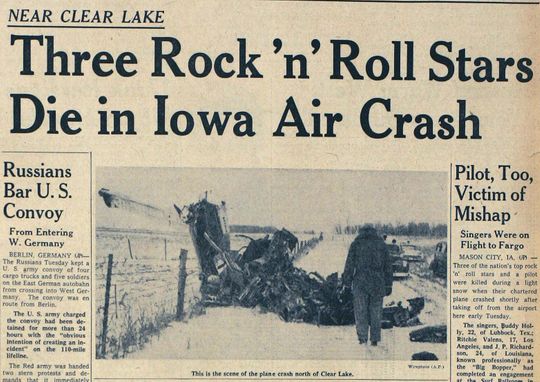
After the show, the manager from the Surf Ballroom drove Holly, Valens, and the Big Bopper to the airport. At the time the plane took off, there was light snow falling. The weather was supposed to get worse along the planned flight path. At 12:55 am, the plane took off from the airport. At 1:00, pilot Roger Peterson was supposed to radio to the airport to check in, but didn’t. The airport continued to try to reach him, but there was no answer.

In the morning, Hubert Dwyer, the owner of the flying service and the plane, took off in his own plane to retrace the path of the plane carrying Holly and the others. At about 9:30, less than 6 miles from the airport, he spotted the wreckage of the plane carrying the singers and pilot. The sheriff’s office was immediately dispatched to the cornfield where the plane had crashed, in Clear Lake, Iowa.

It is estimated that the plane hit the ground at almost 200 mph and did cartwheels before coming to a stop. The bodies of Buddy Holly and Richie Valens were thrown from the plane and were close to the crash site. The Big Bopper was ejected and thrown over a fence into a cornfield. The pilot’s body was wrapped up in the wreckage of the plane.

2566d6e77bb32e0747b0755e463364af

Afterward

When this happened, there was no protocol for withholding names of victims before notifying their family. Because of this, Buddy Holly’s widow found out about her husband’s death from a TV news story about the crash. They had only been married 6 months at the time of his death, and she was pregnant. She suffered a miscarriage shortly after because of “psychological trauma”. She did not attend her husband’s funeral and has never visited his gravesite. She blames herself for him getting on the plane, stating that if she had been with him, he would not have got on the plane.

An investigation into the crash found that despite the fact that the pilot had passed his written flight test, and had flown many hours, he was not prepared to fly in situations where he must rely solely on instruments (Which he would have had to do on this flight because of weather conditions). Another possible factor is the older equipment on the plane may have cause the pilot to believe he was ascending, but instead was descending. He was also not properly briefed on the weather conditions that he was flying into.

The tour continued for a couple weeks afterward with Waylon Jennings taking on the role of lead singer. Bobby Vee came to national attention due to the crash, because he was brought onto the tour because he basically knew all the words to the songs.

The Legends

22-year-old Buddy Holly left behind some songs that, despite his short career, have become rock and roll classics. Peggy Sue, Every Day, That’ll Be the Day, Rave On, True Love Ways, Raining In My Heart, and “I Guess It Doesn’t Matter Any More” remain on the play lists of oldies stations across the country. The Royal Philharmonic Orchestra has released an album of his music with his original vocals with a more orchestral background (they have done this with Elvis, Aretha Franklin, and Roy Orbison), giving the songs a fresh new sound.

The Big Boppper, AKA JP Richardson, will forever be remembered for his classic hits Chantilly Lace and The Big Bopper’s Wedding. He had a career as a radio DJ and also had great success as a songwriter. He wrote George Jones number one song “White Lightening” and Johnny Preston’s “Running Bear.” He was only 28 at the time of his death

Richie Valens was a mere 17 years old when he perished in the crash. His career was only just beginning, having begun just eight months earlier. He left behind three songs that remain fixtures in the first decade of rock and roll: Come One Let’s Go, Oh Donna, and, of course, La Bamba.

Like Elvis Presley, Otis Redding, Sam Cooke, Marvin Gaye, Jim Croce, John Lennon, and Stevie Ray Vaughn – all who left this world too young – we can only sit back and ponder how the face of music would have changed if they hadn’t died so young. Each of their careers cut short by a tragedy. Three voices silenced by fate.

Remembering Them

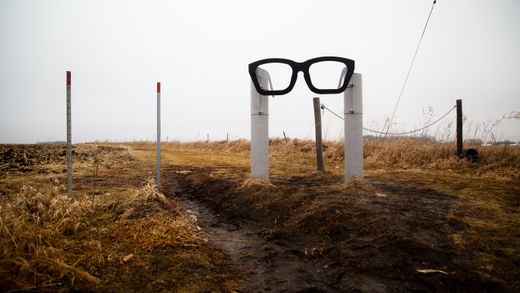
Every year, there is a memorial concert held at the Surf Ballroom to honor the memory of these three rock and roll icons. Outside the venue is a four-foot tall monument that had the names of the pilot and the three singing legends. This was placed there in 1988. At the crash site, there is a large steel structure which looks like a pair of glasses (much like the ones Holly wore), which stands as a memorial.

a90dbc85-a634-411a-8588-b60452f78ba8-0115_gillibrand_16

The most popular tribute is Don McLean’s 1971 American Pie. The song refers to the date of the crash as “the day the music died”. While some take this song to be about Buddy Holly, McLean insists that while the crash is referenced in the song, it is not really about Holly – it’s “about America.” He states, “Buddy Holly’s death is what I used to try to write the biggest possible song I could write about America. And not a ‘This Land Is Your Land’ or America, the Beautiful” or something like that. I wanted to write a song that was completely brand new in its perspective.”

The song will no doubt be played many times on radio stations across the country today.

Final thoughts

60 years later, artists such as The Beatles, Elton John, and Bob Dylan have all cited Buddy Holly as a musical influence. His songs have been covered by numerous artists including Linda Ronstadt, James Taylor, Bruce Springsteen and Martina McBride. There have been movies made surrounding the lives of Buddy Holly and Richie Valens. And the Royal Philharmonic Orchestra album with Holly’s original vocals is available now, too.

So has the music really died? I don’t think so. Today, as we remember the 60th anniversary of their tragic deaths, we must also look back and remember their music and the mark that they left on musical history. Their voices may now be silent, but their influence continues to trickle down through music today. Rave On!