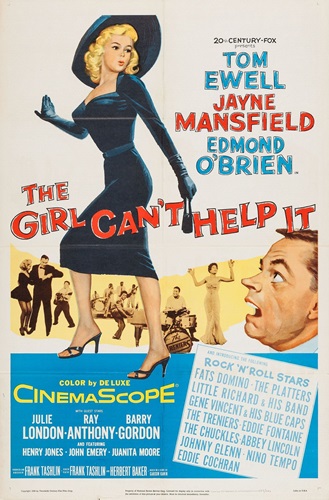
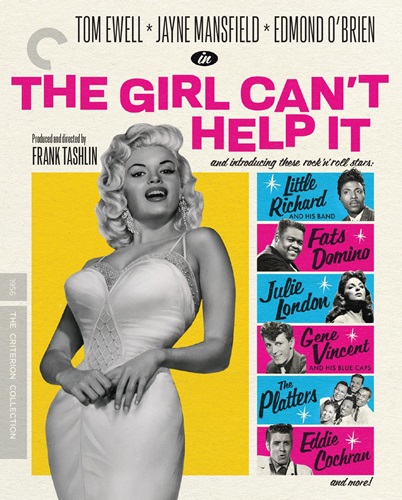
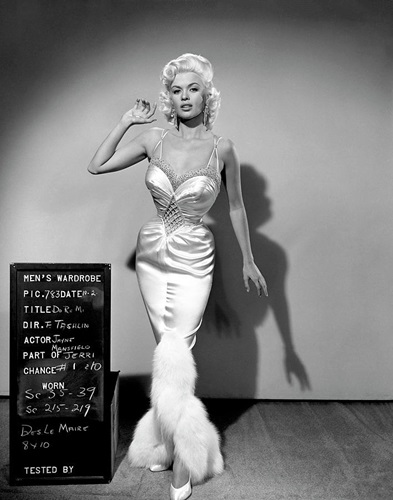
It was on this day in 1956 that “The Girl Can’t Help It” starring Jayne Mansfield, Tom Ewell and Edmund O’Brien opened in theaters.
The movie was originally conceived as a way to build Mansfield’s celebrity, but it took on a life of its own and became a rallying point for young people, helping propel rock and roll into its unofficial “first Golden Age.” The unintended result has been called the “most potent” celebration of rock music ever captured on film. No doubt the cameos by Fats Domino, The Platters, Gene Vincent, Eddie Cochran, Julie London and Ray Anthony helped with that.
The film was based on “Do Re Mi”, a short story by Garson Kanin. After seeing the adapted screenplay, Kanin did not approve of the new take on his story and requested his name be removed from the credits. Subsequently, director Frank Tashlin came up with the new title, The Girl Can’t Help It.
FUN FACT: The film the heavily inspired young, pre-Beatle John Lennon to be a rocker. The impact was so significant that, 12 years later, the Beatles took a break from recording “Birthday” to watch the film premiere on British television (Lennon had seen it in theaters).
The Girl Can’t Help It is the title song to the film, and was written by Bobby Troup. Little Richard recorded it and it was released in 1956. Fats Domino was originally supposed to record the song for the film, but the sessions fell through. The song has been covered by The Everly Brothers, The Animals, Led Zeppelin, and many others.
In the US, the song peaked at No. 49 on the Billboard Top 100 singles chart and No. 7 on the R&B Best Sellers Chart.
Songfacts.com sums up the song in this way:
“The Girl Can’t Help It” is about a young woman so attractive that she unwittingly captures the attention of every guy she passes. In addition to her siren-like sex appeal, there’s a distinctly incendiary element to her superpowers. She turns bread to toast with a wink of an eye and makes “beefsteak become well done” with a smile. She can’t be held responsible for the potentially dangerous effects of her fiery presence. The poor girl just can’t help it.
Welcome back to The Music of My Life, where I feature ten songs from each year of my life. In most cases, the ten songs I choose will be ones I like personally (unless I explain otherwise). The songs will be selected from Billboard’s Year-end Hot 100 Chart, Acclaimed Music, and will all be released in the featured year.
Let’s jump right into 1982. We start with a song that was released in January of ’82 in the United States. Believe it or not, this song would go on to have a special meaning for me and many others from my high school. More on that in a minute.
The Go-Go’s were one of those bands who wrote most of their own songs. “We Got The Beat” was written by guitarist Charlotte Caffey, who drew inspiration from some Motown beats, specifically one that mentioned the name of her group. She explains, “I thought it would be very clever to do ‘Going to a Go Go’ (by the Miracles). I thought, Well, let’s try working this out as a cover song. Which is really funny when I think about it. I was listening to it a lot one day, and later that night, the song came to me within five minutes. I don’t even know if it has anything to do with listening to that song, but this whole idea came to me. It was one of those things that just went right through me and came out my hand; I wrote it down, recorded it a little bit, and then brought it into rehearsal a few days later.”
The Go-Go’s released an early version of “We Got The Beat” in the UK as their first single. It was issued on Stiff Records, which was home to The Specials and Madness, both groups The Go-Go’s toured with in England to promote it. Sadly, it flopped, but the group fared far better in America, where they were signed to IRS Records by Miles Copeland, who managed The Police. In the US, “Our Lips Are Sealed” was released as their first single in the summer of 1981, followed by a new version of “We Got The Beat” in January 1982. This release was The Go-Go’s biggest hit, spending three weeks at #2. (I’ll include both versions below)
Band Camp – Summer 1985. We Got the Beat was a favorite of my high school marching band. I have no idea how long they had been playing it prior to my first year, but it was always played at pep assemblies and when our team won. It was a staple in the marching band music folder. It was the one song that we could play and just have fun. We danced, we jumped, we acted the fool while playing it. It was a celebratory song.
Our band director would say, “Let’s do the little Italian number” during rehearsals. We all knew what he was talking about because he’d often call it, “We Gotta Da Beat.” I want to say our alumni band was around for at least 10 or 12 years after I graduated and they were still playing it. We always joined it because we all had it memorized. I haven’t played my trumpet in years, but I can assure you that if I were to pick it up today, I could still play this song!
We Got the Beat
Real life once again inspired another big hit. Songwriter Wayne Carson, who wrote The Box Tops’ 1967 #1 hit “The Letter,” came up with “Always On My Mind” when he was working at a recording studio in Memphis. He lived with his wife in Springfield, Missouri, and the trip to Memphis had gone 10 days longer than expected.
When he called the missus to tell her he would be there even longer, she let him have it. He tried to assuage her by telling her that was thinking about her all the time – she was “always on my mind.” “It just struck me like someone had hit me with a hammer,” he told the LA Times, “I told her real fast I had to hang up because I had to put that into a song.”
Willie had never heard the song before the song’s co-writer, Johnny Christopher, brought it to him and Merle Haggard, who were busy recording the album Pancho & Lefty (Christopher was playing guitar on the session). “‘Always On My Mind,’ bowled me over the moment I heard it, which is one of the ways I pick songs to record,” Nelson recalled in his 1988 autobiography, Willie. “There are beautifully sad songs that bowl me over… haunting melodies you can’t get out of your mind, with lines that really stick.”
Nelson figured he and Haggard would do the song together, but Haggard didn’t care for it. After they finished recording their album, Nelson stayed in the studio and recorded the ballad solo, just to see what it would sound like. Of course, it sounded like a hit, but Nelson wondered, “We’ll never know what would have happened if Merle had really heard the song right.”
You may remember that Willie Nelson played a big part in my childhood. His Stardust album was played all the time by my grandfather. My grandfather passed away in 1981. Any song by Willie reminded me of my grandpa. My mom really struggled with his passing and I remember being in the car with her when Always on My Mind came on the radio. She had to pull over because it really hit her hard.
It hit me the same way. I know that it is far fetched to believe that grandpa sent a message from beyond the grave, but it felt that way. From Stardust to Always on My Mind and every Willie album that followed, there always seemed to be one song that fit into something that was going on in my life. This one helped me cope with the first death I ever experienced, even though it was more of a love/apology song.
Always on My Mind
One of the things that I noticed as I scanned over the list of singles released in the early eighties was the prominent use of the synthesizer. Rock bands like ZZ Top, Van Halen, and Yes added synthesizers to their mix in the ’80s and scored huge hits by adapting what songfacts.com called “the sound of the decade.” The Steve Miller Band started out as a blues band in the ’60s, evolving into a rock outfit in the ’70s. They often sprinkled electronic effects into their songs, so the keyboards and synth stabs in this song weren’t out of character.
“Abracadabra” was the last US Top 40 hit for the Steve Miller Band, and their third #1. The song was written by Miller and the lyrics were inspired by Diana Ross and the Supremes, whom he had met while performing together on NBC’s Hullabaloo in 1966. “‘Abracadabra’ started off as a great piece of music with really atrocious lyrics,” Miller explained to The Dallas Morning News. “One day I was out skiing in Sun Valley and, lo and behold, who did I see on the mountain but Diana Ross. I skied down off the mountain to go have lunch. I started thinking about the Supremes and I wrote the lyrics to ‘Abracadabra’ in 15 minutes.”
Honestly, I’m really not sure how the Supremes led to the song, but I remember it being a song that really stood out to me on the radio. I rushed out to buy the 45 and it was always a song that wound up on my “driving music” tapes.
Abracadabra
1981 was the year that many were introduced to Men at Work. Their debut single, “Who Can It Be Now” shot straight to #1 on the charts. The group started as an acoustic duo with singer Colin Hay and guitarist Ron Strykert. After a few years playing pubs in Australia, they were discovered by an American who worked for CBS records and signed them.
Colin Hay wrote the song and explained how it came about:
“I was up in the bush in Southern New South Wales with my girlfriend, just sitting outside at night. We had this little tree hut in the middle of the bush. It was a great place to kill the time, mess around with ideas. It was just an idea that popped out, it took about half and hour to write that song. I was living in St. Kilda in Melbourne, which is a great part of Melbourne. At that particular time it was a very interesting area, it was frequented by everybody from the high Jewish population, punks, drug movers, all kinds of different people. It was about six or seven hours drive away, sitting in the middle of the bush in New South Wales and that song just popped out. My girlfriend at the time said, ‘that will be your first hit, that song,’ and she was right.”
Their Business as Usual album was one that I played often.
Fun Fact: The famous saxophone part originally didn’t come in until the middle of the song, which suited when the band played it in bars. When they recorded it, producer Peter McIan identified the sax as a hook and moved it to the beginning of the song, also making it more prominent throughout. This opening sax riff made the song instantly identifiable.
Who Can It Be Now
Juice Newton had a few big hits between Queen of Hearts and Love’s Been a Little Bit Hard On Me. The latter is one of those fun sounding songs, even though it is about the hardships of a relationship. The song was released exactly one week after my 12th birthday.
Juice reminds me of Carlene Carter who had some jumpy, fun songs like this one. Even though she channels Neil Sedaka and sings harmony with herself on the song, that’s one of the reasons I love it. It’s nothing fancy, but it is just good harmony and it blends so well.
One of the things I have enjoyed while picking songs for this year was seeing the videos that were made for certain songs. Wiki describes the music video for this one perfectly. It says that it comically plays off the emotional hurt of love by showing Juice Newton being physically injured by her lover in a series of accidents. The final shot is of Newton singing in the hospital in a full-body cast with her broken leg in the air. The video was awarded Video of the Year by the American Video Association in 1982.
Love’s Been a Little Bit Hard On Me
There is an outdoor amphitheater in the Detroit area that packs in some fantastic shows every summer. I cannot tell you how many shows I have seen at Pine Knob (For some time DTE Energy paid to have the name and even though shows were at “DTE Energy Music Theater,” everyone still called it Pine Knob!). I’ve seen rock shows, comedy shows, country shows, and more there.
For many years, Eddie Money was ALWAYS the guy who played the first show there. He kicked off the summer concert season annually and it became a tradition. One year, I had the opportunity to interview Eddie on the air. It was the easiest interview in the world! Why? You never had to ask questions after he got on the phone. “Hey, Eddie! How are you?” Then Eddie would roll – he’d promote the show, promote an album, share some funny story, talk about the venue, and more. The “Money Man” was great!
I dated in high school who loved Eddie Money’s Music. She had the No Control album on cassette and we’d listen to it in the car. Think I’m in Love was on that album and I remember the first time I saw the video on MTV. Again, these early videos are fun to watch. Eddie plays a sort of vampire character in it. It was a very popular video.
Think I’m In Love
Growing up I listened to Elvis, Bill Haley, Carl Perkins, Eddie Cochran and other artists who played some rockabilly music. So when I heard the Stray Cats in 1982, it was like hearing stuff I was already familiar with. The Built For Speed album was one I played over and over.
Brian Setzer was born in New York and was exposed to a lot of genres of music. He learned to play the guitar at a young age, and when he was a teen, he formed a trio he called the Tomcats, That group would later change their name to the Stray Cats. They were influenced by all those artists I just mentioned and their group developed a fairly large following in the underground punk scene of New York City during the late ’70s. Their fan base expanded so quickly that they found themselves being courted by no less than a half dozen record labels in 1980.
Brian Setzer opted to record and produce the Stray Cats’ debut album in the UK Rock This Town was released there over a year before it was released in the US. Rock This Town was a Top 10 hit for the band. It’s crazy to watch the video and see Brian. He looks like a baby in it. Hard to believe he was only 23 when this video was shot.
Rock This Town
My dad and my uncle used to play old blues music on records and on the guitar. At my graduation party, they played stuff from Jimmy Reed, Bo Diddley, and other blues legends. Because of that, I’ve always loved the blues. Because of that, I was naturally a fan of George Thorogood.
Bad to the Bone is based on the Bo Diddley blues song “I’m a Man.” Bo Diddley was one of George’s heroes. His “version” has a much heavier guitar sound, which replaces the harmonica in Diddley’s recording. Songfacts.com says that “both songs are full of swagger, with the singers exuding lots of testosterone.”
Songfacts.com goes on to say, “With MTV coming on the air in 1981, Thorogood picked a good time to release a memorable video. The clip shows Thorogood playing pool against Bo Diddley in a place where there is no chance of a dance sequence breaking out. Pool champion Willie Mosconi also appears in the clip, which introduced Thorogood – and to some extent, Diddley – to the younger MTV crowd. Among the British New Wave acts that dominated MTV’s playlist at the time, Thorogood certainly stood out, and he created an image of a bad man. While Thorogood is a disciple of the blues, he was raised in a Delaware suburb and by most accounts is actually a pretty nice guy, despite what he claims in this song.”
I love the fact that Diddley is in this video! The song is one that has a life of it’s own. It is used as intro music for wrestlers, it has been used during the removal of the bride’s garter at weddings, and has been used in both movies and television in seriousness and for comedic effect. It is a classic.
Bad to the Bone
I love a great intro. Sometimes a great guitar riff or a neat drum thing is all it takes to hook me. The intro to Everybody Wants You was one of those intros. It appeared as the opening track of his multi-Platinum 1982 album Emotions in Motion.
The song itself didn’t do that great on the Hot 100 chart, as it only went to number 32. However, it was around this time that one of the radio formats that was big was called AOR – Album Oriented Rock. It had great success on these and rock stations. It reached number one on Billboard’s Top Rock Tracks chart. Naturally, the video did well on MTV, too. It remained in heavy rotation for quite some time.
The minute I hear this one, I think back to those nights of shooting pool with my buddies. It was always on the jukebox.
Everybody Wants You
The next song is one that is still applicable today. Perhaps even more so. What exactly is “news” today? Turn on any local news channel or entertainment news show – it is chock full of stories like the ones referenced in Don Henley’s first Top 40 hit as a solo artist – Dirty Laundry.
Again, the intro of this really stood out for me. The lyrics take it to an entirely new level. They are so good and perhaps that is because Henley had plenty of real life to draw from. This song is about unscrupulous news people doing anything for a story. Henley values his privacy, and hates it when reporters pry into his personal life. He had to deal with increased press attention when his girlfriend at the time, Maren Jensen, came down with Epstein-Barr Syndrome. She recovered, but they broke up soon after.
Songfacts.com states: “Henley sings from the standpoint of a news anchorman who “could have been an actor, but I wound up here”. The song’s theme is that TV news coverage focuses too much on negative and sensationalist news; in particular, deaths, disasters, and scandals, with little regard to the consequences or for what is important (“We all know that crap is king”). The song was inspired by the intrusive press coverage surrounding the deaths of John Belushi and Natalie Wood. It was also inspired by Henley’s own arrest in 1980 when he was charged with contributing to the delinquency of a minor and possession of marijuana, cocaine, and Quaaludes after a 16-year-old girl overdosed at his Los Angeles home”
While Don’s version is the best, Lisa Marie Presley (who had to deal with a lot of press intrusions on her personal life) also does a really neat version of Dirty Laundry.
Dirty Laundry
There were plenty of great songs in 1982, I’m sorry if I missed one of your favorites. Next week, we’ll move ahead to 1983 where there will be a good mix of rock, country, pop, soul and a movie song that will forever be associated with summer vacations ….
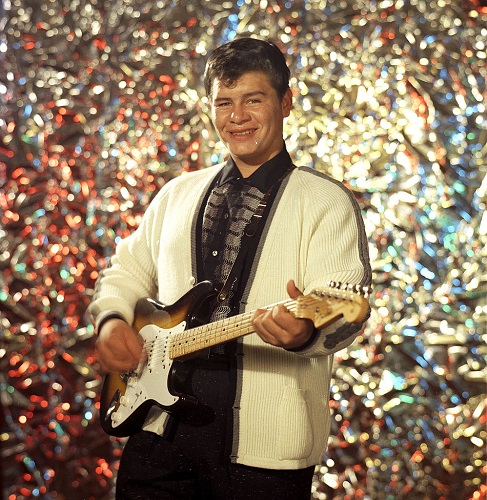
Richard Steven Valenzuela would have been 83 years old today, had he not become part of the story entitled, “The Day the Music Died.” We, of course, know him by his stage name – Richie Valens.
UNSPECIFIED – JANUARY 01: Photo of Ritchie Valens (Photo by Michael Ochs Archives/Getty Images)
In May of 1958, Bob Keane of Del-Fi Records was told about a high school singer who students called “The Little Richard of San Fernando.” This peaked his interest and he went to see him perform. Keane invited Richard to his home to audition for him. After that first audition, Keane signed him to Del-Fi on May 14, 1958. At this point, the musician took the name “Ritchie” because, as Keane said, “There were a bunch of ‘Richards’ around at that time, and I wanted it to be different.” Similarly, he recommended shortening his surname to “Valens” from Valenzuela to widen his appeal beyond any obvious ethnic group.
The first song that Ritchie recorded at a session shortly after being signed was Come On, Let’s Go. Our song for today. But I am getting ahead of myself.
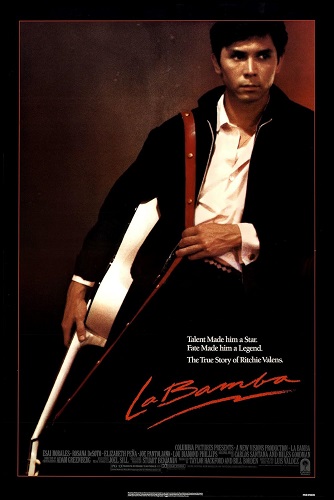
Ritchie’s story was told in the 1987 biographical film, La Bamba, which starred Lou Diamond Phillips as Valens. Marshall Crenshaw played Buddy Holly, Stephen Lee was the Big Bopper, and Brian Setzer makes a cameo as Eddie Cochran. Some of Ritchie Valens’ family even had roles in the film.
The film was well received and Roger Ebert said that he liked the film and the screenplay and writing: “This is a good small movie, sweet and sentimental, about a kid who never really got a chance to show his stuff. The best things in it are the most unexpected things: the portraits of everyday life, of a loving mother, of a brother who loves and resents him, of a kid growing up and tasting fame and leaving everyone standing around at his funeral shocked that his life ended just as it seemed to be beginning.”
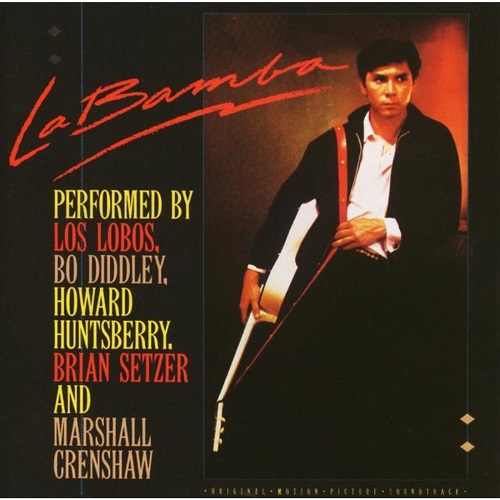
The soundtrack consists of many Ritchie covers done by Los Lobos as well as well as Howard Huntsberry (who played Jackie Wilson in the film), Bo Diddly and Brian Setzer. A second soundtrack was released 1988 with more music from the movie.
Los Lobos did a fantastic job capturing Ritchie Valens’ essence and his songs are fairly true to the originals. While La Bamba will forever be the song Richie is remembered for, Come On, Let’s Go was always my favorite. So for Movie Music Monday, let’s here Los Lobos’ version.
Valens’ story (like that of Buddy Holly and other singers who died young) leaves us wondering “What if ….?” His was a talent taken much too soon.
Yesterday, my Turntable Talk was about the Blues Brothers Soundtrack. Ray Charles is featured on there with his version of Shake a Tailfeather. Also yesterday, my buddy Max from the Power Pop Blog (powerpop.blog) posted about Ray’s version of What’d I Say. That got me in a Ray Charles mood and I was surprised that I’d never posted this song before.
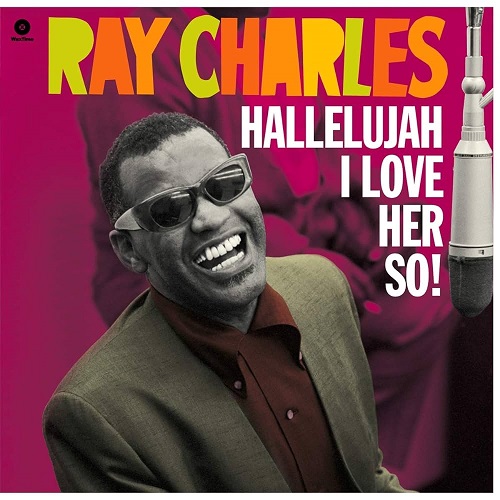
Hallelujah, I Love Her So was written and released by Ray Charles in 1956. I remember playing it on rare occasions when I worked at WHND, Honey Radio in Detroit. It was usually when we were featuring songs from 1956. It didn’t do much on the pop charts, but it was a Top 5 hit on the R&B charts.
As the title insinuates, it has a gospel feel to it. The opening piano lick sounds like something you’d hear before jumping into a happy hymn. One source says the song “is a testament to the joyous release of love, featuring a sophisticated horn arrangement and memorable tenor sax solo by Don Wilkerson.”
My buddy Randy from http://www.mostlymusiccovers.com no doubt knows that there have been plenty of covers of this song. Ray must have been thrilled to have his song covered by folks like Ella Fitzgerald, Peggy Lee, Brenda Lee, Jerry Lee Lewis, Stevie Wonder, Eddie Cochran, Gerry and the Pacemakers, and Frank Sinatra! Oh, and a band called the Quarrymen (who went on to become the Beatles) also covered it!
To start with, here is the original by Ray:
Ella Fitzgerald’s version sounds a bit more church-like to start, but really swings.
From the Beatles Anthology, here are the Quarrymen
Eddie Cochran’s version was released in 1959
I had no idea that Jerry Reed covered it, but it’s neat to hear his take
Sinatra always makes a song his own and he does that with this one. Very bluesy
Hugh Laurie’s version was on the deluxe version of his debut album
Of all the covers, one of my favorite versions is by an Australian singer named Guy Sebastian. From his Memphis Album he a great version.
I hope you love this one as much as I do!
Hallelujah, I Love Her SO
Let me tell you ’bout a girl I know She is my baby and she lives next door Every mornin’ ‘fore the sun comes up She brings me coffee in my favorite cup That’s why I know, yes, I know Hallelujah, I just love her so
When I’m in trouble and I have no friend I know she’ll go with me until the end Everybody asks me how I know I smile at them and say, “She told me so” That’s why I know, oh, I know Hallelujah, I just love her so
Now, if I call her on the telephone And tell her that I’m all alone By the time I count from one to four I hear her (KNOCK) on my door In the evening when the sun goes down When there is nobody else around She kisses me and she holds me tight
And tells me, “Ray Charles everything’s all right” That’s why I know, whoa, I know Hallelujah, I just love her so
Now, if I call her on the telephone And tell her that I’m all alone By the time I count from one to four I hear her (KNOCK) on my door
In the evening when the sun goes down When there is nobody else around She kisses me and she holds me tight And tells me, “Daddy, everything’s all right” That’s why I know, yes, I know Hallelujah, I just love her so
Oh, hallelujah Don’t you know, I just love her so She’s my little woman, waitin’ all this time Babe, I’m a little fool for you, little girl…





 Various Ramblings of a Nostalgic Italian