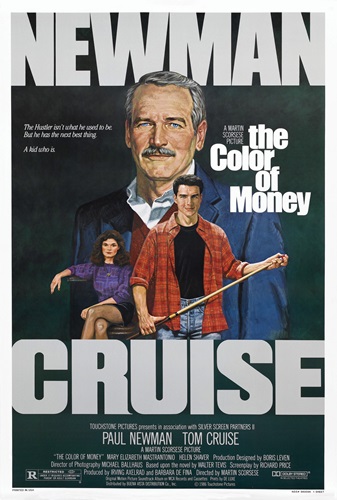
Born today in 1925, the legendary Paul Newman. He was in so many great movies. One of my favorites was the 1961 film The Hustler. Newman played “Fast Eddie” Felson who is a small time pool hustler who challenges Minnesota Fats played by Jackie Gleason. He would reprise that role again 25 years later in The Color of Money.
In the sequel, “Fast Eddie” isn’t as fast as he used to be. He has given up the game and is now a liquor salesman. He comes across a guy who is a skillful pool player and approaches him and his girlfriend and tells them they’d be pretty good at hustling. The trio then head out for six weeks of travel and hustling.
The soundtrack of the film is filled with great music from Willie Dixon, Robert Palmer, BB King, Don Henley, Robbie Robertson, Mark Knopfler and Eric Clapton. It has a very bluesy feel to it which fits the feel of the film. One of my favorite tracks is It’s In the Way That You Use It by Clapton.
(From Songfacts.com) Clapton wrote this with Robbie Robertson, whose work with The Band in the ’60s encouraged Clapton to get away from the long, heavy solos he was playing with Cream. Robertson was in charge of the music for The Color Of Money, but because he was not finished with his first solo album, his record company would not let him sing on any of the songs. He got around it by contributing instrumental songs to the soundtrack.
Billboard magazine called the tune a “neatly executed rocker [that] strongly recalls his mid-’70s.”
Here is the song, with some clips from the film featuring birthday boy, Paul Newman:
Normally, I would steer clear of this song, but because it is his birthday, I will feature it today.
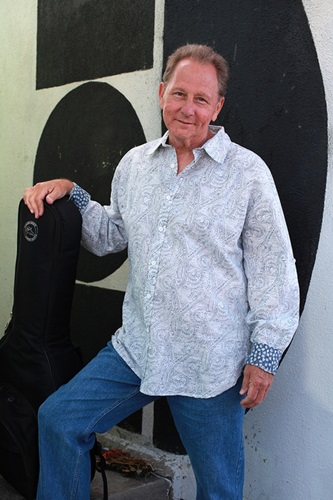
Happy 83rd Birthday to Bob Lind!
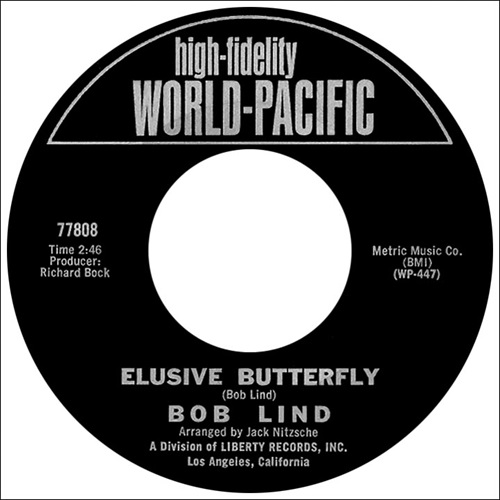
In 1965, Bob Lind signed a contract with World Pacific Records, which was a division of Liberty Records. It was there that he recorded his composition (and only hit) Elusive Butterfly.
From songfacts.com:
Bob Lind wrote this song, where he sees himself as a butterfly hunter. He is looking for romance, but he finds it as elusive as butterflies are to capture. It turned out to be the only hit for Lind, who did a lot of traveling as a kid and ended up playing folk music around Denver when he flunked out of Western State College. He wrote “Elusive Butterfly” as the sun was coming up after staying up all night. He says the song is about “The magic of the quest, the thrill of searching, even when that which is sought is hard to see.”
One of music’s greatest bass players, Carol Kaye, played on the song. She told songfacts.com:
“It was at Sunset Sound. It was kind of a boring tune. I think it was D-flat or something, and it stays a long time in that chord and then it moves in a funny way to the next chord, it’s like a sidebar phrase or something like that. I missed it and I went to go up to the G-flat or whatever and I missed it and I came right back down. I did a slide up and down. And they stopped and I thought, ‘Uh oh, he caught me.’ He said, ‘Do more of those!’ (laughing) So the slide was born, then. I’d stick that slide in here and there on the records I cut.”
I chuckled when I read her quote calling the song “boring.” When I was at WKSG in Detroit, this song would come up on the play list from time to time. Johnny Molson, who did the evening show before I came on the air, had the best description of the song. He told me that the song “sounds like someone ate a Hallmark card … and threw up.”
Happy Birthday to Johnny, by the way. Who knew he and Bob shared a birthday?
Plagued by drug and alcohol problems, Lind gained a reputation in the business for being “hard to work with.” He eventually left the music business for some time, but his music was recorded by over 200 artists. Those artists include: Cher, Glen Campbell, Dolly Parton, Eric Clapton, The Turtles, Johnny Mathis, Nancy Sinatra, The Four Tops, and Petula Clark!
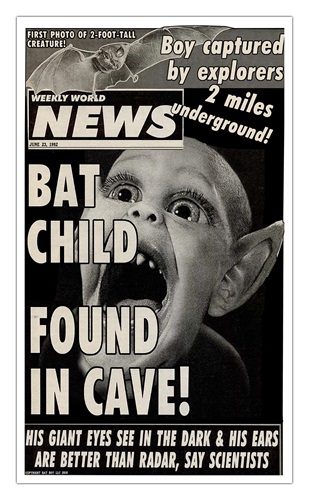
In 1988, he moved to Florida. He wrote five novels, an award-winning play, and a screenplay, Refuge, which won the Florida Screenwriters’ Competition in 1991. He also worked briefly for the Weekly World News and is credited with co-writing their famous “Bat Boy” story.
I’d say that he should stick to singing, but I’m not really keen on that either… So, Happy Birthday, Bob.
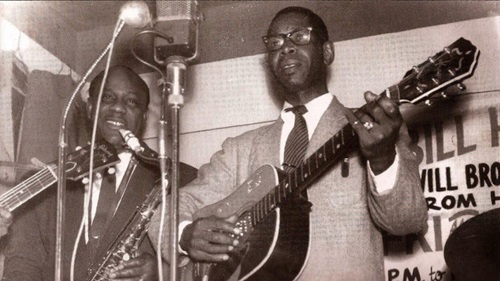
While many attribute today’s song to Stevie Ray Vaughn (who does a fantastic cover), it was originally done by the great Elmore James. James wrote the song and recorded it in 1959.
Elmore James was an American blues guitarist, singer, songwriter, and bandleader. He was noted for his use of loud amplification and his stirring voice. His slide guitar technique earned him the nickname “King of the Slide Guitar”.
The song was written in Chicago after a downpour inspired him during a recording session. The songs features James’ prominent slide guitar and his vocals, accompanied by his longtime backing band, the Broomdusters.
The song itself brings about some questions. James’ unique slide guitar sound on the recording has generated great debate. Bass player, Homesick James, attributed it to a recording studio technique, while others have suggested a different amplifier or guitar setup. Songwriter and musician Ry Cooder felt that it was an altogether different guitar than James’ usual Kay acoustic with an attached pickup.
Artists who have covered the song include Albert King, Eric Clapton and George Thorogood. Elmore’s version reached #15 on the Billboard Hot R&B Sides chart in 1960. The song would be his last charted hit before his death in 1963.
James was inducted into the Rock and Roll Hall of Fame in 1992.
Dave at A Sound Day just wrapped up his monthly feature Turntable Talk. It was an interesting topic this time around and there were a lot of surprises as to who everyone chose to write about. This was my entry to the feature, which originally posted on Dave’s site on Monday:
It is time once again for Dave’s feature Turntable Talk. Dave features this every month on his site A Sound Day. This is the 39th edition, and he continues to come up with fantastic topics. This month is a fun one: Bands? We Don’t Need No Stinkin’ Bands! Dave’s instructions were simple: This time around, we’re looking for artists who left popular bands to go solo and did well (either commercially or else in your own critical assessment.)
I am sure that I did exactly what the other participants did when the topic was presented – I Googled. I was actually surprised at just how many artists moved from a group to become a solo artist. Off the top of my head I can list Diana Ross, Sting, Lionel Richie, Eric Clapton, Gwen Stefani, Ricky Martin, Peter Gabriel, Rob Thomas, Steve Perry, Lou Gramm, and Justin Timberlake. There are SO many.
In all honesty, I had my choice almost immediately. However, as I began to write about him, there was another artist connected with him that became more interesting to me. It was an artist who had solo success for a short time, and then a sad ending.
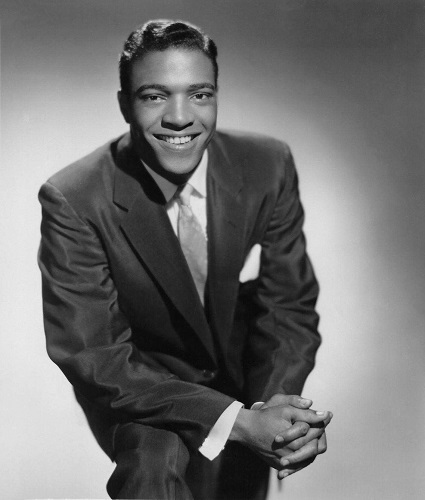
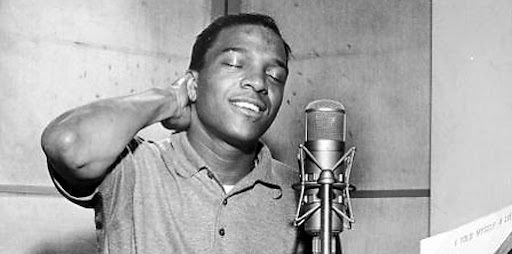
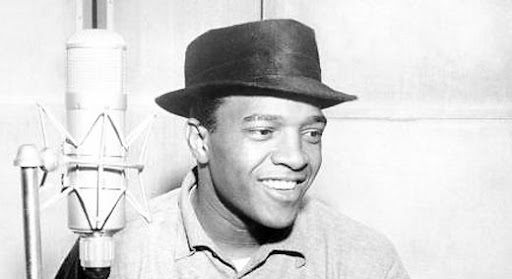
If I mention The Drifters I am sure you can name a few of their big hits. Under The Boardwalk, This Magic Moment, and Up On The Roof are just some of them. The Drifters were formed by my choice artist in 1953. His name was Clyde McPhatter. Let’s go back a couple years to see how it all came together.
Like many artists, Clyde McPhatter began singing in the church choir at his father’s church. In 1950, he was working at a grocery store. He entered the Amateur Night contest at Harlem’s Apollo Theater – and won! Afterward, he went back to working in the store.
One Sunday, Billy Ward of Billy Ward and the Dominoes heard Clyde singing in the choir of Holiness Baptist Church of New York City. He was immediately recruited to join the group. Clyde was there for the recording of their hit “Sixty Minute Man,” which was a number one song on the R&B chart for 14 weeks in 1951.
My original pick for this round was Jackie Wilson. Jackie was hired by Billy Ward in 1953 to join The Dominoes. That same year, Clyde left the group. He coached Wilson while they were out touring together. Wilson would leave in 1957. Apparently, Ward was not pleasant to work with. Wilson said, “Billy Ward was not an easy man to work for. He played piano and organ, could arrange, and he was a fine director and coach. He knew what he wanted, and you had to give it to him. And he was a strict disciplinarian. You better believe it! You paid a fine if you stepped out of line.”
Atlantic Records saw a Dominoes show and noticed that Clyde was not with the group, so they searched for him, found him and wanted to sign him to a record deal. Clyde agreed to sign on one condition – they allow him to form his own group. That group was the Drifters. While known as Clyde McPhatter and the Drifters, they released songs like Money Honey.
Elvis Presley covered Money Honey in 1956. In researching for this piece I was surprised to find that McPhatter and the Drifters did the original of another Elvis hit – Such a Night.
In late 1954, McPhatter was inducted into the U.S. Army. He assigned to Special Services in the continental United States. This allowed him to continue recording. After his tour of duty, he left the Drifters and launched a solo career. The Drifters continued as a successful group, but with many changes in personnel, and the group assembled by McPhatter was long gone by the time their greatest successes were released after he left the group.
It would take two years, but Clyde would finally get his first solo #1 R&B hit when he released “Treasure of Love” in 1956. It would top out at #16 on the US Pop Chart. I love his vocal on this one.
His biggest solo hit would come in 1958 when he recorded and released a song written by Brook Benton. A Lover’s Question would reach #6 on the Pop Chart. If I had to pick my favorite Clyde song, it would be this one. There is so much to love about this song. That acapella bass line being sung throughout the song is very catchy.
McPhatter would leave Atlantic Records and bounce from label to label recording many songs, but not having much success. His last top ten record would come in 1962 with a song written by Billy Swan. Lover Please was first recorded by the Rhythm Steppers in 1960. It was the title track from Clyde’s 1962 album of the same name. It would reach #7 on the Pop Chart.
Clyde did manage to have a top 30 hit in 1964 with “Crying Won’t Help You Now,” but when it fell of the chart, he turned to alcohol for comfort. He would record every so often, but nothing ever really did well on the charts. He always had a decent following in the UK, so in 1968 he moved to England.
He wouldn’t return to the US until 1970. Outside of performing on a few Rock and Roll Revival shows, he lived a very private and reclusive life. In 1972, Decca Records signed him and they were planning a a big comeback. That never materialized as Clyde passed away on June 13, 1972 of complications from liver, heart and kidney disease. This was brought on by his alcohol abuse years earlier. He was only 39 years old.
His legacy consists of over 22 years of recording history. Clyde was the first artist to be inducted twice into the Rock and Roll Hall of Fame, first as a solo artist and later as a member of the Drifters.
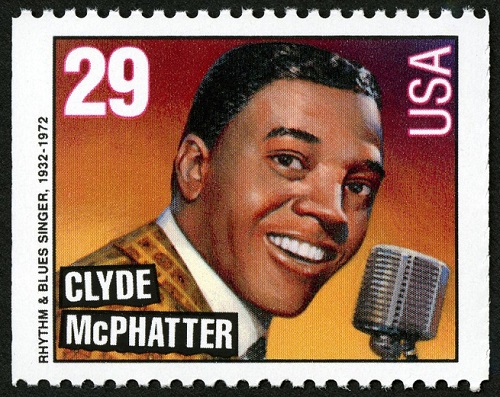
In 1993, Clyde was honored with his own stamp by the US Postal Service.
His career had ups and downs, and his hit songs were an important part of Rock and Roll history. Vocalists like Marv Johnson, Smokey Robinson and Ben E. King are all said to have patterned their vocal styles on Clyde’s. Others have cited him as a major influence as well. In the book “The Drifters” by Bill Millar, he says:
“McPhatter took hold of the Ink Spots’ simple major chord harmonies, drenched them in call-and-response patterns, and sang as if he were back in church. In doing so, he created a revolutionary musical style from which—thankfully—popular music will never recover.”
Thanks again to Dave for hosting another great round of Turntable Talk. I cannot wait to see who the other writers have picked and look forward to Round #40 next month.
I noticed that I accidentally scheduled this to post at 8pm instead of 8am. Sorry I am late.
This is sort of a continuation of the Music of My Life feature. It focused on music from 1970-2025. It featured tunes that have special meaning to me, brought back a certain memory or a tune that I just really like. I found that with the first three decades, there were songs that I didn’t feature. So I sat down with my original lists and selected some songs that “bubbled under,” so to speak.
I figured a good way to present them was to focus on a decade. 10 years = 1 song per year = 10 songs. Last week I wrapped up the 80’s. This week we move on to the 90’s. So, let’s check out a few “Decade Extras.”
1990
My first song this week is one from a group that has music in their bloodline – Wilson Phillips. Chynna Phillips is the daughter of John Phillips and Michelle Phillips of The Mamas & The Papas, while Carnie Wilson and Wendy Wilson are the daughters of Brian Wilson of The Beach Boys and Marilyn Rovell of The Honeys.
Around this time I was really going through some depression. There were so many things coming at me at home, at work, and life in general. Hold On, cheesy as this may sound, really helped me get through some of those times. The song was the breakout hit for the group, and it was a huge one, peaking at #1 on June 9, 1990.
According to Songfacts.com, Chynna Phillips wrote the lyrics about her drug and alcohol addiction.
Producer Glen Ballard had been working with Wilson Phillips when he handed Chynna a cassette tape with some music that needed words. Phillips took it home to work on the lyrics, but inspiration struck before she even got to the front door.
She wrote about the pain of a lost love and the substance that surrounded it while sitting in her driveway. “I thought to myself, ‘Well, AA tells me, just hold on, just one day at a time. I thought, ‘OK, if I can just hold on for one more day, then I can do this.'”
Hold On
1991
The plea for racial tolerance had been going on long before 1991 (and remains to this day). Michael Jackson offered up his plea in the song Black or White. The song was the fastest-rising single in 22 years (since The Beatles’ “Get Back”), jumping from #35 to #3 in its second week, and landing at #1 in its third week.
The video was originally 11 minutes long, but eventually edited down for airplay on channels like MTV. It featured a morphing technique that was very innovative at the time. We see this kind of thing all the time today, but in 1991, it was one of the coolest things I had ever seen.
The video features Macaulay Culkin and George Wendt (Norm from the sitcom Cheers, who passed away yesterday) appeared in it, as well as Tyra Banks before she gained supermodel status.
Black or White
1992
Tears in Heaven by Eric Clapton is just a beautiful (albeit sad) song. Clapton wrote this about his four-year-old son Conor, who died on March 20, 1991 when he fell out of a 53rd floor window in the apartment where his mother was staying in New York City. He wrote it with Will Jennings. Jennings told Songfacts:
“Eric and I were engaged to write a song for a movie called Rush. We wrote a song called ‘Help Me Up’ for the end of the movie… then Eric saw another place in the movie for a song and he said to me, ‘I want to write a song about my boy.’ Eric had the first verse of the song written, which, to me, is all the song, but he wanted me to write the rest of the verse lines and the release (‘Time can bring you down, time can bend your knees…’), even though I told him that it was so personal he should write everything himself. He told me that he had admired the work I did with Steve Winwood and finally there was nothing else but do to as he requested, despite the sensitivity of the subject. This is a song so personal and so sad that it is unique in my experience of writing songs.”
Clapton wasn’t sure he wanted this song to be released at all, but the director of Rush, Lili Zanuck, convinced him to use it in the film. “Her argument was that it might in some way help somebody, and that got my vote,” Clapton said.
The song was a huge hit. It won Grammys in 1993 for Record of the Year, Song of the Year, and Best Male Pop Vocal. Clapton was nominated for nine Grammys that year and won six.
Tears in Heaven
Clapton played an acoustic version on his 1992 MTV Unplugged special. Personally, I love this version best.
1993
There are some songs that will be forever associated with television or movies. The next song is one of those. If I say “What is Love” by Haddaway, you know what you think of …. SNL.
According to Songfacts, this song gained popularity when it was used in a recurring Saturday Night Live sketch about three guys who go clubbing. They dress alike – in outdated fashion – and torment women at the clubs by forcing their dancing upon them. There is very little dialogue in the sketches, and this song plays throughout, with the three men bobbing their heads in unison. In 1998, the skit was extended to a full-length movie called A Night At The Roxbury.
The two regular performers in the skit (and movie) were SNL cast members Will Ferrell and Chris Kattan. The host of the show would often be their third man in the bits – Jim Carrey and Sylvester Stallone each did a turn as the head-bobbing swingers.
Although the song is an upbeat dance track, the lyrics are rather gut-wrenching, as Haddaway sings about trying to love a girl who won’t love him back.
What is Love
1994
1994 features a cover song. The original was done by Vicki Sue Robinson in 1976, and it was her only hit. That song was Turn the Beat Around.
Gloria Estefan’s nearly identical cover version in 1994 was used in the Sharon Stone movie The Specialist. Her version was a #1 Dance hit and went to #13 on the Hot 100. The song reminds me of many of the dances that I DJ’d over the years where it was a big dance tune.
Turn the Beat Around
1995
The next song was meant to be a tribute to Bob Dylan. Apparently, Dylan felt the “tribute” infringed too closely on original work, and he sued the group who recorded it for unauthorized use of his lyrics. Bob wound up receiving a large, out-of-court settlement in 1995. The song? Only Wanna Be With You. The group? Hootie and the Blowfish.
When singer Darius Rucker recorded a country album, he stopped by our station. It was in the late afternoon and I was the morning guy. I honestly didn’t think his country stuff would go anywhere, so I skipped the visit. For what it is worth, that first country album had some great tunes on it and I regret not stopping in.
I Only Wanna Be With You
1996
One of the biggest slow dance songs of 1996 came from a movie that featured – Cartoon characters! R. Kelly wrote I Believe I Can Fly for Space Jam, a movie starring Michael Jordan and other NBA stars in a world of cartoons (including Bugs Bunny). The song plays in the opening scene where a young Jordan is practicing late at night. When his father comes to bring him inside, they talk about Michael’s aspirations: to play at North Carolina; to play in the NBA; to fly.
The movie was big at the box office, but this song was even bigger, becoming an inspirational anthem often played at weddings and used in video tributes. Kelly got an early copy of the movie to view for inspiration. According to Rolling Stone magazine, Kelly said, “I studied it and I prayed over it because I wanted the best thing to come out of it.”
Fun Fact: Kelly may claim that he believes he can fly in this song, but in reality the R&B superstar has a chronic fear of air travel. Kelly is so scared of planes that he even takes boats when he tours Europe.
I Believe I Can Fly
1997
I was still working at the mailroom at EDS when Tonic released If You Could Only See. It played a lot on Planet 96.3 in Detroit when I was doing deliveries. I had no idea how the song came about, but it is a neat story.
Songfacts says, Tonic frontman Emerson Hart wrote this song after a tense phone call with his mother. Hart was 21 years old and planning to get married – not what his mother had in mind. She tried to talk him out of it, but you can’t argue with love. Emerson told her: “If you could only see the way she loves me, then maybe you would understand,” and then he hung up.
With his fire sparked, Hart started writing the song, and it came very quickly, with him taking aim at his mother’s “manipulations” and “lies” during the strident verses, then slowing it down to present his side of the story in the chorus. The song was very cathartic and helped him work out his feelings, but in the end his mother was right: it didn’t work out with the girl and they never got married.
This was Tonic’s first single, but it almost didn’t make the album. The band got a deal with Polydor Records after playing clubs for a few years in the Los Angeles area. When it came time to record their debut album, Emerson Hart wasn’t sure if they should use “If You Could Only See,” since it was a very vulnerable song and he wasn’t sure how it would be received. Polydor, however, loved it and made sure it was the debut single.
If You Could Only See
1998
I’ve said before, Jewel was one of the greatest interviews I ever did. She was such a wonderful and delightful person. The story that proceeds her success is inspiring.
At a February 2008 concert in Las Vegas, Jewel explained that when she was 18, she was living in a van and did some shoplifting. She was going to take a dress when she looked at her hands and realized that she controlled them. Said Jewel, “I realized I was cheating myself. No matter how you work with your hands your own dignity is up to you.”
She played mostly new tracks from her country album when she was with us. I did get her to play Hands for us while we not on the air. She also did a Christmas version on her Christmas album.
Jewel performed this on Late Night with David Letterman a week after the 9/11 terrorist attacks. The song was a popular choice on the radio when a DJ remixed the track after the tragedy.
Hands
1999
American Woman by the Guess Who was the song that was number one on the day I was born. It was featured in the first installment of this feature. It’s interesting that it shows up again in 1999, but this time by Lenny Kravitz.
This was used in the movie Austin Powers 2, The Spy Who Shagged Me. The video featured Heather Graham, who was in the movie, as the American Woman. Kravitz told how he came to record the song in an interview:
“I was called by the people making Austin Powers and they simple asked me to cover ‘American Woman,’ which I thought was odd but I accepted thinking it was an interesting challenge and did my best to change it as much as possible while still respecting the original. I was pleased when Burton Cummings called me to tell me how much he loved it.”
Lenny’s version is actually pretty good. I think he did a great job making it his own. People liked it, too, as it won a Grammy in 1999 for Best Male Rock Vocal Performance.
American Woman
There’s Round 1 of the 90’s. We’ll revisit the decade again next week before moving on into the 2000’s and wrapping up the feature.
Welcome back to The Music of My Life, where I feature ten songs from each year of my life. In most cases, the ten songs I choose will be ones I like personally (unless I explain otherwise). The songs will be selected from Billboard’s Year-end Hot 100 Chart, Acclaimed Music, and will all be released in the featured year.
In 1992, I turned 22 and would land a radio gig at WHND, Honey Radio. It was through my old radio partner that I would become all too familiar with karaoke bars. We spent a lot of time pretending to be singers at them. Believe it or not, it was listening to people try to sing that introduced me to many songs. Many of those songs, were ones I normally would have been unfamiliar with.
Let’s jump right into 1992!
The Spin Doctors are often referred to as an alternative band. I tend to think of them as a rock band, though. Two Princes sounds more like a rock song to me. I could easily hear the Stones covering it.
A buddy of mine used to sing this song all the time. From the opening drum kick and guitar lick, I was hooked. The content of the song was influenced by some classic literature. Chris Barron, said:
“I loved The Lord of the Rings and The Hobbit and Sir Gawain and the Green Knight. I was really into fantasy fiction and stuff like that. I wrote that song when I was 19, so I was still coming out of childhood, and as a child I loved wizards and kings and queens and princess and princesses and stuff like that. And I loved Shakespeare – I already was way into Shakespeare. So I gravitated towards that kind of imagery just because I liked books and poems from that period of time.”
Drummer Aaron Comess said that the song was almost a lot faster. “There are certain songs when you find the right tempo, all of a sudden the lyrics come out, it feels right and I think with ‘Two Princes’ we really lucked out. It’s one of those things, we got in the studio, found a good tempo, we recorded it, everything just really came together. It’s very simple, there’s not a lot of stuff on it, somehow the sound and feel we got, we just lucked out and found the perfect thing.”
Songfacts pointed out that it was songs like this one that were in high demand on radio in 1992-1993. There was an onslaught of hip-hop songs at the time and it was this “sound” that began pushing it back a bit.
Two Princes
Here is another example of how I came to learn of the original because of a parody. I was familiar with the cover of their Nevermind album, but unfamiliar with a lot of their songs. Enter once again, Weird Al.
When Al first heard Nirvana, he was very impressed but thought they wouldn’t catch on. He was thrilled when “Teen Spirit” became a huge hit, since that made the group a parody target.
Al is famous for asking for permission before doing any type of parody. He got permission from Nirvana’s lead singer Kurt Cobain while he was doing an episode of Saturday Night Live. Kurt initially thought the song would be about food. Instead, it was poking fun at how hard it was to understand their lyrics.
The video is a very close parody of Nirvana’s, and got almost as much airplay. For example, the same janitor used in Nirvana’s video also makes an appearance in Weird Al’s. This time donning a tutu and playing a tuba. Al dresses just as Cobain did, complete with wig. He plays a fake blowup guitar and makes fun of the hard-to-understand lyrics by gargling water and singing with marbles in his mouth.
FYI – Dick Van Patten was not in the Nirvana video.
This song is probably the one that really solidified my opinion of Weird Al as a musical genius!
Smells Like Nirvana
For comparison – the original video:
Ok, I admit that the next song was far from a hit. It only peaked at #92 in the US, however in the UK it hit #27. The original, of course, was a number one hit for Elvis Presley in 1957. Personally, I really like Billy Joel’s version of All Shook Up. I think it should have done better on the charts.
The song is one of many Elvis covers from the soundtrack to Honeymoon in Vegas. The movie starred Nicolas Cage, James Caan, and Sarah Jessica Parker. It also featured a whole lot of Elvis impersonators.
What I love about Billy’s version is that it retains the feel of the original, but there is enough “Billy” to make it his song. When I was DJing, I used to put on a cape, an Elvis Wig, Elvis glasses, and grab some random gal out of the audience and “lip synch” this to her. It was ridiculous, but it always got a laugh from the crowd (along with a lot of photos).
All Shook Up
Next, we have the only song that I will fast dance to. I say this, because I believe there is no real dancing necessary. Songfacts explains this perfectly:
House of Pain’s Jump Around earned relentless airplay on MTV and pop radio, and became a huge crowd pleaser in bars and dance clubs. It was great for getting people on the dance floor, as no real dancing is involved – just jumping around.
Exactly. I jump like a fool when this one is on! It’s hard to look bad. It brings the bounce with a steady, throbbing rhythm along with explicit instructions on when to jump. You can’t mess this one up!
Erik “Everlast” Schrody wrote the song. Songfacts explains that the lyrics on this track are very aggressive. It contains lines like “I bust him in the eye, and then I’ll take the punk’s ho.” Everlast was surprised when the song crossed over to a pop audience. He thought it was “too hardcore” to do so. The “pugnacious” lyrics, however, are tempered with comic relief. Listen for lines like “I got more rhymes than there’s cops at a Dunkin’ Donuts shop. ” They make it a lot less threatening.
If the horn flourish that opens this song sounds familiar, it is because it comes from Bob and Earl’s song, “Harlem Shuffle”.
Jump Around
Next a movie song that never made the movie’s soundtrack. In A League of Their Own, Madonna starred with Tom Hanks, Geena Davis and Rosie O’Donnell. The film was based on the true story of an all-women baseball team that was popular during World War II.
The song is about a woman who can’t and let go of her past, with the implication that her present circumstances aren’t so good. The lyrics fit well with the film’s premise, as the now-elderly women reunite and recall their glory days as baseball stars.
To a degree, I can relate to this as I tend to live in my nostalgia and memories, however, my present circumstances are actually good. I find myself thinking of those summers playing ball at our old elementary when I hear this song.
This made me laugh: The video for this song, which shows Madonna singing from the pages of a photo album, bears a strong resemblance to Boy George’s video for his 1987 song “To Be Reborn.” The similarities were not lost on the Culture Club singer, who angrily dubbed it “This Used to Be My Video” in his autobiography.
This Used To Be My Playground
What I love about country music is the honesty of it. There are a handful of songs that I can say really hit home for me. One of them is from Travis Tritt’s third album. For me, I could relate to the lyrics of Lord Have Mercy on the Working Man. After all, I was working on a DJ’s salary!
Truth be told, it doesn’t matter what job you hold, these lyrics hit home. While primarily focusing on the economical injustice to blue collar workers, it fits anyone who struggles financially.
Uncle Sam’s got his hands in my pockets And he helps himself each time he needs a dime
Why’s the rich man busy dancing While the poor man pays the band Oh they’re billing me for killing me Lord have mercy on the working man
The final verse features Tritt’s friends joining in. Listen for Brooks and Dunn, George Jones, Little Texas, Tanya Tucker, T. Graham Brown and Porter Wagoner.
Lord Have Mercy On The Workin’ Man
MTV’s Unplugged had been around since 1989. It featured Joe Walsh, The Cure, Paul McCartney, Sting, and Mariah Carey. Eric Clapton recorded an Unplugged performance at Bray Studios in London. He rearranged many of his classic songs for the acoustic context.
The resulting Unplugged album went on to become the best selling Unplugged album in the U.S. and worldwide with sales of 10 million in the U.S. and 26 million worldwide. He earned six Grammy Awards for the album. He earned Grammys for Record of the Year, Album of the Year, Song of the Year, Best Male Pop Vocal Performance, Best Rock Male Vocal Performance and Best Rock Song.
I have been a fan of acoustic shows for a long time. I loved when artists came in and played acoustically for us. It is raw and you really feel the song. When I heard the Unplugged version of Layla, I couldn’t get enough of it. I loved the entirely different feel to the song! It was so much more bluesy.
The Unplugged version also helped Eric do his vocal. According to Songfacts, “playing the “Layla” riff while singing is like juggling on a unicycle, so Clapton tries to avoid it. When he does the rock version live, he’ll play the riff until his vocals come in, then let one of his band members take over the riff.” With the slower version, it was a lot easier for him.
Layla (Unplugged)
When it comes to Disney, you cannot deny the amazing songs that have been featured in their films. It is truly hard to picture anyone other than Robin Williams as the Genie in Aladdin. He was just perfect. There were hours of audio that were not used in the film from Robin. If it were ever released to the public, I’d buy it in a heartbeat!
Prior to having children, I was not one to run out and watch a Disney movie. However, knowing that Williams was the Genie in this one, I had to go see it. I was not disappointed.
The Genie’s song, Friend Like Me was written by the amazing composer Alan Menken and lyricist Howard Ashman. Menken and Ashman didn’t write this with Robin Williams in mind, but the actor would make the number his own. Menken told Entertainment Weekly:
“We didn’t know who was going to play the genie when we wrote the song. We were looking at the character as black, a hipster, and I suggested a Fats Waller, Harlem stride-piano style from the ’40s. When Robin Williams was suggested, my first thought was, ‘Can he sing like Fats Waller?’ Robin learned every note. He was working on Hook at the time, and he would come in after being stuck in a harness all day and sit at the piano and learn. When we went into the studio, we got exactly the Fats Waller performance we wanted, and then everyone said, ‘Okay, but now can we let Robin do his thing?’ He was amazing. That trumpet wah-wah-wah was supposed to be from an instrument, and he made it vocal. He took ahold of the creative process, both on that and ‘Prince Ali’ especially. My God, he went crazy on ‘Prince Ali.’ He was doing the Thanksgiving Day Parade, Arab-style.”
One source says that the song was originally written as a Cab Calloway style big band number. Some elements of this concept remain (for instance, when the Genie scats, in typical Calloway moves), but after Robin Williams was cast it was expanded as a more comedic, pop-culture-filled song.
I miss Robin Williams. He could do comedy and drama and do them both well. This is what makes a great actor, in my opinion. He was truly one of the best ad-libbers and I always loved watching him on late night shows.
When we were picking songs for our alumni band one year, I picked this song for us. Not the best song to march to in a parade, but it was fun to play.
Friend Like Me
I was disappointed in the soundtrack version, as it seems like Robin’s vocals are a bit buried.
I just realized that my list has two Elvis covers on it. Technically, they are both movie songs, too.
When ZZ Top released their Greatest Hits album, they included a remake of Viva Las Vegas. ZZ Top took it up a notch. They took Elvis’ song and modernized it and gave it a real driving rock sound.
I remember my dad bringing home the 12 inch single of it and saying, “Keith, you’ve got to hear this!” He put it on the turntable and there was a downward swishy sound effect followed by Elvis saying, “Y’all still want me to come with ya?” Once the guitars kick in, it just jams!
It’s one of my guilty pleasure songs.
Viva Las Vegas
I had a meeting with a bride and groom once. We were going over songs for their wedding. When I asked them what their wedding song was, they told me “If I Had $1,000,000 by Barenaked Ladies.” I must have looked like an idiot. I thought they were joking. “Barenaked Ladies?! Really?!” I had never heard of them.
I had no idea what to expect when I went searching for the song. I’ve had my share of weird songs to play for the bridal dance, so I was ready for anything. I was finally able to get a copy of it, but it wasn’t easy. The couple enjoyed their dance and the crowd loved every second of it.
Even though it’s one of the group’s most popular songs, it was never a hit single in America. It wasn’t a hit in the UK either. A lot of it was timing: The group didn’t break through outside of their native Canada until their 1998 album Stunt. The song was even re-released in 1996, but didn’t chart then either.
This is a very important song for Barenaked Ladies. They have performed it at nearly every live show since 1988. Frontman Ed Robertson told Songfacts:
“It has become its own thing and people sing along and it represents a time and a place for so many people. It’s oddly a song I don’t get bored of. It brings such joy to the room that it’s hard to not enjoy it.”
He goes on to say, “That song, it was about being in love and being maybe a little bit extravagant but not losing hold of what’s important.” Ultimately it’s just about celebrating your good fortune with someone else, and I think I’ve stayed pretty true to that.”
The song was my introduction to the group. I have come to enjoy many of their future songs, too. Perhaps one or two may show up in the years to come.
If I Had $1,000,000
That’s a wrap on 1992. Did I miss one of your favorites? Drop it in the comments.
Next week, as we head to 1993, a few ballads with a lot of personal meaning to me, a couple fun dance songs, a spelling lesson, and more stories behind the songs.
Welcome back to The Music of My Life, where I feature ten songs from each year of my life. In most cases, the ten songs I choose will be ones I like personally (unless I explain otherwise). The songs will be selected from Billboard’s Year-end Hot 100 Chart, Acclaimed Music, and will all be released in the featured year.
Before we get into the music, I have to take a moment to mark a blogging milestone. This blog will be the 1400th blog I have written since the Nostalgic Italian site went live.
1400 posts and here you are still reading. For that, I thank you from the bottom of my heart. I am glad that you are here. Now, let’s celebrate by going back to 1989…. when I turned 19.
As I sorted through the singles from 1989, I noticed that there were a lot of duets recorded that year. After All from Peter Cetera and Cher, Don’t Know Much and All My Life from Linda Ronstadt and Aaron Neville, were just a few of them. No duets made my list, however, as I just didn’t feel any of them connected with me enough to bump the ten songs I picked.
I grew up listening to Roy Orbison. He was a favorite for a long time. I used to ask my dad to play his songs on the stereo all the time as a kid. In 1988, Roy saw his career take on new life. He recorded with George Harrison, Jeff Lynne, Tom Petty and Bob Dylan as part of the group The Traveling Wilburys (More on them in a moment) and had recorded a brand new album (Mystery Girl) in November of 1988.
On December 6, 1988, I was at the radio station when an “Urgent” Bulletin came across the AP Newswire stating that Roy had died after having a heart attack. I had never met Roy, but his music was such a big part of my life that seeing the story upset me quite a bit.
You Got It was the first single released from the Mystery Girl album in January of 1989. Orbison wrote the song with his Wilbury friends, Jeff Lynne and Tom Petty. Lynne produced the track and also played guitar, keyboards and bass; Petty played acoustic guitar and sang backup. It would reach #1 on the Adult Contemporary chart and #9 on the Top 40 chart.
Orbison performed this song just once: at the Diamond Awards Festival in Antwerp, Belgium on November 19, 1988. This performance was used as the song’s music video.
You Got It
Every interview I have seen with the guys from the Traveling Wilburys always has them saying how wowed they were by having Roy in their group. When Jeff Lynne was asked about the recording sessions, he said, “Everybody just sat there going, ‘Wow, it’s Roy Orbison!’ … Even though he’s become your pal and you’re hanging out and having a laugh and going to dinner, as soon as he gets behind that [microphone] and he’s doing his business, suddenly it’s shudder time.”
Roy was in the group’s first video (for Handle With Care), and was set to travel to London a couple days after he passed away. One of those videos was for The End of the Line. One of the reasons that I love this video is that the group gives a heartfelt tribute to their friend. When Roy’s vocal happens, we see Roy’s guitar in a rocking chair next to a framed photo of Roy.
The End of the Line
I have never seen the movie Road House. My mom liked it a lot, because she liked Patrick Swayze. Jeff Healey and his band were shooting scenes for the movie (and Jeff had many scenes with Swayze) and recording his See The Light album simultaneously. One of the cuts from this album was Angel Eyes.
I had never heard of Healey before this song. I had no idea that he was blind and marveled at the way he played his guitar (on his lap, like a piano). I was really blown away by his vocals and his guitar playing. He was discovered by two blues legends – Stevie Ray Vaughn and Albert Collins.
He toured and sat in with some fantastic people over the years including Buddy Guy, BB King, Eric Clapton, ZZ Top, The Allman Brothers and Bonnie Raitt (just to mention a few.) While he is mainly known for his bluesy style, by the year 2000 he actually was releasing many jazz albums.
He loved music and he was an avid record collector. He amassed a collection of well over 30,000 old 78 rpm records. Starting in 1990 he hosted a radio program of very early jazz on CIUT at the University of Toronto with Colin Bray. Later he went national on CBC Radio’s program entitled My Kind of Jazz, in which he played records from his vast vintage jazz collection.
Too many people write him off as a “One hit wonder” act. His music is fantastic and this song is so soulful … he was a talent taken too soon.
Angel Eyes
“Hey, man! Have you heard that new song by Marvin Young?” I can’t even imagine what type of music someone called Marvin Young would be singing! However, Young MC just screams rap music, right?! I’ve never been a big rap fan, but there was just something about the baseline and the catchy lyrics that made this a favorite for me.
Bust a Move was a song that whenever I played it, the crowd always new the words and sang along. The verse that every one knows is “Your best friend, Harry, has a brother Larry, in five days from now he’s gonna marry…” The whole rhythm of that verse and the baseline fit so well together. I also like the fact that while there is some sexual innuendo, there is no profanity in the song.
Interesting story from songfacts.com: Flea from The Red hot Chili Peppers played bass on this song and appears in the video, but he didn’t reap the rewards. He explained to Bass Player magazine: “I have a bitter taste in my mouth about that, because I feel as though I got ripped off. The bass line I wrote ended up being a major melody of the tune, and I felt I deserved songwriting credit and money because it was a #1 hit. They sold millions of records, and I got $200! Afterwards, my lawyer told them, ‘You should throw down Flea some cash,’ but the record company said, ‘We told him exactly what to play.’ No one was even in the room at the time but me and the engineer! It was ridiculous, but I learned from it.”
It was one of the first rap records to cross over to the mainstream charts. It went to #7! Young MC recalled to Rolling Stone: “People looked at rap and hard rock as the type of music that you slam your door after you argue with your parents, and bang your head in defiance. My record wasn’t necessarily rebellious, but it was clever enough to grab in a decent segment of people that didn’t listen to rap music.”
Bust a Move
The next song is one that I used to play for my prom date, Karen, after we started dating. This and Just You and I from Eddie Rabbit and Crystal Gayle were “our songs.” I remember the first time I heard Luther Vandross sing Here and Now. I remember how powerful the lyric was and just how perfect his voice was for the song.
Karen and I dated for a bit and broke up around 1990, only to get back together a year or so later before breaking up after another year or so. Somewhere during that time I had made her a mix tape of love songs. This was just one of many that made it to that tape.
It was hard for me after we broke up because I was DJing a lot of weddings and this was a very popular Bride and Groom song. I almost always had to put headphones on and listen to something else while it played. Today, I can listen to it and it doesn’t bother me, but at the time, it brought about a lot of pain.
Here and Now
My next tune is one that I have featured before and I wrote about how it was helpful to me post-divorce. You can read about it here:
I have said many times that Willie Nelson always seemed to have one song on each album that I connected with personally. Many times it was more than that. In 1989, he released a fantastic album entitled “A Horse Called Music.” On the album is a cut that was co-written by Mike Reid (who played five seasons with the Cincinnati Bengals and had a brief country singing career) called There You Are.
I had heard the song many times when listening to the album, but it wasn’t until after the final break up with Karen (see above) that the song really hit me hard. At the time, I was still wrapped up in feelings and hated that we were not together. I found myself thinking about her more than I should have been, especially since she had moved on with her life. Then I heard this song…
I could have written this song! It literally was exactly what was happening to me. For no reason, she’d pop into my head. It was never bad things, it was always some good memory of when we were together. The string arrangement and Willie’s vocal convey those feelings in such a magnificent way. It is beautifully sad …
I had never seen the video for this song until I searched for it today. Willie cleans up pretty good…
There You Are
When you make a list of great songwriters – Leiber and Stoller always are on that list. The next song was written by Oliver Leiber, the son of Jerry Leiber of that aforementioned team. Oliver had already written a couple songs for Paula Abdul (Forever Your Girl and The Way That You Love Me) when he got a call saying that the label needed one more song for her album. That song would be Opposite Attract.
From songfacts: This song evolved into a duet with a cartoon cat named MC Skat Kat, who was actually the duo The Wild Pair. Oliver Leiber explains: “I wrote it all from the perspective of one person singing it. It wasn’t initially a duet. It was saying, ‘I like this and you like that.’ It was basically: I like potatoes, and you like po-tah-toes, all from one singer’s perspective. But I had these two singers I had been working with – Marvin Gunn and Tony Christian. They’re the guys that sang on Prince’s “Kiss” and they were incredibly soulful funky singers that I had been using as part of my sound on the first two tracks I did with Paula, helping to preserve the Minneapolis sound, because they sounded very Prince-y and it really added something to Paula’s vocals.
Basically, he had the Wild Pair sing the entire song and then got Paula to cut her lines later. He wasn’t happy with the original mix, which is why the album and the single versions sound so different.
In the video, the real Paula interacted with the animated MC Skat Kat. The concept of Paula dueting with a cat came from Anchors Aweigh, a movie where Gene Kelly dances with the mouse from Tom & Jerry. The video was directed by Michael Patterson and his wife Candace Reckinger, who also created the MC Skat Kat character and animation. Patterson said: “Gene Kelly loved it; he was a friend of Paula’s. Gene was also an inspiration to Candace and I.”
Fun Fact: Patterson and Reckinger got their start in music videos when they created the iconic clip for a-ha’s Take On Me
I loved the Gene Kelly and Jerry Mouse dance, so naturally, I loved this video (and Paula) too!
Opposites Attract
Before I knew the song was about Elvis, I really loved the sound of Black Velvet by Alannah Miles. It was considered a power ballad, but to me it sounded more like a good blues song. Miles’ voice had that bluesy and sultry voice that fit with the groove of the song perfectly.
The story of how the song came to be is a good one. Co-writer Christopher Ward, who was Myles’ then-boyfriend, was inspired on a bus full of Elvis fans riding to Memphis attending the 10th Anniversary Vigil at Graceland, in 1987. Upon his return to Canada, he brought his idea to Myles and producer David Tyson, who wrote the chords for the bridge. The song was one of three in a demo Myles presented to Atlantic Records, which eventually got her signed to the label.
Songfacts provides a bit of lyric analysis:
“Black velvet and that little boy’s smile” – You can buy a black velvet Elvis painting at any respectable yard sale. Early female fans were drawn to his “Little boy smile.”
“Black velvet with that slow southern style” – Elvis delivered some of his songs with slow, undulating hips. Check out “Steamroller Blues” live.
“Up in Memphis the music’s like a heatwave” – Sun Studios. The epicenter of early rock music and where Elvis recorded.
“Love Me Tender leaves ’em cryin’ in the aisle” – Love Me Tender was a huge hit for Elvis in 1956.
“The way he moved, it was a sin, so sweet and true” – Elvis’ legendary hips swivel, the Pelvis.
“Every word of every song that he sang was for you. In a flash he was gone, it happened so soon, what could you do?” – Elvis died suddenly in 1977.
Black Velvet
For me, the last song for this week is something that I continue to work on in my personal life. In my first marriage and throughout that period of my life, I just found it easier to back down and make everyone happy. I did this even if it made me unhappy. It is challenging to stand your ground and not back down from what you believe in or what you feel is right.
Tom Petty’s song was helpful to him as well. Before recording his Full Moon Fever album, an arsonist burned down his house while he was in it with his family and their housekeeper. They escaped, but Petty was badly shaken and spent much of the next few months driving between hotel rooms and a rented house.
Songfacts says that: It was on these drives that he came up with many of the songs for the album; the fire was a huge influence, especially on this song. Petty felt grateful to be alive, but also traumatized – understandable considering someone had tried to kill him. “I Won’t Back Down” was his way of reclaiming his life and getting past the torment – he said that writing and recording the song had a calming effect on him.
The song was used as a patriotic anthem after the September 11th terrorist attacks. Regarding that, Tom said: “The song has also been adopted by nice people for good things, too. I just write them, I can’t control where it ends up.”
The song has a Wilburys connection. The video features Ringo Starr on drums, with Wilburys’ George Harrison and Jeff Lynne on guitar. Harrison did play on the track and contributed backing vocals, but Ringo had nothing to do with the song itself.
I Won’t Back Down
That’s it for the 1980’s! We’ll dive into a brand new decade next week. 1990 was a good year for music. Starting in the 1990’s my music choices tended to lean a bit more country as far as new stuff. In 1990 alone, I could have picked 10 country songs for the list. I didn’t, but I could have.
Next week’s list will feature and interesting mix of music, largely due to the radio station where I was working at the time … some classic rock, some soulful songs, and big pants ….
Did I miss a favorite of yours from 1989? Tell me all about it in the comments. See you next week.
Welcome back to The Music of My Life, where I feature ten songs from each year of my life. In most cases, the ten songs I choose will be ones I like personally (unless I explain otherwise). The songs will be selected from Billboard’s Year-end Hot 100 Chart, Acclaimed Music, and will all be released in the featured year. I turned four in ’74, so let’s venture back there and give a listen….
Bob Marley wrote I Shot the Sheriff and recorded it in 1973. Eric Clapton covered in for his 461 Ocean Boulevard album. Billboard magazine called his version a “catchy goof of a winner.” Clapton softens up the reggae a bit and it went straight to the top spot on the Hot 100 Chart.
I Shot the Sheriff
June of 1974 was a hot month for music releases as the next five songs all hit the radio in that month. First, we have a soul hit from the Three Degrees – When Will I See You Again.
Before I go on, let me explain why it is on my list. I was dating my prom date, Karen, and we often spent evenings driving around and listening to the radio. There was a “love song” show called Pillow Talk that aired at night. It always seemed to play on that show and throughout the day on the Adult Contemporary stations.
I think we both thought the name of the song was “Precious Moments” for some reason. All I can recall is that we both laughed at the “Hoo” and “Hah” at the beginning. I don’t know about her, but every time I hear it, I think of her and us laughing at that song.
The lead singer on the song, Sheila Ferguson, hated it the first time she heard the demo. She said she’d never sing it because she felt it was insulting to be given a song that “took no talent to sing.” Her thoughts obviously changed after the song’s success, and the group had a #2 hit!
When Will I See You Again
Canadian singer Andy Kim hadn’t had a hit record since 1971 and has lost his record deal in 1973. He never gave up and created his own label (Ice Records) and used his own money to record Rock Me Gently.
The song was released in June and hit #1 in September of 1974. The B-side was an instrumental version of the song and some stations played that, too. Rock Me Gently was the last Top Ten hit for him.
Rock Me Gently
Long before I was a radio DJ, I was introduced to Wolfman Jack by the Guess Who. The Guess Who’s Burton Cummings explained that the song began as a jam and was originally called “Clap For Napoleon.” As they were appearing on NBC’s Midnight Special a few times in 1973 (they hosted the show in ’74), they changed the lyric as a tribute to the show’s host, the late Wolfman Jack. The Wolfman can be heard throughout the song.
In his autobiography Have Mercy!: Confessions of the Original Rock ‘n Roll Animal, Wolfman Jack singles out Burton Cummings for adding his name to the song and taking him on tour to promote it. According to the Toronto Sun, the Wolfman quit his job at WNBC (where he enjoyed “$350,000 – plus a secretary, a chauffeured limousine, a bodyguard, and a well-ventilated private room at Rockefeller Center for the smoking of dope in”) to go on tour with The Guess Who.
Clap For The Wolfman
You would think that if someone wrote a song called Sweet Home Alabama, they’d be from there, right? Nope. None of the writers hailed from that state. Ronnie Van Zant and Gary Rossington were from Florida and Ed King was from California.
Lynyrd Skynyrd enjoyed a top 10 Hit with the song that will forever be recognized by that wonderful guitar intro. Gary Rossington explained the writing process: “I had this little riff. It’s the little picking part and I kept playing it over and over when we were waiting on everyone to arrive for rehearsal. Ronnie and I were sitting there, and he kept saying, ‘play that again’. Then Ronnie wrote the lyrics and Ed and I wrote the music.”
Sweet Home Alabama
You can blame my mother for the next entry on the list. She loved listening to “easy listening” stuff and this was one that she always sang along with (when she remembered the words).
Annie’s Song was written by John Denver for his wife, Annie. She explained, “It was written after John and I had gone through a pretty intense time together and things were pretty good for us. He left to go skiing and he got on the Ajax chair on Aspen mountain and the song just came to him. He skied down and came home and wrote it down… “
The song was on his album Back Home Again and was his second number-one song in the US, occupying that spot for two weeks in July 1974.
Annie’s Song
Everlasting Love was originally a hit in 1967 by Robert Knight and there are plenty of cover versions. My favorite version has to be by Carl Carlton.
Carl himself chose to record the song as he liked David Ruffin’s version from 1969. It was originally released as a B-side in 1973, but it was remixed with a disco beat and released as a single in 1974. It was a disco staple at discotheques all across the country.
Everlasting Love
In 1964, Chuck Berry wrote Promised Land basing it on the melody for Wabash Cannonball. He wrote the song while he was in prison. He borrowed an atlas from the prison library and he plotted out all the stops from Norfolk to California.
In 1974, it was Elvis who recorded a version of this great story song that is faster and makes even the hardships experienced by the “poor boy” sound fun. It became the title track for Elvis’ 1975 album.
Promised Land
I certainly cannot imagine the next song as a country song, but believe it or not, that was the intention. In 1953 Peter Radcliffe wrote You’re the First, My Last, My In-Between but it was never recorded. That is until Barry White rewrote the lyrics in 1974 and recorded it with a disco beat as You’re the First, My Last, My Everything.
Most of the lyrical changes came to Barry during a rough recording session when it didn’t seem like the song was going to pan out. “I went into the studio and made up my own melody all the way through. Half of the words in it I changed right in front of the microphone.” When Peter Radcliffe heard the final result, he cried. The song went to #2 on the charts.
I always loved how Barry always seemed to have some sort of seductive talk before he sang. One morning we discussed this on our radio show. My partner dismissed it by saying, “Hey, there ain’t nothing better than two minutes and forty two seconds of Barry White saying cool things!”
You’re the First, My Last, My Everything
My final song from 1974 comes from Michigan’s own Grand Funk Railroad. This would be a bigger hit in 1975 because it wasn’t released until December of 1974. It actually went on to become the sixth biggest hit of 1975.
Some Kind of Wonderful was originally recorded by the Soul Brother Six in 1967, but it barely cracked the Top 100, only reaching 91. Grand Funk recorded it for their album All the Girls in the World, Beware! It would reach #3 on the charts.
Grand Funk drummer Don Brewer explained, “We used to listen to a station called WAMM, which was a black station in Flint (Michigan). We all grew up on R&B, gospel and soul music, and they used to play the Soul Brothers Six version of that song all the time on WAMM radio in the ’60s. When we were traveling around the country, I used to start singing that song in the back of the car a cappella, and everybody would just kind of jump in and sing along with me – ‘I don’t need a whole lots of money, I don’t need a big fine car.’ We’d kind of shear off on the choruses and stuff, and our manager said, ‘That’s a great song, why don’t you record it,’ so we recorded the song and it became a huge hit.”
I love stories like that!
Some Kind of Wonderful
That wraps it up for 1974. Did I miss one of your favorites? Tell me about it in the comments.
In a past blog I mentioned that I had a few ideas for new features – most are music oriented. I haven’t decided whether to do some weekly or biweekly, so I’m playing it by ear.
Today is the first installment of Movie Monday Music. As a fan of movie soundtracks, I thought it might be neat to feature from them. This will allow me to feature some hits and some odd cuts, too.
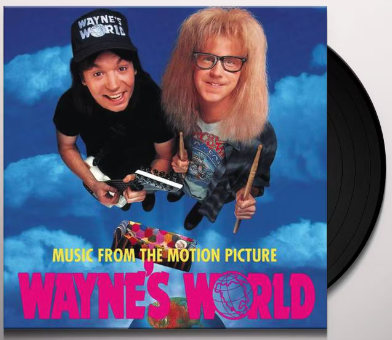
For Earth Day, I wanted to pick a song from a movie featuring Earth or World in the title. One movie jumped right out at me – 1992’s Wayne’s World.
The soundtrack album topped the Billboard Top 200 album chart and for a good reason – it had some great music on it. There were songs from Jimi Hendrix, Alice Cooper, Eric Clapton, Tia Carrere and, of course, Queen.
I suppose I could feature Bohemian Rhapsody, but that would be too easy. Instead, I chose a song that I’ve always liked – Dream Weaver by Gary Wright.
The song was recorded and released in 1975. With the exception of the percussion, all the instrumentation was done on a synthesizer. It went to number one in Canada, but topped out at number 2 in the US.
Another movie connection for the song: Wes Craven once said the song was the inspiration for his film Nightmare on Elm Street.








 Various Ramblings of a Nostalgic Italian