It was 39 years ago today that the Rock and Roll Hall of Fame inducted its inaugural class. When you look at the 10 inductees, you cannot help but be impressed. These artists are legends who were a part of the birth of Rock and Roll. The performers category is meant for recording artists and bands that have “influence and significance to the development and perpetuation of rock and roll.” Each of them did just that!
To honor this class of Rock and Roll pioneers, I thought I would feature a favorite song from each of them. Feel free to add your favorites in the comments.
Chuck Berry– No Particular Place To Go
The “Granddaddy of Rock and Roll”
James Brown – Please, Please, Please
“The Godfather of Soul”
Ray Charles – Hallelujah, I Love Her So
“The Genius”
Sam Cooke – Twisting The Night Away
“The King of Soul”
Fats Domino – I’m Walkin’
“The Father of Rock and Roll”
The Everly Brothers – Bye Bye Love
Buddy Holly – Rave On
Jerry Lee Lewis – Whole Lotta Shakin’ Goin’ On
“The Killer”
Little Richard – Rip It Up
“The Architect of Rock and Roll” (Also “The Bronze Liberace”)
Elvis Presley – Blue Suede Shoes
“The King of Rock and Roll”
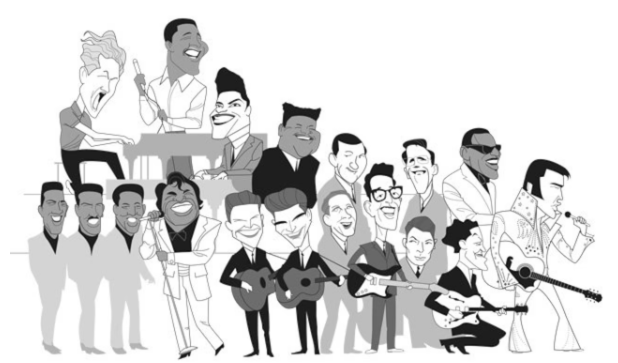
I wish I could find out who the artist is on this amazing caricature! I love this and would love to get a print of it.
The amount of music that these ten performers put out in their lifetime is overwhelming! It is fitting that they make up the first class of Rock and Roll Hall of Fame inductees.
My wife and I took a trip to Cleveland for our anniversary one year. We visited the Hall of Fame and I was in awe walking amongst the pieces of history. If you have never been there, I highly recommend a visit!
Welcome back to The Music of My Life, where I feature ten songs from each year of my life. In most cases, the ten songs I choose will be ones I like personally (unless I explain otherwise). The songs will be selected from Billboard’s Year-end Hot 100 Chart, Acclaimed Music, and will all be released in the featured year.
In 1999, I turned 29 years old. In September of that year, I would venture into a marriage that would fail years later. Two great sons came out of it though, and that was a great thing.
1999 was also the year that I began receiving monthly CDs with new music on them. It was a great was to always be sure to have clean edits of songs and be current. I received my first CD in May of that year and thankfully so!
I had been hired to DJ a prom. It was the first one I had ever done. I had been able to scrounge up some of the “newer” songs thanks to friends. However, a lot of the brand new stuff not in stores yet. (This is probably before I got my iPod and iTunes). Two days before the prom, that CD had the hottest song on the radio at the time. The song was Ricky Martin’s Livin’ La Vida Loca.
That night, I had requests for it and was surprised (and thankful) it was on the CD! I played it at least three times that night and knew my investment was a good one. Those CDs saved me plenty of times.
Frank Sinatra died on May 14, 1998, which was around the time this song was conceived. Co-writer Desmond Child told Songfacts that Sinatra’s music was a strong influence on this song. He said, “Frank Sinatra’s music was coming out of the airwaves, and we were all of a sudden into this Rat Pack idea, and also the Latin Elvis concept that we had for him. So we put that into the songs, as well – there was a swing aspect to it. So the verses were more like that, and then the choruses were all out rock anthems, with horns. Because horns had fallen out of favor, we brought horns back.”
Paul McCartney’s guitarist, Rusty Anderson, played on the song. Co-writer Robi Rosa asked him to put some guitar on some sections that were blank slates. He remembers: “I was thinking more of a James Bond vibe actually. But I kinda liked the way it counter-balanced the song.”
Anderson recorded his guitar work at his studio intending it to just be a demo. “I didn’t have a reverb to print that I was happy with so I figured the mixer would have the perfect reverb in mixdown,” he explained. “That recording turned into the single. When I heard it on the radio, I was shocked that they left it dry!”
Many years later, the song re-entered my life when I took my son to the movies. In Shrek 2, Puss in Boots (Antonio Banderas) and Donkey (Eddie Murphy) sing it as the credits roll.
Livin’ La Vida Loca
Next is a song that I always felt should have been a bigger hit. I Know How The River Feels was a song that was recorded first by country singer Ty Herndon in 1996. His version was never released. Diamond Rio recorded it for their Unbelievable album and it was their third single from it.
I liked it because it gave Diamond Rio a different sound. This was the first song of theirs to feature outside instruments as they added a string section to the arrangement. The song, however, was met with some negative reviews from critics. It only went to #33 on the Country charts.
I love the way the song uses a river with its twists and turns to describe the search for love. Finally, when it reaches the sea – the search, the twists, and the turns – you reach the final destination.
Now I know how the river feels When it reaches the sea And finally finds the place It was always meant to be Holding fast, home at last Knowing the journey’s through Lying here with you I know how the river feels
I Know How The River Feels
Hey Leonardo by Blessid Union of Souls is a song that I liked for a few reasons. First, the parenthetical title is “She likes me for me.” Isn’t that what love is about? It’s not about the physical things, the status and such. It is about loving a person because they are that person. Next, I like when a song tosses in some pop culture references.
Songfacts says: This song is written in the form of a letter to someone named Leonardo – a reference to actor Leonardo DiCaprio. In the song, the singer lists many celebrities and the qualities they possess making them attractive to women. He emphasizes that while he does not have the same qualities, his girlfriend loves him just the way he is.
The celebrities that are referenced include: Tyson Beckford, Robert Redford, Steve Buscemi and the movie Fargo. It also references opera singer Pavarotti, model Cindy Crawford, Clint Eastwood’s characterization of Dirty Harry, and Jim Carrey in the movie The Cable Guy.
Hey Leonardo
For the longest time I had only ever heard the clean edit of the next song. When I downloaded “Why Don’t You Get a Job” by the Offspring, it was the album version. It certainly was not edited. As I think of the words that are edited from it, I chuckle. They seem tame compared to what words are allowed on the radio today.
Offspring’s Americana album was a concept album. It examined the unpleasant side of life in America. Songfacts says, The song fits the concept by examining how so many people get by in the country without being productive and contributing to society.
If you listen closely, the melody might sound familiar. That is because it is based on The Beatles song “Ob-La-Di, Ob-La-Da,” with some elements of Simon & Garfunkel’s “Cecilia.”
Why Don’t You Get A Job
I’ve told this story before. When the Dixie Chicks first hit the radio, I did not think they would last. I felt that they had too much of a traditional sound and that listeners would not like it. I was wrong and I am glad that they went on to have radio success.
Their album Wide Open Spaces was full of hits. I came to really love the harmonies of the Dixie Chicks, especially on the last single from the album.
The Chicks’ version of “Tonight the Heartache’s on Me” was released in April of 1999. It had been recorded in 1994 by singer/songwriter Joy Lynn White, whose version was much slower. The Chicks version has a tempo and attitude that conveys all the feelings of the lyrics.
I love the play on words in the title. “The next round’s on me” is something you might hear in bars all over the country. The story of the song takes place in a bar. A gal sees her ex walk in with another woman and “Boom” – the hurt is there. “Bartender, pour the wine, ’cause the hurtin’s all mine. Tonight, the heartache’s on me!”
The song is a guilty pleasure, I suppose.
Tonight The Heartache’s On Me
I hate to say that Sheryl Crow is a cover artist, because she is not. However, her cover songs are really good! Take for example, her cover of 1987’s Sweet Child ‘O Mine.
It was originally done, of course, by Guns N’ Roses. The lyrics came from a poem Axl Rose was working on. Songfacts says that “he wrote the song about his girlfriend, Erin Everly, the daughter of Don Everly of the Everly Brothers. After dating for four years, they got married at a quickie wedding in Las Vegas on April 28, 1990, but just nine months later, the marriage was annulled, with Everly claiming abuse.“
The Sheryl Crow version appeared in the Adam Sandler movie Big Daddy. It earned her the Grammy Award for Best Female Rock Vocal Performance in 2000. Her version appears near the middle of the movie right after they take the kid away. The Guns N’ Roses original is also played in the movie (at the end with the credits.)
I think her voice compliments this song very well. Her voice is much better than some of the folks who attempted to sing this when I hosted karaoke!
Sweet Child O’ Mine
The aforementioned green ogre, Shrek, ties in with my next song. I think this is the one that most people associate with the Shrek films. I’m talking, of course, about All Star by Smash Mouth.
Like most Smash Mouth originals, it was written by their guitarist, Greg Camp. He said in a Songfacts interview:
“When we were on tour for the first record, it’s still when people were writing fan mail, like, in the form of paper and pencils and typewriters and stuff,” said Camp. “We would get these big bags of fan mail and we would take them to the Laundromat and do our laundry and read all this mail while we were sitting around waiting for our clothes to get dry. And about 85-90 percent of the mail was from these kids who were being bullied or their brothers or older siblings were giving them s–t for liking Smash Mouth or liking whatever they’re doing or the way they dressed and stuff. So we were, like, ‘We should write a song for fans.’
Before I stopped DJing a couple years ago, this song was still being requested at high school dances.
All Star
It is always great to see an artist from the past make a come back. 1999 was a great year for Carlos Santana!
Most music people are aware of Clive Davis. He is a legendary record executive who has worked with many artists and even appeared on American Idol. He was the mastermind behind Santana’s Supernatural album.
Santana hadn’t had a hit since “Hold On” in 1982, so Davis teamed him with contemporary musicians like Wyclef Jean, Everlast and Lauryn Hill to make sure the younger generation took notice. The result was a wildly successful album that went over well with Santana’s old fans and created a legion of new ones. “Smooth” was the first single; it spent 12 weeks at #1 in the US.
Rob Thomas sang lead on “Smooth,” but that wasn’t the plan. He had never written a song for someone else before, so he jumped at the chance to write a song for Santana. When he finished it, Thomas suggested George Michael, one of his musical heroes, as the vocalist. Arista Records ended up asking Thomas to do the vocals, and when he did, it was in Michael’s style. “If you listen to the melody and the cadence, it’s an attempt to emulate his style in so many ways,” Rob said.
Smooth” won Song Of The Year and Record Of The Year at the 2000 Grammy Awards. Supernatural also won for Best Rock Album and Album Of The Year. Santana picked up a total of eight awards that night.
Fun fact: Santana has the distinction of waiting the longest between his first charting single and first #1 hit. In 1969, “Tango” hit #56 in the US, and 30 years later, “Smooth” was #1.
Smooth
The next song was probably THE ear worm of 1999. It was certainly one of those songs that got into your head. Believe it or not, Lou Bega’s “Mambo No 5” was a cover song! The song was originally done in 1952 by the Cuban-Mexican bandleader Perez Prado. Known as the “King of the Mambo,” Prado recorded numerous mambos. When he ran out of inspiration, he would simply number them. “Mambo No 5” was one of a series of eight.
The difference between the two versions? Perez Prado’s version was instrumental. In 1999, Lou Bega added lyrics to it. By doing so, he transformed it into a love song for several women. Those women: Angela, Pamela, Sandra, Rita, Monica, Erica, Tina, Mary and Jessica. It was reported that the girls he mentioned were all Lou’s former girlfriends. It is probably beyond coincidence that eight of the girls in the song have names that end in “A,” making them quite singable.
Why is it on my list? Because I will forever link it to Barbara Eden. Let me explain. My buddy Steve said to me one day, “Hey. Did you know that you can sing the I Dream of Jeannie Theme song to Mambo No 5 and it fits perfectly?” I looked at him like he was nuts…until I heard it.
So, when you give it a listen, when Lou says, “A little bit of (Girl’s name)…” when he says the girls name, start singing the theme song and watch how it fits. It’s uncanny and it is ridiculous! Now, every time I hear it, that is ALL I hear!
If you’d like me to punch my friend for you, I will.
Mambo #5
Finally, this week a song that I literally just mentioned because of a birth anniversary. Last Tuesday, I featured this for Tune Tuesday and Robert Goulet’s birthday. I didn’t realize that it would coincide with this week’s list. You can read about that here:
Alright, which one of your favorites did I miss from 1999? Tell me about it in the comments.
Next week, we enter a new decade with the year 2000. It was a year that seemed SO far away for many of us. We all breathed a sigh of relief when the world didn’t shut down at midnight on January 1st (the Y2K fiasco!). Remember that?
My list next week is straight forward, and has no cover songs on it (I may have to double check to be sure). There are a few songs that strike a chord with me, especially as I celebrated birthday #30. Another good mix comes your way in 7 days.
Welcome back to The Music of My Life, where I feature ten songs from each year of my life. In most cases, the ten songs I choose will be ones I like personally (unless I explain otherwise). The songs will be selected from Billboard’s Year-end Hot 100 Chart, Acclaimed Music, and will all be released in the featured year. I turned 8 years old in ’78 and much like in ’77, there is an interesting mix of tunes.
In January of 1978, Kansas released a song that was what Steve Walsh said, “defies the basic formulas that most (rock) groups try to follow,” and it paid off in spades! Dust in the Wind has one of the greatest guitar intros! The story of how it came to be is fantastic.
Kerry Livgren devised what would be the guitar line for “Dust in the Wind” as a finger exercise for learning “fingerpicking.” His wife, Vicci, heard what he was doing, remarked that the melody was nice, and encouraged him to write lyrics for it. Livgren was unsure whether his fellow band members would like it, after all, it was a departure from their signature style. After Kansas had rehearsed all the songs intended for the band’s recording sessions of June and July 1976, Livgren played “Dust in the Wind” for his bandmates, who after a moment’s “stunned silence” asked: “Kerry, where has this been? That is our next single!”
Dust in the Wind
In February of 1978, a song that will forever be associated with a geriatric sitcom was released. Even though Andrew Gold’s version was not the version used as the Theme to the Golden Girls, the song was (A jingle singer named Cynthia Fee sang the TV version). It is one of my ten picks because there are so many female friends that love the show. My wife is a big fan of the show as well, so here it is.
Andrew Gold says that the song was “just this little throwaway thing” that took him “about an hour to write.” Writing is was obviously a breeze, however, recording it was a different story. They recorded 40 different takes of the song, finally releasing take number 40!
If you listen closely, you can hear sleigh bells in the instrumentation of the song.
Thank You For Being a Friend
In March of 1978, the great Warren Zevon released what some call a Halloween classic, even though it was intended to inspire a dance craze. Phil Everly of the Everly Brothers had seen the 1935 film, Werewolf of London on TV and joked to Zevon that he should adapt the title for a song and new dance. He played with the idea with his band members, who wrote the song together in about 15 minutes, all contributing lyrics that were transcribed by Zevon’s wife Crystal. However, none of them took the song seriously.
The song had been written long before it was recorded. It finally appeared on Warren’s third album, Excitable Boy, which was produced by Jackson Browne (who had already been performing the song at shows.) Although 59 takes were recorded, Browne and Zevon selected the second take for the final mix. The record label really pushed for Werewolves to be a single, but Zevon liked a couple other songs. The label released it and it became Warren’s only top 40 hit.
Werewolves of London
Three of my picks from 1978, all were released in my birthday month of May. The first one is by a group that was lucky enough to get a radio station to play a demo of one of their songs on air – and have it lead to a record deal. As a former radio guy, let me tell you, that just does not happen! It did, however, for the Cars.
Just What I Needed was written by Ric Ocasek. The band recorded a two track demo of the song and My Best Friend’s Girl. In Boston, in 1977, DJ Maxanne Sartori, who was given the tapes of these songs by Ocasek, recalled, “I began playing the demos of ‘Just What I Needed’ and ‘My Best Friend’s Girl’ in March during my weekday slot, from 2 to 6 p.m. Calls poured in with positive comments.” With a song on the radio in a major market, The Cars were a surefire success and had their pick of record labels. They went with Elektra, who had them re-record the song and released it as their first single.
Benjamin Orr sang lead on the song and it was a top 30 hit for the band.
Just What I Needed
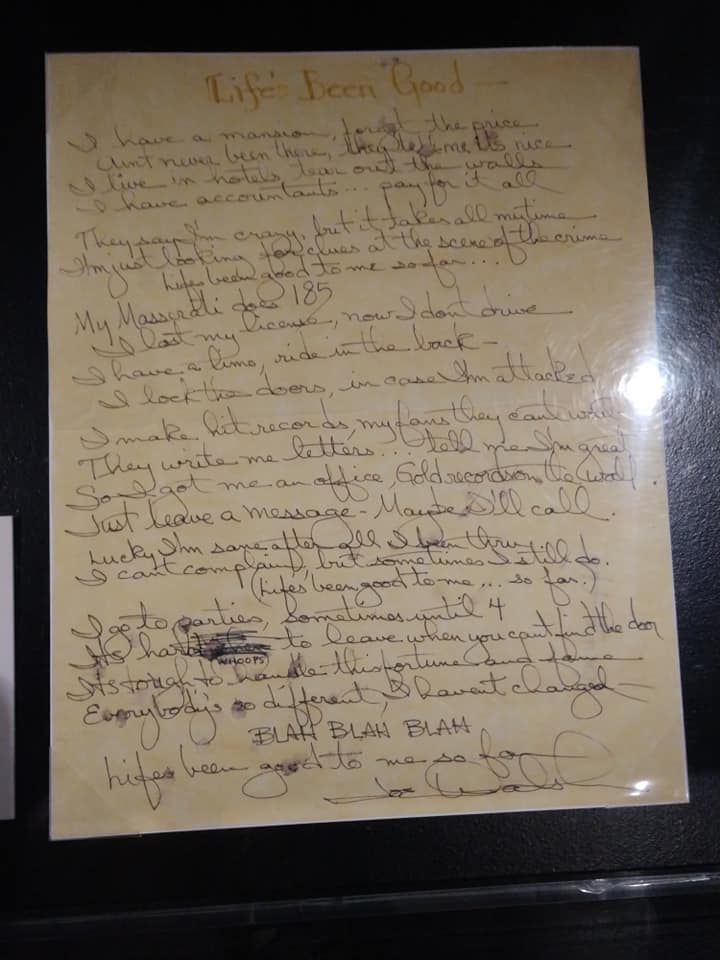
The next May release is a song that will always remind me of shooting pool with my best friend, Jeff. He always picked songs for the jukebox and Life’s Been Good by Joe Walsh was always a pick. We always laughed at the lyrics. Even Walsh says the song was meant to be a humorous look at fame and fortune.
In a 1981 interview with the BBC, Walsh explained: “I wanted to make a statement involving satire and humor, kind of poking fun at the incredibly silly lifestyle that someone in my position is faced with – in other words, I do have a really nice house, but I’m on the road so much that when I come home from a tour, it’s really hard to feel that I even live here. It’s not necessarily me, I think it paraphrases anyone in my position, and I think that’s why a lot of people related to it, but basically, that’s the story of any rock star – I say that humbly – anyone in my position. I thought that was a valid statement, because it is a strange lifestyle – I’ve been around the world in concerts, and people say ‘What was Japan like?’, but I don’t know. It’s got a nice airport, you know… so it was kind of an overall statement.”
The song first appeared on the soundtrack to the movie FM and later on Walsh’s But Seriously, Folks album. The album version is over 8 minutes long, but the radio single clocked in at about 4 and a half minutes. Made after Walsh had joined the Eagles, “Life’s Been Good” was incorporated into that group’s concert repertoire, appearing in shows at the time as well as reunion tours.
Life’s Been Good
The last May 1978 song on my list was one that three years later would hit me a bit more personally – not because of the content of the song, but because of the title. Only the Good Die Young was a top 30 hit for Billy Joel, and as controversial as it was, the attempts to censor the song (or have it banned from radio) only helped it to gain spins and popularity.
Virginia, as mentioned in the first line is a real person. Virginia Callaghan was a girl Billy had a crush on when he first started playing in a band. She didn’t even know he existed until she saw him at a gig, but 13 years later he used her as the main character in this song about a Catholic girl who won’t have premarital sex. In a 2008 interview, Joel also pointed out one part of the lyrics that virtually all the song’s critics missed – the boy in the song failed to get anywhere with the girl, and she kept her chastity.
In 2023, Joel said of the song “It’s occurred to me recently that I’m trying to talk some poor innocent woman into losing her virginity because of my lust. It’s kind of a selfish song – like, who cares what happens to you? What about what I want?… But on the other hand, it was of its time.
In 1981, my grandfather died suddenly of a heart attack. He was only 58. It was the first time I ever experienced death. At the funeral, I would hear people saying nice thing about him, and I often heard, “He was too young,” or “He was a good man.” Yes, he was, and only the good die young …
Only the Good Die Young
Earlier I mentioned how Dust in the Wind was a totally different sound for Kansas, and my next song also was very different for the artist who recorded it. The Commodores were really known for being a funk band, but when Lionel Richie brought them Three Times a Lady, they knew it was going to be a hit.
This was a breakthrough song for the Commodores and for Lionel Richie as a songwriter. It crossed over to pop, easy listening and even country formats, setting the stage for further Commodores hits and Richie’s massive solo success. In a Blues & Soul interview, Richie said: “The song has given me so much personal satisfaction. I think it is every songwriter’s dream to be totally accepted. And from the masses of awards that the song has won, it seems that the whole world really does love that song. It’s a great feeling.”
It entered the Billboard Hot 100 chart on June 18, 1978, at number 73. Eight weeks later, it reached number 1, where it remained for two weeks. It became the Commodores first number one on this chart.
There are two reasons I have this on my list. First, it was one of those songs that was on my mother’s famous red 8-track tape. Lastly, it always reminds me of the first time I saw Eddie Murphy on SNL. He was doing a phony commercial for an album called “Buckwheat Sings” as Buckwheat from the Little Rascals. “Unce. Tice. Fee Tines a Mady!”
Three Times a Lady
For readers of this blog, you know that I have blogged about Willie Nelson’s Stardust album many times. Making a long story short, my grandparent’s place didn’t have a TV at first, so we listened to the radio and two cassette tapes. One of those was Stardust.
In July of 1978, released the song Blue Skies from that album. The song was written by Irving Berlin way back in 1926 and has been covered by many great singers. Those singers include Bobby Darin, Al Jolson, Bing Crosby and Danny Kaye, Johnny Rivers and the great Ella Fitzgerald. Willie Nelson took the song to the top of the Billboard Country Chart and crossed over to the Adult Contemporary chart, too (where it peaked at 32).
Blue Skies
In October of 1978, a group of guys released a song that would go on to be named the 7th Greatest Dance Song of the 20th Century by VH1. It is a song that was inducted into the Grammy Hall of Fame in 2020 and was selected by the Library of Congress for preservation in the National Recording Registry for being “culturally, historically, or aesthetically significant.” Believe it or not, that song was Y.M.C.A. by the Village People.
There is only one reason why it is on my Music of My Life list. If I had a dollar for every time I have played this at a wedding or DJ event, I could probably retire! I am probably on about 100 Facebook pages where videos of me, a groom and his groomsmen are dressed up as the Village People leading the crowd in the dance. It is totally ridiculous, but true.
The song went to number one in countries all over the world, but it only reached number 2 here in the US. It continues to be played at parties and sporting events throughout the world.
Y. M. C. A.
I certainly do not want to wrap the year on that song, so instead, I will end with another party classic. I’ll also end with a “feel good song.” How can you NOT love September by Earth, Wind and Fire? The song has a tendency to make people happy when they hear it. Allee Willis, who wrote the song with Maurice White and Al McKay from Earth, Wind & Fire, describes it as “Joyful Music.”
Every year, on September 21st, you will hear this song all over the radio! There are many theories as to the significance of the “21st night of September” in the opening lyrics, and until 2018, even the song’s co-writer was in the dark – Maurice White told her it had no real significance and was chosen because it sang well phonetically. White died in 2016; two years later, Willis was having lunch with his widow, Marilyn, who told her that September 21 was the due date for their son, Kahbran, and that Maurice put that specific date into the song as a secret message. Kahbran ended up being born early on August 1, which definitely wouldn’t have the same ring to it as a lyric.
Although many people hear the first words in the chorus as “Party On,” it’s really “Bah-dee-Ya.” Allee Willis explained in a Songfacts interview: “I absolutely could not deal with lyrics that were nonsensical, or lines that weren’t complete sentences. And I’m exceedingly happy that I lost that attitude. I went, ‘You cannot leave bada-ya in the chorus, that has to mean something.’ Maurice said, ‘No, that feels great. That’s what people are going to remember. We’re leaving it.’ We did try other stuff, and it always sounded clunky – thank God.” She went on to say, “The main lesson I learned from Earth, Wind & Fire, especially Maurice White, was never let a lyric get in the way of a groove,” she added. “Ultimately it’s the feel that is the most important, and someone will feel what you’re saying if those words fit in there right.”
The first appearance of the song was on The Best of Earth, Wind and Fire – Volume 1. It is a great groove that still fills the dance floor!
Next week, we’ll take a look at the final year of the 70’s. 1979 promises to be a good mixture of genres and will feature one of my first television heroes, who starred in a couple TV shows, many movies, and is still popular today.
Welcome back to The Music of My Life, where I feature ten songs from each year of my life. In most cases, the ten songs I choose will be ones I like personally (unless I explain otherwise). The songs will be selected from Billboard’s Year-end Hot 100 Chart, Acclaimed Music, and will all be released in the featured year. I turned five in ’75, so let’s give a listen together…
Why not start off with a song that soared to number one? Shining Star was released by Earth, Wind and Fire in January of 1975. Maurice White was taking a late night walk while recording the album That’s the Way of the World and was inspired by the stars in the sky. He took the idea back to other members of the band and wrote the song.
The song was inducted into the Grammy Hall of Fame in 2008 and still sounds great today! One music critic called the song, “sweaty funk” … So let’s get funky!
Shining Star
Honestly, I wasn’t really into KISS when I was five. I suppose I was in my teens when I came to appreciate some of their songs. We played one or two at the first oldies station I worked at and I heard them a lot when me and my buddies would go play pool together. One that always played was Rock and Roll All Night.
Originally released on their Dresses to Kill album, the studio version only went to number 69 on the singles chart. Later, the live version would go all the way to number 12. I would guess that it has become their “theme” song. It has been the song that the group has used as a closing concert tune in almost every show since 1976.
The song was written by Paul Stanley and Gene Simmons in Los Angeles, but on January 26, 1976, Stanley told an audience at Cobo Hall in Detroit that the song was written in and for Detroit! I like that, so I’ll go with it…
Rock and Roll All Night
(Studio version)
(Live version)
Speaking of Detroit, the next song comes from hometown hero Bob Seger. Bob released his Beautiful Loser album in ’75 and Katmandu was a cut from it. Katmandu wasn’t a huge hit, but it has always been one of my favorite Seger tunes. It was later featured on his Live Bullet album.
Seger says that the song was written at a time in his life where he wasn’t sure if he was going to make it. He said, “It’s an exasperated song. It’s like: ‘I’m never gonna make it, I’m just gonna go to Katmandu.'”
He says that Glenn Frey and Don Henley pulled him aside and “told me that the Beautiful Loser album was the first little step in the right direction for me. Then the next step after that was Live Bullet, which was a huge step. And the next step was Night Moves, which was an even huger step. By 1980 both records were at six million, and they kept selling continuously. Beautiful Loser was a transitional album, and in the song “Katmandu” I still had some of that defeatist mentality and you can hear it in there.”
Katmandu
The next song was released one day before my fifth birthday. Low Rider appeared on War’s Why Can’t We Be Friends album.
From song facts.com:
The group’s sax player, Charles Miller, came up with the idea for the song. Harold Brown told Songfacts: “What happened on ‘Low Rider’ was in the studio, we were jamming, and I was supposed to have been on the downbeat. But all of the sudden I was on the upbeat. And I said, ‘Oh, boy. I got the beat turned around.’ I didn’t panic. I said, ‘Wait a minute. Stay there. Don’t change it. Stay.’ Because as long as you keep doing it over and over and over, it won’t be a mistake.
We were just messing around, you know. Then the next thing I know, Charles started just singing, ‘Low ri-der drives a little slower. The low…’ he was just pumping it. And then the next thing I know Lee’s over there putting that harmonica on, because Lee is a melody man all the time. And then – boom.
If you’d hear the original version of it, all with that jam, that would be worth a million right there. When we finished it, all of us looked at it, ‘That’s a hit.’ We didn’t know that it was going to be an icon.
Low Rider
In June of ’75, Bad Company released a classic. Did you know that Feel Like Makin’ Love is actually a combination of two separate songs?
Several years after Paul Rodgers wrote the song, he played it to Bad Company guitarist Mick Ralphs, who came up with some big chords for the chorus. Ralphs recalled:
“I came up with the riff, and I suggested we put the two together to create a song. I think that’s the feel of the song, the verses are very appealing to the ladies, probably more than the men; and then the riff comes in which is all bloody macho. It’s a big chorus and it worked out really well.”
It reached number 10 on the Hot 100 Chart.
Feel Like Makin’ Love
Despite being a song of their second album, Orleans scored their first Top 40 hit with “Dance With Me.” The song was released in July of ’75. It was written by group member John Hall and his then wife Johanna. John told Songfacts.com:
“I started playing it on acoustic guitar and developed it, just jamming by myself in the living room. The whole song – the verses, the bridge, the ending – was all complete coming out of my acoustic guitar. Johanna yelled from the other room, ‘That sounds like ‘Dance With Me.” And I went, ‘Can’t we come up with something a little bit more unusual than that?” And she said, “I don’t know, it really sounds like ‘Dance With Me.”
She couldn’t get past that and I couldn’t get past that any further, so I played the instrumental version for Larry Hoppen and he said, ‘Boy, you really need to finish that, that sounds like a hit song.’
So coming back from a show in Ithaca, New York, on the western part of the state, through the Woodstock area again, Johanna and I were riding in the car, and suddenly she says, ‘Pick the beat up and kick your feet up.’ She starts scribbling on another one of those envelopes, and by the time we got home, we had kicked the ideas back and forth and finished the lyric.
I love the guitar work and harmonies in it.
Dance With Me
I was probably about 4 years away from my introduction to Willie Nelson in 1975. When I was finally introduced to him, it was thanks to my dad and my grandfather. They had a cassette of Willie’s Stardust album and they played the heck out of it. It drove us kids crazy! After my grandfather passed away in 1981, I began to listen to more and more from Willie and came to really love his music.
Willie is a fantastic song writer, having written hits like “Crazy,” “Hello Walls,” and so many others, but he did NOT write Blue Eyes Crying in the Rain. It was written by Fred Rose in the late 1940’s. It was recorded by Roy Acuff, Hank Williams Sr., Ferlin Husky, Bill Anderson and Conway Twitty all before Willie recorded it in 1975 for his Red-Headed Stranger album.
In October 1975, the song became Willie’s first Number 1 hit as a singer, and at year’s end, was the third-biggest song of 1975 on the Billboard Hot Country Singles chart. It got Top 40 airplay, too, reaching number 21 on the Hot 100 Chart. At the 18th Annual Grammy Awards, the song won Willie a Grammy for Best Male Country Vocal Performance.
Fun (but sad) Fact: Elvis Presley recorded a version of the song in the Jungle Room at Graceland in 1976. The song would be the last one he played before he died. In the early morning of August 16, 1977, he played it on his piano in Graceland. Later that day, he died.
Blue Eyes Crying In The Rain
Earlier I mentioned playing pool with some my friends in my teens and many of the songs I mention will be ones that played on the jukebox while we were there. One of those songs was Tush by ZZ Top. Before the song’s release in 1975, they were well known in Texas, but Tush became their first nationwide hit.
According to Dusty Hill, the song was written in under ten minutes during a soundcheck in Alabama. Billy Gibbons said “We were in Florence, Alabama, playing in a rodeo arena with a dirt floor. We decided to play a bit in the afternoon. I hit that opening lick, and Dave Blayney, our lighting director, gave us the hand [twirls a finger in the air]: ‘Keep it going.’ I leaned over to Dusty and said, ‘Call it ‘Tush.’
So what does it mean? In a 1985 interview with Spin magazine, bass player Dusty Hill explained: “Tush, where I grew up, had two meanings. It meant what it means in New York. Tush is also like plush, very lavish, very luxurious. So it depended on how you used it. If somebody said, “That’s a tush car,’ you knew they weren’t talking about the rear and of the car. That’s like saying, ‘That’s a cherry short.’ But tush as in ‘That’s a nice tush on that girl,’ that’s definitely the same as the Yiddish word. I don’t know how we got it in Dallas. All it could have took was one guy moving down from New York.”
Tush
The next song is one that comes from my family’s infamous red 8 track tape. It was one of the first things I blogged about when I started this site. You can read that blog here:
Songfacts.com says: In the DVD Hell Freezes Over, the Eagles discussed this song’s origins. When they were a struggling band in Los Angeles, they saw a lot of beautiful women around Hollywood who were married to wealthy, successful men, and wondered if they were unhappy. One night they were drinking in a bar (their favorite watering hole: Dan Tana’s) when they spotted this stunning young woman; two steps behind her was a much older, fat, rich guy. As they were half laughing at them, Glenn Frey commented, “Look at her, she can’t even hide those lyin eyes!”
Realizing they had a song title, the band members began grabbing for cocktail napkins to write down lyrics to go with that great observation.
The song reached number 2 on the Hot 100 Chart.
Lyin’ Eyes
In 1975, Capitol Records couldn’t seem to make up their mind about which song to release first from Linda Ronstadt’s Heart Like a Wheel album. It was a toss up between You’re No Good and When Will I Be Loved and the prior won out. Linda’s Everly Brothers cover would be the second single, released in March of ’75.
Both the Everly’s and Linda had top ten hits with the song, but Linda’s went to number 2 while the Everly Bros peaked at number 8. Linda’s version also went to number 1 on the country chart. Singing with Linda on this single are Kenny Edwards (from her band the Stone Poneys) and Andrew Gold (Who later had success with Thank You For Being a Friend). I absolutely love the harmonies on this one.
And there are my picks for 1975! What did I miss?
Next week, I’m sure there will be a shiny disco ball hanging over the dance floor as we head to 1976! See you then.
For our anniversary, my wife and I wanted to plan a little getaway to celebrate. Neither one of us had too much PTO in our “banks” at work, so we decided on a weekend trip. During the planning the destinations changed frequently. Originally, we had hoped to head back for another trip to Florida, but due to the lack of time available, we decided on something a bit closer to home.
There was talk of going to Nashville and maybe catching a show at the Grand Ole Opry. Then there was talk of Gatlinburg, where my mom so often talked about. I think we even chatted about Pennsylvania, too. Eventually, we decided that Chicago was where we wanted to go, but then realized that it was St. Patrick’s Day weekend, and we figured it might be just a tad crazy (although seeing the river turned green would have been cool.
Cleveland??
To be honest, I am not even sure how we decided on Cleveland, Ohio. I had mentioned that my dad had gone to the Rock and Roll Hall of Fame and said it was cool. I started to look at things in Cincinnati. There was a lot to do there, but why wasn’t the Hall of Fame coming up in any of my searches? I knew that Cincy was close to Louisville, KY and thought that we could maybe do something there, too. I had gone as far as to drop a radio buddy a note to say we were gonna be down there and asked for good restaurants to eat at … only to then realize the Hall of Fame was in Cleveland!
Now that we had cleared that up, we were set for Cleveland. Now, I will be the first to admit “Cleveland,Ohio” as the answer to “Where did you and your wife spend your first wedding anniversary?” is not at all romantic. Many people laughed when I told them. Here is the thing about my wife and I, the destination really didn’t matter – it was simply the fact that we were going to be together. To me, this is just one of the reasons I love her. We can be content with just having time with each other, no matter where we are, or what we are doing.
We have made it a tradition to go to restaurants that local wherever we go. If we can go there at home, we’ll go there at home! By doing this, we have really been treated to some amazing food. We always try to find a good steak house or something very unique to the city we are in and we have yet to be disappointed.
The Hall of Fame
Personally, I think Sam loves watching me get excited about stuff like this. We both love museums, but I must have been like a little kid on his birthday during this trip! I had, of course, seen pictures of the Hall of Fame, but it was something else to be standing in front of it. The big red block letters that sit upon the sidewalk read “LONG LIVE ROCK”. As I walked up the steps, there are phoney concert speakers erected by the hand rails. The excitement builds as you walk in.
As you enter, you walk into a huge foyer/lobby. The gift shop is to your right, to the left a cafe/coffee shop, and in front of you there is an escalator to take you down to purchase tickets. After buying our tickets, you get ready to enter and above the doors the perfect AC/DC quote to welcome you: “For those about to rock …”
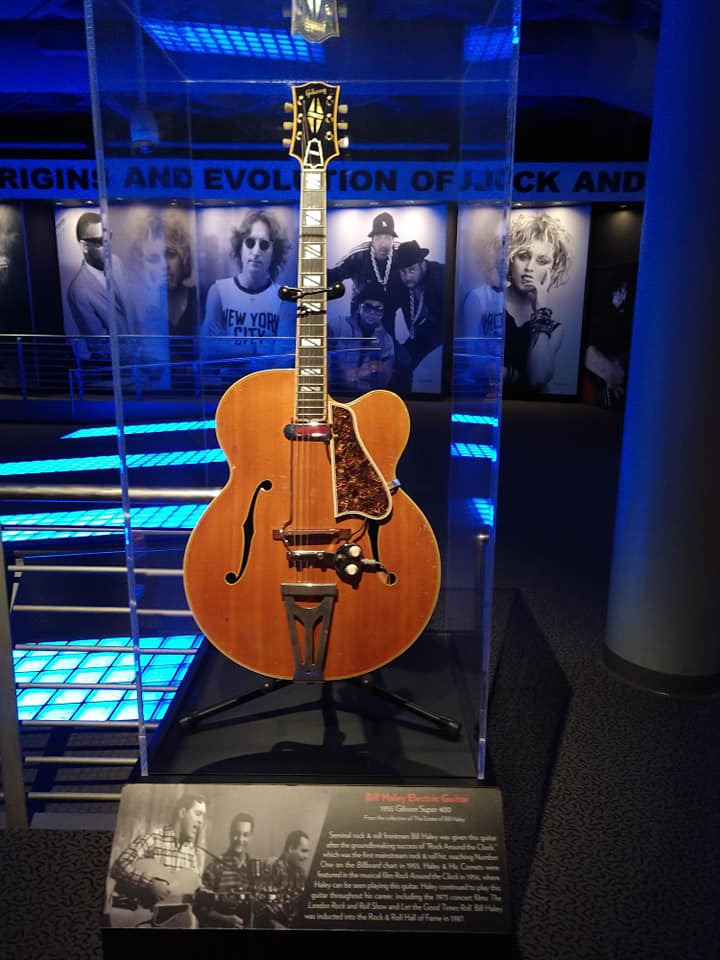
Walking into the main exhibition hall, the first thing I noticed were pictures of John Lennon and Ray Charles on the wall. The first thing I am drawn to is a glass case containing Bill Haley’s guitar. Bill is often credited as being the singer of the first “rock and roll” song – Rock Around the Clock. There is a picture of him playing it in the case as well. I am not sure why I was so taken in by it, but I was.
The next thing we saw was a line of bass guitars that belong to Geddy Lee of Rush. I didn’t count , but there had to be like a dozen of them. The information said that this was only part of his massive collection.
The Roots
One thing I was thrilled to see here was the fact that the “roots” of Rock and Roll were well represented. Rock really evolved from a combination of Gospel, R&B, Bluegrass, Country, Folk, and Blues music. Each of those genres was represented here. Among my favorite things I saw: a suite belonging to Hank Williams Sr.; Louis Jordan’s music folder with his music and cue sheets; stuff from Muddy Waters, BB King, and Mahalia Jackson; Ray Charles sunglasses; Carl Perkins Guitar; salutes to Johnny Otis, Big Joe Turner, and Sam Cooke and so much more. The roots of rock were so well represented. Without these people and the genres of music, there would be no rock and roll.
Elvis
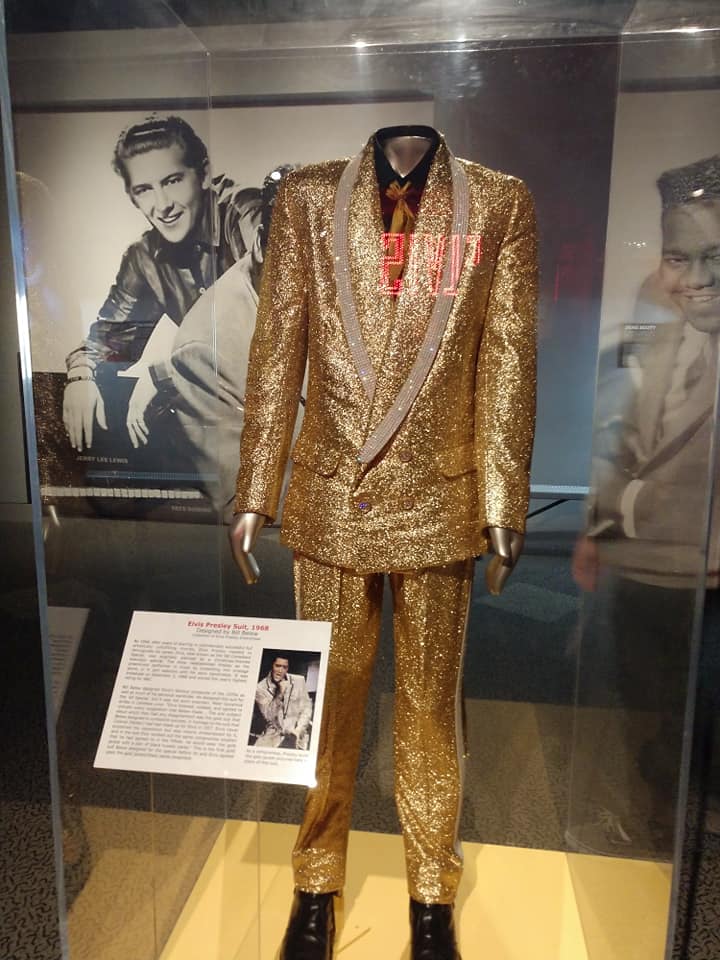
There is a pretty cool section devoted to Elvis, who was one of the first 10 artists inducted into the Hall of Fame. The Hall has a standing agreement with Graceland in Memphis (which is a museum in itself) and they send memorabilia to them often, so the exhibit changes often. There was a very cool motorcycle that was custom-built for Elvis. His gold sequins suit is there, and a jukebox which was given to him as a gift from RCA Records – it contains only Elvis records. Also on display was a double Gibson guitar which he played in his film Spinout.
The Summer of Love
With the 50th anniversary of the “Summer of Love”, there were some very cool things here. I saw groovy outfits from the Mama’s and the Papa’s, clothing from Jimi Hendrix, and the HUGE mixing board that was used to record some of Jimi’s music.
On thing I really liked to see was the various things that song lyrics were written on. There were quite a few original pieces of paper where the beginnings of songs were scribbled. There were also plenty of hotel pads of paper with lyrics on them. Loved seeing where changes were made to lyrics.
Cities and Sounds
I loved that there was a section of the hall that saluted cities and sounds. There was a section devoted to Memphis, Los Angeles, San Francisco, London and Liverpool, Seattle, and of course, Detroit.
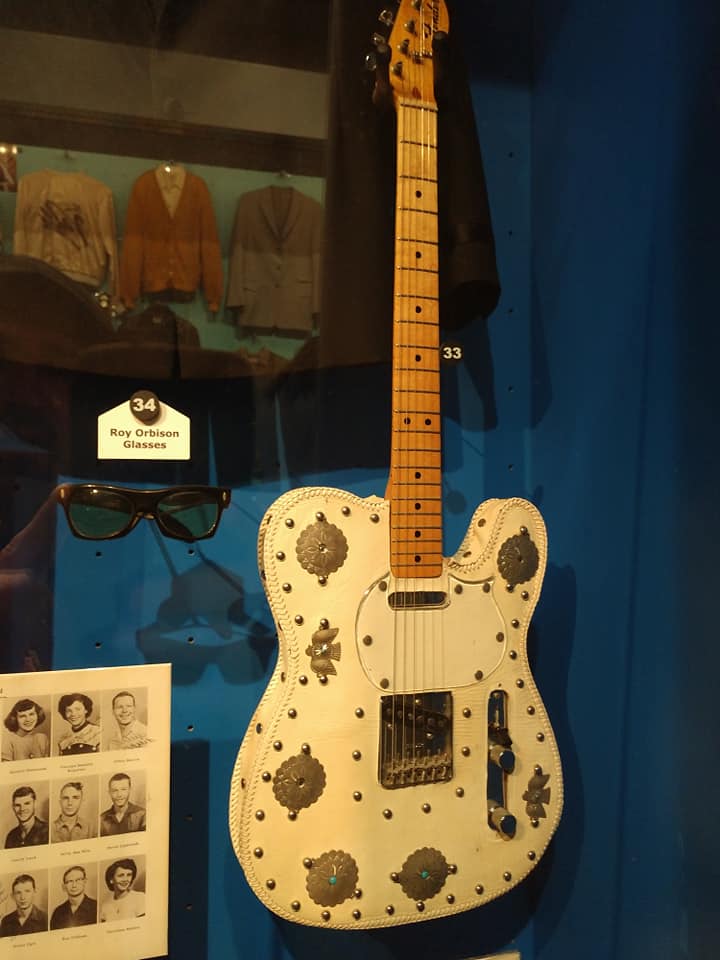
In the Memphis section, there were plenty of neat things from Sun Records. Johnny Cash, Elvis, Jerry Lee Lewis, Carl Perkins and Roy Orbison all recorded there. To stand in front of Roy Orbison’s glasses and guitar was pretty awesome. My earliest musical memories are of my dad playing Roy’s music for me.
A nice tribute to Motown is here with stuff from Barry Gordy, The Supremes (you can see some of their dresses), Smokey Robinson, and the Temptations are all here. They were playing the episode of To Tell The Truth with Barry Gordy as we walked through this section.
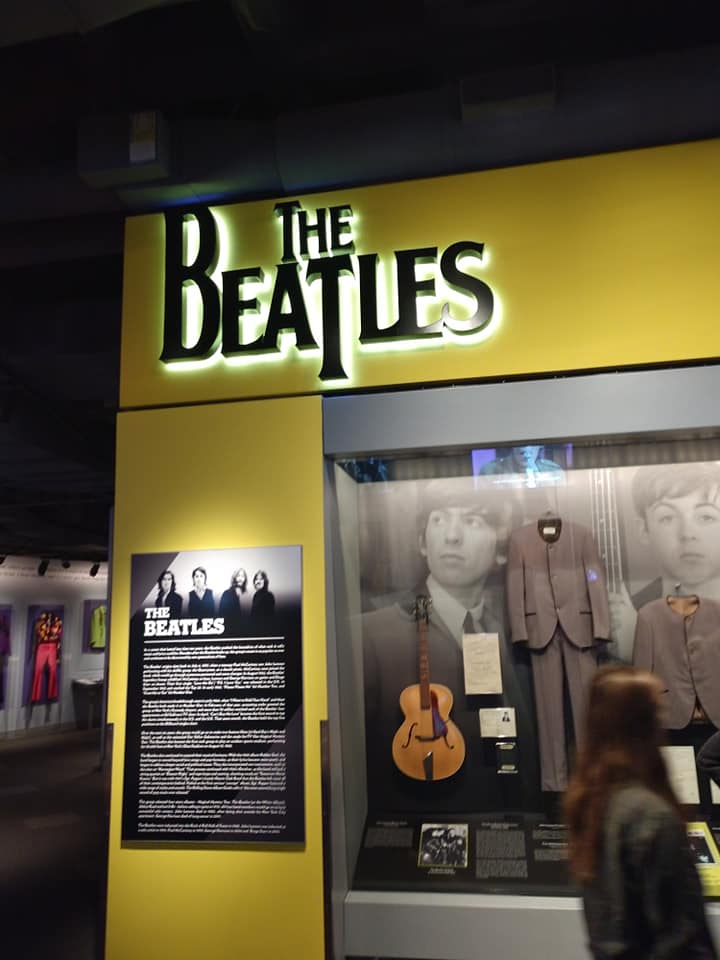
The Beatles and the Rolling Stones each have a nice section at the Hall. I thought Mick Jagger of the Stones was taller, but standing by some of his outfits, he’s shorter than I thought. There is the Asher family piano that Paul McCartney donated, some of John Lennon’s outfits, and the handwritten lyrics to “In My Life”. A very cool documentary was playing in their section as well.
I jumped ahead a bit because the next section was London and Liverpool. There were some very neat things from the Yardbirds, Peter and Gordon, Herman’s Hermits and the Zombies too. All in all a nice salute to the British Invasion.
San Fran featured stuff from The Grateful Dead and Janis Joplin, while LA featured stuff from The Eagles, Jackson Brown, Joni Mitchell and Neil Young. One cool thing here was a duffle bag full of hotel keys. I don’t recall, but I think it said it belonged to one of the Eagles. They basically kept the hotel key (and keychain) from every place they stayed while on tour. The bag was stuffed full of some very cool looking keychains!
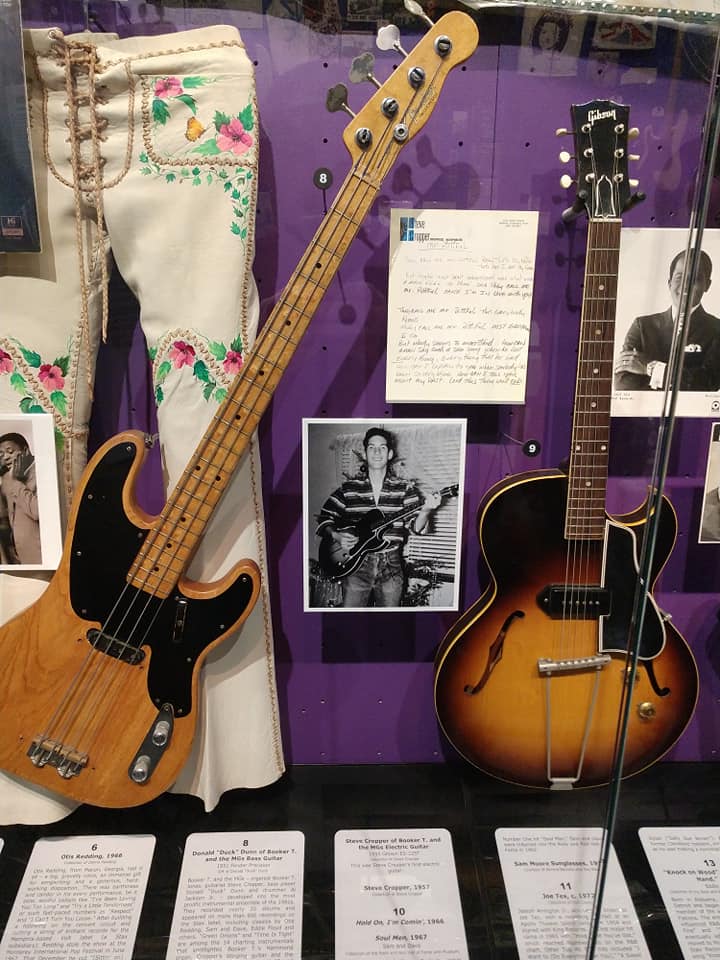
This section also had tributes to grunge music, punk music and a section called “Rave On” which focused on the “pioneers” of rock. Those pioneers included Fats Domino, Chuck Berry, Little Richard, The Everly Brothers and Buddy Holly. Soul Music was also spotlighted here with some awesome suits from James Brown, stuff from Aretha Franklin, pieces of the wreckage from Otis Redding’s plane crash, and Sam and Dave. Featured in the soul section were two amazing things – guitars from Donald “Duck” Dunn and Steve “The Colonel” Cropper. They played on almost every Atlantic and Stax record. They were members of Booker T and the MG’s, and also played with the Blues Brothers. Very cool to see!!!
Don’t worry metal heads, there was a section for Heavy Metal too. Oh, and a section for Rap, as well.
Protests
When Rock and Roll started to make waves, it wasn’t too popular with folks. We tend to forget the hatred toward the genre, but they had plenty of newscasts about burning records, and protests that happened. It was weird to watch the hatred toward the Beatles and read hate mail to the Rolling Stones. Other artists that were discussed in this section were Frank Zappa and ELO.
On the Radio
As a radio guy, it was cool to be able to walk up to an interactive touch screen and select a region of the US and then listen to old airchecks of DJ’s from different eras. Naturally, I had to listen to some of the Detroit personalities: Dick Purtain, Robin Seymour, and The Electrifying Mojo! There were plenty of familiar names from all over the states and it was nice to get to listen to their stuff too.
The Power of Rock
On the third level, there was a wall with each “class” inducted into the Hall of Fame by year. You could also go to a touch screen and search by class, by year, or by artist, and listen to their music. SO many great songs!!!
The Power of Rock is a short film by Jonathan Demme which features many performances from past Hall of Fame inductions. So many stars and so many great songs were in this film. The theater had a light show and great sound for the film and it was almost like you were watching a concert live. The film ends with Prince’s guitar solo on While My Guitar Gently Weeps – WOW! Forgot how amazing that was! They also had some of the great quotes on the walls of the hallway that you left the theater by. Prince’s outfit from that show and other outfits were there as well.
Rock on TV
It was also very cool to see some of the TV show memorabilia on this level. You could go and record something about your favorite singer or album in special booths. It was pretty cool to stand in front of Dick Clark’s American Bandstand podium! His microphone was in a glass case with other things like the set design for the Beatles appearance on Ed Sullivan. They had TV cameras there, Don Cornelius’ suit from Soul Train, outfits from the Jackson Five and Sonny & Cher and the coat worn by Davy Jones of the Monkees that he wore on The Brady Bunch. There was also some cool musically related stuff from Saturday Night Live, and from various music videos we all watched on MTV. It was neat to see Paul Shaffer’s keyboard that he played for so many years on the Late Show with David Letterman.
On the Radio – LIVE
One thing I didn’t realize was that Sirius XM broadcasts their “Classic Vinyl” station out of the Hall of Fame. Rachel Steele was on air when we went through. There is a glass window that allows you to look into the studio and watch them broadcast. I actually felt bad for her. One thing radio people like is the fact that they can go in to work without really worrying about what to wear, because….who is going to see you!? Whoever is on the air here, really has to “doll up” every day.
Over all, I loved every second of my visit here! Any music lover would enjoy themselves!! If you have never been …. you have to!
Christmas in March
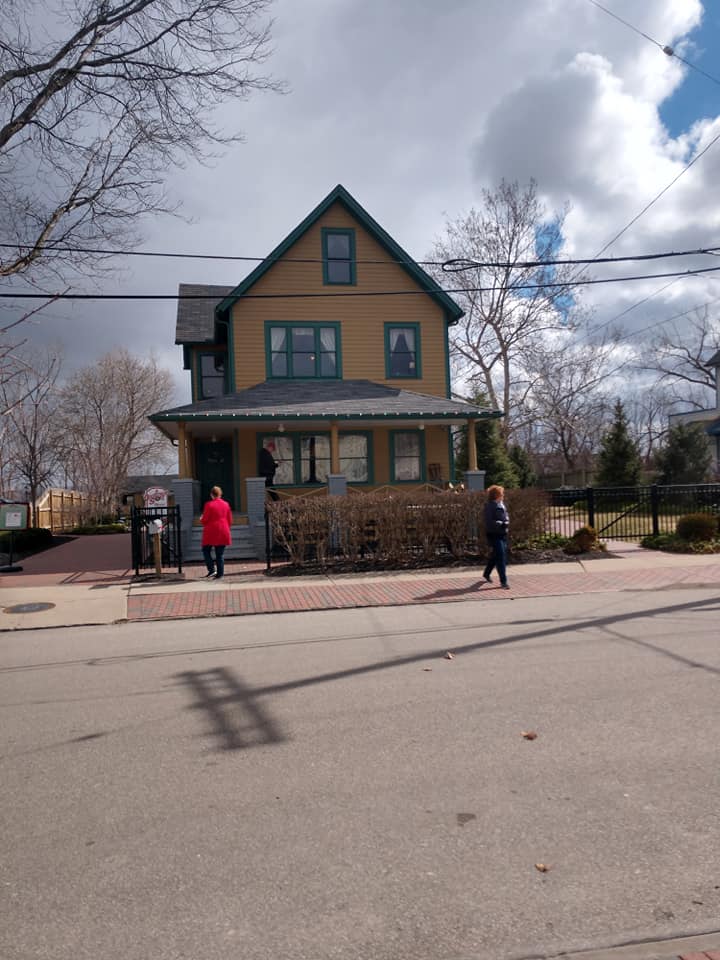
The final stop on the trip was The Christmas Story House. It is the house featured in the holiday classic. They renamed the street “Cleveland Street” in honor of the movie. The Leg Lamp proudly sits in the front window and the Bumpass House is next door.
This is such an inexpensive treat! The house looks a little different on the inside, but they have restored much of it to be exactly like it looks in the film, which took a bit because there were a few owners since the movie.
We were allowed to take as many pictures as we liked. There was a guide who took us through the house and told some stories. You can see the bathroom where Ralphie solves Little Orphan Annie’s secret message, you can see the many plugs the tree was plugged into, pick up the phone that Mrs. Parker calls Flick’s mom on, see the boy’s room, and see the damper in the kitchen that billows black smoke because of the “clinker” furnace.
From the backyard you can see the steel mill (still in operation), which helped Jean Sheppard (the author) pick that particular house for the film. Across the street is a museum with the actual Red Rider BB gun used in the film, outfits from the cast, Darren McGavin’s plaster life mask (used for make up and such), plenty of behind the scenes pictures, and the Old Man’s car. The gift shop is full of great items and yes, you can purchase a pink bunny suit or a leg lamp (in various sizes).
Sam told me she’d buy me a bunny suit, but only if I wore it every Christmas! Incidentally, if you have the $$, you can spend the night in the house or next door at the Bumpass house.
The trip was short, but full of good memories. I love that we were able to do it and I love that we got to spend time with each other. It was the perfect anniversary trip.






 Various Ramblings of a Nostalgic Italian