Movie Music Monday – Bull Durham

Today we go back to 1988 to the film Sports Illustrated magazine called the Greatest Sports Movie of All Time – Bull Durham.
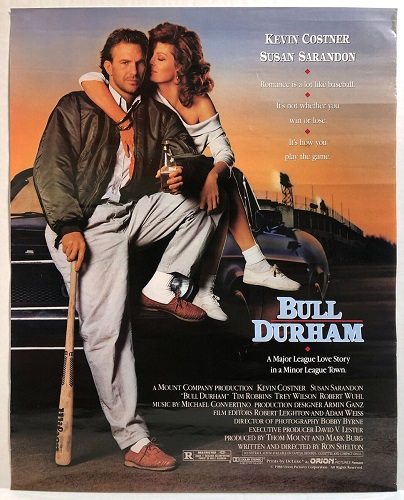
The romantic comedy starred Kevin Costner, Susan Sarandon, and Tim Robbins. The soundtrack for the movie includes some great songs from Joe Cocker, Los Lobos, and The Fabulous Thunderbirds. It also includes some bluesy tracks from Bonnie Raitt, Dr. John, Stevie Ray Vaughn and George Thorogood. You can also find John Fogerty’s baseball anthem, Centerfield, on the soundtrack.

There is one thing about movie soundtracks that has always bugged me. I hate when a movie features a song and it never makes it on to the official soundtrack. That is the case with today’s Movie Music Monday song.

It was on this day in 1950 that Billy Ward and the Dominoes stepped into the National Studios recording studio. They recorded a song that is considered to be one of the earliest to shape and generate rock and roll. It was also one of the first R&B songs to cross over and become a pop hit. That song was Sixty Minute Man.

The song was written by group member Billy Ward and his collaborator/business partner Rose Marks. The song is rooted in Blues music, and the singer brags about his sexual prowess. (Hey, it fits a romantic comedy, right?) This song had more of an R&B sound and was an early influence on Rock music.

Songfacts says that this was one of the first ever double-entendre hits. Billy Ward and His Dominoes were a big deal in the 1950s. They were one of the best-selling acts of that decade. They had three Billboard Top-40 hits by the end of the decade.

It should be noted that the song is often referred to as a “dirty blues” song. Ok, it is. The content is pretty risque for 1950. However, songs of this type are known to go back as far as the 1930’s. There were plenty of them, but this one was important to rock and roll.

“Sixty Minute Man” was banned by many radio stations and was seen as more of a novelty record. (From Wiki) “In hindsight it was an important record in several respects: it crossed the boundaries between gospel and blues. The lyrics pushed the limits of what was deemed acceptable. It appealed to many white as well as black listeners, peaking at number 17 on the pop chart. Cover versions were made by several white artists. Bill Haley and the Comets sang the song in the mid-1950s during their live shows.”

Despite being banned, the song did very well. It was released in May of 1951. By the end of the month had reached number one on the R&B chart. It held that position for an almost unprecedented 14 weeks. The single also made it to number 17 on the pop singles chart and was voted “Song of the Year” for 1951.

I have a radio story about the song, but that will have to wait for another blog. For now, here are the Dominoes…

Tune Tuesday – Wash Out

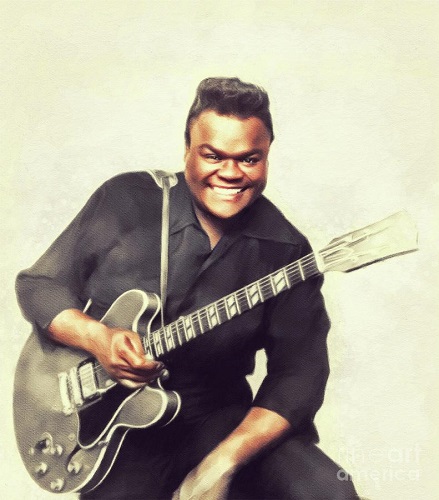
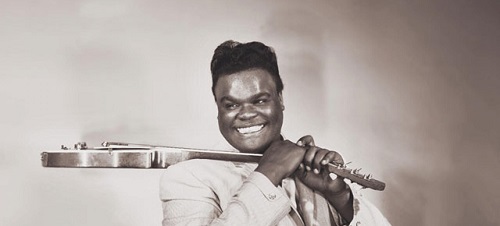
Today is the birthday of one of the “Three Kings of Blues Guitar.” The best known of these three is most likely B.B. King, followed closely by Albert King, and last but not least, the birthday boy, Freddie King. All three Kings – but no relation to each other. Freddie was born today in 1934.

Freddie was not just a great guitarist, he was also a songwriter and singer. His voice has been called “soulful and powerful,” but today I’ll focus on his guitar playing.

He was taught to play by his mother and uncle as child and eventually moved to Chicago. There he formed a band called the Every Hour Blues Boys. He tried many times to get a record deal at Chess Records (the home of Muddy Waters and Howlin’ Wolf), but was rejected every time. They told him that he “sounded too much like B.B. King.”

Persistence paid off for him as he finally landed a record deal with Federal Records in 1960. In August of 1960, he recorded his debut single, “Have You Ever Loved a Woman.” At that same session, he recorded an instrumental that has gone on to become a blues “standard,” “Hide Away.”

Hide Away reached number five on the R&B Chart and number 29 on the Pop Chart, an unprecedented accomplishment for a blues instrumental at a time when the genre was still largely unknown to white audiences.

While at Federal Records, Freddie became good friends with Sonny Thompson, a pianist, producer, and A&R man for Cincinnati’s King Records. Federal Records was a subsidiary of King Records. After the success of Hide Away, Thompson and Freddie recorded over 30 instrumentals (including today’s pick). Yes, they recorded vocal tracks throughout this period but often released the tunes as instrumentals on albums.

On the last day of local broadcasting at Honey Radio, my partner Rob Main and I were given 6 hours of the day to play whatever we wanted. We had decided to do have each hour focus on something different. Hour 1 was songs with Male names. Hour 2 was songs with Female names. Hour 3 had songs with body parts in the title. Hour 4 focused on instrumentals. That hour got a ton of requests for more and we did an extra hour of them.

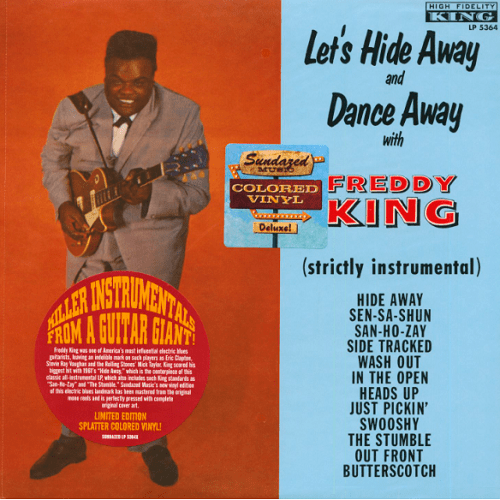
Rob was a guitar player and he was the guy who introduced me to today’s Freddie King song. He had the “Let’s Hide Away and Dance Away” album his favorite cut was called Wash Out. I remember he told me he thought it had an “early Elvis” feel to it. The repeated guitar lick does remind me a bit of Elvis’ Blue Christmas.

He handed the song to me on a cart (what we played songs off of before CDs) and I played it on air without ever hearing it. We both sat with our headphones on listened. When it was done, we cracked the microphone and he asked me if I liked it. I remember telling him that it sounded like I was just listening to a couple guys sitting in a room jamming together. That’s what it felt like to me, improvising the blues.

Freddie was always out on the road. He toured with guys like Sam Cooke, James Brown, and Jackie Wilson. He was on the road almost 300 days out of the year. All the touring caught up with him. In 1976 he began suffering from stomach issues. Painful ulcers and acute pancreatitis led to failing health and he passed away just after Christmas in 1976 at the young age of 42.

In 2012, ZZ Top inducted him into the Rock and Roll Hall of Fame. A year later, Rolling Stone magazine ranked him 15th on their list of 100 Greatest Guitarists of All Time.

Happy Birthday to Freddie King!