I have featured this film before, but for a different reason. The last time was the anniversary of Glenn Miller’s Chattanooga Choo Choo becoming the first gold record. Today is for a much sadder anniversary.
It was on this day in 1944 that Glenn Miller’s plane disappeared somewhere over the English Channel. The incident remains an unsolved mystery. No wreckage was ever found. There are a few theories about what happened including bad weather causing the carburetor to freeze up, a fire on board, and even some sort of espionage.
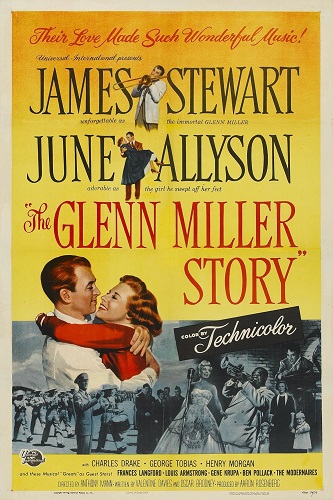
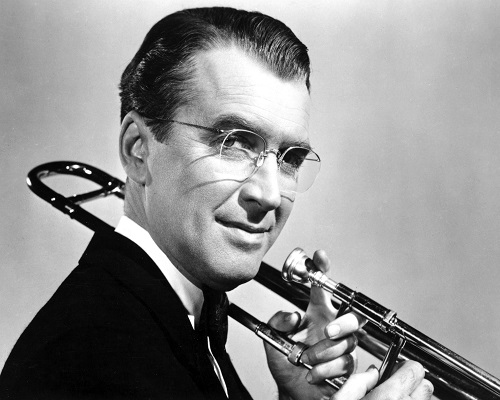
In the film, Jimmy Stewart portrays Miller. It covers his early days in the music business in 1929 through his disappearance on this day in 1944.
Moonlight Serenade was released as an instrumental in May of 1939. It is often referred to as the song that first introduced the “Miller Sound.” What made his music unique is that many of his songs, including Moonlight Serenade, have a clarinet lead. Often times, the melody in most big bands would be done by the trumpet or trombone.
The song would become Miller’s signature song. Lyrics were added to the instrumental that were composed by Mitchell Parish.
In 2004, a jazz critic named Gary Giddins told the New Yorker, “Miller exuded little warmth on or off the bandstand, but once the band struck up its theme, audiences were done for: throats clutched, eyes softened. Can any other record match ‘Moonlight Serenade’ for its ability to induce a Pavlovian slobber in so many for so long?”
Before I start today, I promise that this will all tie together. Today’s film is the biography of Glenn Miller, The Glenn Miller Story. The 1954 film starred Jimmy Stewart as Glenn Miller and June Allyson as his wife.
The film really is good, even though there are places where it may not be historically accurate. Jimmy does a pretty good job as Miller. I think any time someone plays a musician, who isn’t necessarily a musician, you’re going to be scrutinized by a musician. I watched pretty closely to his trombone “playing” and it is good enough to fool some people.
The movie follows Miller through his early career right up until he is lost over the English Channel. When I first saw this movie, I was unaware that was how he died. I really did enjoy this movie and recommend it to those who love music.
I picked this film today because one of the songs in it, made history today. Glenn and his band had many hits. They include, I Got a Gal in Kalamazoo, Moonlight Serenade, American Patrol, and Tuxedo Junction. His best known is In the Mood, but none of those are songs that I’m presenting today.
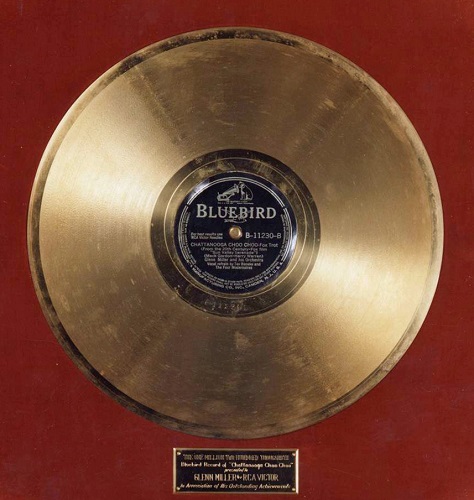
It was on this day in 1942 that the first literal gold record was awarded. It was given to Glenn Miller from RCA Victor Bluebird for selling 1.2 million copies of “Chattanooga Choo Choo” on this day. W. Wallace Early, the manager of record sales had this to say:
“We’re mighty proud of that Chattanooga Choo Choo, and the man that made the record, Glenn Miller. You see it’s been a long time – 15 years in fact – since any record has sold a million copies. And Chattanooga Choo Choo certainly put on steam and breezed right through that million mark by over 200,000 pressings. And we decided that Glenn should get a trophy. The best one we could think of is a gold record of Chattanooga.”
In 1958, the Recording Industry Association of America introduced a gold record award program. It was for any record which received one million dollars in retail sales.
So, hop on board as we chug along on the Chattanooga Choo Choo…
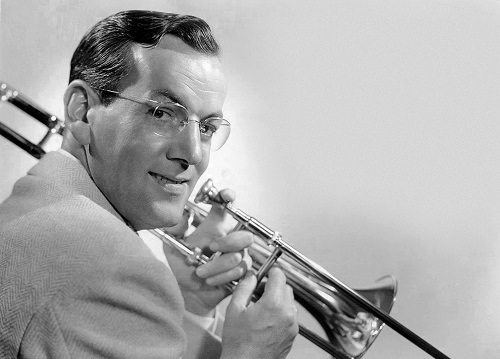
The Real Glenn MillerJimmy Stewart as Glenn Miller
Welcome to the first Turntable Talk of 2025, hosted by Dave of A Sound Day. This is the 34th round, if you are keeping track. If you are a new follower, let me fill you in on how it works. Dave Ruch offers up a musical topic to a group of us music fans each month. Each of the writers come up with a response to the topic and Dave runs each piece on his website.
We have had some fun and interesting topics, and this one is no exception. This time around, Dave asks, “What’s my scene?” Our instructions: Pick a sort of music “Scene” that either you would have liked to have been a part of or one that you think really created a lot of the music you love. Pick a general place and time and have fun….
My fellow music bloggers know my musical tastes pretty well by now. So, let’s see a show of hands – How many thought I’d pick The Rat Pack in Vegas? I almost did, but I know I have written on a live Rat Pack show in the past. Honestly, as awesome as that would be, the more I thought about it the more I leaned another way.
My scene certainly influenced the Rat Pack. Dean Martin cut an album called Swingin’ Down Yonder. Frank Sinatra recorded albums titled: Sinatra Swings, Songs for Swingin’ Lovers, Swing Easy, Sinatra’s Swingin’ Session, Sinatra and Swingin’ Brass, and A Swingin’ Affair! You know what the song says, “It don’t mean a thing, if it ain’t got that swing!”
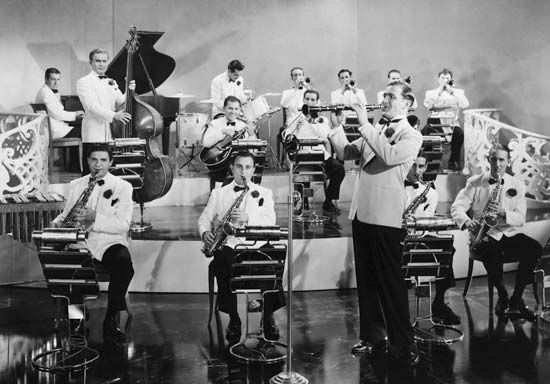
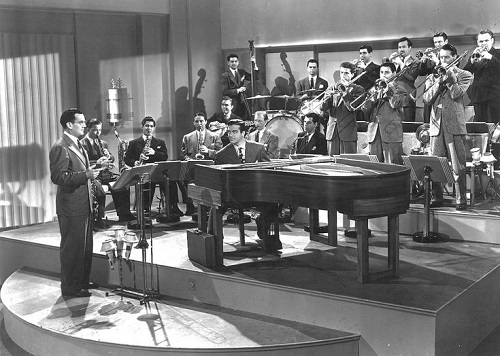
As a mediocre trumpet player, I have always loved Big Band/Swing music. Most folks would consider the Swing Era to be from the early 1930’s to around the mid 1940’s. Even though swing music was prominent in the early 1930’s, it was often ridiculed for its style and feel. Some went as far as to call it a menace (much like Rock and Roll when it gained popularity). After 1935, big bands rose to prominence playing swing music. They held a major role in defining swing as a distinctive style.
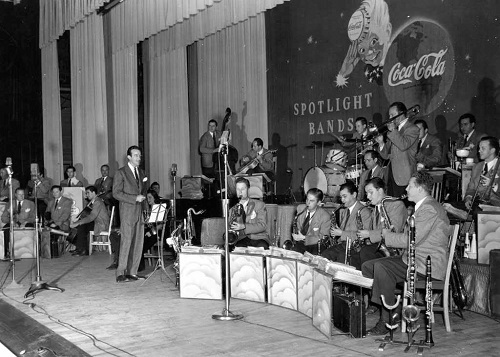
There were many big bands on the scene at this time. Each had a very distinct sound and feel to it. For example, Glenn Miller’s orchestra often used a clarinet lead. Count Basie’s sound has a relaxed feel to it. Benny Goodman used a driving and hard swing sound. Duke Ellington’s songs has a sophisticated sound to them.
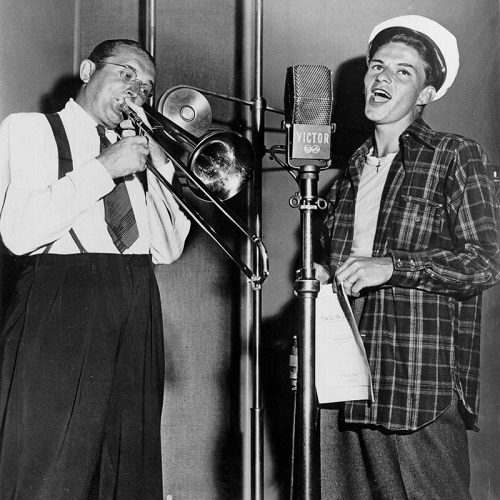
The band leaders often took the spotlight. They were amazing instrumentalists. Harry James and his trumpet, Benny Goodman and Artie Shaw on their clarinets, Gene Krupa on his drums, the trombones of Tommy Dorsey and Glenn Miller, and Lionel Hampton’s vibes. Along with those great leaders, there were plenty of talented musicians within those bands who went on to make a name for themselves.
Perhaps Sinatra recorded his many swing songs because he rose to fame alongside Tommy Dorsey. He was one of many singers who sang with those big bands. Others included the voices of Ella Fitzgerald, Billie Holiday, Kay Starr, Peggy Lee, Doris Day, Kitty Kallen, and Dick Haymes. While they all started with the big swing bands, they also went on to have prolific careers.
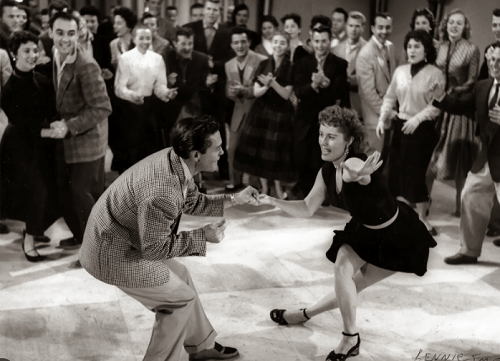
During the swing era, the big bands would often play at dance halls across the country. They appeared on the radio playing dance music. Some appeared in movies, and all of them made records. Their music had teenagers and young adults dancing until their feet hurt.
As years went on, the taste of music listeners changed. Swing began to fade away to make way for music that was less “danceable” like bebop. Many of the swing bands broke up, while other continued without their original leaders. The Glenn Miller Orchestra still tours today, for example.
When I put on headphones and listen to old big band recordings, I picture myself there listening. I picture myself in one of those great 1930’s suits with a stylish fedora.
Maybe it is in a dance hall or at a live concert. Maybe I am in the audience of a radio program where the band is playing. Wherever the music is being played, I am zoned in on it. I am listening to the drum beat of Sing, Sing, Sing and Benny Goodman. I can hear the vibrato of Tommy Dorsey’s trombone solo on I’m Getting Sentimental Over You. I marvel as I watch and listen to Harry James play his theme song, Ciribiribin.
Throughout the evening, I will study those great instrumentalists who improvise solos off the top of their head. Looking at nothing but chords and making up their own melodies. This is something I wish I could do as a trumpet player.
In all honesty, in my “scene,” I would be happy as a clam to just be in the audience. It would be the bees knees just watching those guys swing! Yeah, I can totally see myself swinging, singing, and dancing to the sounds of swing.
Thanks again, Dave for inviting me to take part in this feature. It is always fun to contribute and to read the other submissions. I’m already looking forward to next month’s topic!
When I thought about what to do for the year’s “bonus” day, my first thought was to list a bunch bunch of songs about “leaping” and “jumping.” Then I thought that was just too easy. So I decided to take another musical look at February 29th.
I present to you a look at songs that have the honor of being number one on Leap Day. So let’s leap back to 1940 …
2/29/40 – Glenn Miller and his Orchestra had the number one song with their best known song. In the Mood.
2/29/44 it was Glen Gray and the Casa Loma Orchestra with My Heart Tells Me
2/29/48 – Art Mooney was feeling lucky with I’m Looking Over a Four Leaf Clover
2/29/52 – Johnny Ray was shedding tears with his number one – Cry.
2/29/56 – The Nelson Riddle Orchestra took us to Lisbon Antigua
2/29/60 – It was Percy Faith and his orchestra with The Theme From a Summer Place.
2/29/64 – Of course, in 64 it had to be a Beatles song – I Want to Hold Your Hand was on top of the charts.
2/29/68 Yet another instrumental was number one. This time, Love is Blue from Paul Mauriat
2/29/72 – Harry Nilsson lamented about living Without You
2/29/76 – A TV Tune was number one. The Theme from S.W.A.T. from Rhythm Heritage
2/29/80 – Classic Queen! Freddy Mercury and the boys sat at number one with Crazy Little Thing Called Love.
2/29/84 – A song about leaping/jumping …. Jump from Van Halen
2/29/88 – George Michael took the top spot with Father Figure
2/29/92 – The is some confusion as to this particular year, however, the chart is dated 2/29/92 and it says the number one was held by Mr. Big – To Be With You (some people say Right Said Fred – I’m Too Sexy)
2/29/96 – It was the amazing pairing of Boys II Men and Mariah Carey on One Sweet Day
2/29/2000 the group Savage Garden hit number one with a forgotten favorite – I Knew I Loved You
2/29/04 Usher said “Yeah!” about having the number one tune. Any time I think of Lil Jon, I think of that sketch on the Dave Chappelle Show … LOL
2/29/08 – Flo-Rida hit number one with a song that still makes people dance – Low
2/29/12 Kelly Clarkston held the number one spot with Stronger
2/29/16 Justin Beiber was sitting at number one with Love Yourself
2/29/20 it was a song that I find to be a total piece of garbage. The lyrics disgust me and the fact that it was a number one song really makes me sick. I’ll just mention it, but I certainly will not be posting it here. The Box by Roddy Ricch.
As for today, it seems that Beyonce is at number one with something called Texas Hold ‘Em. I read the lyrics. Never heard it. I don’t care to.
Final thoughts? There were a lot of instrumentals on Leap Day! There were certainly some good tunes, some long forgotten, and some crap. Music is subjective. Any stick out for you?


 Various Ramblings of a Nostalgic Italian