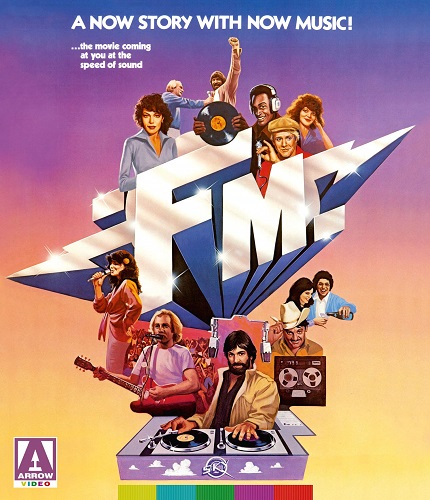
It was on this day in 1978 that “FM” premiered in theaters. As a former radio DJ, I knew it was just a matter of time before this movie would pop up in this feature. I’m surprised that it hasn’t come up already, as it has one of the best movie soundtracks!
Version 1.0.0
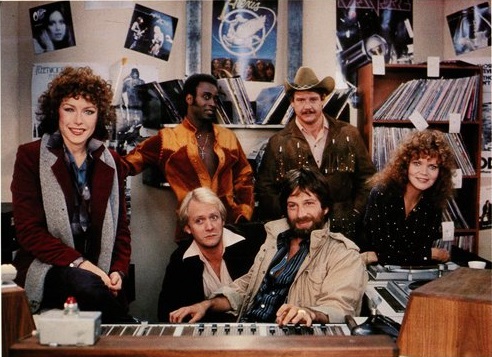
The film starred Michael Brandon, Eileen Brennan, Alex Karras, Cleavon Little, Martin Mull, Linda Ronstadt, Jimmy Buffett, and REO Speedwagon (just to name a few). Despite what they say, this film was not the inspiration for WKRP in Cincinnati (which was in the works at the same time).
Honestly, it’s really not that great of a movie. It’s billed as a comedy, but it’s not something you’ll be belly laughing at. It also has some serious moments that are a bit forced. Then there is the lackluster “feelgood” ending that feels more fake than good. Thank goodness for the amazing soundtrack!
The soundtrack is like a snapshot of 1978 rock radio and is loaded with hits. It is so difficult to choose just one song to play here, as there are so many to choose from. Bob Seger, Steve Miller Band, Tom Petty, Foreigner, The Eagles, Boz Scaggs, Linda Ronstadt, Jimmy Buffett, Billy Joel, Joe Walsh, and even Queen! I decided to choose a band that I haven’t featured on the blog before – Steely Dan.
I suppose that it makes sense to pick the movie’s title song, FM (No Static At All). Walter Becker and Donald Fagen wrote this song specifically for the film. Fagen told American Songwriter magazine: “There was a film called FM and we were asked to do the title song,” he said. “And I said, ‘Does it have to have any specific words?’ And they said, ‘No, it just has to be about FM radio.’ We wrote that very quickly, I remember, in one or two days. And we also recorded it very quickly, too. Johnny Mandel came in and did the string chart. It was fun to meet Johnny Mandel.”
The song sold a ton of records and was actually much more popular than the movie. Fagen felt the song could have been a bigger hit if the movie had been more successful. “The song was a hit, but I think we should have seen the movie before we committed ourselves,” he said in 2007. “As you know, it wasn’t a very successful movie.”
As a piece of music, it has a lot going on. Look it up on Wikipedia and the description sounds like a music theory class! You have an overture to start, arpeggios, tonal chords, thirds and fifths, a string section, major chords and minor chords, and all kinds of key changes. It’s actually cool to hear in headphones.
When the movie came out, FM radio listening was on the rise. As the song says, it had less static than AM radio. What made FM radio stations popular was their ability to take chances by playing lesser known bands and album cuts. Listeners couldn’t get enough of it.
Welcome back to The Music of My Life, where I feature ten songs from each year of my life. In most cases, the ten songs I choose will be ones I like personally (unless I explain otherwise). The songs will be selected from Billboard’s Year-end Hot 100 Chart, Acclaimed Music, and will all be released in the featured year.
In 1992, I turned 22 and would land a radio gig at WHND, Honey Radio. It was through my old radio partner that I would become all too familiar with karaoke bars. We spent a lot of time pretending to be singers at them. Believe it or not, it was listening to people try to sing that introduced me to many songs. Many of those songs, were ones I normally would have been unfamiliar with.
Let’s jump right into 1992!
The Spin Doctors are often referred to as an alternative band. I tend to think of them as a rock band, though. Two Princes sounds more like a rock song to me. I could easily hear the Stones covering it.
A buddy of mine used to sing this song all the time. From the opening drum kick and guitar lick, I was hooked. The content of the song was influenced by some classic literature. Chris Barron, said:
“I loved The Lord of the Rings and The Hobbit and Sir Gawain and the Green Knight. I was really into fantasy fiction and stuff like that. I wrote that song when I was 19, so I was still coming out of childhood, and as a child I loved wizards and kings and queens and princess and princesses and stuff like that. And I loved Shakespeare – I already was way into Shakespeare. So I gravitated towards that kind of imagery just because I liked books and poems from that period of time.”
Drummer Aaron Comess said that the song was almost a lot faster. “There are certain songs when you find the right tempo, all of a sudden the lyrics come out, it feels right and I think with ‘Two Princes’ we really lucked out. It’s one of those things, we got in the studio, found a good tempo, we recorded it, everything just really came together. It’s very simple, there’s not a lot of stuff on it, somehow the sound and feel we got, we just lucked out and found the perfect thing.”
Songfacts pointed out that it was songs like this one that were in high demand on radio in 1992-1993. There was an onslaught of hip-hop songs at the time and it was this “sound” that began pushing it back a bit.
Two Princes
Here is another example of how I came to learn of the original because of a parody. I was familiar with the cover of their Nevermind album, but unfamiliar with a lot of their songs. Enter once again, Weird Al.
When Al first heard Nirvana, he was very impressed but thought they wouldn’t catch on. He was thrilled when “Teen Spirit” became a huge hit, since that made the group a parody target.
Al is famous for asking for permission before doing any type of parody. He got permission from Nirvana’s lead singer Kurt Cobain while he was doing an episode of Saturday Night Live. Kurt initially thought the song would be about food. Instead, it was poking fun at how hard it was to understand their lyrics.
The video is a very close parody of Nirvana’s, and got almost as much airplay. For example, the same janitor used in Nirvana’s video also makes an appearance in Weird Al’s. This time donning a tutu and playing a tuba. Al dresses just as Cobain did, complete with wig. He plays a fake blowup guitar and makes fun of the hard-to-understand lyrics by gargling water and singing with marbles in his mouth.
FYI – Dick Van Patten was not in the Nirvana video.
This song is probably the one that really solidified my opinion of Weird Al as a musical genius!
Smells Like Nirvana
For comparison – the original video:
Ok, I admit that the next song was far from a hit. It only peaked at #92 in the US, however in the UK it hit #27. The original, of course, was a number one hit for Elvis Presley in 1957. Personally, I really like Billy Joel’s version of All Shook Up. I think it should have done better on the charts.
The song is one of many Elvis covers from the soundtrack to Honeymoon in Vegas. The movie starred Nicolas Cage, James Caan, and Sarah Jessica Parker. It also featured a whole lot of Elvis impersonators.
What I love about Billy’s version is that it retains the feel of the original, but there is enough “Billy” to make it his song. When I was DJing, I used to put on a cape, an Elvis Wig, Elvis glasses, and grab some random gal out of the audience and “lip synch” this to her. It was ridiculous, but it always got a laugh from the crowd (along with a lot of photos).
All Shook Up
Next, we have the only song that I will fast dance to. I say this, because I believe there is no real dancing necessary. Songfacts explains this perfectly:
House of Pain’s Jump Around earned relentless airplay on MTV and pop radio, and became a huge crowd pleaser in bars and dance clubs. It was great for getting people on the dance floor, as no real dancing is involved – just jumping around.
Exactly. I jump like a fool when this one is on! It’s hard to look bad. It brings the bounce with a steady, throbbing rhythm along with explicit instructions on when to jump. You can’t mess this one up!
Erik “Everlast” Schrody wrote the song. Songfacts explains that the lyrics on this track are very aggressive. It contains lines like “I bust him in the eye, and then I’ll take the punk’s ho.” Everlast was surprised when the song crossed over to a pop audience. He thought it was “too hardcore” to do so. The “pugnacious” lyrics, however, are tempered with comic relief. Listen for lines like “I got more rhymes than there’s cops at a Dunkin’ Donuts shop. ” They make it a lot less threatening.
If the horn flourish that opens this song sounds familiar, it is because it comes from Bob and Earl’s song, “Harlem Shuffle”.
Jump Around
Next a movie song that never made the movie’s soundtrack. In A League of Their Own, Madonna starred with Tom Hanks, Geena Davis and Rosie O’Donnell. The film was based on the true story of an all-women baseball team that was popular during World War II.
The song is about a woman who can’t and let go of her past, with the implication that her present circumstances aren’t so good. The lyrics fit well with the film’s premise, as the now-elderly women reunite and recall their glory days as baseball stars.
To a degree, I can relate to this as I tend to live in my nostalgia and memories, however, my present circumstances are actually good. I find myself thinking of those summers playing ball at our old elementary when I hear this song.
This made me laugh: The video for this song, which shows Madonna singing from the pages of a photo album, bears a strong resemblance to Boy George’s video for his 1987 song “To Be Reborn.” The similarities were not lost on the Culture Club singer, who angrily dubbed it “This Used to Be My Video” in his autobiography.
This Used To Be My Playground
What I love about country music is the honesty of it. There are a handful of songs that I can say really hit home for me. One of them is from Travis Tritt’s third album. For me, I could relate to the lyrics of Lord Have Mercy on the Working Man. After all, I was working on a DJ’s salary!
Truth be told, it doesn’t matter what job you hold, these lyrics hit home. While primarily focusing on the economical injustice to blue collar workers, it fits anyone who struggles financially.
Uncle Sam’s got his hands in my pockets And he helps himself each time he needs a dime
Why’s the rich man busy dancing While the poor man pays the band Oh they’re billing me for killing me Lord have mercy on the working man
The final verse features Tritt’s friends joining in. Listen for Brooks and Dunn, George Jones, Little Texas, Tanya Tucker, T. Graham Brown and Porter Wagoner.
Lord Have Mercy On The Workin’ Man
MTV’s Unplugged had been around since 1989. It featured Joe Walsh, The Cure, Paul McCartney, Sting, and Mariah Carey. Eric Clapton recorded an Unplugged performance at Bray Studios in London. He rearranged many of his classic songs for the acoustic context.
The resulting Unplugged album went on to become the best selling Unplugged album in the U.S. and worldwide with sales of 10 million in the U.S. and 26 million worldwide. He earned six Grammy Awards for the album. He earned Grammys for Record of the Year, Album of the Year, Song of the Year, Best Male Pop Vocal Performance, Best Rock Male Vocal Performance and Best Rock Song.
I have been a fan of acoustic shows for a long time. I loved when artists came in and played acoustically for us. It is raw and you really feel the song. When I heard the Unplugged version of Layla, I couldn’t get enough of it. I loved the entirely different feel to the song! It was so much more bluesy.
The Unplugged version also helped Eric do his vocal. According to Songfacts, “playing the “Layla” riff while singing is like juggling on a unicycle, so Clapton tries to avoid it. When he does the rock version live, he’ll play the riff until his vocals come in, then let one of his band members take over the riff.” With the slower version, it was a lot easier for him.
Layla (Unplugged)
When it comes to Disney, you cannot deny the amazing songs that have been featured in their films. It is truly hard to picture anyone other than Robin Williams as the Genie in Aladdin. He was just perfect. There were hours of audio that were not used in the film from Robin. If it were ever released to the public, I’d buy it in a heartbeat!
Prior to having children, I was not one to run out and watch a Disney movie. However, knowing that Williams was the Genie in this one, I had to go see it. I was not disappointed.
The Genie’s song, Friend Like Me was written by the amazing composer Alan Menken and lyricist Howard Ashman. Menken and Ashman didn’t write this with Robin Williams in mind, but the actor would make the number his own. Menken told Entertainment Weekly:
“We didn’t know who was going to play the genie when we wrote the song. We were looking at the character as black, a hipster, and I suggested a Fats Waller, Harlem stride-piano style from the ’40s. When Robin Williams was suggested, my first thought was, ‘Can he sing like Fats Waller?’ Robin learned every note. He was working on Hook at the time, and he would come in after being stuck in a harness all day and sit at the piano and learn. When we went into the studio, we got exactly the Fats Waller performance we wanted, and then everyone said, ‘Okay, but now can we let Robin do his thing?’ He was amazing. That trumpet wah-wah-wah was supposed to be from an instrument, and he made it vocal. He took ahold of the creative process, both on that and ‘Prince Ali’ especially. My God, he went crazy on ‘Prince Ali.’ He was doing the Thanksgiving Day Parade, Arab-style.”
One source says that the song was originally written as a Cab Calloway style big band number. Some elements of this concept remain (for instance, when the Genie scats, in typical Calloway moves), but after Robin Williams was cast it was expanded as a more comedic, pop-culture-filled song.
I miss Robin Williams. He could do comedy and drama and do them both well. This is what makes a great actor, in my opinion. He was truly one of the best ad-libbers and I always loved watching him on late night shows.
When we were picking songs for our alumni band one year, I picked this song for us. Not the best song to march to in a parade, but it was fun to play.
Friend Like Me
I was disappointed in the soundtrack version, as it seems like Robin’s vocals are a bit buried.
I just realized that my list has two Elvis covers on it. Technically, they are both movie songs, too.
When ZZ Top released their Greatest Hits album, they included a remake of Viva Las Vegas. ZZ Top took it up a notch. They took Elvis’ song and modernized it and gave it a real driving rock sound.
I remember my dad bringing home the 12 inch single of it and saying, “Keith, you’ve got to hear this!” He put it on the turntable and there was a downward swishy sound effect followed by Elvis saying, “Y’all still want me to come with ya?” Once the guitars kick in, it just jams!
It’s one of my guilty pleasure songs.
Viva Las Vegas
I had a meeting with a bride and groom once. We were going over songs for their wedding. When I asked them what their wedding song was, they told me “If I Had $1,000,000 by Barenaked Ladies.” I must have looked like an idiot. I thought they were joking. “Barenaked Ladies?! Really?!” I had never heard of them.
I had no idea what to expect when I went searching for the song. I’ve had my share of weird songs to play for the bridal dance, so I was ready for anything. I was finally able to get a copy of it, but it wasn’t easy. The couple enjoyed their dance and the crowd loved every second of it.
Even though it’s one of the group’s most popular songs, it was never a hit single in America. It wasn’t a hit in the UK either. A lot of it was timing: The group didn’t break through outside of their native Canada until their 1998 album Stunt. The song was even re-released in 1996, but didn’t chart then either.
This is a very important song for Barenaked Ladies. They have performed it at nearly every live show since 1988. Frontman Ed Robertson told Songfacts:
“It has become its own thing and people sing along and it represents a time and a place for so many people. It’s oddly a song I don’t get bored of. It brings such joy to the room that it’s hard to not enjoy it.”
He goes on to say, “That song, it was about being in love and being maybe a little bit extravagant but not losing hold of what’s important.” Ultimately it’s just about celebrating your good fortune with someone else, and I think I’ve stayed pretty true to that.”
The song was my introduction to the group. I have come to enjoy many of their future songs, too. Perhaps one or two may show up in the years to come.
If I Had $1,000,000
That’s a wrap on 1992. Did I miss one of your favorites? Drop it in the comments.
Next week, as we head to 1993, a few ballads with a lot of personal meaning to me, a couple fun dance songs, a spelling lesson, and more stories behind the songs.
Welcome back to The Music of My Life, where I feature ten songs from each year of my life. In most cases, the ten songs I choose will be ones I like personally (unless I explain otherwise). The songs will be selected from Billboard’s Year-end Hot 100 Chart, Acclaimed Music, and will all be released in the featured year. I turned 8 years old in ’78 and much like in ’77, there is an interesting mix of tunes.
In January of 1978, Kansas released a song that was what Steve Walsh said, “defies the basic formulas that most (rock) groups try to follow,” and it paid off in spades! Dust in the Wind has one of the greatest guitar intros! The story of how it came to be is fantastic.
Kerry Livgren devised what would be the guitar line for “Dust in the Wind” as a finger exercise for learning “fingerpicking.” His wife, Vicci, heard what he was doing, remarked that the melody was nice, and encouraged him to write lyrics for it. Livgren was unsure whether his fellow band members would like it, after all, it was a departure from their signature style. After Kansas had rehearsed all the songs intended for the band’s recording sessions of June and July 1976, Livgren played “Dust in the Wind” for his bandmates, who after a moment’s “stunned silence” asked: “Kerry, where has this been? That is our next single!”
Dust in the Wind
In February of 1978, a song that will forever be associated with a geriatric sitcom was released. Even though Andrew Gold’s version was not the version used as the Theme to the Golden Girls, the song was (A jingle singer named Cynthia Fee sang the TV version). It is one of my ten picks because there are so many female friends that love the show. My wife is a big fan of the show as well, so here it is.
Andrew Gold says that the song was “just this little throwaway thing” that took him “about an hour to write.” Writing is was obviously a breeze, however, recording it was a different story. They recorded 40 different takes of the song, finally releasing take number 40!
If you listen closely, you can hear sleigh bells in the instrumentation of the song.
Thank You For Being a Friend
In March of 1978, the great Warren Zevon released what some call a Halloween classic, even though it was intended to inspire a dance craze. Phil Everly of the Everly Brothers had seen the 1935 film, Werewolf of London on TV and joked to Zevon that he should adapt the title for a song and new dance. He played with the idea with his band members, who wrote the song together in about 15 minutes, all contributing lyrics that were transcribed by Zevon’s wife Crystal. However, none of them took the song seriously.
The song had been written long before it was recorded. It finally appeared on Warren’s third album, Excitable Boy, which was produced by Jackson Browne (who had already been performing the song at shows.) Although 59 takes were recorded, Browne and Zevon selected the second take for the final mix. The record label really pushed for Werewolves to be a single, but Zevon liked a couple other songs. The label released it and it became Warren’s only top 40 hit.
Werewolves of London
Three of my picks from 1978, all were released in my birthday month of May. The first one is by a group that was lucky enough to get a radio station to play a demo of one of their songs on air – and have it lead to a record deal. As a former radio guy, let me tell you, that just does not happen! It did, however, for the Cars.
Just What I Needed was written by Ric Ocasek. The band recorded a two track demo of the song and My Best Friend’s Girl. In Boston, in 1977, DJ Maxanne Sartori, who was given the tapes of these songs by Ocasek, recalled, “I began playing the demos of ‘Just What I Needed’ and ‘My Best Friend’s Girl’ in March during my weekday slot, from 2 to 6 p.m. Calls poured in with positive comments.” With a song on the radio in a major market, The Cars were a surefire success and had their pick of record labels. They went with Elektra, who had them re-record the song and released it as their first single.
Benjamin Orr sang lead on the song and it was a top 30 hit for the band.
Just What I Needed
The next May release is a song that will always remind me of shooting pool with my best friend, Jeff. He always picked songs for the jukebox and Life’s Been Good by Joe Walsh was always a pick. We always laughed at the lyrics. Even Walsh says the song was meant to be a humorous look at fame and fortune.
In a 1981 interview with the BBC, Walsh explained: “I wanted to make a statement involving satire and humor, kind of poking fun at the incredibly silly lifestyle that someone in my position is faced with – in other words, I do have a really nice house, but I’m on the road so much that when I come home from a tour, it’s really hard to feel that I even live here. It’s not necessarily me, I think it paraphrases anyone in my position, and I think that’s why a lot of people related to it, but basically, that’s the story of any rock star – I say that humbly – anyone in my position. I thought that was a valid statement, because it is a strange lifestyle – I’ve been around the world in concerts, and people say ‘What was Japan like?’, but I don’t know. It’s got a nice airport, you know… so it was kind of an overall statement.”
The song first appeared on the soundtrack to the movie FM and later on Walsh’s But Seriously, Folks album. The album version is over 8 minutes long, but the radio single clocked in at about 4 and a half minutes. Made after Walsh had joined the Eagles, “Life’s Been Good” was incorporated into that group’s concert repertoire, appearing in shows at the time as well as reunion tours.
Life’s Been Good
The last May 1978 song on my list was one that three years later would hit me a bit more personally – not because of the content of the song, but because of the title. Only the Good Die Young was a top 30 hit for Billy Joel, and as controversial as it was, the attempts to censor the song (or have it banned from radio) only helped it to gain spins and popularity.
Virginia, as mentioned in the first line is a real person. Virginia Callaghan was a girl Billy had a crush on when he first started playing in a band. She didn’t even know he existed until she saw him at a gig, but 13 years later he used her as the main character in this song about a Catholic girl who won’t have premarital sex. In a 2008 interview, Joel also pointed out one part of the lyrics that virtually all the song’s critics missed – the boy in the song failed to get anywhere with the girl, and she kept her chastity.
In 2023, Joel said of the song “It’s occurred to me recently that I’m trying to talk some poor innocent woman into losing her virginity because of my lust. It’s kind of a selfish song – like, who cares what happens to you? What about what I want?… But on the other hand, it was of its time.
In 1981, my grandfather died suddenly of a heart attack. He was only 58. It was the first time I ever experienced death. At the funeral, I would hear people saying nice thing about him, and I often heard, “He was too young,” or “He was a good man.” Yes, he was, and only the good die young …
Only the Good Die Young
Earlier I mentioned how Dust in the Wind was a totally different sound for Kansas, and my next song also was very different for the artist who recorded it. The Commodores were really known for being a funk band, but when Lionel Richie brought them Three Times a Lady, they knew it was going to be a hit.
This was a breakthrough song for the Commodores and for Lionel Richie as a songwriter. It crossed over to pop, easy listening and even country formats, setting the stage for further Commodores hits and Richie’s massive solo success. In a Blues & Soul interview, Richie said: “The song has given me so much personal satisfaction. I think it is every songwriter’s dream to be totally accepted. And from the masses of awards that the song has won, it seems that the whole world really does love that song. It’s a great feeling.”
It entered the Billboard Hot 100 chart on June 18, 1978, at number 73. Eight weeks later, it reached number 1, where it remained for two weeks. It became the Commodores first number one on this chart.
There are two reasons I have this on my list. First, it was one of those songs that was on my mother’s famous red 8-track tape. Lastly, it always reminds me of the first time I saw Eddie Murphy on SNL. He was doing a phony commercial for an album called “Buckwheat Sings” as Buckwheat from the Little Rascals. “Unce. Tice. Fee Tines a Mady!”
Three Times a Lady
For readers of this blog, you know that I have blogged about Willie Nelson’s Stardust album many times. Making a long story short, my grandparent’s place didn’t have a TV at first, so we listened to the radio and two cassette tapes. One of those was Stardust.
In July of 1978, released the song Blue Skies from that album. The song was written by Irving Berlin way back in 1926 and has been covered by many great singers. Those singers include Bobby Darin, Al Jolson, Bing Crosby and Danny Kaye, Johnny Rivers and the great Ella Fitzgerald. Willie Nelson took the song to the top of the Billboard Country Chart and crossed over to the Adult Contemporary chart, too (where it peaked at 32).
Blue Skies
In October of 1978, a group of guys released a song that would go on to be named the 7th Greatest Dance Song of the 20th Century by VH1. It is a song that was inducted into the Grammy Hall of Fame in 2020 and was selected by the Library of Congress for preservation in the National Recording Registry for being “culturally, historically, or aesthetically significant.” Believe it or not, that song was Y.M.C.A. by the Village People.
There is only one reason why it is on my Music of My Life list. If I had a dollar for every time I have played this at a wedding or DJ event, I could probably retire! I am probably on about 100 Facebook pages where videos of me, a groom and his groomsmen are dressed up as the Village People leading the crowd in the dance. It is totally ridiculous, but true.
The song went to number one in countries all over the world, but it only reached number 2 here in the US. It continues to be played at parties and sporting events throughout the world.
Y. M. C. A.
I certainly do not want to wrap the year on that song, so instead, I will end with another party classic. I’ll also end with a “feel good song.” How can you NOT love September by Earth, Wind and Fire? The song has a tendency to make people happy when they hear it. Allee Willis, who wrote the song with Maurice White and Al McKay from Earth, Wind & Fire, describes it as “Joyful Music.”
Every year, on September 21st, you will hear this song all over the radio! There are many theories as to the significance of the “21st night of September” in the opening lyrics, and until 2018, even the song’s co-writer was in the dark – Maurice White told her it had no real significance and was chosen because it sang well phonetically. White died in 2016; two years later, Willis was having lunch with his widow, Marilyn, who told her that September 21 was the due date for their son, Kahbran, and that Maurice put that specific date into the song as a secret message. Kahbran ended up being born early on August 1, which definitely wouldn’t have the same ring to it as a lyric.
Although many people hear the first words in the chorus as “Party On,” it’s really “Bah-dee-Ya.” Allee Willis explained in a Songfacts interview: “I absolutely could not deal with lyrics that were nonsensical, or lines that weren’t complete sentences. And I’m exceedingly happy that I lost that attitude. I went, ‘You cannot leave bada-ya in the chorus, that has to mean something.’ Maurice said, ‘No, that feels great. That’s what people are going to remember. We’re leaving it.’ We did try other stuff, and it always sounded clunky – thank God.” She went on to say, “The main lesson I learned from Earth, Wind & Fire, especially Maurice White, was never let a lyric get in the way of a groove,” she added. “Ultimately it’s the feel that is the most important, and someone will feel what you’re saying if those words fit in there right.”
The first appearance of the song was on The Best of Earth, Wind and Fire – Volume 1. It is a great groove that still fills the dance floor!
Next week, we’ll take a look at the final year of the 70’s. 1979 promises to be a good mixture of genres and will feature one of my first television heroes, who starred in a couple TV shows, many movies, and is still popular today.
Once again, Dave Ruch from A Sound Day has offered up a gem of a topic for his monthly Turntable Talk feature! This month it is a topic that I have been hoping he’d get around to. Per his instructions:
“This time around, let’s look for THE SOUNDTRACK OF OUR LIVES ! Pick a great movie soundtrack and talk a bit about it. It can be from a great movie or a dog of one (or anything in between), one made specifically for the film or one assembled from existing tunes as long as it’s one that works for you!“
There are certainly many fantastic soundtracks to choose from. Movies that are known for being a great film and also their great soundtracks include American Graffiti, Smokey and the Bandit, The Wedding Singer, The Sting, and Forrest Gump. Those aren’t even considered “musicals!” When I think about musicals, wow, that list is a long one.
Plenty of movie (and TV) soundtracks can be found in my collection. When I worked in radio, I would often buy soundtracks so I could uses some instrumental tracks as voiceover beds (music that plays underneath your voice as you are doing a bit or talking to a listener). I used a variety of cuts from Napoleon Dynamite, Stripes, The Three Amigos, Dragnet, and movies that were box office bombs! My pick comes from a movie that was far from a bomb. It was one of the biggest films of the 1980’s.
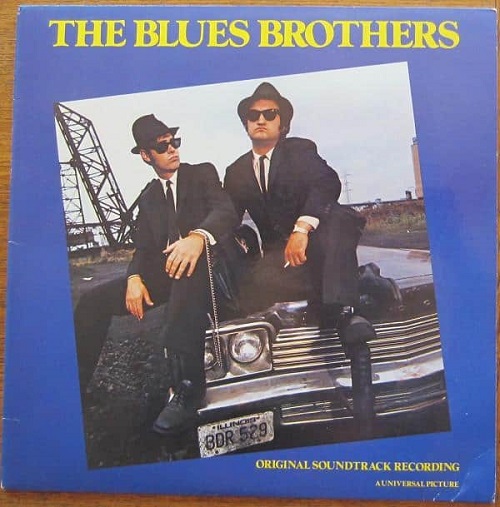
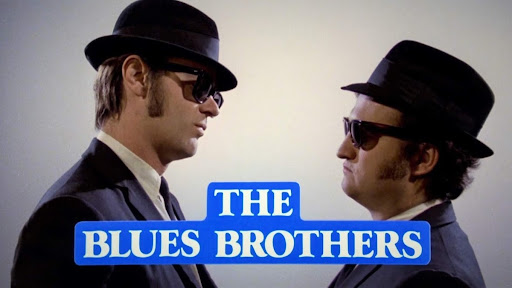
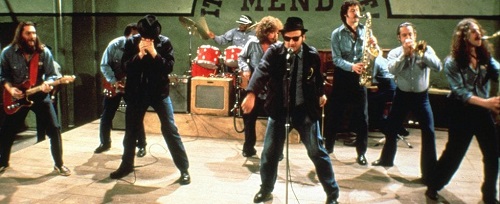
The one soundtrack that has always been a favorite for me (and it doesn’t even contain all the songs featured in the film) is The Blues Brothers. It has some fantastic cuts from Belushi and Aykroyd as well as musical legends like Ray Charles, Aretha Franklin, and Cab Calloway.
I had this soundtrack on vinyl and I played the heck out of it. Many of the songs were featured on my “driving mix tapes” when I had my first car! While the album contains 11 great tracks, the film included many other classics that I wound up searching for to add to my collection. The music doesn’t follow their chronological appearance in the film for some reason.
She Caught the Katy
The album opens with this Taj Mahal song. The Blues Brothers version has a lot more sound to it. It is so much fuller with the horns and guitars of the band. It is the song that the starring credits roll under. The opening guitar lick leads to the first big horn stab (and we see Belushi) then you have another horn stab (and we see Aykroyd) and the third big horn stab hits as we see the movie’s title card.
Belushi’s vocal on this is perfect. I like his vocal on this cut more than any other song on the album.
Peter Gunn Theme
This is the first of two TV themes on the album. This instrumental plays as the Blues Brothers are driving back to Elwood’s place. There are some really great shots of the city of Chicago in this scene. As you listen to this one, you can hear the talents of Tom “Bones” Malone, “Blue” Lou Marini, and “Mr. Fabulous” Alan Rubin. If I had a dollar for every time I used this as background music to introduce a wedding party I could fly to Italy!
Gimme Some Lovin’
Best known for being a hit for the Spencer Davis Group (and a young Steve Winwood), the soundtrack features the full song. In the film, the band begins to play this song at Bob’s Country Bunker (a country bar) and the owner shuts the lights off on them. If I had to choose between the two, I’d pick the Spencer Davis version over this one, but it is still a great jam.
Shake a Tail Feather
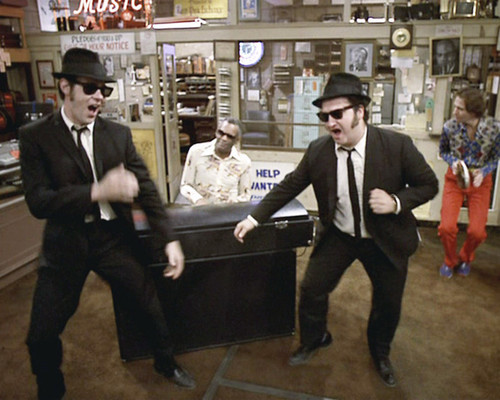
Originally done by the Five Du-Tones of Chicago in 1963, James and Bobby Purify had a bigger hit with it in 1967. This version tops them because of one man – the great Ray Charles. In the film, he owns a music shop and the band is buying new instruments. Ray is asked about a keyboard and Murphy Dunn tells him that the “action” of the keys is not that great. Ray sits down and says, “I don’t see anything wrong with the action on this piano” and launches into this song.
As Ray plays, a crowd gathers outside the store and dances along with the song doing all the dances mentioned in it (the monkey, the jerk, the boogaloo, etc…). This song is fantastic.
Everybody Needs Somebody To Love
The song was written by Solomon Burke and recorded by him in 1964. Wilson Pickett’s 1966 cover is probably the best known version. This song is featured at the Blues Brothers’ big concert toward the end of the film. Over the intro, Elwood (Aykroyd) speaks to the audience and thanks “the members of Illinois law enforcement” who are present and waiting to arrest them. We get to hear a big more of Aykroyd on this track.
The Old Landmark
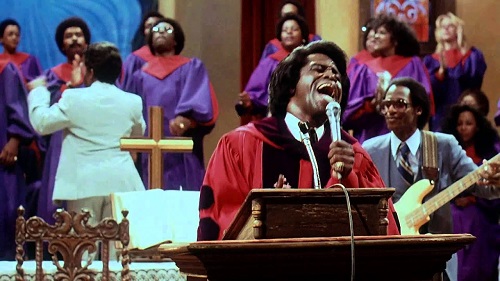
When you mention the Blues Brothers to someone, they will often quote “We’re on a mission from God.” This song is performed by the Godfather of Soul, James Brown who plays a preacher. Jake and Elwood are attending this church service and it is a pivotal moment in the film (and what sets them off on their “mission from God.”
The Old Landmark is a gospel song written by Dr. William Herbert Brewster Sr. back in 1949. It has been recorded by the Staple Singers, Aretha Franklin, Dionne Warwick and many others. James Brown takes this to a whole new level. It’s hard to imagine anyone performing this. He performed/recorded this one live on set.
Think
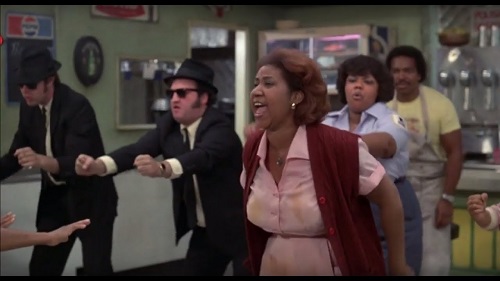
The Queen of Soul, Aretha Franklin, performs this one as she is telling off her husband Matt “Guitar” Murphy. The song was a hit for Aretha in 1968. For the film, they bump up the tempo and add some dancers. This track is SO good! ”Blue” Lou Marini grabs his sax midway through the number and really jams through the end.
This was one of the harder songs to do in the film. Aretha had recorded the song and found it difficult to lip synch to her vocals as they filmed. It was a scene that needed many takes to do. This version is far superior to her original version.
Theme From Rawhide
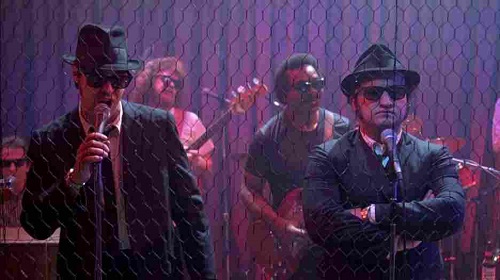
The second TV theme on the album takes place in that country bar. After the lights go out they band has to figure out something that the audience will like. They wind up performing this one. Aykroyd’s vocal is just awesome here not to mention the “call and answer” between him and Belushi. Add in a whip and you have a real country hit on your hands!
This scene always makes me laugh because they perform on a stage surrounded by chicken wire. Why? Because the crowd gets so excited they throw beer bottles at them!
Minnie The Moocher
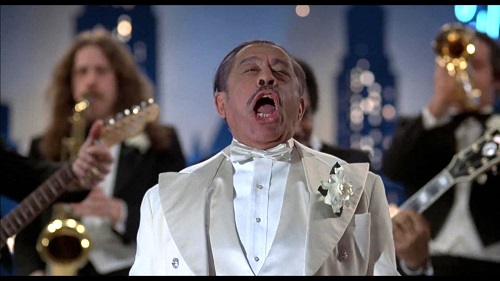
This was a song that Cab Calloway had been singing for decades! He was the “Hi-De-Ho Man.” I just love this version of the song. The rumor is that Cab wanted to do the disco version of the song that he had recorded in the past. They insisted that it needed to be the jazz/big band sound.
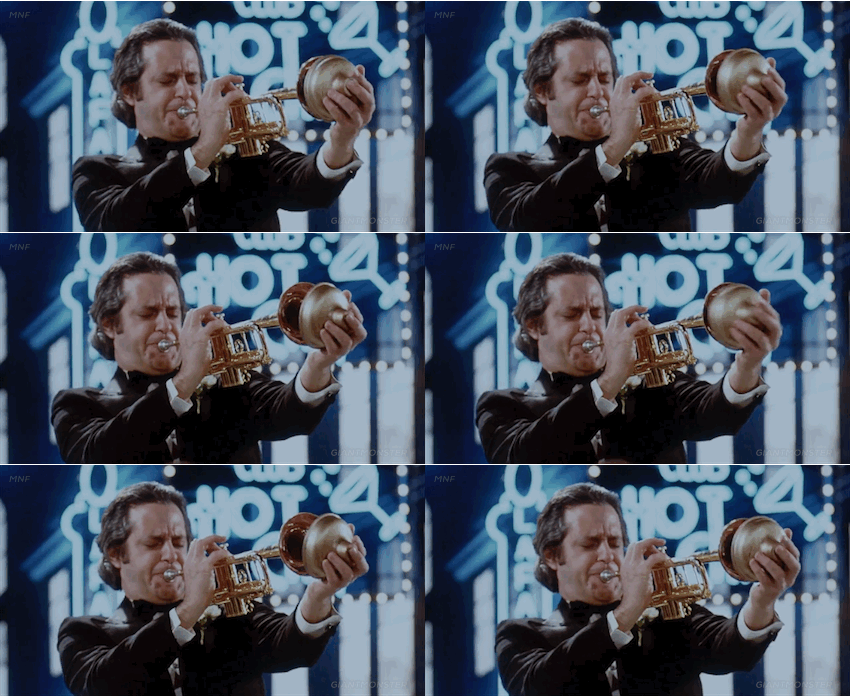
The song itself send you right back to the 1940’s. The full sound of the band, the horn section, and the amazing trumpet solos by Alan Rubin. Without a visual, it is still fantastic. Watching it in the film only enhances the experience.
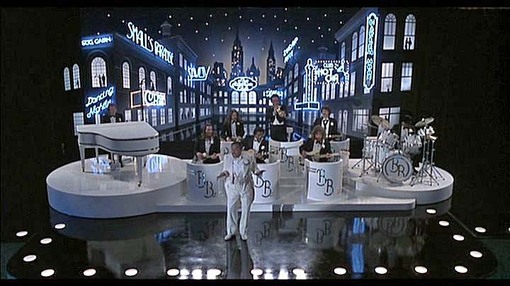
They band is on stage waiting for Jake and Elwood to arrive. The crowd is getting antsy. The band is dressed in street clothes and look sort of shabby. Cab asks if they know the song and the band says they do. He yells, “Hit it!” and the curtain opens. Out struts Cab in a white tuxedo backed by the band, wearing black tuxes and looking sharp. The stage now has an backdrop of famous 40’s places with neon signs and a sweet looking band stand.
As a trumpet player, I can’t NOT mention the spectacular trumpet playing of Alan Rubin on this one!
Cab was a scat singer and his call and answer with the audience is just priceless. I’m not sure how old he was here, but his vocals are right on! He was a legend!
Sweet Home Chicago
This is the longest track on the soundtrack. The original version was done by Robert Johnson in 1936. This is the second song the band plays at their big concert (and the one where they make their escape, hence the long instrumental ending). As they intro it, they dedicate it to the late, great Magic Sam (who was from Chicago) who recorded it in 1967.
This is such a fun song to listen to and to watch in the film. The looks that they give John Candy’s character and the other folks who have been chasing them always make me smile. The song serves as the background music as we transition from night to day and the ultimate finale of the movie.
Jailhouse Rock
Movie Spoiler: The entire Blues Brothers Band gets arrested at the end of the movie. Naturally, the final song of the movie is Jailhouse Rock, originally done by Elvis Presley. Trivia: In the film, the first “prisoner” to jump up on the tables and dance is Joe Walsh!
On the soundtrack, the song is a bit different than in the film. You have a complete cut on the album, while in the movie each band member has a little solo as their name appears in the credits. In the film version you also get a line or two sung by James Brown, Cab Calloway, Aretha Franklin, Ray Charles and more. It’s a perfect capstone to wrap the soundtrack.
I have played the songs on this album over and over again on vinyl, cassette, on my iPod, and YouTube. It remains one of my favorite soundtracks of all time! What disappoints me is the many songs that were featured in the film that didn’t make the soundtrack. They are worth finding and checking out!
Of course, I can’t tease those without listing them, so here goes:
Somebody Loan Me a Dime – Fenton Robinson (Plays while Jake is escorted from his prison cell)
Shake Your Moneymaker – Elmore James (Plays while Jake and Elwood visit with Curtis at the orphanage)
Soothe Me/Hold On, I’m Comin’ – Sam and Dave (Plays on the 8 track in the Bluesmobile while Jake and Elwood are driving and get pulled over)
I Can’t Turn You Loose – The Blues Brothers – Originally done by Otis Redding (Plays while they drive through the mall and as they take the stage at the Palace Hotel Ballroom concert)
Let the Good Times Roll – Louis Jordan (Plays on the record player in Elwood’s place)
Anema e core (Until) – Ezio Pinza (The piece is playing the apartment that Tom Malone and Lou Marini used to stay – the “Are you the police?” scene)
Quando, Quando, Quando – Murph and the Magictones (Plays in the Holiday Inn scene)
Just the Way You Are – Muzak version of the Billy Joel song. (Plays in the Holiday Inn scene)
Die Romantiker (The waltz that plays at the Chez Paul restaurant)
Boom Boom – John Lee Hooker (Plays as the Blues Brothers are going to meet Matt “Guitar” Murphy)
Mama Lawdy/Boogie Chillen – John Lee Hooker (Plays when Jake calls Maury Sline and on the way to Bob’s Country Bunker)
Your Cheatin’ Heart – Kitty Wells (Plays as the Blues Brothers enter Bob’s Country Bunker)
Stand By Your Man – The Blues Brothers (Plays at Bob’s Country Bunker)
I’m Walkin’ – Fat’s Domino (Plays as Jake and Elwood and the orphans promote the concert)
Ride of the Valkyries – Richard Wagner (Plays as the Nazis are chasing the Blues Brothers toward the end of the movie)
The Girl from Impanema – Muzak version (Plays, naturally, in an elevator as the Blues Brothers go up the 11th floor with the tax money)
The Blues Brothers may or may not have been the first movie of “mine” that I made my wife watch with me. I’m sure that she made me watch one of her tear jerking chick flicks to get back at me afterward. To me, this movie remains a classic. As far as the sequel – not so much. It did have a decent soundtrack, but that is about it.
I have been wanting to write about this album for a long time and am glad that Dave finally gave me a reason to indulge myself with this blog. I am also excited to see what the rest of the bloggers have chosen for their soundtrack.
I’m already looking forward to next month’s topic! Thanks for reading!



 Various Ramblings of a Nostalgic Italian