Turntable Talk #28 – Musical Road Map

Welcome to my submission for A Sound Day’s monthly feature – Turntable Talk, hosted by Dave Ruch. This is the 28th installment of this feature and I’ve had the pleasure of writing since for it since the beginning. His topics each month are always something that I look forward to writing about.

This month his instructions were to “unfold the Musical Road Map! The idea is to pick a song with a specific location in its title and write about it. Pick a song you like, even if it’s not a place that is high on your list of dream destinations.  It could be a city, a country , a state or province, even some magical mystical place living in the imagination.” 

As I thought about this topic, plenty of songs entered my head. The challenge I seem to face every month is to try to pick something that one of the other contributors hasn’t already picked. There were many hits that jumped right out at me (Sweet Home Alabama, I Left My Heart in San Francisco, Houston, etc…), so I started thinking about songs that would not be something too popular.

Arrivederci Roma and On An Evening in Roma, both by Dean Martin were the first songs to come to mind. Dean made me think of Frank Sinatra and New York, New York. Frank then got me thinking about Sammy Davis Jr. and I knew that the song I was going to write about would not only be something that the other bloggers wouldn’t pick, but a song that not many people have ever heard before.
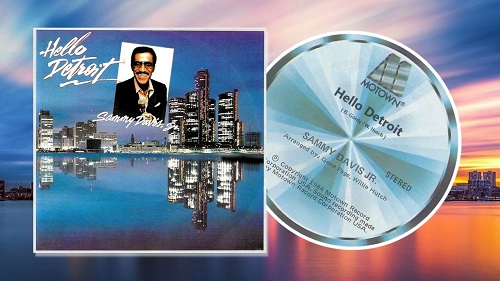
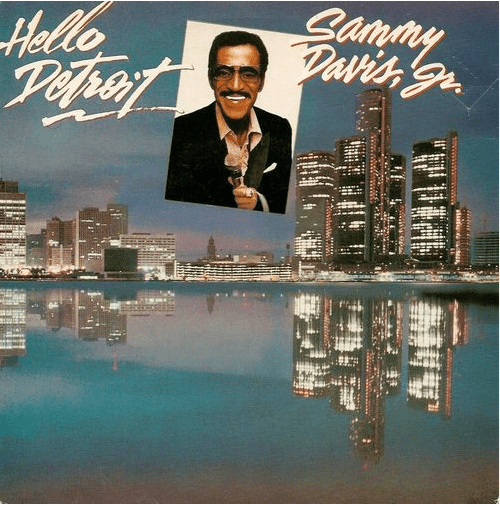
Yesterday, the City of Detroit celebrated its 323rd birthday! Back in 1984, Detroit’s Mayor (Coleman Young) reached out to Berry Gordy Jr. of Motown Records to write an anthem for the city. Berry wrote “Hello, Detroit” with Sammy Davis Jr. in mind to record it. When he showed Sammy the song, Gordy says that he “fell in love with it and felt it reflected his feelings on Detroit.”
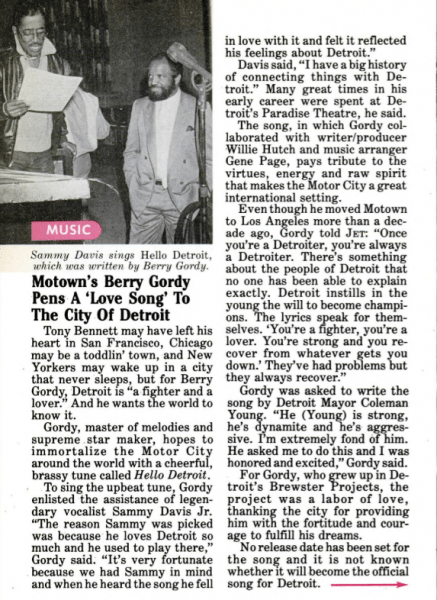
“Hello, Detroit” is certainly not the best song to come out of Motown, and it wasn’t as big as Frank Sinatra or Tony Bennett’s love letters to their respected cities. However, you cannot help but hear the love for the city as Sammy begins to sing:

You’re a fighter, you’re a lover
You’re strong and you recover
From whatever gets you down

Those words certain have a lot of truth to them. The city of Detroit has really turned around over the past decade or so. Downtown is thriving. Ford Field (Lions) and Comerica Park (Tigers) are right across the street from each other, and from the street you can see that amazing Detroit skyline.
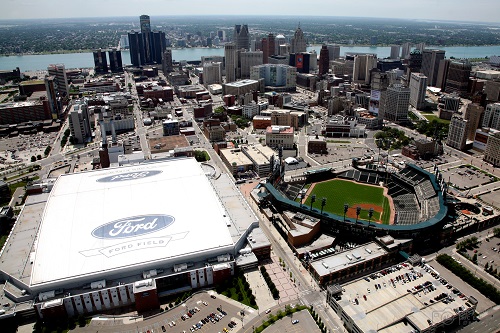
Comerica Park and Ford Field with The Downtown Detroit Skyline in the Background

There is so much more happening in the growing city, but as with any “dated” song, things change.

Hello Detroit, you’ve won my heart
Your renaissance, and waterfronts
Give you a flare of your own

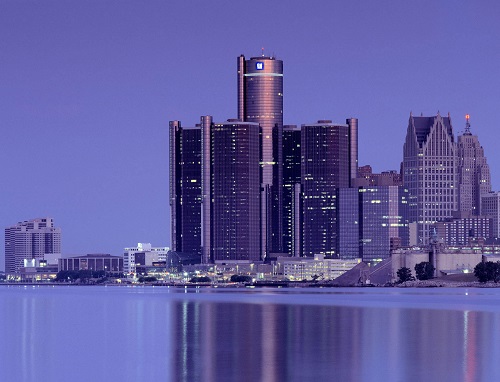
The Renaissance Center has been a staple for years, but General Motors will move out next year and, looking to the future, CEO Mary Barra doesn’t rule out the demolition of the building. The company announced the move earlier this year — pulling out of the iconic skyline staple after 28 years in the name of downsizing.
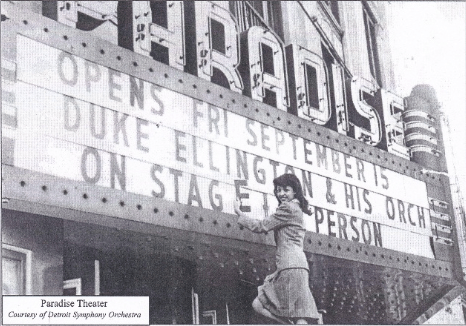
Sammy Davis Jr. said, “My home has always been show business” and Detroit was always hospitable. He said that he had “a big history of connecting things with Detroit,” as he often played the Paradise Theater in Detroit early in his career.
Toward the end of his career, he would take the stage at another theater. Sammy was there for the rebirth of the Fox Theater, along with Frank Sinatra and Liza Minelli.
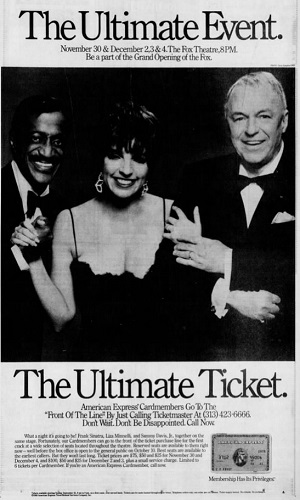
Their five-night stand, complete with a 30-piece orchestra, kicked off a new era for the Fox Theatre. This kind of brought things full circle for Sammy. The Fox originally opened in 1928, and it was the same year a 3-year-old Sammy Davis Jr. performed for the first time.
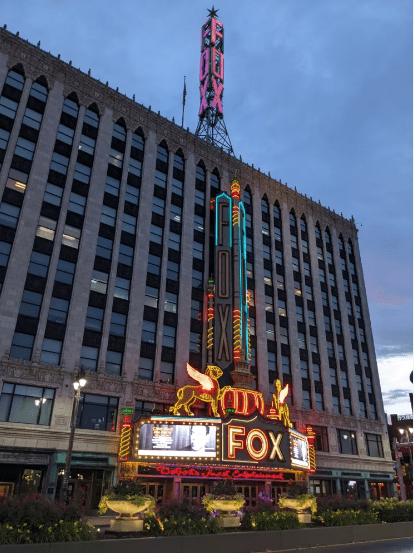
Sammy performed “Hello, Detroit” on opening night at the Grand Reopening of the Fox Theater. The concert rebroadcast may have been the most dignified three hours of content to air on Showtime in all of 1989.

I remember the first time I heard “Hello, Detroit.” It gave me chills. I wish that I could perfectly sum up in my own words what the song means to me and the many folks who call Michigan home, but every time I wrote something, I wound up deleting it. Why? Because I found something online that truly expresses it better than I ever could. This is copied from lyricslayers.com:

Sammy Davis Jr.’s song ‘Hello Detroit’ is a heartfelt tribute to the city of Detroit, capturing its spirit, resilience, and unique charm. The lyrics paint a vivid picture of a city that has faced numerous challenges but continues to thrive and inspire. Davis Jr. describes Detroit as a ‘fighter’ and a ‘lover,’ emphasizing its strength and ability to recover from adversity. This portrayal resonates with the city’s history of economic struggles and its ongoing efforts to reinvent itself.

The song highlights various aspects of Detroit that make it special, from its renaissance and waterfronts to iconic locations like Belle Isle Park and Greektown. These references not only celebrate the city’s physical beauty but also its cultural and social vibrancy. The mention of Detroit’s influence on the young, encouraging them to become ‘stars and champions,’ underscores the city’s role in nurturing talent and ambition, particularly in the realms of music and sports.

Davis Jr.’s repeated affirmations of care and prayer for Detroit reflect a deep emotional connection and a sense of loyalty to the city. The song’s affectionate tone and personal touch make it more than just a tribute; it’s a love letter to a place that has profoundly impacted the artist. The references to ‘Big D,’ ‘Motor City,’ and the ‘Motown sound’ further anchor the song in Detroit’s rich musical heritage, celebrating its contributions to the world of music and its enduring legacy.

‘Hello Detroit’ is a celebration of the city’s indomitable spirit, its cultural richness, and its ability to inspire and uplift. Through his soulful performance, Sammy Davis Jr. captures the essence of Detroit, making listeners feel the same admiration and affection he holds for this remarkable city.

That sums up the song perfectly! It was used in countless promotional ads for television and radio for a few years. Some morning radio shows would play it at the beginning of their shifts every day. Sadly, it faded away and doesn’t get much play any more. That is reason enough for me to feature it here on Turntable Talk.

Hello Detroit

You’re a fighter, you’re a lover
You’re strong and you recover
From whatever gets you down
And there’s so many, many reasons
Any time, any season
Is the right time to be with you

Hello, Detroit!
You’ve won my heart
Your renaissance and waterfronts
Give you a flair of your own

Irresistible you
Hug and kissable you
You’re alive with so much feeling
And I will always be there for you
I will say a little prayer for you
And I will always care for you
Hello

Hello, Detroit!
You’ve touched my soul
Thanks for the memories
I can reach so
Winter, spring, summer and fall
You’ve got it all
Hello, hello, hello!

Hello, Detroit!

I must go through Belle Isle Park
Greet town after dark
You’re in still in the young of will
To become stars and champions

Hello, my friend!
How have you been?
It’s every air
It’s everywhere
The magical touch of you

Irresistible you
Hug and kissable you
You’re alive with so much feeling
And I will always be there for you
I will say a little prayer for you
And I will always care for you

Hello
A big deep
The motor city
And the Motown song that’s got the whole world singing

And I will always be there for you
I will always say a little prayer for you (I will say a little
prayer for you)
And I will always care for you
Hello!

(Hello, Detroit!)
(Detroit!)

(Irresistible you)
(Hug and kissable you)
(You’re alive with so much feeling)
(And I will always be there for you)
(I will say a little prayer for you)
(And I will always care for you)
(Hello!)

Hello, Detroit!
Thanks to Dave for allowing me to participate once again! I not only look forward to reading the other contributions, but to next month’s topic.
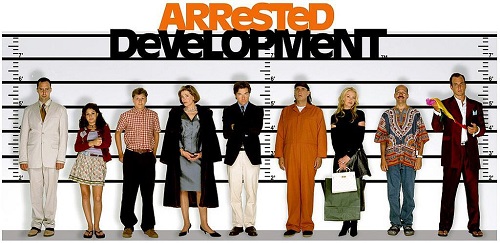
TV Show Draft – Round 9 Pick – Arrested Development

My ninth pick in the Hanspostcard TV Show Draft is a show that consistently made me laugh out loud – Arrested Development. I know going into this blog that it was a show that not everyone “gets.” I recall going to work raving about the show and how much I laughed at it. I encouraged others to watch it. Some got it and most didn’t.

In almost everything you read about the show, it is referred to as “a cult classic.” To a degree, I guess that may be true. I remember how giddy I got when a couple people in my sleep program also were big fans of the show. We were constantly quoting it in class as many stared at us like we were freaks. Maybe we were.

Before continuing, let me say that I chose this show based on the 3 seasons that aired on Fox. I am aware that years later, two more seasons were produced by Netflix (where you can see the entire 5 seasons). As a fan of the show, I watched the two additional seasons, and while there were some funny moments, and while I loved seeing the return of the cast/characters, it lacked so much of what the first three seasons had. That being said, let’s move on …

Ask me the question, “Just why is Arrested Development so good?” or “What makes the show so funny?” and I cannot give you an answer. In preparing to write this, I did a Google search of those questions. There were many Reddit forums and fan sites that come up with personal opinions about it, but none of them really has a solid answer. After all, “comedy is subjective.”

The Origins of the Show

In 2002, Actor/Director Ron Howard had the idea to create a TV comedy that would involve using handheld cameras and shoot sort of like reality TV. It was to have a look of a documentary, yet be a comedy. NBC’s The Office was shot this way and often referred to as a “mock-umentary.”

He met with some people at Imagine Entertainment to discuss the idea and Mitch Hurwitz mentioned the fact that there were a lot of corporate accounting scandals that were in the news (like Enron and Adelphia), and the story of a family that went from rags to riches might work. Howard liked the idea and had Hurwitz begin writing the series. After creating the story’s characters and plot line, he had a pilot script done in January of 2003 and the first episode was shot just two months later. Howard acted as the show’s narrator and in the opening credits welcomes viewers to the “story of a wealthy family who lost everything, and the one son who had no choice but to keep them all together. It’s Arrested Development”.

The show is about a family – albeit a VERY dysfunctional family. I think that is what makes this whole show work. Watching each of these characters, with their own insecurities and idiosyncrasies, interacting with each other allows for comedy to flourish. (It also will cause you to see members of your own family as members of this one!) Add to brilliantly funny “cut-aways,” narrator comments, and strong comedy writing and you have a show that will make your sides hurt from laughing.

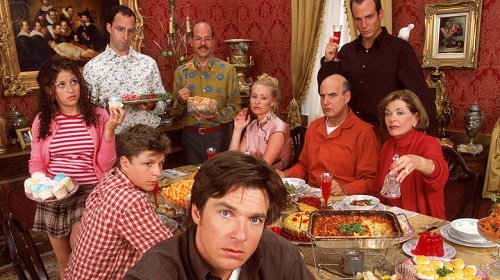
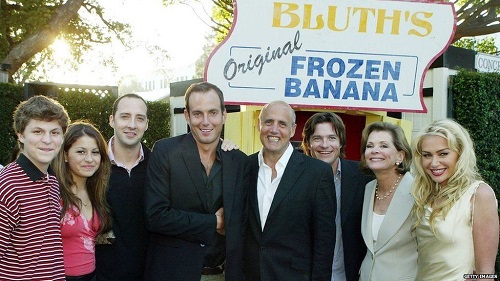
In a nutshell, the show follows the formally wealthy Bluth family as Micheal (Justin Bateman), the only responsible Bluth, tries to keep them and their company from going completely bust while desperately attempting to set a good example for his teenage son (Micheal Cera). The family includes imprisoned father George (Jeffrey Tambor), hypercritical matriarch Lucille (Jessica Walter), failed magician Gob (Will Arnett), spoiled sister Lindsay (Portia de Rossi), and man-child Buster (Tony Hale). 

Wikipedia describes the show this way:

The plot of Arrested Development revolves around the members of the Bluth family, a formerly wealthy family who continue to lead extravagant lifestyles despite their changed circumstances. At the center of the show is Michael Bluth, the show’s straight man, who strives to do the right thing and keep his family together, despite their materialism, selfishness, and manipulative natures. Michael is a widowed single father. His teenage son, George Michael, has the same qualities of decency but feels a constant pressure to live up to his father’s expectations and is often reluctant to follow his father’s plans. He battles with a crush he has on cousin Maeby, which developed from a kiss she gave him as part of a prank.

Michael’s father, George Bluth Sr., is the patriarch of the family and a corrupt real estate developer who is arrested in the first episode. George goes to considerable lengths to manipulate and control his family in spite of his imprisonment, and makes numerous efforts to evade justice. His wife, and Michael’s mother, Lucille Bluth, is ruthlessly manipulative, materialistic, and hypercritical of every member of her family, and constantly drinks alcohol. Her grip is tightest on her youngest son, Byron “Buster” Bluth, an over-educated (yet still under-educated) mama’s boy who has dependency issues and is prone to panic attacks.

Michael’s older brother is George Oscar Bluth II, known by the acronym “Gob” (pronounces like “Job” in the Bible).  An unsuccessful professional magician whose business and personal schemes usually fail or become tiresome and are quickly abandoned, Gob is competitive with Michael over women and bullies Buster. Michael’s twin sister Linday is spoiled and materialistic, continually seeking the center of attention and leaping on various social causes for the sake of vanity. She is married to Tobias Funke (David Cross), a discredited psychiatrist-turned-aspiring actor. Tobias is a self-diagnosed “never-nude” (a disorder comparable to gymnophobia) whose language and behavior have heavily homosexual overtones to which he seems oblivious and which are the center of much tongue-in-cheek comedy throughout the series. Their daughter is Mae “Maeby” Funke (Alia Shawkat), a rebellious teen with an opportunistic streak, who seeks to defy her parents for the sake of attention, and otherwise pursues boys and power, and furthers her complicated relationship with George Michael.

The supporting cast and characters are just as strong and developed as the main ones. Those include Jeffrey Tambor as George Sr.’ identical twin Oscar, Liza Minnelli as Lucille Austero (or Lucille 2), Carl Weathers appears as himself (and is hilarious), and Henry Winkler as the family’s attorney Barry Zuckerkorn. Other guest stars include Ed Begley Junior, Ben Stiller, Christine Taylor, Julia Louis-Dreyfus, and Charlize Theron.

One Reddit user said:

I’ve never found another sitcom on TV that assumed its viewers had concentration spans and didn’t need to be spoon fed things. The producers were more than happy to let a brilliant joke sail past half the audience rather than overexpose it so everyone watching understood. They were not only happy to include subtle references to episodes that occurred a year or two before they were happy to throw in references to things that were going to happen later in the season. And all without a laugh track or excessive mugging to the camera to tell us when to laugh.

Of course being subtle and extremely clever on its own isn’t enough to make a good sitcom. Arrested Development also benefited from brilliant stories, very clever writing and perfect performances from the entire cast.

The countless in-jokes, references to other jokes and jokes that reference jokes that are referencing the in-jokes. The show is so layered that there are literally hundreds of clever idiosyncrasies within each episode. Like someone said earlier, the viewer feels rewarded when they get a joke that refers to an earlier episode.

One of the things I still love about the show is that it gets better with each viewing! I can watch an episode again and find jokes I had missed before. It is constantly offering a “pay off.” It is different from say Friends or Fraiser, in that every time you watch an episode again, you find a comedy “nugget.”

There are many fantastic running gags on the show. Rolling Stone wrote a very nice article on them. You can find that here:

https://www.rollingstone.com/tv/tv-lists/arrested-development-the-funniest-running-jokes-48542/the-banana-stand-46247/

There is also a great Watch Mojo Top 10 list:

Visual gags and word play were often a source of laughs on the show. I remember one gag that really pushed the envelope and left me laughing and wondering how they got away with it at the same time:

One of the silliest gags on the show is the Bluth Family Chicken Dance, which is mentioned in the video above. It is not something they all do in unison, let me be clear on that. Each member of the Bluth family has their own – very unique way – of dancing like a chicken. This is often used when insinuating that another family member is chicken or scared of doing something. I’m including this video, because in the one above, some of the “set up” to the full family dance was omitted.

In the middle of the third season, it was clear that viewership was down and the show was probably going to be cancelled. As a matter of fact, Fox pulled the show from the November sweeps that year AND cut down the order for 22 episodes to just 13 (something which became a joke throughout that third season.)

In 2004, the show was nominated for 7 Emmy awards and won five of them.  It won for Outstanding Comedy Series, Outstanding Directing for a Comedy Series, Outstanding Casting for a Comedy Series, Outstanding Single-Camera Picture Editing for a Comedy Series and Outstanding Writing for a Comedy Series. It was praised by critics for being one of the funniest shows on TV, but the ratings never really lived up to that hype.

I was excited to write about this show, but now that I am reaching the end, I feel that I have in no way, shape, or form done it justice. I just don’t know how to do that. It is a show that makes me laugh out loud, yet I cannot fully explain why. It is a show that you will either love or hate – based on what you find funny.

Remember at the beginning of this blog I asked: “Just why is Arrested Development so good?” or “What makes the show so funny?”

In an interview with The Guardian, Justin Bateman may have the answer! He explained the key to what makes Arrested Development so hilarious is how seriously the characters take their ridiculous lives. He states that the sitcom is actually more like a drama for its ensemble of characters. The comedy, he feels, comes from the fact that the Bluth family has no idea how funny they really are.

“This is not funny to anybody inside the show. This is a drama to them. Almost like an animal documentary, where you’re watching these freaks, and how they gather their food, and how they make their house. And let’s make sure we all whisper because we don’t want these folks to know how much we’re laughing at them.” – Justin Bateman

Thank you, Bluth Family, for all the laughs!