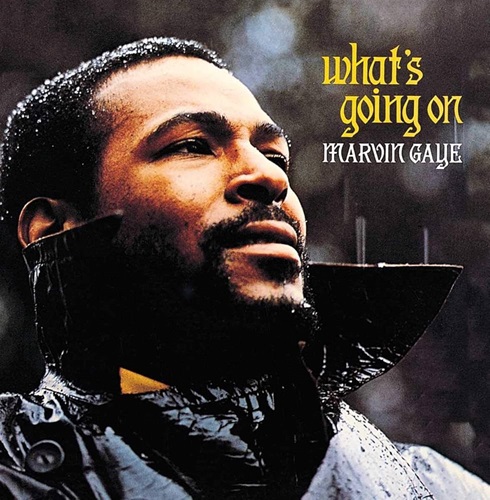
It was on this day in 1971 that Tamla Records (a division of Motown) released Marvin Gaye’s What’s Going On. According to many stories, it almost wasn’t released.
From songfacts.com:
According to the book Mercy, Mercy Me: The Art, Loves & Demons of Marvin Gaye, Motown head Berry Gordy initially refused to release this song, calling it the “worst record I ever heard in my life.” The song was slipped out by the man in charge while Gordy was on vacation and, of course, he was furious… until he found out the single sold 100,000 copies in the US upon its release. Needless to say, he soon changed his mind about this song.
Although Berry Gordy admits he had reservations about “What’s Going On,” he claims all of the stories surrounding his refusal to release the song are false. He explained to the Wall Street Journal: “For years, people have written that I stood in the way of this song’s release and that Marvin had threatened never to record for me again if I didn’t put it out,” he said. “That must make for great reading, but none of it is true.”
He went on to explain the potential ramifications of the song: “My reason for pushing back on Marvin wasn’t to stop the single, just to determine whether or not this was another one of his wild ideas,” Gordy said. “Motown was about music for all people – white and black, blue and green, cops and the robbers. I was reluctant to have our music alienate anyone. This was a big risk for his image.”
The song was written by songwriter Al Cleveland, Four Tops member Renaldo “Obie” Benson and Marvin Gaye. It was Marvin who added lyrics and worked on the arrangement. Marvin did not want to record the song, he wanted the Originals to record it. However, Benson and Cleveland persuaded Gaye to do it himself.
Songfacts.com says,
Until this song, Gaye rarely participated in the songwriting process. For this album, he took control of the production so he could make a statement as an artist. Motown management was skeptical, but Gaye was an established star and had enough power to pull it off, going so far as to use an orchestra on this track.
The song is one of Motown legend. James Jamerson, the bass player for the Funk Brothers, was apparently drunk when he arrived at the studio. Jamerson could not sit properly in his seat and, according to one of the members of the group, lay on the floor playing his bass riffs.
Fun Fact: At the beginning of the song, there are people chatting. Marvin wanted to give the song a laid back feel, so he, the Funk Brothers and Mel Farr and Lem Barney of the Detroit Lions are the ones having conversation as the song begins.
The song was one of the first Motown songs to make a political statement. Jackson Browne said in a 2008 interview with Rolling Stone: “No one was expecting an anti-war song from him. But it was a moment in time when people were willing to hear it from anybody, if it was heartfelt. And who better than the person who has talked to you about love and desire?”
It was nominated for two Grammy Awards in 1972, but did not win either category. It peaked at #2 on the Billboard Hot 100 chart and was ranked the fourth greatest song of all time by a 2004 Rolling Stone poll. It was also ranked the 2nd on the Detroit’s 100 Greatest Songs List by the Detroit Free Press.
Welcome back to The Music of My Life, where I feature ten songs from each year of my life. In most cases, the ten songs I choose will be ones I like personally (unless I explain otherwise). The songs will be selected from Billboard’s Year-end Hot 100 Chart, Acclaimed Music, and will all be released in the featured year. Much of the information presented with the help of Songfacts.com.
I would turn 45 in 2015. I was still DJing school dances and proms, which helped me become familiar with some of the new music. I was still getting music sent to me monthly via a service. I would just download everything and play songs that were requested (if it was clean) or songs I was playing on the Adult Contemporary Station.
Maroon 5’s Sugar was one I played on the radio. When I first heard it, I thought of Michael Jackson’s “Beat It.” I thought I was weird, but apparantly I wasn’t the only one. Songfacts even said “both songs have a similar chorus structure with an almost-identical syllable count.”
The song always got folks on the dance floor. The kids loved it, probably because of the amount of sexual innuendo in the lyrics.
The music video was directed by filmmaker David Dobkin and shot in Los Angeles during December 2014. The clip follows the plot story of Dobkin’s 2005 romantic comedy film Wedding Crashers as we witness the band drive across Los Angeles, surprising a handful of newlyweds on their big day. “Adam and I are old friends and have been talking about doing something together for over a decade,” said Dobkin. “Plus, it’s very meaningful because the band was in New York ten years ago and attended the original Wedding Crashers première.”
Sugar
I first heard Ellie Goulding’s Love Me Like You Do when it played on my radio show. Whether it was the instrumentation of the song, or her unique voice, something stuck out to me. I really liked this song. Honestly, I had no idea she recorded it for that 50 Shades of Grey movie.
Songfacts says:
This song was the first time that Ellie Goulding worked with producer Max Martin. She subsequently teamed up with the Swedish hitmaker for several Delirium tracks. Goulding explained to Billboard magazine how he unlocked her voice. “He directed me on a couple of songs and he’d be like, ‘Can you do this? And I’d be like, ‘Do you mean this?'” she said. “and he’d be like, “Where did that come from? Never heard that before. Never heard you sing low on any of your records before.” And yeah, it was great. It just came out of nowhere. He was good at bringing that confidence out of me.”
That confidence is evident in the song and its powerful chorus.
Love Me Like You Do
In 2015, there were many things happening in my life which I couldn’t control. I became a “yes man” and began to let people walk over me. I seemed to cave every time there was conflict. I just tried to make everyone, but me, happy.
I can still remember hearing the line, “I’ve still got a lot of fight left in me” In Rachel Platten’s Fight Song. It slapped me in the face. It was instrumental in me trying to take back things in my life. Unfortunately, it was that change that only led to more conflict.
Rachel had been playing music for a long time, but nothing ever really came from it. This song changed everything. She said,
“I grinded and worked so hard for so long and got to the point of… I didn’t think it was going to happen. I thought I might need to figure something else out. That moment bred ‘Fight Song.’ So that song came because I had to make a decision, ‘Am I going to keep going or am I going to give up on myself?'”
“I came up with the answer to the decision, I guess through writing the song,” she added. “I didn’t even realize it was happening, but through writing the song I made the decision to not give up on myself. Even if it’s only getting to play to a handful of people a night, that’s enough. At least I get to spread this message. Then funnily enough, by releasing the song, I got this amazing opportunity.”
Fight Song
What drew me to Dear Future Husband by Meghan Trainor was the sound. It sounded like a 50’s song and I liked it. This baffled me because I hated her debut song, “All About That Bass.”
Meghan revealed to The Miami Herald that the song’s subject matter was inspired by an ongoing joke between her and her father that Meghan’s future husband is out there somewhere, “chilling.”
The lyrics list the various things she expects from her future “groom-to-be.” They include “flowers every anniversary.” “open doors for me” and, “don’t have a dirty mind.” She says, “Girls need to be treated better. I never got that growing up.”
Hopefully, there are still men who do those things for their woman. Society tends to make those things old fashioned, but I disagree.
Dear Future Husband
Long before Sam and I were married, we were friends. We both work in sleep medicine. We would chat on the phone and talk about work. She knew I worked in music and told me that her new favorite song was Stressed Out by Twenty One Pilots. I hadn’t heard that one yet.
What has the guys stressed out these days? Tyler Joseph explains:
“I think one of the toughest things is that balances act of trying to maintain relationships while being on the road. It’s been a crazy few years. Josh and I are both very close with our families. It’s one of our favorite moments in our careers is being able to have our families in that video at the end. With that being said, it has been tough trying to maintain those relationships. The other stress is trying to outdo ourselves we either write a song or we play a show. Josh and I, we come from a local scene where every time you played your hometown you had to do something new. You can’t just play the same set. So we kind of apply it to the way that we approach every show, always trying to outdo ourselves.”
Fun Fact: Much of the video was filmed at Josh Dun’s childhood home. Because the home number is listed, Dun’s parents had to cancel the landline to put an end to the calls that were coming in all day and all night!
The song always reminds me of the early days of our friendship.
Stressed Out
Remember earlier in this series when I said “Gangnam Style” was the worst dance song ever? Well, I forgot about the annoying craze started by Silento. I didn’t know what the “Whip” or the “Nae Nae” were! Oh, the requests that I got for their piece of garbage! I would often have to play this two or three times at school dances. URGH!!!
According to songfacts:
“Watch Me (Whip/Nae Nae)” was the soundtrack to the biggest dance craze of 2015. It’s actually two dances. For The Whip, just keep your arm straight and swing it in front of your face like you’re driving a car. The Nae Nae is similar, but with an open hand. They combine very well.
The Nae Nae is based on the character Sheneneh, played by Martin Lawrence in his ’90s TV series Martin. Sheneneh is a very brash woman who is extremely confrontational but gets offended easily. When she gets excited or upset, she makes an exaggerated “talk to the hand” gesture, which is the dance move here.
This song launched his career, but his success didn’t last long. A few years later, in 2021, he was indicted for murder after killing his cousin.
Watch Me
Another song that stuck out to me on the radio was 7 Years by Lukas Graham. The song has some really powerful lyrics.
Lukas Graham explained the song’s message to radio.com:
“The song’s basically just about becoming a good father, and being such a good father that your children would want to come and visit you when you’re an old, boring man,” he said. “I had a really, really cool father, so that’s what I wanna be too.”
“A lot of older people are actually very, very young,” he continued. “And they look at their age as some stamp that now they can point fingers at all the people that are younger than them; in reality I am probably a lot smarter than some of them anyway, at least. I’ve read more books; I’ve tried more stuff; I’ve seen more things.”
“And I think that’s why I can write a song like ‘Seven Years,’ because I might only be 27, but I know what my dreams are,” Graham concluded. “I knew when I was a young man that I wanted to be a father, and I knew I was gonna be a good father at that.”
I can totally relate to that. I have really tried to be a good father to all of my children.
If you listen closely, the sound of a film projector comes in during the quite parts of this song, including the intro. This gives it a nostalgic feel as if watching home movies.
7 Years
I also think of my wife when I hear the next song. I was unaware of her love of country music early in our relationship. Then she started to talk about Thomas Rhett. Die A Happy Man happened to be the first Rhett song I played when I was working at the country station.
He wrote the song for his wife, who’d been asking him to write her a love song. When he played it for her, he said watching her listen to it for the first time was very rewarding. He said:
“I’ve written love songs but never to the extent of that personal,” he said. “We strictly wrote that song about me and my wife’s relationship. I just think this song shows how me and Lauren love each other, and I hope this song is an encouragement to other married couples or people that are dating.”
It certainly was an encouragement to me!
Die A Happy Man
There was a student at one of the schools that would always ask for the group Panic! At The Disco. I’d see him walk up the me and I knew exactly what he wanted to hear. He’d come up multiple times with different songs. It is because of him that I became familiar with Death of a Bachelor.
In 2015, Frank Sinatra would have turned 100. The band used this song as a tribute to him. Brendon Urie posted on his Instagram in reference to the song’s release.
“I attach his music to so many memories: opening presents on Christmas day, my grandparents teaching the rest of the family to swing dance, watching Who Framed Roger Rabbit with my siblings (Sinatra makes a cameo in the form of a cartoon sword singing ‘Witchcraft’).”
“His music has been a major player in the soundtrack of my life. So it’s only right that I return the favor and/or pay it forward. I wrote a new album this year and even in the few songs that don’t sound remotely similar to any of his music I still felt his influence in the writing and the need to relate so personally to each song.”
He said of the song, “It’s like if Sinatra and Beyoncé made a song together. It’s like some Beyoncé beats with some Sinatra vocals. It’s really crazy.”
You even get a Sinatra vibe from the video
Death of a Bachelor
The next song is one that didn’t mean much to me until my divorce – Love Yourself by Justin Bieber. After a break up, the singer is still dealing with an ex. He tells her he’s not crying about things and she should really just go lover herself. It’s a great “blow off” song.
It was written by Ed Sheeran. Out of the many songs he has co-written for other artists, he considers this his favorite.
“I feel like the one that is the slam dunk, whenever I’m at a gig, to play someone else’s song that I had written is “Love Yourself” by Justin Bieber because it was so massive for him. I think it’s his biggest song… anywhere in the world, if I picked up a guitar and played that, they’d be like ‘oh my god, you wrote that!'”
“People always say, ‘Why didn’t you keep it?’ And to be honest, he was on such a roll at that point that I think it wouldn’t have been as big if I’d sung it,” he continued. “He had his whole period of his life that was a bit… you know what I mean. And America loves a comeback story.”
Love Yourself
As a bonus song, here is one that I really like because of its soulful sound. It is the debut single for Charlie Puth – Marvin Gaye. He wrote the chorus the first day he came to Los Angeles. Puth says he was at a coffee shop when the melody struck – he found himself tapping his foot and clapping out the beat.
The song is a duet with Meghan Trainor. Charlie explains how it all came about:
“Meghan and I were at a party one night, and we were exchanging the new music, and she heard ‘Marvin Gaye; and asked, ‘Who else is singing on this? It should be a duet. Let me sing on it!’ So I’m like… OK, Meghan Trainor just asked me to sing on my song, absolutely! In one day, she knew the whole thing. We did it all in one take.”
Asked if Marvin Gaye inspires his music, Puth replied:
“I listened to a lot of Marvin Gaye and Motown records. When I was making my record, I just wanted to make this soulful sound. When Marvin Gaye made his music, he evoked this feeling that would reach everybody.”
The video takes place at a school dance. There is plenty of sexual innuendo, but the music is so smooth and soulful that the people can’t help but dance.
Bonus: Marvin Gaye
So that wraps up 2015. Did I miss one of your favorites? Tell me in the comments. Next week, will be a little different. You may recall me mentioning that the further I got into the 2000’s, the less I connected with the music. I may have been familiar with a song or two, but if I couldn’t connect with it personally or call it a favorite – I didn’t add it.
Because of that, next week will feature the years 2016 & 2017. My list will feature a song with a life lesson, a suggestion for “our” song from my wife, movie music, a song that has a bit of a 60’s sound, and a song that pushes blame. I hope you’ll come back next week.
Welcome back to The Music of My Life, where I feature ten songs from each year of my life. In most cases, the ten songs I choose will be ones I like personally (unless I explain otherwise). The songs will be selected from Billboard’s Year-end Hot 100 Chart, Acclaimed Music, and will all be released in the featured year.
I turned 15 in 1985. It was sophomore year and I had moved up from the Freshman band to the Concert/Marching band. It is the year that consisted of many of my favorite songs that I recently posted about in this week’s Turntable Talk blog. It was also the year that I went on my first date and my first dance. How did the music of 1985 play into my life? Let’s find out…
My first pick is a soulful tribute to two amazing singers who passed away in 1984. It is also the only hit that the Commodores had after Lionel Richie left the group. I am talking, of course, about Nightshift.
The song is a tribute to singers Marvin Gaye and Jackie Wilson. Marvin was 44 when he passed away, while Jackie was only 49. In 1974 the Righteous Brothers had a hit with Rock and Roll Heaven, where they picture fallen stars like Jimi Hendrix and Janis Joplin forming a band in heaven. This was supposed to be a soul version where Marvin Gaye and Jackie Wilson are on heaven’s nightshift, playing some sweet sounds.
I love how the intro starts with that percussion lick and the smooth bass line that works its way to the vocal. It is such a funky, soulful and loving tribute to Marvin and Jackie – two legends!
Nightshift
As a sophomore, I ventured out of my comfort zone a bit and decided it was ok to go to high school dances. Mostly, the guys just hung out at a table and talked. However, after my first official date, I began actually wanting to go to dances with a female date. While I cannot remember for certain, I am pretty sure that one of my first dances ever with a girl was to Crazy For You by Madonna.
Admittedly, I am not a huge fan of hers. My brother, on the other hand, loved her! There are a few songs that I do like by her, and this is one of them. What I remember most about dancing to this song was that she was singing “crazy for you” and I wasn’t sure what kind of message that may or may not have been sending to my date. I was also thinking about making sure I was swaying the same way she was and NOT stepping on her toes. It had to be a very uncomfortable dance for her.
Fun Fact: Madonna reportedly only took one take to record this song.
This was recorded for the soundtrack to the wrestling film Vision Quest, which also featured a guest appearance by Madonna herself, who played a singer at a local restaurant. After the success of this song, the film was renamed Crazy For You in some European countries to capitalize on the song’s popularity.
Crazy For You
How does that saying go? Everything old is new again? I don’t know. What I do know is that Netflix is currently airing the 4th installment of the Beverly Hills Cop Franchise and I hear it is doing well. It was back in 1984 that Eddie Murphy first played Detroit Cop Axel Foley. The character’s name is what led to the title of my next song, Axel F.
Before the title was settled on, it went by a different name. During production of the movie, it known as the “Banana Theme,” as it was slated for a scene where Axel Foley shoves a banana in the tailpipe of police officers intending to pursue him. The composer was German musician Harold Faltermeyer and truly, this song was all him.
According to Wikipedia, he recorded the tune using five instruments: a Roland Jupite-8 provided the distinctive saw lead, a Moog modular synthesizer 15 provided the bass, a Roland JX-3P provided chord stab brasses, a Yamaha DX7 was used for the marimba sound, and a LinnDrum was used for drum programming. Faltermeyer played every single instrument.
He was also the musical director on Beverly Hills Cop and did the score for the film. The soundtrack went to #1 in the US and won a Grammy for Best Album Of Original Score Written For A Motion Picture Or A Television Special. The song topped out at #3.
We played this at a concert one year in band, and though it sounds pretty easy, it was a bit tougher than I anticipated. It may have been in a weird key. It was one of many fun numbers we played.
Axel F
There are some songs that when you hear them, you cannot help but feel happy. My next pick is one of those songs. I have rarely played this at a party or wedding where it didn’t cause people to just get up and dance.
Remember the feeling you got when you first found out that someone truly loved you? There was that feeling of joy that just overflows from you! You can feel that joy and excitement in the vocals by Katrina Leskanich in Walking on Sunshine. It just makes you feel good!
The wife of one of my second cousins threw him a birthday party I DJ’d. The song was on the “must play” list. I remember having a conversation about the song and she said that it was the kid of song that you should play the minute you wake up in the morning. She said that it would just set the mood for the day. She always seemed to be in good mood when I saw her, so maybe she did just that!
Songfacts says, The video got a lot of airplay on MTV. It shows the band hanging around London, with Katrina very colorful and bouncy, and her bandmates more subdued. She had to make her own sunshine, as there was none in London – it was a typically cloudy and cold day.
Katrina’s look was anti-glam, with tennis shoes and the kind of fashions you’d find at the mall. In interviews from this time, she often took shots at singers like Madonna and Pat Benatar for adopting more suggestive looks.
Teen boys didn’t seem to mind….
Take four major country superstars, all who are friends with each other, pitch them an old song and tell them they should record it together and you get one really neat song. That’s the basic story of how Willie Nelson, Waylon Jennings, Kris Kristofferson, and Johnny Cash became The Highwaymen.
Country legend Jimmy Webb wrote the song about a soul with incarnations in four different places in time and history: as a highwayman, a sailor, a construction worker on the Hoover Dam, and finally as a captain of a starship. Webb released his version in 1977, it was covered in 1979 by Glen Campbell, who took the song to Johnny Cash, who was recording with Nelson, Jennings and Kristofferson.
The story goes that the four were all together in Switzerland doing a television special and decided that they should do a project together. While the four were recording their first album, Johnny’s friend Marty Stuart played the song for Cash, saying it would be perfect for them. It had four verses, four souls, and four of them.
The song led to the name of their supergroup, their album, and of course, their first single. Each of the four verses was sung by a different performer: first Nelson as the highwayman, then Kristofferson as the sailor, then Jennings as the dam builder, and finally Cash as the starship captain. Webb later observed, “I don’t know how they decided who would take which verse, but having Johnny last was like having God singing your song.”
No personal story to go with this one, I just like it!
I am embarrassed to say that up until 1985, I had never seen a James Bond movie. I was familiar with the fact that Roger Moore played Bond. My mom would rent Bond films on occasion and also watch them on cable. Moore played a Bond-like version of himself in Cannonball Run in 1981, but I had never really seen him AS Bond.
So when a friend of mine asked if I wanted to go to the show with him we saw A View to a Kill. It was actually neat to see this in the theaters. I had often seen the Bond movie intro being parodied, but to see it kick off the film and to hear the song was all new to me. I was grateful to be able to see it.
Knowing Duran Duran and some of their songs, I was surprised that they did the theme song. The story of how they got it is interesting. Songfacts says: “according to the bassist John Taylor, was that he approached the longtime Bond producer, Albert R. ‘Cubby’ Broccoli, while extremely intoxicated when they were both at a party. He stated that he was a long time fan (Major Bond geek would be more accurate. An Aston Martin was said to be one of his first “rock star” purchases, and he frequently mentioned his Bond video collection in interviews) of the series, but the music for the last few movies had been mediocre. He then offered to have his band fix the problem and Broccoli took the idea under advisement.Being asked to perform the theme song for a James Bond movie is a great honor, but the requirement to include its title in the lyrics can be challenging. Just ask John Taylor. “To this day we are forever grateful that we didn’t get Quantum Of Solace,” he said.
It is the only theme from a Bond movie to hit #1 in America.
A View To A Kill
I’ve made it all the way to 1985 and have yet to feature a Prince song. Not that I don’t like him, he was a musical genius. I am still blown away by his Rock and Roll Hall of Fame performance and his Superbowl Halftime Show. He was a talent, no doubt. My only real connection to him was that we play Let’s Go Crazy in Marching Band one year.
However, I can connect this one to me because it was on my 15th birthday that Prince released Raspberry Beret. Prince originally recorded “Raspberry Beret” in 1982, but re-worked it with his newly re-formed Revolution backing band.
At the time this was released, Prince was under fire from Tipper Gore during the notorious PMRC witch hunt, which placed two of his songs on the list of the “filthy 15.” So this is one of the songs where Prince started making his lyrics more family friendly. But if you really listen closely, you know that Prince still slipped in a “filthy” reference.
Raspberry Beret
1985 was the year that one of my favorite movies was released – Back to the Future. If you’ve read this blog for any length of time, I reference the movie a lot and have read my fair share of time travel novels. It is a masterpiece and I will always watch it when it is on.
When Marty realizes he’s going to be late for school and he leave’s Doc’s place on his skateboard, Huey Lewis and The News’ The Power of Love makes the perfect song to accompany the scene. How did Huey become involved?
The film’s director Robert Zemeckis wanted Lewis to do the song – Huey Lewis & the News were rising stars with a modern sound that worked well in the movie, which takes place in both 1955 and 1985. Lewis had never done film work and hesitated at first, since he didn’t want to write a song called “Back to the Future.” When Zemeckis told him that the song didn’t have to be about the movie, Lewis accepted the challenge.
All Back to the Future fans know that Lewis has an uncredited cameo in this movie. Lewis has an uncredited cameo in this scene, where he plays a teacher who is judging the auditions. An early scene in the film has Marty McFly and his band The Pinheads auditioning for the high school dance. Huey plays a teacher who is judging the auditions. The group plays the beginning of “The Power of Love,” but before Marty can sing a note, Lewis cuts them off, telling them, “I’m afraid you’re just too darn loud.”
The music video doesn’t contain scenes from the film, but does feature an appearance by Christopher Lloyd in character as Doc Brown. We see him pull up in the DeLorean outside of a club where Huey Lewis & the News are performing.
The Power of Love
Yesterday marked the 34th anniversary of the passing of Stevie Ray Vaughn. I debated posting one of his songs for Tune Tuesday, but opted for a more uplifting post.
I was late to the SRV party. I was introduced to him after he passed away. I marveled at his playing and his vocal abilities. I really fell in love with his music.
I wrote about this song before, probably for one of the Song Drafts we were doing. It is Stevie’s cover of the old Hank Ballard song, “Look at Little Sister.”
Look At Little Sister
My final pick is another fun song. It reminds me a lot of the Kinks Come Dancing (which I just wrote about for Max’s PowerPop blog) because of the sound of the opening keyboards.
The Dire Straits were coming off the success of Money For Nothing which really established the band on MTV and on Top 40 radio in America. The fourth single from their Brothers In Arms Album was Walk of Life.
Mark Knopfler wrote this song to celebrate the street buskers of London, hence the references to “Be-Bop-a-Lula” and “What’d I Say,” which were two standards that might be part of a singer’s repertoire in the mid-’80s. Before the lyrics kick in, Knopfler does a few “who-hoo”s, which help create a whimsical vibe. When he spoke with the BBC in 1989, he expressed some “woo-hoo” remorse. “There’s too many ‘woos’ at the beginning of ‘Walk of Life,'” he said. “I heard it on the radio the other day and thought, Oh my God! What was I doing that for?”
Walk of Life (US)
Walk of Life (UK)
What song defined 1985 for you?
Next week we’ll share some songs from 1986. As I look at the music from that year, there were some great music videos! The year will feature my high school class song, my first attempt at Karaoke – before there was Karaoke, and two fantastic cover songs!
It is time once again for another edition of Turntable Talk. This is a feature created by my friend Dave Ruch from the A Sound Day Blog. This is my 18th submission for this feature and it is something I look forward to writing each month.
This time around, Dave took us to the Land of Oz for inspiration. His instructions:
“Pay No Attention to That Man (Or Woman) Behind The Curtain” . Yep the famous phrase about the Wizard of Oz.
We’ve looked at a number of great artists – singers, groups, musicians – and their records. This time we’re switching it up just a little and are going to salute someone “behind the scenes” that was significant to music. All too often people do pay no attention to the people behind the curtain in music that are so important to the albums and groups we love. There are record producers, the record company bosses and talent scouts, the people on radio who used to make the hits happen, even unsung heroes like concert roadies. Pick one you feel is important and maybe a little un-noticed and tell us why!
As a former radio guy, I immediately thought I should write about a well known DJ. There are many of them who played a big part in the music industry. Dick Clark, Casey Kasem, Wolfman Jack and Alan Freed come to mind. However, I decided that I would feature a man who played on some of the biggest hits on the radio, yet until recently was relatively unknown.
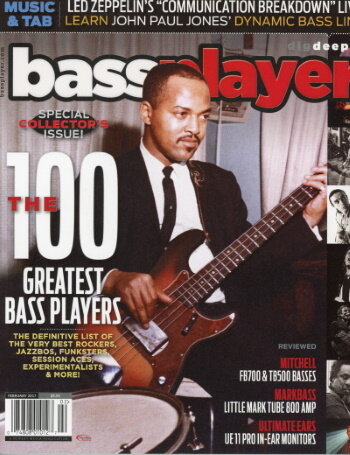
40 years ago, James Jamerson passed away at the young age of 47. At the time he passed away, no one really knew who he was, despite being one of the best (if not THE best) bass player of all time! As a matter of fact, he often tops the list of Best Bass Players of all time by numerous publications. It has been said that he single-handedly revolutionized bass playing. I agree. His creative contributions to music certainly makes him a good pick for a “man behind the curtain.”
James Jamerson was born on January 29, 1936 in Charleston, SC. When his parents divorced, his mother moved to Detroit to find work. He would spend time with his aunt, grandmother and cousin. His aunt sung at church while his grandmother and cousin played piano. He spent time listening to gospel, Jazz, and blues music and that influenced his own musical abilities.
In 1954, his mother sent for him and he attended Northwestern High School. In the music room of the high school, he saw a stand up bass lying on the floor. He picked it up and began to play with it. He had “found” his instrument. He began to play at many of the Detroit area blues and jazz clubs.
He began to get noticed and he began playing for dances, weddings, frat parties, and other events. He was quite a local celebrity. It was hard to miss him driving through town with his bass sticking out the window of his car! Because he was still a minor, the good folks at the Detroit Police Dept. gave him a permit so that he could play in clubs that served alcohol. This allowed him to get more work.
Believe it or not, Wayne State University offered him a full ride music scholarship which he turned down! He was playing so often, he figured he was already in the music field, so why would he need to go to college? Instead, after he graduated high school, he joined up with Washboard Willie and the Super Suds of Rhythm (How’s that for a group name?!). It was during this time that he began to drink alcohol (which would eventually lead to his death).
In 1958, someone from the Northern Records label heard him play and asked him to sit in on the session recordings for the label. The unique way he played caught the ear of other labels. He began to work for Fortune, Tri-Phi, Anna Records, and eventually Motown.
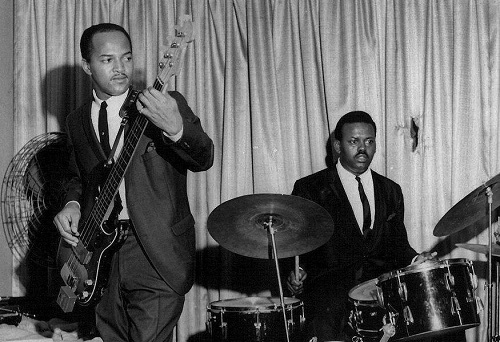
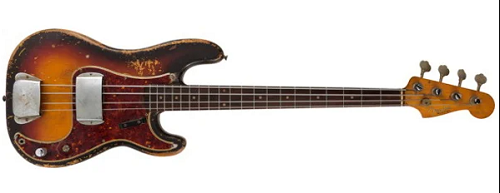
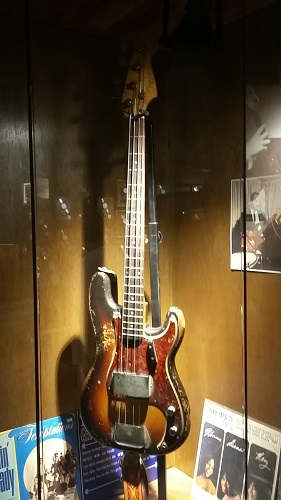
He and the Funk Brothers (pianist Earl Van Dyke, drummer Benny Benjamin, and guitarists Robert White and Joe Messina) spent the days recording in the “Snake Pit” (the Basement of Motown Records) and playing at Jazz clubs in the evenings. Jamerson had switched from an upright bass to a brand new creation – the electric Fender Precision Bass.
The switch really made his work stand out. On some songs, he’d play the stand up bass and then double it with the electric. What made his work on the electric so awesome is that he played the electric just like he played the stand up bass – with one finger (which many folks called “the claw”).
While he is known for playing on many of the Motown songs, he also played on Boom Boom by John Lee Hooker, Whispers Getting Louder and Higher and Higher by Jackie Wilson, Agent Double-O-Soul by Edwin Starr, Cool Jerk by the Capitols, Show and Tell by Al Wilson, Boogie Fever by the Sylvers, and so many other hits! What made the Motown stuff so good was he had some free reign to be “James Jamerson.”
Musician magazine interviewed him in 1983 and he stated that the Motown songwriting and productions teams “would give me the chord sheet, but they couldn’t write for me. When they did, it didn’t sound right. When they gave me that chord sheet, I’d look at it, but then start doing what I thought would fit. I’d hear the melody line from the lyrics and build the bass line around that.”
One of the coolest examples of how he listened and did his thing was on two separate recordings of the same song. To help illustrate this, I found some isolated bass lines on YouTube that are fascinating! Jamerson played on Marvin Gaye’s I Heard It Through the Grapevine – a Motown classic! Check out the soulful line here:
Now check out the same song – and a funkier bass line – on the Gladys Knight Version:
I find it amazing that the same man can take the same song and make them so different.
Speaking of Marvin Gaye, the Funk Brothers shared a story about how Marvin wanted Jamerson to play on What’s Going On. James was out drinking and Marvin went out looking for him. When he found him, he brought him back to the studio. Jamerson was so drunk that he couldn’t even stand up! It was no problem for him, though, he just laid on his back on the floor and played on the track!
Trivia Bit: What’s Going On is the first track that Jamerson is credited on a recording.
It is said that James Jamerson played on almost every Motown song between 1963 and 1968. That would include over 60 songs that hit #15 or better on the charts. He also performed on 23 # 1 songs on the pop charts and 56 #1 songs on the R&B charts! Berry Gordy called him an “incredible improvisor” and said “I, like the other producers, would not do a session unless at least two of the Funk Brothers were present, namely Benny Benjamin and James Jamerson.”
Some of the other Motown songs that feature Jamerson:
Ain’t No Mountain High Enough – Diana Ross and the Supremes
Ain’t That Peculiar – Marvin Gaye
Ain’t to Proud to Beg – The Temptations
Baby, I Need Your Loving – The Four Tops
Baby Love – The Supremes
Bernadette _ The Four Tops
Can I Get a Witness – Marvin Gaye
Dancing in the Streets – Martha and the Vandellas
Don’t Mess With Bill – The Marvelettes
Going to a Go Go – Smokey Robinson and the Miracles
Home Cooking – Jr. Walker and the All Stars
It Takes Two – Marvin Gaye and Tammy Terrell
My Cherie Amour – Stevie Wonder
My Girl – The Temptations
Pride and Joy – Marvin Gaye
Reach Out, I’ll Be There – The Four Tops
Shotgun – Jr. Walker and the All Stars
This Old Heart of Mine – The Isley Brothers
Two Lovers – Mary Wells
What Becomes of the Broken Hearted – Jimmy Ruffin
You can also hear him on :
The Theme from S.W.A.T. – Rhythm Heritage
The Theme from Starsky and Hutch
Just Like Romeo and Juliet – The Reflections
Rock the Boat – Hues Corporation
The list of people who were influenced by Jamerson’s playing is almost as long as the list of songs he played on! Saxophone and bass player Wilton Felder called him “The Godfather of the electric bass.”
Suzi Quatro says, “I grew up in Detroit, so I was weaned on James Jamerson and Motown music. It’s in my DNA. He is still the best and I took my style from him. It’s hard to improve on what he did, because you are talking perfection.”
Sir Paul McCartney says, “Jamerson was where I picked up a lot of my bass style. Because bass players normally have to follow: we follow chords, follow the drummer, follow the vocalist, we have a following role. Suddenly the bass had power! We could dictate the direction of the music and add excitement. James Jamerson became just my hero, really.”
James Jamerson Jr. says, “As for his sense of syncopation, that was his God-given gift. I couldn’t even explain that one. I put it like this: My dad liked to dance, so he just danced on the bass. He would occasionally polish his bass, but he’d never touch the gunk that built up on that fingerboard. he told me the ‘dirt keeps the funk’.”
Years of drinking finally caught up with Jamerson. On August 2, 1983, he died of complications from cirrhosis of the liver, heart failure and pneumonia.
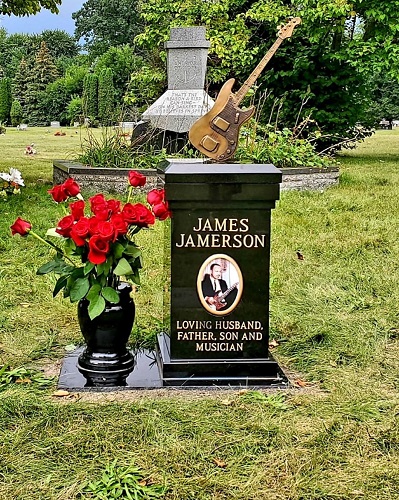
He was buried in Detroit’s Woodlawn Cemetery. A few years ago, Jamerson’s cousin saw a picture of his grave site. There was no headstone, only a grass marker. Eventually, the funds were raised and a proper headstone was set in place on August 27, 2021.
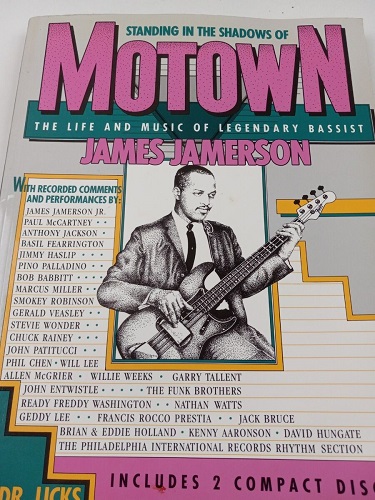
In 1989, Jamerson was the subject of a book loaded with great stuff – Standing in the Shadows of Motown. I think you can still get this on Amazon. A documentary of the same name was produced in 2002
He was posthumously inducted into the Rock and Roll Hall of Fame in 2000, received a Grammy Lifetime Achievement Award in 2004, and inducted into the Musicians Hall of Fame in 2007. Last month, in South Carolina, he was honored when a street was named for him.
It is a shame that it took so long for Jamerson and the Funk Brothers to get the recognition that they deserve.
As I prepared for this piece I found myself on YouTube listening to track after track of Motown stuff and listening with different ears. I focused on that bass line and really was blown away. These are songs I have heard countless times, yet focusing on that bass made them so fresh! As I said, the isolated tracks are an entirely different thing – it is so awesome to hear Jamerson “feel” and “drive” the tunes. It is no wonder that he is ranked the #1 bass player in the business by so many different sources, including Rolling Stone magazine.
Thanks again to Dave for allowing me to be a part of such a cool feature. I have already been impressed by the other blogger’s submissions. I am sure that they love taking part in this feature as much as I do.
As the Song Draft continues, we have come to my fifth pick. I have noticed that I have primarily leaned very “local”. In all honesty, I don’t think I did this intentionally. I have featured songs from my home state of Michigan, and primarily from the Detroit area. I would be remiss if I did not include a song from the Motown Label.
I thought long and hard about just which song to pick. As I looked through the LONG list of Motown groups, I saw The Four Tops, The Supremes, The Temptations, Edwin Starr, Marvin Gaye, The Marvelettes, Diana Ross, The Jackson 5, Gladys Knight and the Pips, The Isley Brothers, Mary Wells, Tammi Terrell, The Spinners and more! There were so many artists to chose from.
Now look at that list of artists again, and imagine the list of songs associated with them! The amount of hits (and non hits) produced out of Motown are plenty. However, as I looked through the list of songs, there was one stand out. I dare say that the song is THE BEST of all of the Motown songs. That song, and my fifth pick for the 2021 Song Draft, is I Heard It Through the Grapevine.
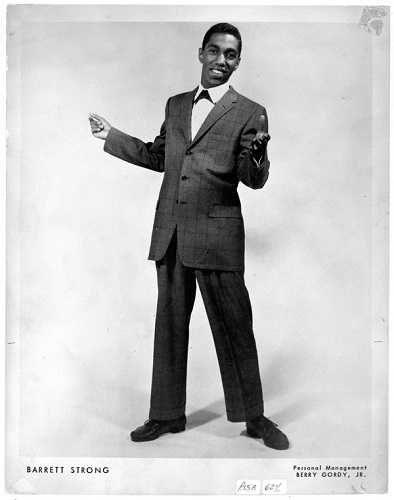
The song was written by another Motown artist, Barrett Strong.
Barrett is famous for his song Money (which was once covered by the Beatles) and for writing other songs like Papa Was a Rolling Stone. He got the idea for the song when he was living in Chicago and heard lots of people using the phrase “I heard it through the grapevine.” Barrett said, “Nobody wrote a song about it, so I sat at a piano and came up with the bass line.”
From Song Facts:
The classic about a man who finds out his woman is cheating on him was written by Norman Whitfield and Barrett Strong. Strong came up with the idea and asked Motown writers Holland-Dozier-Holland to work on it with him. They refused to credit another writer, so Strong took it to Whitfield, who helped put it together. The song eventually became a Motown classic, but it had a rough start, as executives at the company thought it was too bluesy and lacked hit potential.
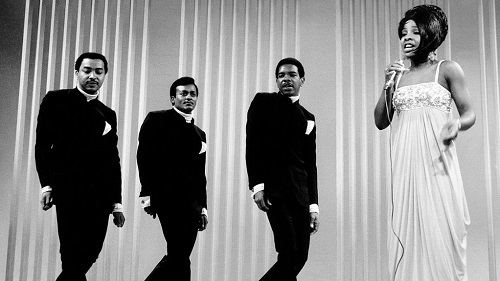
Smokey Robinson and the Miracles were the first to record the song, but their version wasn’t released until years later on an album called Special Occasion. The Isley Brothers then took a crack at it, but their version wasn’t released. Whitfield and Strong then had Marvin Gaye record the song but still no luck: Motown head Berry Gordy chose Holland-Dozier-Holland’s “Your Unchanging Love” over “Grapevine” as his next single. Finally, a new Motown act Gladys Knight and the Pips recorded the song as a gospel rocker. Their version was a hit, entering the Top 40 in November 1967 and going to #2 in America.
Marvin Gaye’s version was included on his 1968 album In The Groove (later re-titled I Heard It Through The Grapevine). After E. Rodney Jones, the Chicago disc jockey at WVON, started playing it on the air, Berry Gordy reconsidered and released Gaye’s version as a single, which became even more popular and known as the definitive version of the song. Gaye’s “Grapevine” pounded the charts about a year after Knight’s, going to #1 in America on December 14, 1968.
On the Motown Box Set, Gladys Knight’s version and Marvin’s version are included. If I had to chose which version I like more, I’d lean more Marvin. However, that being said, Gladys version is really cool too. Hers has a more uptempo feel to it, the bass line (played by James Jamerson in both versions) is extra funky and I love to listen to the drum work in it. Check it out here:
Then you get to Marvin’s version. Slower, groovier, and perfect.
What makes Marvin’s so special? According to Song Facts: Marvin Gaye wrung out the emotion in the song thanks to Norman Whitfield, who produced the track and gave him very specific instructions. Whitfield had Gaye sing slightly higher than his normal range, which created the strained vocal, and he made him do it over and over until he got it right. Gaye explained to NME: “I simply took direction, as I felt the direction he was expounding was a proper one. Had I done it myself I would not have sung it at all like that, but y’see there are many benefits in just singing other people’s material and taking directions. The job of interpreting is quite an important one, because when people are not able to express what is in their souls if there is an artist who can… then I think that is very valuable.”
With that in mind, one of the most amazing videos on YouTube is this version of Grapevine where Marvin’s vocal is isolated. I still get chills listening to the perfection in his voice.
WOW! Just WOW!!
Heard It Through The Grapevine – Lyrics
Ooh-ooh, bet you’re wond’ring how I knew ‘Bout your plans to make me blue With some other guy that you knew before Between the two of us guys, you know I love you more
It took me by surprise I must say When I found out yesterday
Ooh-ooh I heard it through the grapevine Not much longer would you be mine Ooh-ooh I heard it through the grapevine And I’m just about to lose my mind Honey honey yeah
You know that a man ain’t supposed to cry But these tears I can’t, hold inside Losin’ you would end my life you see ‘Cause you mean that much to me
You could have told me yourself That you found someone else
Instead I heard it through the grapevine Not much longer would you be mine Ooh-ooh I heard it through the grapevine And I’m just about to lose my mind Honey honey yeah
People say you have from what you see And not not not from what you hear I can’t help, bein’ confused If it’s true, won’t you tell me dear
Do you plan to let me go For the other guy that you knew before
Ooh-ooh I heard it through the grapevine Not much longer would you be mine Ooh-ooh I heard it through the grapevine And I’m just about to lose my mind Honey honey yeah
Ooh-ooh I heard it through the grapevine Not much longer would you be mine Ooh-ooh I heard it through the grapevine And I’m just about to lose my mind
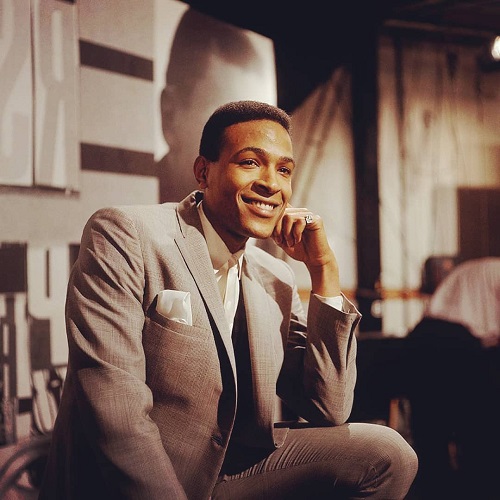
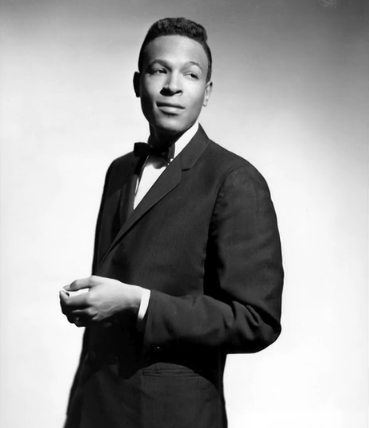
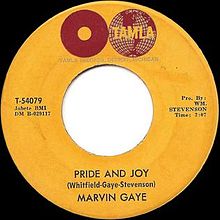
The song in my head on this Tune Tuesday is a two-minute masterpiece from one of the greatest voices to come out of Motown – Marvin Gaye. Yesterday would have been his 80th birthday. In his short, but amazing career, he had many hits which included I’ll Be Doggone, What’s Going On?, Sexual Healing, Can I Get a Witness?, and, of course, I Heard It Through the Grapevine. I could have easily picked any one of those today, but instead, I chose one of his early (and sometimes overlooked) classics – Pride and Joy.
The song opens with a “question and answer” between the bass guitar and piano and from the moment Marvin begins singing, the bass and the piano bounce along with him as he sings. The bass bounces along with the piano just seems to be playing around in the background, and it just sounds fun.
The song was recorded in 1962 and released in 1963. The instrumentation on the song is performed by The Funk Brothers. The background singers on the song are none other than Martha and the Vandellas, who would go on to have great success a few weeks later with their song “Heatwave.” The song is soulful, playful, and perfect.
Lyrically, the song is a simple love song (supposedly written for Marvin’s girlfriend at the time Anna Gordy – Motown founder Barry Gordy’s sister). Marvin’s vocal is spot on. The “question and answer” that started with the bass and piano now is exchanged by Marvin and the background singers. There is almost a “gospel” feel to the song. I love how Marvin can bounce from higher notes to lower ones and make it sound so effortless. The song would go on to become Marvin’s first Top 10 record.
“Pride And Joy”
You are my pride and joy
And I just love you, love you darlin’
Like a baby boy loves his toy
You’ve got kisses sweeter than honey
And I work seven days a week to givea you all my money
And that’s why you’re my pride and joy
And I’m tellin’ the world
You’re my (pride and joy) pride and joy (pride and joy)
I believe I’m your (baby boy) baby boy (baby boy)
And I know you’re mine (pride and joy)
My pride and joy (pride and joy)
Yeah baby (baby boy) Yeah baby (baby boy)
You, you are my pride and joy
And a love like mine, yeah baby
It’s something nobody can ever destroy
You pick me up (pick me up) when I’m down (when I’m down)
And when we go out, pretty baby
You shake up the whole town (whole town)
And that’s why (that’s why)
I believe you’re my (you’re my) pride and joy (pride and joy)
(Pride and joy)[x4] (baby boy)[x2]
(Pride and joy) My pride and joy (pride and joy)
And I love you like a baby loves his toy (pride and joy)
Yeah Yeah Yeah Yeah (pride and joy) My pride and joy (pride and joy)
Oh Oh (pride and joy) In the morning (pride and joy)









 Various Ramblings of a Nostalgic Italian