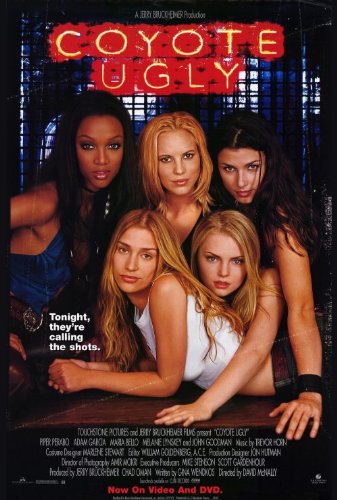
Honestly, I’ve never seen the movie Coyote Ugly. I did mention it on the radio a few times because we played songs from the soundtrack. The film premiered on this day in 2000.
“Can’t Fight The Moonlight” by LeAnn Rimes is the theme song to the movie. In the film Piper Perabo’s character plays a singer-songwriter from New Jersey who moves to New York City to pursue her music career. She ends up getting a job at a bar called the Coyote Ugly, where she makes enough money to buy a Mac that she uses to write and record this song. It earns her a showcase audition where she performs the song, wowing the crowd and earning a label deal.
“Can’t Fight The Moonlight” was a huge international hit, topping the charts in Australia, the UK, The Netherlands, New Zealand, and several other territories. In Australia, it was the best-selling single of 2001.
Believe it or not, the song didn’t do so well in America, where it only reached #71 in September 2001, It was released as the first single from the Coyote Ugly soundtrack. Seeing the international success, Rimes’ label, Curb, gave it another shot, re-releasing the song with a renewed promotional push. The re-release went to #11 in March 2002, long after the film had left theaters. Second time’s the charm apparently.
LeAnn provided the voice for Perabo’s singing in the film, and actually shows up to sing it in the film. The video is essentially an extended version of Rimes’ appearance in the film, showing her singing the song on the Coyote Ugly bar, intercut with other scenes from the movie.
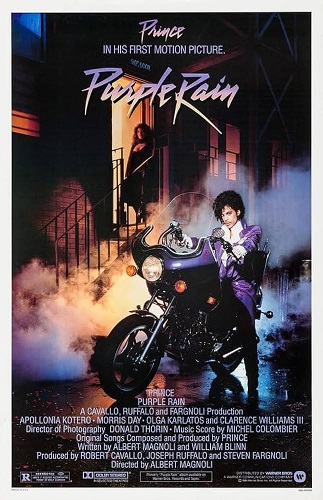
Last year Rolling Stone magazine listed its 100 Best Movie Soundtracks list. It was interesting to scroll through. There were plenty of movies on the list that I have never seen. Sitting at the top of the list was Prince’s Purple Rain.
The soundtrack was loaded with hits: Let’s Go Crazy. I Would Die 4 U, Purple Rain and today’s featured song. According to Songfacts.com, the film is semi-autobiographical, but how much is based on real life remains a mystery, as Prince rarely gave interviews and didn’t talk about his personal life.
In the movie, When Doves Cry expresses his fear of becoming like his parents. When the doves cry, that’s his musical refuge – the barrage of keyboards in the chorus represents the doves crying. Besides writing and composing the track, Prince played all the instruments on the song.
I never noticed this before, but there is no bass on this song. Prince took out the bass track at the last minute to get a different sound, though he hated to see it go.
“Sometimes your brain kind of splits in two – your ego tells you one thing, and the rest of you says something else. You have to go with what you know is right,” he told Bass Player magazine.
Prince used his trusty LM-1 drum machine (now on display at Paisley Park) on this track to create the unique percussion. It was ntroduced in 1980 by Roger Linn, the LM-1 was the first programmable drum machine that sampled real drums.
To make the sound, Prince used a recording of a cross-stick snare drum, where you hold the tip onto the drum head and slap the stick against the rim of the drum. He then tuned it down an octave to give it more of a knocking sound, and ran it through a guitar processor.
Fun fact: Although there is no bass in the song and the percussion part is played entirely by drum machine, Prince’s drummer and bass player from his band The Revolution still appear in the video “playing” along on their instruments.
It was 82 years ago today that the musical Stormy Weather premiered in the US.
The movie starred the beautiful Lena Horne, Bill “Bojangles” Robinson, and Cab Calloway. Also making appearances were Fats Waller and Dooley Wilson (who was the piano player in Casablanca). The movie is loosely based on Robinson’s life. It would be Robinson’s last film (he passed away in 1949).
Wiki says: “Stormy Weather is a primary showcase of some of the leading African American performers of the day, during an era when African American actors and singers rarely appeared in lead roles in mainstream Hollywood productions.” The entire movie is only about 75 minutes long, yet it is full of music! 20 songs to be exact.
The soundtrack is full of great songs like Ain’t Misbehavin’ from Fats Waller, Cab Calloway and his band offer up a few numbers including Jumpin’ Jive and then there is the title track performed by Lena Horne. While she is remembered for her version of the song, she also performs in several dance numbers with Robinson. It was one of her few non-MGM film appearances, and one of only two films from the 1930s-1940s in which she played a substantial role.
It was first sung by Ethel Waters under the title of “Stormy Weather (Keeps Rainin’ All The Time)” at the Cotton Club in Harlem. “When I got out there in the middle of the Cotton Club floor,” Waters recalled. “I was singing the story of my misery and confusion … the story of the wrongs and outrages done to me by people I had loved and trusted … I sang ‘Stormy Weather’ from the depths of my private hell in which I was being crushed and suffocated.”
Lena Horne’s version of the song is probably the best-known recording of this standard and became her signature tune. She originally sang it in 1941 for RCA Victor, but it was re-recorded in 1943 for the soundtrack. Noteworthy cover versions have been recorded by Judy Garland, Ella Fitzgerald, Frank Sinatra and Billie Holiday, among many others.
Fun Fact: Lena Horne’s version of the song was inducted into the Grammy Hall of Fame in 2000 and Ethel Waters’ recording three years later.
Here is the version from the film:
Here is the 1943 recording:
I have always loved the bluesy Jackie Wilson version:
Most people have never heard the “doo wop” version that the Spaniels (who sang Goodnight Sweetheart) did. I just love everything about this version:
I could play so many other versions of the song, but instead I will encourage you to search up the great covers on YouTube. It is just such an amazing song, it’s hard to have a bad version of it.
It was on this day in 1881 that Billy the Kid was shot dead by police.
His story is one of fascination and uncertainty. Eyewitness history says that prior to his death “Billy worked as a ranch hand for John Tunstall. Tunstall befriended the Kid acting in many ways as a surrogate father. Tunstall’s ambush and murder in 1878 by a sheriff’s posse set the Kid off on a path of revenge. His first victims were the sheriff and his deputy, killed from ambush on the streets of Lincoln. On the run for two years, the Kid was eventually captured, tried, convicted and returned to Lincoln to hang for the murders.
On the evening of April 28, 1881 as he was climbing the steps returning him to his cell, the Kid made a mad dash, grabbed a six-shooter and shot his guard. Hearing the shots, a second guard ran from across the street only to be gunned down by the Kid standing on the balcony above him. Mounting a horse, he galloped out of town and into history.”
After his escape he was pursued by sheriff, Pat Garrett. “I knew the desperate character of the man,” Garrett later wrote. “That he was daring and unscrupulous, and that he would sacrifice the lives of a hundred men who stood between him and liberty, when the gallows stared him in the face, with as little compunction as he would kill a coyote.”
That July, Garrett and his deputies followed the outlaw’s trail to Fort Sumner, New Mexico, and to a ranch owned by Peter Maxwell. On that fateful night, Garrett snuck into Maxwell’s home and found the rancher in bed. There, in the dark, the sheriff suddenly heard someone else approaching. He hardly had time to react when a shadowy figure appeared in the doorway and demanded in Spanish to know who else was there.
“That’s him,” Maxwell whispered to Garrett, so the sheriff raised his gun.
Billy the Kid died that night at the age of 21, shot near the heart as he lurched into Maxwell’s bedroom. But despite several people coming forward in the subsequent days to identify his body, it didn’t take long for rumors to circulate that Billy the Kid had actually escaped death — again.
Emilio Estevez starred as Billy the Kid in the 1988 film, Young Guns and the 1990 sequel. A third installment is currently in the works with Estevez returning again as the Kid.
For the sequel, Emilio Estevez asked Jon Bon Jovi for permission to use the song “Wanted: Dead or Alive” in the movie. Bon Jovi didn’t feel the song’s lyrics were appropriate; however, he was inspired by the project and resolved to write a new song for the film that would be more in keeping with the period and setting. He quickly wrote the song “Blaze of Glory”, and performed it on acoustic guitar in the Utah desert for Estevez and screenwriter John Fusco. John loved it and put it in the movie.
Fun Fact: Bon Jovi wrote the song on a napkin in a diner on the set of Young Guns II. Emilio Estevez has it framed on a wall at his home.
Bon Jovi ended up recording a whole album of songs inspired by Young Guns II, which was released a week after the film and also called Blaze of Glory. It was his first solo album, and it sold over 2 million copies. To play on the album, Jon recruited some big names, including Elton John, Little Richard and Jeff Beck, who played slide guitar on this track.
Sources: Songfacts, All That’s Interesting, Eyewitness History.
Nine notes. Nine notes that are still recognizable today. Broken into two parts – 4 notes, then 5 notes. “Dum da dum dum” (Pause) “Dum da dum dum da.” Those notes were immediately followed by a stern narrator who informed listeners, “Ladies and gentlemen. The story you are about to hear is true. Only the names have been changed to protect the innocent.”
On this day in 1949, Jack Webb debuted on radio as Sergeant Joe Friday in Dragnet. He created and produced the show as well. Wiki states that “Dragnet is perhaps the most famous and influential police procedural crime drama in American media history. Webb’s aims in Dragnet were for unpretentious acting and a realistic depiction of policing. The series portrayed police work as dangerous and heroic, and helped shape public perception of law enforcement in the 20th century, improving the public’s opinion of police officers.”
The radio show was so popular that it made the transition to television. It ran on NBC from 1951 to 1959. NBC brought the show back to television from 1967 to 1970. It first appeared as a feature film in 1954. It became the first theatrical film to be based on a TV show.
Check out this trailer!
A TV movie was produced in 1966 with the intention of it launching the return of the show to TV. It didn’t air until 1969 for some reason. The final film version made Dragnet a comedy starring Dan Aykroyd and Tom Hanks.
Wiki says “The film contrasted the terse, clipped character of Friday, a hero from an earlier age, with the “real world” of Los Angeles in 1987 to broad comedic effect. Apart from Aykroyd’s spot-on imitation of Webb’s Joe Friday and Harry Morgan reprising his role of Bill Gannon (now Captain), the film version has few similarities with previous incarnations. This Dragnet parody was a hit with audiences.”
Dragnet was no stranger to parodies. It was parodied by Looney Tunes, Woody Woodpecker, Sesame Street, The Three Stooges, Rocky and Bullwinkle, and a series of audio parodies by Stan Freberg. Jack Webb loaned Stan the actual band/orchestra he used on radio for his parodies.
As I mentioned, the theme is instantly recognized today. For the 1987 film, producers got the British band The Art of Noise to perform it. The them is actually two songs merged together. The opening is entitled Danger Ahead, and what follows is the Dragnet March. The Art of Noise version is very …. 80’s.
The first “hit version” was done by Ray Anthony and His Orchestra in 1953. It starts very familiar and gets a bit “jazzy.”
And to start your Monday with a laugh or two, here are a couple of Stan Freberg’s Dragnet parodies. Notice how the music “stabs” were used to enhance the story, just like on the radio.
It was on this day in 1989 that Dennis Quaid hit the big screen as Jerry Lew Lewis in Great Balls of Fire.
The film covers the early career of Lewis, from his rise to rock-and-roll stardom to his controversial marriage to his 13-year-old cousin. That marriage led to his downfall. Until the scandal of the marriage depreciated his image, many had thought Lewis would take over Elvis Presley as the “King of Rock and Roll” in the 1950s.
The story was co-written by Myra Gale Lewis (her autobiography Great Balls of Fire!), the former wife of Jerry Lee Lewis, with Murray Silver. Despite this, co-writer Silver was upset by the lack of accuracy in the film, claiming it was “phoney”.
Lewis openly stated that he hated the film and the book it was based on. He did, however, praise Quaid’s portrayal of him in the film, saying “he really pulled it off”. Quaid even learned to play “Lewis-style” piano for the role.
For the soundtrack, Lewis re-recorded some of his music from the 1950s. The songs included “Whole Lotta Shakin’ Goin’ On,” “That Lucky Old Sun,” “High School Confidential,” “Breathless,” and the title track.
Overall, the re-recordings aren’t bad. Jerry Lee’s voice still sounds great and the sound is pretty close to that of the originals. Many of them are longer and contain extra solos, which is actually neat to hear.
I could pick a few from this soundtrack, but I’ve gotta go with the title track. Here are the versions from the film, the soundtrack and the original hit.
It was on this day in 1989 that Michael Keaton hit the big screen as Batman. Jack Nicholson was chosen to play the Joker.
Growing up, my only knowledge of Batman was from cartoons and the 1966 series. When the previews came out for this, I was very apprehensive. It was darker than any previous incarnation of the character I had seen.
I remember being one of the “hold outs” who didn’t really want to see the movie. My girlfriend at the time wanted to see it, so I eventually caved (pun intended) and went to see it
I truly loved the movie. Keaton was actually pretty good as the title character. Nicholson was, of course, fantastic as the Joker. He kind of stole the show, as they say.
The opening theme from Danny Elfman perfectly fits the movie. His music throughout the film seemed to enhance the scenes they accompanied. Then there was the “other” soundtrack.
From Songfacts.com:
Because of the abundance of music available for the movie (Danny Elfman of Oingo Boingo created the instrumental score), there were two soundtrack albums: Elfman’s and Prince’s. Everything that Prince composed for the movie, whether it was used in the film or not, went onto his album, including “Batdance.”
Director Tim Burton asked Prince to contribute songs for his Batman movie (at the time, he was using “1999” and “Baby I’m a Star” on a temporary soundtrack). Prince accepted while watching a rough cut of the movie and noticed four places in the film that would be “natural” locations for his songs.
Prince canceled a scheduled Paris vacation to write and produce songs for the movie. A month after the meeting with Burton, he played the director eight songs, all of them synchronized to the film. Burton rejected some of them (including “Rave the Joy Fantastic,” and “200 Balloons”), but liked most of what he heard and asked for two additional songs. “Trust” and “Partyman” were quickly offered by the Purple One.In the end, six Prince songs were used in the film.
“Batdance” was not used in the movie, and Prince never offered it up. Comprised of bits Prince pieced together overnight from music, sounds and dialogue from the movie, it served as a companion piece for the film and was essentially promotional vehicle for Batman.
Batdance was Prince’s first #1 hit since “Kiss” in early 1986. It seemed to be on every radio station around this time and did help boost the popularity of the movie. Personally, it didn’t do much for me.
Elfman’s theme, however, was a cut that I just loved! That entire build up until the opening chord (:40 seconds in) builds so much suspense. When that chord ceases and the theme continues it foreshadows the action that the film will present. It’s so good.
47 years ago today, Grease opened in theaters starring John Travolta and Olivia Newton-John. In its opening weekend, the film grossed $8,941,717 in 862 theaters in the United States and Canada, ranking at number 2 (behind Jaws 2).
The soundtrack album for Grease featured some original songs (Grease, Summer Nights, You’re the One That I Want) and covers mostly sung by Sha-Na-Na (Blue Moon, Hound Dog, Tears on My Pillow). It wound up being the second best selling album of the year. The soundtrack that was number one was from Saturday Night Fever, which also starred Travolta.
Fun fact: Two of the bass players who recorded on the Grease soundtrack were members of the band Toto.
Olivia Newton-John’s contract for Grease stipulated that she should have a solo spot. However, nobody had any ideas for a song for her character, Sandy, until Olivia’s producer John Farrar came up with “Hopelessly Devoted To You” halfway through the shoot. Director Randal Kleiser wasn’t wholly convinced by the song at first and had to come up with an entirely new scene to fit it in. It was eventually filmed and recorded after the movie had wrapped and it earned the film’s only Oscar nomination, for Best Music – Original Song.
John Travolta evoked this song when he introduced the In Memoriam segment at the Oscars in 2023, seven months after Olivia Newton-John died of cancer at 73. “In this industry we have the rare luxury of getting to do what we love for a living, and sometimes getting to do it with people we come to love,” a tearful Travolta said. “They’ve touched our hearts, they’ve made us smile, and became dear friends that we will always remain hopelessly devoted to.”
Michael J. Fox celebrates his 61st birthday today. He started acting as a child in the 70’s, but his role as Alex Keaton on Family Ties in the 80’s made him a star.
The role of Marty McFly in Back to the Future was first given to actor Eric Stoltz. His performance didn’t fit what they were looking for and he was replaced by Michael J. Fox.
Fox was the original choice to play Marty. Producers gave the script to the producer of Family Ties and asked him to give the script to Fox. They didn’t. After shooting scenes with Stoltz and deciding he was wrong for the part, they approached the Family Ties producer again. This time he told Fox that he was wanted for a role. They also told him he could take it as long as filming didn’t interfere with his work on Family Ties. Fox accepted the role without even reading the script.
Michael would film Family Ties during the day and Back to the Future at night until production ended on Family Ties. This left him exhausted, but according to him “Worth it.”
Huey Lewis was approached to write a song for the movie. He contributed Back In Time and The Power of Love.
My favorite cut on the soundtrack is the version of Johnny B. Goode that Marty sings at the dance in the film. Producers wanted audiences to think that it was Michael singing the song, so they never gave credit to Mark Campbell who is really singing.
Fox was taught how to look like he was playing guitar, as well as mimicking the moves of Jimi Hendrix, Pete Townshend, and Chuck Berry. Berry originally wrote and had a hit with Johnny B. Goode. He waited until the day before filming to give them permission to use the song in the film.
In the movie, Marty kind of goes crazy at the end of the song, leaving the audience and band members wondering just what he was doing. On the soundtrack, we hear a version with bits of the guitar solo from the film, but not the craziness Marty does in the film.
American composer and conductor Marvin Hamlish was born on this day in 1944. He is one of a handful of people to win the “EGOT” (Emmy, Grammy, Oscar, and Tony awards).
Marvin’s first film score was in 1968 for The Swimmer. He also wrote the score for The Way We Were, the theme music to Good Morning America, and the score of the Broadway Musical A Chorus Line. He was also conductor for symphony orchestras in San Diego, Buffalo, Dallas and Pittsburgh. It is obvious to say that he was musically busy.
He may be best known for adapting the music of Scott Joplin for the movie The Sting in 1973.
The Entertainer is a rag that was composed by Scott Joplin, the first classically trained black composer to become a household name in America. The piece was copyrighted December 29, 1902; copies were received by the Copyright Office, January 8, 1903.
Joplin died in April 1917; although his place in the history of contemporary music was already secured, he predicted that he would not receive the recognition he deserved until 25 years after his death. He had no Idea that his music would go on to chart success over 50 years later!
Marvin Hamlisch on adapting Joplin’s tunes for The Sting:
“From the beginning, [director] George Roy Hill’s idea had always been to use the ragtime music of Scott Joplin. I was well aware that there were other musicians who knew the music of Scott Joplin far more intimately than I, men who had popularized Joplin’s famous piano ‘rags.’ But I knew how to write for film, marrying music to the length of each scene, and I could also play the piano ‘rags’ – those Juilliard piano lessons were about to pay off.
The real fun came for me when we started recording the soundtrack. We didn’t have a full-size orchestra, as with The Way We Were, but we had eight or nine great musicians, with yours truly at the keyboard. We spent hours making ragtime; the piano player in me had found a long-lost brother in Scott Joplin.”
Hamlisch’s rendition peaked at #3 on the Hot 100 in May 1974. It hit #1 on the Adult Contemporary charts.