
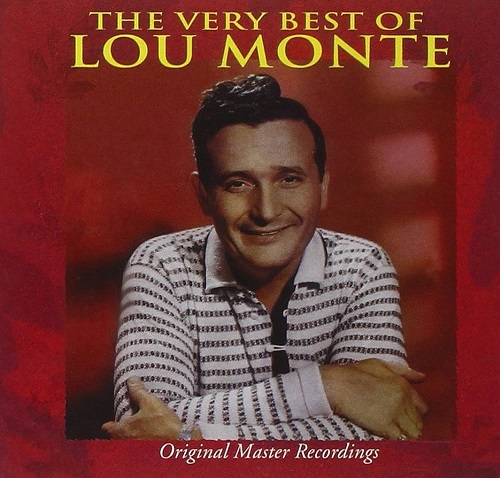
As the Nostalgic Italian, it only makes sense to feature one of the great Italian American singers on his birthday – Lou Monte. Many people will have no idea who he is until you mention the Christmas song Dominick the Donkey. Yep, he sang that one. Personally, it saddens me that he will be remembered for that one more than his other hits.
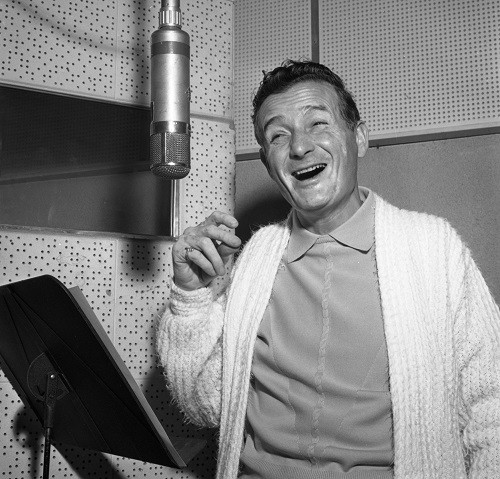
Much of this is taken and adapted from the biography at his official website loumonte.com.
Lou Monte was born as Louis Scaglione today in 1917 He was born in Manhattan, New York. He played the guitar and started singing as a child beginning his professional career as a singer, comedian, and musician as a young man just prior to World War II. After a stretch in the military, Monte settled in Lyndhurst, New Jersey and his first real break came when he had a radio show in Newark, New Jersey. Eventually, Monte was given a television program on that same popular station, WAAT.
Entertainment journalist June Bundy notes, “although Lou had been singing professionally for fifteen years, it wasn’t until he recorded an Italian-English version of “Darktown Strutter’s Ball” at the end of 1953, that he hit the big time.” After that, his records, both comedic and not, sold in the millions. He appeared regularly at many famous nightclubs and, unlike most Italian-American comedians of the era, he was seen frequently on national T.V. At the pinnacle of his popularity, he was promoted in various press releases as “The Godfather of Italian Humor” and “The King of Italian-American Music.”
Here is the 1953 song that Bundy mentions:
The medium of most of Lou Monte’s comedy is song, although his extensive and impressive night club act also contained a good deal of stand- up. Many of his songs were sung, and nightclub acts performed, in English with a liberal interspersing of Italian dialect (of Neapolitan and Calabrian). As one commentator has noted, “He translates American music into Italian and Italian music into English.” As was stated in a past nightclub review, Monte’s “songalog is heavily laden with pizza pieces, including Italo verses of his American numbers with emphasis generally on comedy tunes.” Monte’s appeal to the Italian-American audience can be understood in both emotional and social terms. Emotionally, his humor provided some Italian Americans with a sense of comfort, of one-upmanship, or the sense of being a part of an inside joke, and, socially, of having a slice of their world recognized by others. His appeal to other ethnic groups was based upon their perception that his humor related to their own experiences in associating to American society.
An important theme in Monte’s Italian-American humor is his tendency to Italian-Americanize American history and life. Such a technique served this marginal ethnic group by making it feel a part of America’s early historical development. It also served to heighten a sense of in-group solidarity by the ludicrous layering of Italianicity on things supposedly rock-solid Anglo-Saxon. In one song, he asks the question, “What did Washington say when crossing the Delaware?” The answer: “Fa un’fridd! (It’s cold!).” This bit is a take-off on a joke which was popular in the Italian- American community, although Monte sanitized the coarser punch line.” In this way, he played to the Italian-American audience, knowing its members would enjoy and relate to the reference.” In another example, according to Monte, the name of Paul Revere’s horse was Baccigallup. The hit song, “Please Mr. Columbus” offers yet another of Monte’s unique historical interpretations.
I love Please, Mr. Columbus! I’ve seen many men’s vocal groups perform this on stage, but the song loses something when you lose the “Italian” in it.
A lot of Lou’s music dealt with the common themes of marriage, courtship, sexual relationships, and food. In his food song, “My Rosina – The Menu Song,” the lyrics include: “She is so good looking when she is cooking, what a beautiful sight among the pots and pans.” In collaboration with Ray Allen, Monte wrote, “Who Stole My Provolone?” (sung to the tune of “Hang Down Your Head Tom Dooley”) a song parody, making use of the double entendre. Originally, my thought was just to post one song, neither of which I have mentioned yet, but as I read through the biography, I thought I would share the above songs, too.
The song I originally wanted to feature is a song that means a lot to me. When I got married the first time, I wanted to be sure to share a dance with my Italian grandmother. Looking back, I probably should have picked a Dean Martin song, as she loved him, however, I wanted to have some fun. So I chose an Italian Tarantella that was popular at weddings (and is even featured in the wedding scene in the film The Godfather) – Lazy Mary.

The song is a remake of the Italian song “Luna Mezzo Mare.” It tells the tale of a conversation between a young woman who wishes to be married, and her mother. The somewhat risque song mixes English and Italian verses. The two use double entendre to compare the occupations with the sexual appetites of the various suitors. The song goes back to the mid-1800s and the lyrics got a bit raunchier by the end of the century.
Monte’s 1958 version of the song peaked at number 12 on the U.S Pop Singles chart. Believe it or not, it was banned initially by British radio because of the innuendos in the song. That obviously doesn’t bother Americans, as the song has played during the seventh inning stretch at almost every New York Mets home game since the mid-1990s.
Unlike most Italian-American comedians of his time, Lou Monte received much national television exposure on such programs as the Perry Como Show and The Ernie Kovacs Show. Monte’s records sold in the millions. As a matter of fact, Reprise records had its first smash hit with Monte’s “Peppino The Italian Mouse” recording. Monte also made appearances at prominent feasts and festivals it is said that had a role in the comedy hit film, “Robin and the Seven Hoods” (1964), although I cannot find proof of that.
Lou Monte died in Pompano Beach, Florida in June of 1989. The Nostalgic Italian wishes Lou Monte a happy heavenly birthday!!
 Various Ramblings of a Nostalgic Italian