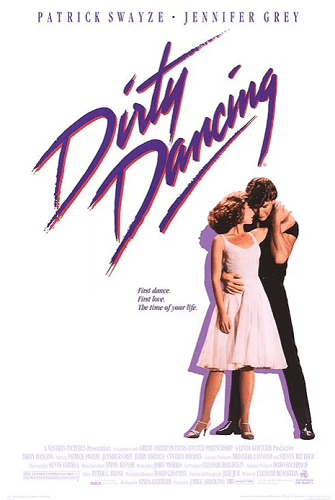
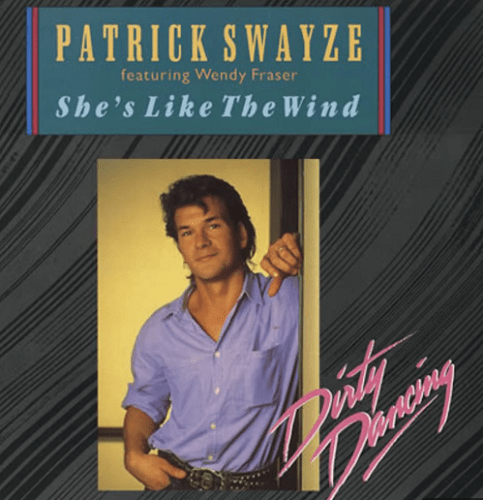
Today would have been Patrick Swayze’s 73rd birthday. So it’s only fair to focus on his movie hit – She’s Like the Wind from Dirty Dancing.
“She’s Like The Wind” is featured in the 1987 film Dirty Dancing in the scene where Patrick Swayze says goodbye to Jennifer Grey after their summer fling. He tells her, “I’ll never be sorry.” Her reply: “Neither will I.”
Swayze doesn’t sing it on camera, making it a rare case where the star of a film soundtracks his own scene.
Songfacts.com says that this wasn’t written for Dirty Dancing. Swayze wrote the song with his friend Stacy Widelitz for a movie he was shooting in 1984 called Grandview, U.S.A.
Swayze had the basic chords and the opening lyrics (“She’s like the wind, through my tree…”). They hashed out the song over the next few days, but it was rejected for the film. Two years later, Swayze was working on Dirty Dancing, and he played the demo of the song for the producers, who gave it the green light. They recorded a proper version with Michael Lloyd producing, and the song became a big part of the soundtrack, which sold over 30 million copies and spent 18 weeks at #1 in the US. It was the first song Patrick Swayze released.
The song was the third hit from the movie soundtrack. The film itself was released in August of 1987. The first single, “(I’ve Had) The Time of My Life” hit #1 US in November. The next single, “Hungry Eyes” reached #4 in February, and “She’s Like The Wind” landed at #3 later that month.
Songfacts.com says that Patrick Swayze was big into music, but there was far more demand for his acting than his singing. He did a duet with Larry Gatlin called “Brothers” for the soundtrack of his 1989 film Next Of Kin, and has two songs on the soundtrack to Road House, another film his starred in that year. His 2003 film One Last Dance also featured two Swayze songs on the soundtrack, but “She’s Like The Wind” was his only hit, making Swayze one of the more high-profile one-hit wonders.
Welcome back to The Music of My Life, where I feature ten songs from each year of my life. In most cases, the ten songs I choose will be ones I like personally (unless I explain otherwise). The songs will be selected from Billboard’s Year-end Hot 100 Chart, Acclaimed Music, and will all be released in the featured year.
Before we get into the music, I have to take a moment to mark a blogging milestone. This blog will be the 1400th blog I have written since the Nostalgic Italian site went live.
1400 posts and here you are still reading. For that, I thank you from the bottom of my heart. I am glad that you are here. Now, let’s celebrate by going back to 1989…. when I turned 19.
As I sorted through the singles from 1989, I noticed that there were a lot of duets recorded that year. After All from Peter Cetera and Cher, Don’t Know Much and All My Life from Linda Ronstadt and Aaron Neville, were just a few of them. No duets made my list, however, as I just didn’t feel any of them connected with me enough to bump the ten songs I picked.
I grew up listening to Roy Orbison. He was a favorite for a long time. I used to ask my dad to play his songs on the stereo all the time as a kid. In 1988, Roy saw his career take on new life. He recorded with George Harrison, Jeff Lynne, Tom Petty and Bob Dylan as part of the group The Traveling Wilburys (More on them in a moment) and had recorded a brand new album (Mystery Girl) in November of 1988.
On December 6, 1988, I was at the radio station when an “Urgent” Bulletin came across the AP Newswire stating that Roy had died after having a heart attack. I had never met Roy, but his music was such a big part of my life that seeing the story upset me quite a bit.
You Got It was the first single released from the Mystery Girl album in January of 1989. Orbison wrote the song with his Wilbury friends, Jeff Lynne and Tom Petty. Lynne produced the track and also played guitar, keyboards and bass; Petty played acoustic guitar and sang backup. It would reach #1 on the Adult Contemporary chart and #9 on the Top 40 chart.
Orbison performed this song just once: at the Diamond Awards Festival in Antwerp, Belgium on November 19, 1988. This performance was used as the song’s music video.
You Got It
Every interview I have seen with the guys from the Traveling Wilburys always has them saying how wowed they were by having Roy in their group. When Jeff Lynne was asked about the recording sessions, he said, “Everybody just sat there going, ‘Wow, it’s Roy Orbison!’ … Even though he’s become your pal and you’re hanging out and having a laugh and going to dinner, as soon as he gets behind that [microphone] and he’s doing his business, suddenly it’s shudder time.”
Roy was in the group’s first video (for Handle With Care), and was set to travel to London a couple days after he passed away. One of those videos was for The End of the Line. One of the reasons that I love this video is that the group gives a heartfelt tribute to their friend. When Roy’s vocal happens, we see Roy’s guitar in a rocking chair next to a framed photo of Roy.
The End of the Line
I have never seen the movie Road House. My mom liked it a lot, because she liked Patrick Swayze. Jeff Healey and his band were shooting scenes for the movie (and Jeff had many scenes with Swayze) and recording his See The Light album simultaneously. One of the cuts from this album was Angel Eyes.
I had never heard of Healey before this song. I had no idea that he was blind and marveled at the way he played his guitar (on his lap, like a piano). I was really blown away by his vocals and his guitar playing. He was discovered by two blues legends – Stevie Ray Vaughn and Albert Collins.
He toured and sat in with some fantastic people over the years including Buddy Guy, BB King, Eric Clapton, ZZ Top, The Allman Brothers and Bonnie Raitt (just to mention a few.) While he is mainly known for his bluesy style, by the year 2000 he actually was releasing many jazz albums.
He loved music and he was an avid record collector. He amassed a collection of well over 30,000 old 78 rpm records. Starting in 1990 he hosted a radio program of very early jazz on CIUT at the University of Toronto with Colin Bray. Later he went national on CBC Radio’s program entitled My Kind of Jazz, in which he played records from his vast vintage jazz collection.
Too many people write him off as a “One hit wonder” act. His music is fantastic and this song is so soulful … he was a talent taken too soon.
Angel Eyes
“Hey, man! Have you heard that new song by Marvin Young?” I can’t even imagine what type of music someone called Marvin Young would be singing! However, Young MC just screams rap music, right?! I’ve never been a big rap fan, but there was just something about the baseline and the catchy lyrics that made this a favorite for me.
Bust a Move was a song that whenever I played it, the crowd always new the words and sang along. The verse that every one knows is “Your best friend, Harry, has a brother Larry, in five days from now he’s gonna marry…” The whole rhythm of that verse and the baseline fit so well together. I also like the fact that while there is some sexual innuendo, there is no profanity in the song.
Interesting story from songfacts.com: Flea from The Red hot Chili Peppers played bass on this song and appears in the video, but he didn’t reap the rewards. He explained to Bass Player magazine: “I have a bitter taste in my mouth about that, because I feel as though I got ripped off. The bass line I wrote ended up being a major melody of the tune, and I felt I deserved songwriting credit and money because it was a #1 hit. They sold millions of records, and I got $200! Afterwards, my lawyer told them, ‘You should throw down Flea some cash,’ but the record company said, ‘We told him exactly what to play.’ No one was even in the room at the time but me and the engineer! It was ridiculous, but I learned from it.”
It was one of the first rap records to cross over to the mainstream charts. It went to #7! Young MC recalled to Rolling Stone: “People looked at rap and hard rock as the type of music that you slam your door after you argue with your parents, and bang your head in defiance. My record wasn’t necessarily rebellious, but it was clever enough to grab in a decent segment of people that didn’t listen to rap music.”
Bust a Move
The next song is one that I used to play for my prom date, Karen, after we started dating. This and Just You and I from Eddie Rabbit and Crystal Gayle were “our songs.” I remember the first time I heard Luther Vandross sing Here and Now. I remember how powerful the lyric was and just how perfect his voice was for the song.
Karen and I dated for a bit and broke up around 1990, only to get back together a year or so later before breaking up after another year or so. Somewhere during that time I had made her a mix tape of love songs. This was just one of many that made it to that tape.
It was hard for me after we broke up because I was DJing a lot of weddings and this was a very popular Bride and Groom song. I almost always had to put headphones on and listen to something else while it played. Today, I can listen to it and it doesn’t bother me, but at the time, it brought about a lot of pain.
Here and Now
My next tune is one that I have featured before and I wrote about how it was helpful to me post-divorce. You can read about it here:
I have said many times that Willie Nelson always seemed to have one song on each album that I connected with personally. Many times it was more than that. In 1989, he released a fantastic album entitled “A Horse Called Music.” On the album is a cut that was co-written by Mike Reid (who played five seasons with the Cincinnati Bengals and had a brief country singing career) called There You Are.
I had heard the song many times when listening to the album, but it wasn’t until after the final break up with Karen (see above) that the song really hit me hard. At the time, I was still wrapped up in feelings and hated that we were not together. I found myself thinking about her more than I should have been, especially since she had moved on with her life. Then I heard this song…
I could have written this song! It literally was exactly what was happening to me. For no reason, she’d pop into my head. It was never bad things, it was always some good memory of when we were together. The string arrangement and Willie’s vocal convey those feelings in such a magnificent way. It is beautifully sad …
I had never seen the video for this song until I searched for it today. Willie cleans up pretty good…
There You Are
When you make a list of great songwriters – Leiber and Stoller always are on that list. The next song was written by Oliver Leiber, the son of Jerry Leiber of that aforementioned team. Oliver had already written a couple songs for Paula Abdul (Forever Your Girl and The Way That You Love Me) when he got a call saying that the label needed one more song for her album. That song would be Opposite Attract.
From songfacts: This song evolved into a duet with a cartoon cat named MC Skat Kat, who was actually the duo The Wild Pair. Oliver Leiber explains: “I wrote it all from the perspective of one person singing it. It wasn’t initially a duet. It was saying, ‘I like this and you like that.’ It was basically: I like potatoes, and you like po-tah-toes, all from one singer’s perspective. But I had these two singers I had been working with – Marvin Gunn and Tony Christian. They’re the guys that sang on Prince’s “Kiss” and they were incredibly soulful funky singers that I had been using as part of my sound on the first two tracks I did with Paula, helping to preserve the Minneapolis sound, because they sounded very Prince-y and it really added something to Paula’s vocals.
Basically, he had the Wild Pair sing the entire song and then got Paula to cut her lines later. He wasn’t happy with the original mix, which is why the album and the single versions sound so different.
In the video, the real Paula interacted with the animated MC Skat Kat. The concept of Paula dueting with a cat came from Anchors Aweigh, a movie where Gene Kelly dances with the mouse from Tom & Jerry. The video was directed by Michael Patterson and his wife Candace Reckinger, who also created the MC Skat Kat character and animation. Patterson said: “Gene Kelly loved it; he was a friend of Paula’s. Gene was also an inspiration to Candace and I.”
Fun Fact: Patterson and Reckinger got their start in music videos when they created the iconic clip for a-ha’s Take On Me
I loved the Gene Kelly and Jerry Mouse dance, so naturally, I loved this video (and Paula) too!
Opposites Attract
Before I knew the song was about Elvis, I really loved the sound of Black Velvet by Alannah Miles. It was considered a power ballad, but to me it sounded more like a good blues song. Miles’ voice had that bluesy and sultry voice that fit with the groove of the song perfectly.
The story of how the song came to be is a good one. Co-writer Christopher Ward, who was Myles’ then-boyfriend, was inspired on a bus full of Elvis fans riding to Memphis attending the 10th Anniversary Vigil at Graceland, in 1987. Upon his return to Canada, he brought his idea to Myles and producer David Tyson, who wrote the chords for the bridge. The song was one of three in a demo Myles presented to Atlantic Records, which eventually got her signed to the label.
Songfacts provides a bit of lyric analysis:
“Black velvet and that little boy’s smile” – You can buy a black velvet Elvis painting at any respectable yard sale. Early female fans were drawn to his “Little boy smile.”
“Black velvet with that slow southern style” – Elvis delivered some of his songs with slow, undulating hips. Check out “Steamroller Blues” live.
“Up in Memphis the music’s like a heatwave” – Sun Studios. The epicenter of early rock music and where Elvis recorded.
“Love Me Tender leaves ’em cryin’ in the aisle” – Love Me Tender was a huge hit for Elvis in 1956.
“The way he moved, it was a sin, so sweet and true” – Elvis’ legendary hips swivel, the Pelvis.
“Every word of every song that he sang was for you. In a flash he was gone, it happened so soon, what could you do?” – Elvis died suddenly in 1977.
Black Velvet
For me, the last song for this week is something that I continue to work on in my personal life. In my first marriage and throughout that period of my life, I just found it easier to back down and make everyone happy. I did this even if it made me unhappy. It is challenging to stand your ground and not back down from what you believe in or what you feel is right.
Tom Petty’s song was helpful to him as well. Before recording his Full Moon Fever album, an arsonist burned down his house while he was in it with his family and their housekeeper. They escaped, but Petty was badly shaken and spent much of the next few months driving between hotel rooms and a rented house.
Songfacts says that: It was on these drives that he came up with many of the songs for the album; the fire was a huge influence, especially on this song. Petty felt grateful to be alive, but also traumatized – understandable considering someone had tried to kill him. “I Won’t Back Down” was his way of reclaiming his life and getting past the torment – he said that writing and recording the song had a calming effect on him.
The song was used as a patriotic anthem after the September 11th terrorist attacks. Regarding that, Tom said: “The song has also been adopted by nice people for good things, too. I just write them, I can’t control where it ends up.”
The song has a Wilburys connection. The video features Ringo Starr on drums, with Wilburys’ George Harrison and Jeff Lynne on guitar. Harrison did play on the track and contributed backing vocals, but Ringo had nothing to do with the song itself.
I Won’t Back Down
That’s it for the 1980’s! We’ll dive into a brand new decade next week. 1990 was a good year for music. Starting in the 1990’s my music choices tended to lean a bit more country as far as new stuff. In 1990 alone, I could have picked 10 country songs for the list. I didn’t, but I could have.
Next week’s list will feature and interesting mix of music, largely due to the radio station where I was working at the time … some classic rock, some soulful songs, and big pants ….
Did I miss a favorite of yours from 1989? Tell me all about it in the comments. See you next week.
Welcome back to The Music of My Life, where I feature ten songs from each year of my life. In most cases, the ten songs I choose will be ones I like personally (unless I explain otherwise). The songs will be selected from Billboard’s Year-end Hot 100 Chart, Acclaimed Music, and will all be released in the featured year.
In 1981 there were two things that influenced me musically. First of all, I discovered American Top 40 with Casey Kasem. My dad had it the radio on one day while he was washing the cars and doing yard work. It was my first exposure to a countdown show. As a matter of fact, as I looked over the list of possible songs for my list, there were plenty of songs that I remember hearing for the first time on AT40. Some of those that are not on my list are: Start Me Up, Centerfold, Waiting for a Girl Like You, Elvira, Bette Davis Eyes, Hearts, Physical, and so many others!
The second thing that not only influenced me musically, but everyone else in the country, was the birth of MTV in August of 1981. This changed the way people listened to music. Some of those 80’s music videos are forever etched in my mind. I loved the creativity of many of those videos. In many cases, the videos helped with the popularity of songs and how much airplay they got on the radio. Perhaps you’ll remember the videos from some of the songs on my list?
Here we go ….
My dad played guitar in a wedding band for many years. Often, my brother and I would have to go to band practice with him. It was there that I recall being introduced to some of the current songs. One of them was Just The Two of Us by Grover Washington Jr. and Bill Withers. I can remember the distinct mystical sounding keyboard part at the beginning from my dad’s band and being wowed at how it sounded exactly like the record.
Grover Washington, Jr. wrote this with his musical partner Bill Salter before Withers added to the lyrics. It was produced by Ralph MacDonald, a percussionist who played on many of Washington’s tracks. MacDonald was friends with Withers and made the connection. Bill said in an interview with songfacts:
“I’m a little snobbish about words, so they sent me this song and said, ‘We want to do this with Grover, would you consider singing it?’ I said, ‘Yeah, if you’ll let me go in and try to dress these words up a little bit.’ Everybody that knows me is kind of used to me that way. I probably threw in the stuff like the crystal raindrops. The ‘Just The Two Of Us’ thing was already written. It was trying to put a tuxedo on it. I didn’t like what was said leading up to ‘Just The Two Of Us.'”
The song reached number 2 on the charts, but never made it to number 1. It was kept from that spot by Sheena Easton’s Morning Train (9 to 5) and Kim Carnes’ Bette Davis Eyes. The song did win a Grammy award for Best R&B Song. It would be Grover Washington Jr’s only Top 40 hit.
Just The Two of Us
I’ve told this story before, but it is why the next song is here. I remember my dad throwing the 45 of The Breakup Song on the turntable and playing the intro over and over. He’d pick on his guitar and work out that intro over a matter of minutes. Once I heard him play it note for note, I was in awe of him.
The Greg Kihn Band had been around for some time. Their album Rockihnroll was their sixth studio album. It celebrates the quality of breakup songs in rock’s earlier times, as the narrator laments both his recent breakup and the fact that they don’t write good breakup songs anymore. The song is perhaps best known by the hook, “They Don’t Write ‘Em Like That Anymore.”
The Breakup Song
I have always loved the Commodores, with and without Lionel Richie. Lady (You Bring Me Up) was released as the lead single from their album In The Pocket, their last with Lionel Richie in the group. Lionel didn’t write the song, Commodores’ trumpet player William King did. He wrote it with his wife, Shirley, and Harold Hudson, a member of the Commodores’ backing group, The Mean Machine.
In 1981, sexually suggestive songs like “Physical” and “Girls on Film” caused a bit of controversy. Naturally, some disc jockeys poked fun by warning listeners that this was another song with sexually suggestive lyrics: “Lady, you bring me up when I’m down.” In truth, the song is simply a song about a man whose woman gets him through life’s difficult times. It went to #8 on the Hot 100 chart.
Lady
It wasn’t until years later that I found out that Juice Newton wasn’t the first one to sing Queen of Hearts. It was actually written by Hank DeVito of Emmylou Harris’ band and first recorded in 1979 by rocker Dave Edmunds. His version was big in the UK and Ireland, but didn’t go far anywhere else.
Juice Newton had the biggest success with “Queen of Hearts” after it appeared on her 1981 album, Juice. In September 1981, Newton’s version peaked at #2 on the US charts, having shifted over one million copies. It almost didn’t happen, though. Juice remembers, “I did [‘Queen of Hearts’] live for about a year…Then I brought it to [producer] Richard Landis when we started the Juice album. He wasn’t convinced at that point that it was a breakout song but I told him I think this is a real cool song … so we cut it”.
In 1982, the song was nominated for the Grammy Award for Best Female Country Vocal Performance. Dave Edmunds told Creem Newton stole his composition: “She did pinch my arrangement, note for note, but I’m not angry with that.”
Queen of Hearts
Before Foreigner recorded this album 4, two members of the group left, trimming the band from six members to four. This, along with the fact that it was their fourth album, explains the title. My favorite cut on the album has a Motown connection.
Future Mr. Shania Twain, Mutt Lange, produced the album. Lange wanted to hear every music idea guitarist Mick Jones had recorded on tape, no matter how embarrassing. One of these ideas was the opening riff for what would become “Urgent”. “I had the riff starting out,” Jones recalled. “And I said, ‘That’s like an experimental instrumental thing that I’m working on.’ He said, ‘No, it isn’t anymore – let’s take that one, because that’s got a lot of potential.’ There wasn’t even a song with it.”
The group wanted a “Junior Walker-style” sax solo for this record. When they took a break from recording, one of the members read in New York newspaper The Village Voice that Walker was performing that night mere blocks from the recording studio. Walker accepted their offer to play, and the recording of the sax solo was swift and without a hitch.
Urgent
ELO’s TIME is a concept album about a time traveler who visits the year 2095. This song takes place on his return trip in 1981. He is inspired, and now knows that everything he needs he can find back home. “Hold On Tight” was the first single from the album.
By this time, the band was credited as ELO, downplaying the orchestra because they had recently jettisoned their string section. The lead instrument on “Hold On Tight” is piano played by group leader Jeff Lynne, who wrote the song. Billboard called it an “affectionate tip-of-the-hat to ’50s rock ‘n’ roll” that was inspired by the piano playing of Jerry Lee Lewis. That sound is probably why I love this song so much, as well as the uplifting message.
There was an elaborate (for its time) video was made of this song. Wikipedia states that this was the most expensive music video ever made (at the time). Directed by Mike Mansfield, it’s a sendup of sci-fi movie trailers from the 1940, which often blared words on the screen in huge font (AMAZING!, BREATH-TAKING!). Their violinist, Mik Kaminski, had left the group by this time but shows up in the video miming guitar.
The song topped out at number 2 on the Billboard Top Tracks chart.
Hold On Tight
Who can deny a great cover song? Am I right? (I’m talking to you Randy! LOL)
Yep, one of the biggest 80’s hits is actually a cover of a song first recorded in 1964. Ed Cobb of the Four Preps composed the song, and it was first recorded by Gloria Jones. (Fun Fact: Glen Campbell was a studio musician and played guitar on that version!) Her version was actually the B-side of her single, “My Bad Boy’s Comin’ Home.”
In 1973, British club DJ Richard Searling purchased a copy of the almost decade-old single while on a trip to the United States. The track’s Motown-influenced sound (featuring a fast tempo, horns, electric rhythm guitar and female backing vocals) fit in perfectly with the music favored by those involved in the UK’s Northern soul club scene of the early 1970s.
In the book 1000 UK #1 Hits by Jon Kutner and Spencer Leigh, Soft Cell’s Marc Almond called this song “A mixture of cold electronics with an over-passionate, over-exuberant, slightly out of key vocal.” Almond recalls, “Dave (Ball) introduced me to the record and I loved it so much and we wanted an interesting song for a encore number in our show. Dave loved northern soul and it was a novelty to have an electronic synthesizer band doing a soul song. When we signed with our record company, they wanted to record it. They told us to put bass, guitar and drums on it as they said it was too odd. They put it out anyway and the next thing it was gathering radio play and then it was #1. I was fascinated that it was originally by Gloria Jones, the girlfriend of Marc Bolan and I’d always been a T-Rex fan.”
Marc Almond’s vocal is the first take he recorded. That take was actually a run-through so they could tweak the settings, but it had just the right emotion, so that was the one they used. Obviously it was the right take because even Gloria Jones liked it. She said that she considers the Soft Cell version to be the best one. “I loved the emotion in his voice,” she said. “Their version was far better than mine.”
Tainted Love
Here is another song with a Dave Edmunds connection. Tempted was the second single off Squeeze’s East Side Story album. It was written by Chris Difford and Glenn Tilbrook. Chris wrote the lyric while the band was taking a taxi to Heathrow Airport. The descriptions of the city and airport sights are interspersed with the narrator’s ruminations on a relationship that is failing, or has failed, due to his own infidelities. As he recalled,
The original story behind “Tempted” is we’re going on another American tour. I got on a taxi and I started writing down what I saw lyrically. I don’t know the course of time of how long it took, but then I gave Glenn the lyrics and then Glenn put the music to it. It’s an extraordinary song. It’s one of the most played songs that we have in our catalog.
Unlike most other Squeeze songs, which are sung usually by Tilbrook or Difford, the song’s lead vocal is sung by newly recruited keyboardist Paul Carrack. According to Carrack, this was the result of a suggestion by co-producer Elvis Costello:
They’d actually recorded a version of that song before I was on board. Dave Edmunds produced it, and it was completely different. The song was in the can, and we were recording the other songs from East Side Story when we had some downtime and played ‘Tempted’ but in that slow, soulful, Motown groove. Elvis Costello, who was producing, ran in and said, ‘Let’s put this down on tape!’ So, we did, and Elvis said ‘Paul, you should sing it.’
I had never heard the song before, but in 1994, I was driving a lot for my job and this would come on Planet 96.3. I have always loved the opening line of this song, “I bought a toothbrush, some toothpaste, a flannel for my face” I can’t imagine it without the slow bluesy feel.
Tempted
Loverboy’s first single from their Get Lucky album didn’t really burn up the charts, however, years later it would be linked forever to a classic Saturday Night Live sketch.
Working for the Weekend originated when guitarist Paul Dean was out walking one Wednesday afternoon, looking for inspiration in his songwriting. He noticed that much of the area was deserted, as most people were at work. “So I’m out on the beach and wondering, ‘Where is everybody? Well, I guess they’re all waiting for the weekend,'” he later said. Mike Reno, the band’s vocalist, suggested they change the title to “Working for the Weekend”. According to Dean, he first began writing the song in a hotel room following a Montreal concert. At the time, the band were still playing bars to little response from patrons. After completing the song, they used it to open one set, and Dean recalled that “the dance floor was packed”.
The video had a life of it’s own on MTV. Loverboy lead singer Mike Reno tells about the filming of this video: “We would play the song over and over again, and we’d bounce around like we normally did. Here’s what I thought was kind of interesting: The director would say, ‘OK, we’re going to shoot another song, now go get changed.’ ‘What do you mean?’ ‘You have to put on a whole new outfit, and we’re going to change the lighting a bit.’ But it was the same stage! So basically, we just had to get some other clothes, fix your hair, take a break, and then jump back on stage and do the same thing over and over again. I really felt like I was being abused a bit, but that’s the nature of the beast.”
On October 27, 1990, Patrick Swayze hosted Saturday Night Live. It was on that show that the famous Chippendale’s Audition sketch debuted. It featured Chris Farley and Swayze auditioning for the final spot in the Chippendale line up. Their audition was done to this song.
Working for the Weekend
“Shake It Up,” was the title track of The Cars’ fourth album. It is hard not to want to dance when you hear it. Some call it a “tailor-made party song.”
It was written by Cars’ frontman Ric Ocasek. It really is an odd song for Ric in that it’s very straightforward, simply encouraging us all to get on the dance floor and boogie like nobody’s watching. Ocasek’s songs were generally far more enigmatic. Years later, Ocasek dismissed the song’s lyrics, saying, “I’m not proud of the lyrics to ‘Shake It Up.'”
This song has some throwback elements, like the “ooo ooo ooo” backing vocals and references to a “quirky jerk” and “night cats” – lingo that was hep in the ’60s when songs about dancing were in vogue. At the same time, “Shake It Up” as a futuristic sound, with synthesizers and drum machines that were part of the new wave.
It was released as the lead single from the album. “Shake It Up” was a big American hit for The Cars, getting them into the Top 10 for the first time as the song reached #4. The song was such a departure from what fans expected that some accused the band of “selling out.” The band, however, insisted they were simply progressing and growing (one point in their defense: they continued to live in Boston instead of relocating to New York or Los Angeles). The jabs came mostly from the UK, where the band got lots of positive press early on but faced the wrath of a finicky press when they released this song about dancing.
Fun Fact: Guitarist Elliot Easton said he wanted his solo to sound like “two guys trading off”. He first plays a Fender Telecaster, in a style skewing country, then midway through the solo switches to a Gibson guitar for a heavier rock sound.
Shake It Up
Finally, a song that has yet another Michigan connection. When Styx was preparing their tenth album, Paradise Theater, guitarist Tommy Shaw, says he was asked to write one more song for the album, which followed the theme of a concert hall rising to prominence and then crumbling. Shaw liked the concept, but was having trouble writing songs that fit. So he just wrote one that didn’t follow the theme – “Too Much Time On My Hands.”
Shaw had a long drive to and from the recording studio, and on one trip, the bassline popped into his head: “dun-dun dun-dun dun-dun-dun-dun.” When he arrived, he quickly had the band record what was in his head so he wouldn’t lose it. He found himself calling out chord changes as they played, which laid the groundwork for the track.
When it came to the lyrics, he drew inspiration from a real bar in Niles, Michigan, where he was living. “I think officially it was called Mark’s Tavern, but everybody called it Mark’s Bar. It was the local watering hole. The drinks were good, and the drinks were cheap. You could go in there with 20 bucks and be a hero, you know – buying rounds of drinks. And you’d always run into somebody you knew in there. That was the basis of the song.”
The song was released in the spring of 1981 and reached its US chart of #9 in May. In August, MTV went on the air, which gave the song new life, since the video was one of the few the network had available from an American rock band, and they played constantly.
Too Much Time On My Hands
Looking back over the list of songs released in 1981, there are so many worth mentioning. Did I miss one of yours?
As I start looking at each year and jotting songs, I have gone from 2 pages to 3 pages of songs to chose from. These 80’s years are probably going to be the toughest to narrow down for me.
Next week, we’ll jump into 1982 and see what 12 year old Keith was liking ….
Thanks for reading!
(Most info was gathered using sources like Wiki, songfacts.com, and artist websites)




 Various Ramblings of a Nostalgic Italian