
I am currently reading the book Ghosts of Hiroshima by Charles Pellegrino. I love to read about historical events. In high school we read John Hersey’s book Hiroshima and it was eye opening. Ghosts of Hiroshima is just as eye opening as it follows many of the survivors after the bombs were dropped. More on that when I finish the book.
The reason for this post is that in the book it mentioned Mitsuo Fuchida. For those who don’t know, he is the Japanese pilot who led the raid on Pearl Harbor on December 7, 1941. He was considered a hero in Japan. What I had never heard was that after the war, he became a Christian. He chronicled his story in his book, “From Pearl Harbor to Golgotha” (later entitled, “From Pearl Harbor to Calvary.”
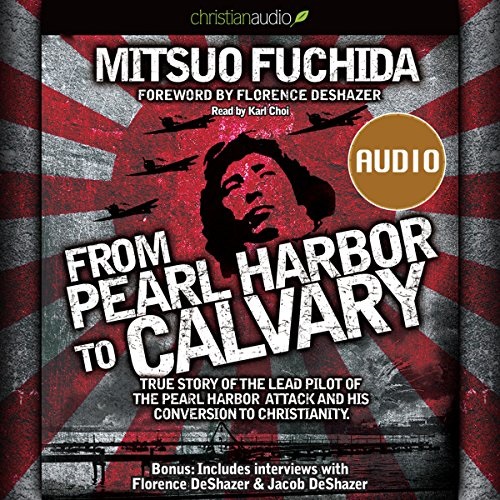
I found, and listened to the audio book (which was about 2 hours long). Before I go one, here is what Goodreads had to say about it:
Mitsuo Fuchida was a Captain in the Imperial Japanese Navy Air Service who is perhaps best known for leading the first air wave attacks on Pearl Harbor on December 7, 1941. Fuchida was responsible for the coordination of the entire aerial attack working under the overall fleet commander Vice Admiral Chuichi Nagumo. After World War II ended, Fuchida became an evangelist, Christian preacher and frequently traveled to the United States to minister to the Japanese expatriate community. He became a United States citizen in 1966. His autobiography was originally released in 1953, and this edition was published to coincide with the 70th anniversary of the attack on Pearl Harbor on December 7, 2011.
The old saying goes, “God works in mysterious ways,” and you can see that in Fuchida’s story. There is a brief synopsis of it in Ghosts of Hiroshima, but Fuchida’s book gives a bit more info. As you hear the story, you see how three people’s lives and the Bible bring it all together.
Spoiler summary:
First, there is the daughter of missionary parents who are killed by the Japanese, who goes to Japanese POW camps and treats prisoners with love and kindness. Next, you have an American who bombed Tokyo with his squadron, only to run out of gas and become a POW. The prisoners asked for a Bible to read. Each man got to have it for three weeks and during his stay in solitary confinement, the Bible opened up to him. The story of the American POW was printed on pamphlets and distributed in Japan. One of those ended up in Fuchida’s hands. That lead to him purchasing a Bible and his conversion.
It was truly amazing to read how God’s Word changed Fuchida. The conversion led him to befriend that American POW whose story was in the pamphlet. Together they visited the other’s country (Fuchida in America, and the POW in Japan) to share their story and preach the message of peace and love.
The audiobook I listened to (on Hoopla) had an interview with the American POW and another with the POW’s wife). Those took what Fuchida wrote and expounded on their impact and friendship. It was amazing to hear how these two men, who once had so much hatred for the other nation, were able to set everything in the past behind them and move forward as friends and fellow ambassadors of the Gospel.
I’m not trying to preach here, but as I listened to this book, I was reminded of something a pastor once said. He said that “you don’t read the Bible. The Bible reads YOU.” In Hebrews 4:12 is reads: “For the word of God is quick, and powerful, and sharper than any twoedged sword, piercing even to the dividing asunder of soul and spirit, and of the joints and marrow, and is a discerner of the thoughts and intents of the heart.”
This story illustrates just how powerful it is.


 Various Ramblings of a Nostalgic Italian