
They say “out with the old and in with the new,” but I’m glad that an old feature continues! I am, of course, talking about Turntable Talk hosted by Dave Ruch from A Sound Day. For 22 months, he has proposed various musical topics for our group of music lovers to write about. Not only do I love writing for it, but I love reading the other submissions.
This month we go “wordless.” Dave says, “…let’s look at INSTRUMENTAL IN THEIR SUCCESS. Share with us all an instrumental tune you like a lot, and a few words about why.”
I write this, knowing that I am one of the last contributors, so I have no idea what has already been featured by other writers. As far as the topic, there was no shortage of songs to choose from. I began a list of instrumentals on a post it note pad. Each song made me think of another. About 20 post it notes later, I knew I had to stop and pick one. The problem was, which one to choose.
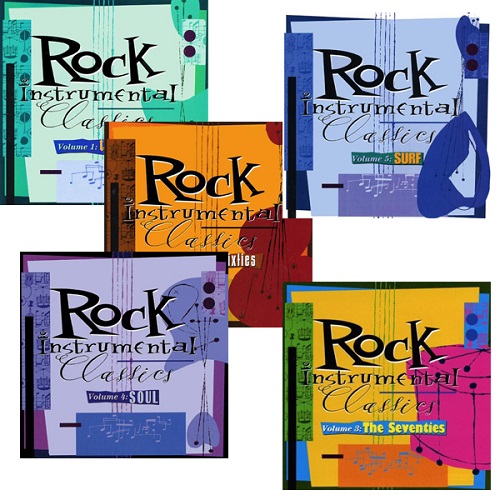
I LOVE instrumentals. I have countless CD collections featuring instrumental hits. One of the best was a series from Rhino Records called “Rock Instrumental Classics.” It was a 5 CD series that featured instrumental hits from the 50’s, the 60’s, the 70’s, surf hits, and soul hits.
Time Life Records had a series called “Your Hit Parade,” which featured music from the 1940’s all the way through the early 1960’s. That collection featured many instrumentals, too. There are SO many to pick from. My list included:
- Green Onions – Booker T & the MG’s
- Bumble Boogie – B. Bumble and the Stingers
- One Mint Julep – Ray Charles
- Kokomo – Asia Minor
- Topsy Part 2 – Cozy Cole
- Classical Gas – Mason Williams
- Java – Al Hirt
- Yakety Sax – Boots Randolph
- Popcorn – Hot Butter
- Axel F – Harold Faltermeyer
- No Matter What Shape Your Stomach’s In – The T-Bones
- The Theme From Sanford and Son – Quincy Jones.
That last one led me on a rabbit trail of TV Theme songs. There were plenty that were hits: Peter Gunn, Bonanza, Mission: Impossible, Theme from SWAT, Miami Vice, Route 66, Dragnet, The X-Files, The Rockford Files …. and finally, my pick for this month’s topic.
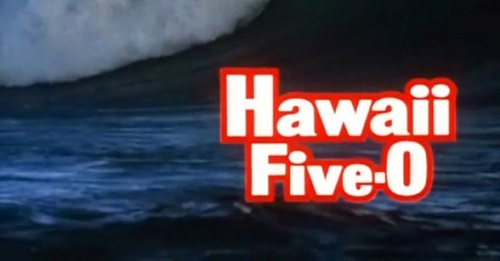
Hawaii Five-O was a long-running police procedural drama (1968-1980) about detectives Steve McGarrett (played by Jack Lord) and Dan “Danno” Williams (played by James MacArthur) who worked the Hawaiian islands beat. The theme was composed by Morton Stevens, who started out as an arranger/conductor for Sammy Davis Jr. and became director of music for CBS on the West Coast. The theme song won Stevens two Emmy Awards (in 1970 and 1974).
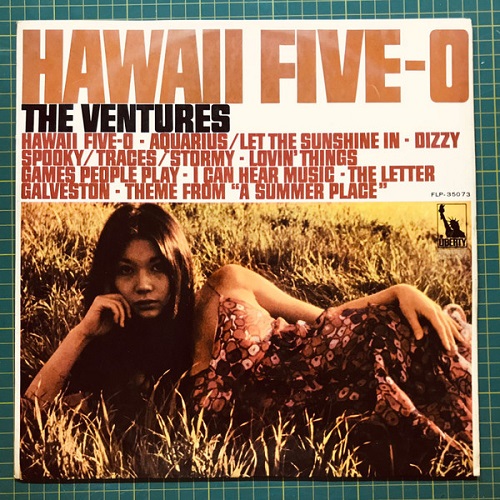
The song was recorded by the Ventures, who were instrumental (pun intended) in popularizing the electric guitar throughout the 1960’s. Their first hit was Walk, Don’t Run in 1960. The quartet charted 14 singles on the Billboard Hot 100 Chart and have sold over 100 million records making them the greatest instrumental band of all time.
The Venture’s version of the song was a Top 5 record, peaking at #4 spending 14 weeks on the chart. There were many session musicians who played along with the group including guitar player Tommy Tedesco of the famous Wrecking Crew.
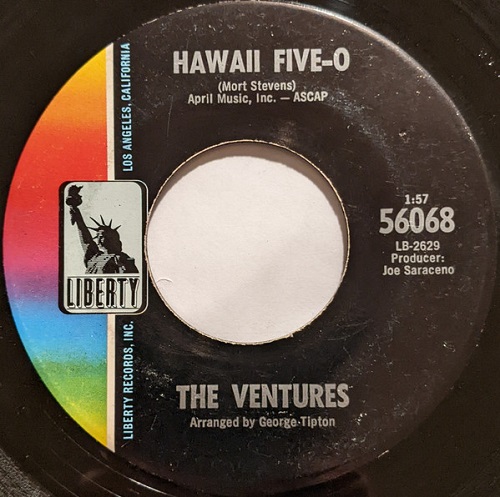
I read somewhere that the Hawaii Five-O theme is the unofficial fight song for the University of Hawaii. This is one of those songs I wish we had played when I was in band. As a matter of fact, being a former band geek is probably why I love this song so much. I can listen to it 4 or 5 times in a row and focus on different things in the song. There are so many cool musical things in it. Allow me to illustrate with words and then listen to see if my wordy description makes sense.
Right from the get-go that drum crescendo into the tympany grabs me. (In one of my many listens to this song, I actually thought about making a list of great “tympany songs!”). Then you have the guitar and trumpets come in with the main theme doing a call and answer type thing with that flute-y instrument for the first verse. Another drum/horn crescendo to take you to the second verse with more guitar and now the flute answer is more of a counter melody.
A minute in and you get another drum/horn crescendo and a repeat of the melody. This time, you have some horns and trumpets on the answer. At 1:15, you get that fantastic staccato trumpet stings that take you to the final 30 seconds of the song. Now we’re at the big build to the grand finale. Here, you begin to hear what our band director used to call “pyramids.” You have one instrument, then another, and another and another building on each other until that final bit. There is a fast short pyramid from 1:27 to 1:30 between the horns and trumpets. Then at 1:35 the big build happens, followed by another bigger pyramid until the final trumpet stabs and guitar tympani ending. The song is an almost 2 minute masterpiece that always makes me feel good.
Ok, I know my description was a bit much. However, this is the perfect illustration of what I tend to do when listening to music. One listen I focus on the guitar and the next listen I check out the drum part. I tend to pick it apart and then appreciate how it all comes together.
It is interesting to know that there are actually a couple vocal versions of the song! I won’t post links here because we are focused on instrumentals. It should be no surprise that Don Ho did a vocal version. HIs version starts fast and turns into a ballad (“You Can Come With Me”). Then, Sammy Davis Jr, who composer Morton Stevens worked for at one time, did a version called “You Can Count on Me.” Both versions are on YouTube.
Thanks again to Dave for asking me to take part in this feature and for hosting it. I look forward to the next musical topic.
Thanks for reading.
 Various Ramblings of a Nostalgic Italian