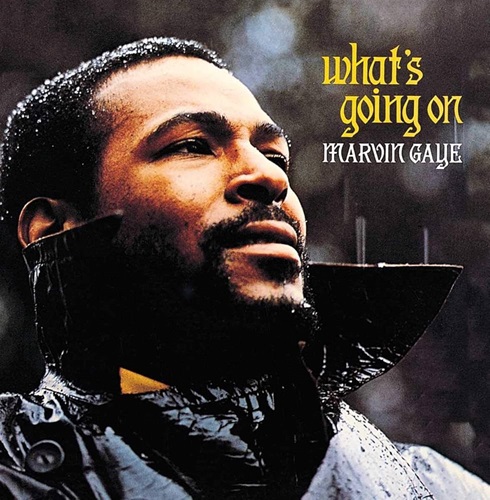
It was on this day in 1971 that Tamla Records (a division of Motown) released Marvin Gaye’s What’s Going On. According to many stories, it almost wasn’t released.
From songfacts.com:
According to the book Mercy, Mercy Me: The Art, Loves & Demons of Marvin Gaye, Motown head Berry Gordy initially refused to release this song, calling it the “worst record I ever heard in my life.” The song was slipped out by the man in charge while Gordy was on vacation and, of course, he was furious… until he found out the single sold 100,000 copies in the US upon its release. Needless to say, he soon changed his mind about this song.
Although Berry Gordy admits he had reservations about “What’s Going On,” he claims all of the stories surrounding his refusal to release the song are false. He explained to the Wall Street Journal: “For years, people have written that I stood in the way of this song’s release and that Marvin had threatened never to record for me again if I didn’t put it out,” he said. “That must make for great reading, but none of it is true.”
He went on to explain the potential ramifications of the song: “My reason for pushing back on Marvin wasn’t to stop the single, just to determine whether or not this was another one of his wild ideas,” Gordy said. “Motown was about music for all people – white and black, blue and green, cops and the robbers. I was reluctant to have our music alienate anyone. This was a big risk for his image.”
The song was written by songwriter Al Cleveland, Four Tops member Renaldo “Obie” Benson and Marvin Gaye. It was Marvin who added lyrics and worked on the arrangement. Marvin did not want to record the song, he wanted the Originals to record it. However, Benson and Cleveland persuaded Gaye to do it himself.
Songfacts.com says,
Until this song, Gaye rarely participated in the songwriting process. For this album, he took control of the production so he could make a statement as an artist. Motown management was skeptical, but Gaye was an established star and had enough power to pull it off, going so far as to use an orchestra on this track.
The song is one of Motown legend. James Jamerson, the bass player for the Funk Brothers, was apparently drunk when he arrived at the studio. Jamerson could not sit properly in his seat and, according to one of the members of the group, lay on the floor playing his bass riffs.
Fun Fact: At the beginning of the song, there are people chatting. Marvin wanted to give the song a laid back feel, so he, the Funk Brothers and Mel Farr and Lem Barney of the Detroit Lions are the ones having conversation as the song begins.
The song was one of the first Motown songs to make a political statement. Jackson Browne said in a 2008 interview with Rolling Stone: “No one was expecting an anti-war song from him. But it was a moment in time when people were willing to hear it from anybody, if it was heartfelt. And who better than the person who has talked to you about love and desire?”
It was nominated for two Grammy Awards in 1972, but did not win either category. It peaked at #2 on the Billboard Hot 100 chart and was ranked the fourth greatest song of all time by a 2004 Rolling Stone poll. It was also ranked the 2nd on the Detroit’s 100 Greatest Songs List by the Detroit Free Press.
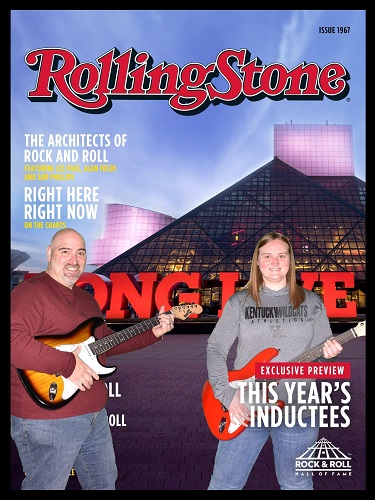
I was looking for something for a coworker yesterday and was going through a bunch of thumb drives. I actually found some photos that I had forgotten about. Look at this gem:
Sam and I took a trip down to Cleveland for our anniversary one year. We visited the Christmas Story House and the Rock and Roll Hall of Fame. The photo above was one of those green screen pictures they take when you first walk in. They used this ridiculous pose and put us on stage with a huge crowd in front of us in one picture. My favorite was this one.
This one made me think of the Dr. Hook song “On the Cover of the Rolling Stone.” Neither one of us thought that our pose was good, but it made us laugh, so we bought the pictures. When I found it I actually chuckled out loud remembering the first time we looked at it.
That was a fantastic trip! It reminds me that we are overdue for a getaway for the two of us!
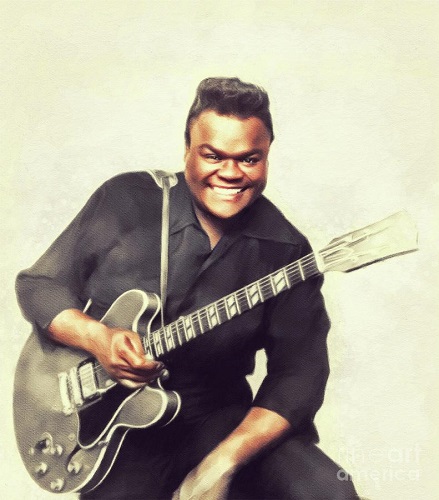
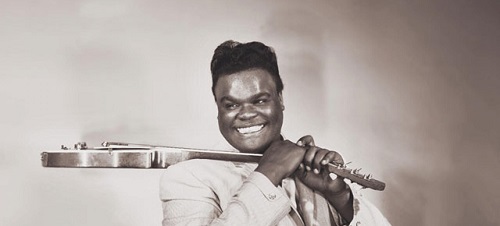
Today is the birthday of one of the “Three Kings of Blues Guitar.” The best known of these three is most likely B.B. King, followed closely by Albert King, and last but not least, the birthday boy, Freddie King. All three Kings – but no relation to each other. Freddie was born today in 1934.
Freddie was not just a great guitarist, he was also a songwriter and singer. His voice has been called “soulful and powerful,” but today I’ll focus on his guitar playing.
He was taught to play by his mother and uncle as child and eventually moved to Chicago. There he formed a band called the Every Hour Blues Boys. He tried many times to get a record deal at Chess Records (the home of Muddy Waters and Howlin’ Wolf), but was rejected every time. They told him that he “sounded too much like B.B. King.”
Persistence paid off for him as he finally landed a record deal with Federal Records in 1960. In August of 1960, he recorded his debut single, “Have You Ever Loved a Woman.” At that same session, he recorded an instrumental that has gone on to become a blues “standard,” “Hide Away.”
Hide Away reached number five on the R&B Chart and number 29 on the Pop Chart, an unprecedented accomplishment for a blues instrumental at a time when the genre was still largely unknown to white audiences.
While at Federal Records, Freddie became good friends with Sonny Thompson, a pianist, producer, and A&R man for Cincinnati’s King Records. Federal Records was a subsidiary of King Records. After the success of Hide Away, Thompson and Freddie recorded over 30 instrumentals (including today’s pick). Yes, they recorded vocal tracks throughout this period but often released the tunes as instrumentals on albums.
On the last day of local broadcasting at Honey Radio, my partner Rob Main and I were given 6 hours of the day to play whatever we wanted. We had decided to do have each hour focus on something different. Hour 1 was songs with Male names. Hour 2 was songs with Female names. Hour 3 had songs with body parts in the title. Hour 4 focused on instrumentals. That hour got a ton of requests for more and we did an extra hour of them.
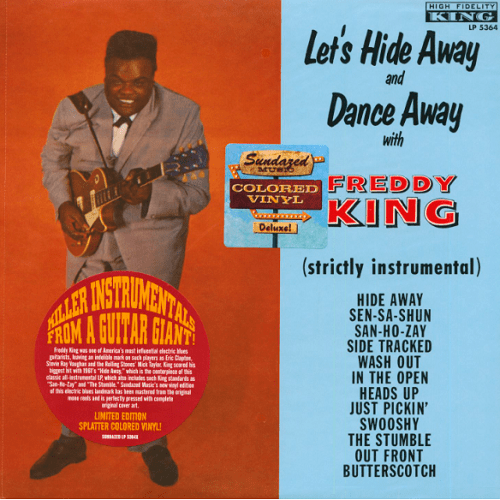
Rob was a guitar player and he was the guy who introduced me to today’s Freddie King song. He had the “Let’s Hide Away and Dance Away” album his favorite cut was called Wash Out. I remember he told me he thought it had an “early Elvis” feel to it. The repeated guitar lick does remind me a bit of Elvis’ Blue Christmas.
He handed the song to me on a cart (what we played songs off of before CDs) and I played it on air without ever hearing it. We both sat with our headphones on listened. When it was done, we cracked the microphone and he asked me if I liked it. I remember telling him that it sounded like I was just listening to a couple guys sitting in a room jamming together. That’s what it felt like to me, improvising the blues.
Freddie was always out on the road. He toured with guys like Sam Cooke, James Brown, and Jackie Wilson. He was on the road almost 300 days out of the year. All the touring caught up with him. In 1976 he began suffering from stomach issues. Painful ulcers and acute pancreatitis led to failing health and he passed away just after Christmas in 1976 at the young age of 42.
In 2012, ZZ Top inducted him into the Rock and Roll Hall of Fame. A year later, Rolling Stone magazine ranked him 15th on their list of 100 Greatest Guitarists of All Time.
Welcome back to The Music of My Life, where I feature ten songs from each year of my life. In most cases, the ten songs I choose will be ones I like personally (unless I explain otherwise). The songs will be selected from Billboard’s Year-end Hot 100 Chart, Acclaimed Music, and will all be released in the featured year.
I turned 13 in 1983. I had a paper route and a weekly income because of it. I spent my money on toys, books and music. I loved going into Harmony House and buying 45’s or albums. As I get deeper into the 80’s, I’m seeing more and more songs that I “had” to have.
I am noticing something about a lot of the songs on my lists. There have been some that have not necessarily been meaningful to me the year they were released, but wound up being important later on in my life. That is the case of a few of them from this year. That being said, let’s check out my list….
When Lionel Richie left the Commodores, he had a number one song with “Truly.” The follow up song has always been one of my favorites. I can still see and hear my mother singing along the the chorus of “You Are.”
What I love about this is the fact that while it is a love song, it has some tempo to it. It also has a horn section. Future hit maker Richard Marx sang backup on this track. His first job in music was singing on the Lionel Richiealbum, and he proved himself on this track, which required some deft background vocals. Richard told songfacts.com: “Every session I ever did with Lionel, or for him, was a very fun atmosphere. I’ve been on so many sessions where it’s a downer, and you just try to get through it and nobody is having fun. Lionel is always having fun – no matter what.”
You Are
When I worked in country radio, I used to go to the Country Radio Seminar. It was a place where you got to hear various panels discussing programming, promotions and more. There were plenty of artists there (both old and new) to entertain. We’d often bring stuff for artists to sign so we could auction them off for St. Jude.
Every night there was always a show somewhere. Everyone had always talked about “the boat.” One record label would bring folks about the General Jackson Showboat and provide dinner and drinks. While us radio people would sit and eat, they would bring artists out on the stage to play for us. Many times it was familiar artists featuring their new songs or new artists that the label wanted to showcase.
One of the things about the boat was that there were always one or two surprise guests. You never knew who might show up. The year before my first boat ride, Huey Lewis had mad an appearance. The first time I was on the boat, they wheeled out this piano on the stage. Next, they brought out Ronnie Milsap and I was thrilled. I had always loved his music and he did not disappoint.
He came out laughing and joking and cranked out a few songs, including Stranger In My House. It was written by Mike Reid, who was a defensive tackle for the Cincinnati Bengals for five seasons and had a couple country hits of his own. The song was a country hit and also crossed over to the AC and Hot 100 charts.
The song is done in a minor key and from the opening chords, I was hooked.
Stranger In My House
Anyone who goes through a divorce or a break up knows that what follows can be a rough road. The next song is an example of a song that meant nothing to me at the time, but years later it did.
The fighting, the bickering, the pettiness, the blame, the suffering, the accusations and all the things that comes with a divorce is difficult enough. Once they hand you the final decree, it is important to start anew. I had a wonderful support system in place for me and as time passed, I looked back to see that I was making it. I had been through the war and I had made it to the victory.
Elton John’s I’m Still Standing was used in an animated movie called “Sing.” It was while watching that with the kids that I really heard and felt the lyrics. I can look in the mirror and know that I’m Still Standing and life is GOOD!
I’m Still Standing
Remember ELO’s song “Motor Factory?” Of course, you don’t. That’s because as the group was recording the song, it went through a bunch of changes. They lyrics were completely changed and it became Rock and Roll Is King. The song was released as a single from their Secret Messages album.
ELO’s Dave Morgan said in an interview, “I sang on quite a few tracks, I sang on ‘Rock ‘N’ Roll Is King’. I played on that one, but it wasn’t called that, it was something about something about working at Austin Longbridge! It was full of car plant sounds, you could hear it going clank, clank, clank, like somebody hitting a lathe with a hammer, and Jeff went away and made it into ‘Rock ‘n’ Roll Is King’, wiped off everything we’d done, no, there was still some backing left in there, It was much better how he finished it off than it was before.”
I remember recording this off the radio as a kid. I didn’t realize that there was (what we radio guys call) a “fake cold” ending. That’s where the song stops, you think it’s over, and they come back and sing again. The first time I recorded it off the radio I hit pause on the fake cold, only for ELO to start singing again. Urgh! I got smart after that and went and bought the single.
Rock and Roll Is King
Fleetwood Mac’s Lindsey Buckingham released a few solo albums in the 80’s. Despite some songs that were Top 40 hits, not many folks can recall them. There is, however, one song that folks know thanks to the misadventures of a family named Griswold.
Thanks to National Lampoon’s Vacation, Buckingham’s song Holiday Road had become his best known song. That’s really saying something for a song that never cracked the Top 40 and peaked at #82 when it was released. The song almost didn’t happen.
Actor/director Harold Ramis asked Buckingham to create two songs for his film National Lampoon’s Vacation. He was initially reluctant, believing that soundtrack work “wasn’t part of his discipline.” Thankfully, he decided to grant Ramis’s request, and wrote. Buckingham recorded “Holiday Road” without seeing the entire film. He figured that the movie “had to be somewhat uplifting and a little bit funny”. To keep in line with that, he added dog barks near the end of the song, unaware that the movie featured a scene where a dog is accidentally dragged to death from the bumper of a car.
It is one of those songs that makes you unconsciously press down a bit too much on the gas pedal if your driving while it is playing. I’m not sure I ever “got” the video for the song, though.
Holiday Road
ZZ Top’s Eliminator album was one of few albums that have sold over 10 million copies in America, earning Diamond certification. I helped it get there! This was an album that I remember buying and dropping the needle on for the first time. It had such a neat sound.
Billy Gibbons says that he got the idea for Sharp Dressed man when he saw a movie and a character was listed in the credits as “Sharp-Eyed Man.” According to songfacts.com, the song attracted a slew of new fans to ZZ Top when the video ran constantly on MTV. Their long beards made them instantly recognizable and the babes certainly helped, but the car was the real star.
Prior ZZ Top albums had a Tex-Mex vibe, but when it came time to sort out visuals for the album, the hot rod was finally ready – Gibbons had been working on it for years. It was good timing, giving them an MTV-friendly focal point just when they needed it. They had never made videos before and had no acting experience, but their videos provided everything MTV’s target audience craved: girls, rock and roll, and a really sweet ride.
The music video was the first that was a sequel. It picked up the story from the “Gimme All Your Loving” video of the down-on-his-luck gas station worker who is swept away by three beautiful women. In “Sharp Dressed Man,” he’s a valet, and he encounters the same three girls and is once again given the keys to the Eliminator, Billy Gibbons’ 1933 Ford Hot Rod.
Sharp Dressed Man
I had no idea in 1983 that I would be working as a sleep technologist. The next song is one that is based on a real sleep disorder – somniloquy (Sleep talking). “Talking In Your Sleep” is the biggest hit of The Romantics’ career. In fact, it’s their only Top 10 hit, and only one other song by them (“One in a Million”) even made it to the Top 40. Contrast that with the number of times you’ve heard their song, “What I Like About You,” which only made it to #49.
I love this story about the song: As usual, MTV helped boost The Romantics’ success right around this time with videos of their songs. In Greg Prato’s book MTV Ruled the World, Romantics’ lead singer Jimmy Marinos talks about this song: “That was the last song recorded for the album In Heat. All we had was a backtrack, the instrumental part of the song. And we realized it was too good a track to leave unfinished. So everybody put their heads together, and in a couple of days, we finished up the song melodically and lyrically.” Ha also mentions that the video was filmed at 8:00 in the morning in Detroit, surrounded by girls in their jammies, at what was deemed “not really rock ‘n’ roll hours.” So if they look like they just woke up, that’s because they did – and it works great!
Check out their hair in this video!!
Talking In Your Sleep
Two years ago, Dave Ruch invited a bunch of us to write a column for his Turntable Talk feature. The first topic was about why the Beatles are still relevant, the next song is an example of their influence.
When Genesis began to write That’s All, it was intended as an attempt to write a simple pop song with a melody in the style of The Beatles. Phil Collins even acknowledged in a subsequent interview that the song also features one of his attempts at a “Ringo Starr drum part.”
Genesis keyboard player Tony Banks was one of the first to use an Emulator, which was one of the first digital samplers (it was introduced in 1981). Banks would record his bandmate Mike Rutherford as he noodled around on his instruments, then play around with those samples to craft a track, which is how this song developed.
That’s All was the band’s first Top 10 hit in the US, setting the stage for their tremendous success the rest of the decade as they adapted their sound from progressive rock to tighter pop songs. The video certainly played a part in the success of the song, too. It depicts the band as homeless men taking shelter outside a disused factory. They perform the song, eat soup, play cards, and keep warm around an open fire. It was the first time Genesis used director Jim Yukich, who would direct the majority of their next videos as well as many of Collins’s solo videos.
That’s All
Remember the group Blue Angel? Me either. It was the group that Cyndi Lauper was in in 1981. It was her solo career and her first single, however, that made her famous. It is interesting to note that Girls Just Wanna Have Fun didn’t start out as the female anthem that Cyndi made it.
A Philadelphia singer/songwriter named Robert Hazard, who had a band called Robert Hazard and the Heroes, wrote it. He recorded a demo of it in 1979. Speaking with Rolling Stone, Lauper said that she had to alter the lyrics from Hazard’s original. “It was originally about how fortunate he was ’cause he was a guy around these girls that wanted to have ‘fun’ – with him”
Believe it or not, Cyndi didn’t want to record this song, but her producer, Rick Chertoff, was convinced it could become her anthem. The challenge for her was figuring out how to sing it. She ended up doing her vocal in the style of the ’50s hit “Let the Good Times Roll” by Shirley & Lee, which Shirley Goodman sings in a high-pitched voice. It obviously worked as the song went to number 2 on the Billboard Hot 100 chart.
MTV again played into the success of the song, as this was a very fun video to watch. The video, which ran constantly on MTV, features the wrestler Captain Lou Albano as Lauper’s father, and also Lauper’s real-life mother, who had no acting experience but did just fine. It won the first ever award for Best Female Video at the 1984 MTV Video Music Awards.
The song had a huge influence on how girls dressed in the 80’s. When I think of it, I can picture so many of my gal friends who dressed like Cyndi.
Girl’s Just Want To Have Fun
Everyone I grew up with had the 1984 album from Van Halen. The song actually was a bigger hit in 84, but it is on this list because it was released in December of 1983. Jump is just one of many songs that used synthesizers in the 80’s. The synthesizer intro for Van Halen’s Jump is iconic, but not everyone in the band wanted to use it.
The synthesizer was a point of contention in the band. Eddie wanted to use it, but lead singer David Lee Roth thought it would look like they were selling out to get more radio play. Eddie was classically trained on piano growing up – he didn’t start playing guitar until he was a teenager – so it wasn’t that far a stretch for him. Had the band brought in an outside keyboard player they probably would have gotten a lot of flak, but Eddie was held in such high esteem that fans were happy to hear him on another instrument.
Songfacts.com says: 1984 was David Lee Roth’s last album with Van Halen before he left the band in 1985; the video for “Jump” inflamed the tensions that led to his departure. The video was produced by Robert Lombard, who wanted to show the personal side of the band on stage. Roth, however, wanted the performance intercut with footage of him doing other things, so they shot him doing things like riding a motorcycle and getting arrested while wearing nothing but a towel. Lombard edited the video and used none of the extra Roth footage, taking it to Eddie and Alex for approval. Two days later, the band’s manager fired him for bypassing Roth. Lombard says he never received the award the video won from MTV.
Jump
Next week, we’ll look at songs from 1984. 1984 was a big year for me in a lot of ways. Musically, it was a big year for ballads. With a mix of country, R&B, and a song that led to me embarrassing myself on the air years later, it will be an interesting list!
Tell me about your favorite from 1983 that I may have missed in the comments and I will see you next week.
My ninth pick in the Hanspostcard TV Show Draft is a show that consistently made me laugh out loud – Arrested Development. I know going into this blog that it was a show that not everyone “gets.” I recall going to work raving about the show and how much I laughed at it. I encouraged others to watch it. Some got it and most didn’t.
In almost everything you read about the show, it is referred to as “a cult classic.” To a degree, I guess that may be true. I remember how giddy I got when a couple people in my sleep program also were big fans of the show. We were constantly quoting it in class as many stared at us like we were freaks. Maybe we were.
Before continuing, let me say that I chose this show based on the 3 seasons that aired on Fox. I am aware that years later, two more seasons were produced by Netflix (where you can see the entire 5 seasons). As a fan of the show, I watched the two additional seasons, and while there were some funny moments, and while I loved seeing the return of the cast/characters, it lacked so much of what the first three seasons had. That being said, let’s move on …
Ask me the question, “Just why is Arrested Development so good?” or “What makes the show so funny?” and I cannot give you an answer. In preparing to write this, I did a Google search of those questions. There were many Reddit forums and fan sites that come up with personal opinions about it, but none of them really has a solid answer. After all, “comedy is subjective.”
The Origins of the Show
In 2002, Actor/Director Ron Howard had the idea to create a TV comedy that would involve using handheld cameras and shoot sort of like reality TV. It was to have a look of a documentary, yet be a comedy. NBC’s The Office was shot this way and often referred to as a “mock-umentary.”
He met with some people at Imagine Entertainment to discuss the idea and Mitch Hurwitz mentioned the fact that there were a lot of corporate accounting scandals that were in the news (like Enron and Adelphia), and the story of a family that went from rags to riches might work. Howard liked the idea and had Hurwitz begin writing the series. After creating the story’s characters and plot line, he had a pilot script done in January of 2003 and the first episode was shot just two months later. Howard acted as the show’s narrator and in the opening credits welcomes viewers to the “story of a wealthy family who lost everything, and the one son who had no choice but to keep them all together. It’s Arrested Development”.
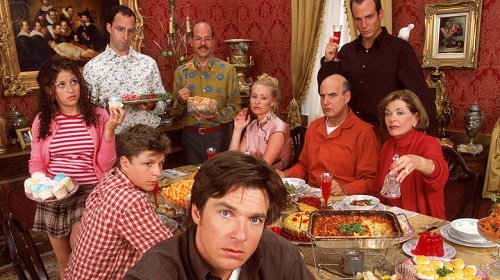
The show is about a family – albeit a VERY dysfunctional family. I think that is what makes this whole show work. Watching each of these characters, with their own insecurities and idiosyncrasies, interacting with each other allows for comedy to flourish. (It also will cause you to see members of your own family as members of this one!) Add to brilliantly funny “cut-aways,” narrator comments, and strong comedy writing and you have a show that will make your sides hurt from laughing.
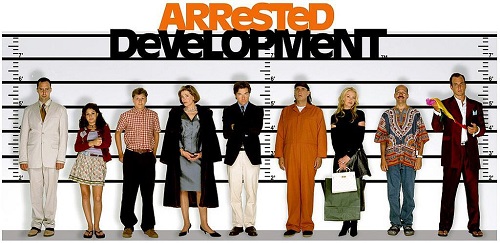
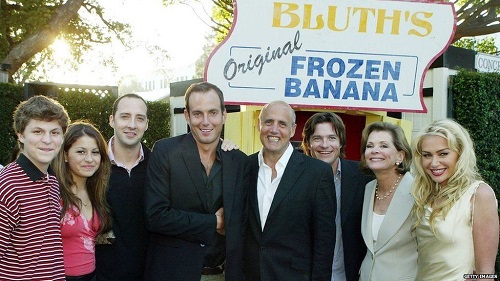
In a nutshell, the show follows the formally wealthy Bluth family as Micheal (Justin Bateman), the only responsible Bluth, tries to keep them and their company from going completely bust while desperately attempting to set a good example for his teenage son (Micheal Cera). The family includes imprisoned father George (Jeffrey Tambor), hypercritical matriarch Lucille (Jessica Walter), failed magician Gob (Will Arnett), spoiled sister Lindsay (Portia de Rossi), and man-child Buster (Tony Hale).
Wikipedia describes the show this way:
The plot of Arrested Development revolves around the members of the Bluth family, a formerly wealthy family who continue to lead extravagant lifestyles despite their changed circumstances. At the center of the show is Michael Bluth, the show’s straight man, who strives to do the right thing and keep his family together, despite their materialism, selfishness, and manipulative natures. Michael is a widowed single father. His teenage son, George Michael, has the same qualities of decency but feels a constant pressure to live up to his father’s expectations and is often reluctant to follow his father’s plans. He battles with a crush he has on cousin Maeby, which developed from a kiss she gave him as part of a prank.
Michael’s father, George Bluth Sr., is the patriarch of the family and a corrupt real estate developer who is arrested in the first episode. George goes to considerable lengths to manipulate and control his family in spite of his imprisonment, and makes numerous efforts to evade justice. His wife, and Michael’s mother, Lucille Bluth, is ruthlessly manipulative, materialistic, and hypercritical of every member of her family, and constantly drinks alcohol. Her grip is tightest on her youngest son, Byron “Buster” Bluth, an over-educated (yet still under-educated) mama’s boy who has dependency issues and is prone to panic attacks.
Michael’s older brother is George Oscar Bluth II, known by the acronym “Gob” (pronounces like “Job” in the Bible). An unsuccessful professional magician whose business and personal schemes usually fail or become tiresome and are quickly abandoned, Gob is competitive with Michael over women and bullies Buster. Michael’s twin sister Linday is spoiled and materialistic, continually seeking the center of attention and leaping on various social causes for the sake of vanity. She is married to Tobias Funke (David Cross), a discredited psychiatrist-turned-aspiring actor. Tobias is a self-diagnosed “never-nude” (a disorder comparable to gymnophobia) whose language and behavior have heavily homosexual overtones to which he seems oblivious and which are the center of much tongue-in-cheek comedy throughout the series. Their daughter is Mae “Maeby” Funke (Alia Shawkat), a rebellious teen with an opportunistic streak, who seeks to defy her parents for the sake of attention, and otherwise pursues boys and power, and furthers her complicated relationship with George Michael.
The supporting cast and characters are just as strong and developed as the main ones. Those include Jeffrey Tambor as George Sr.’ identical twin Oscar, Liza Minnelli as Lucille Austero (or Lucille 2), Carl Weathers appears as himself (and is hilarious), and Henry Winkler as the family’s attorney Barry Zuckerkorn. Other guest stars include Ed Begley Junior, Ben Stiller, Christine Taylor, Julia Louis-Dreyfus, and Charlize Theron.
One Reddit user said:
I’ve never found another sitcom on TV that assumed its viewers had concentration spans and didn’t need to be spoon fed things. The producers were more than happy to let a brilliant joke sail past half the audience rather than overexpose it so everyone watching understood. They were not only happy to include subtle references to episodes that occurred a year or two before they were happy to throw in references to things that were going to happen later in the season. And all without a laugh track or excessive mugging to the camera to tell us when to laugh.
Of course being subtle and extremely clever on its own isn’t enough to make a good sitcom. Arrested Development also benefited from brilliant stories, very clever writing and perfect performances from the entire cast.
The countless in-jokes, references to other jokes and jokes that reference jokes that are referencing the in-jokes. The show is so layered that there are literally hundreds of clever idiosyncrasies within each episode. Like someone said earlier, the viewer feels rewarded when they get a joke that refers to an earlier episode.
One of the things I still love about the show is that it gets better with each viewing! I can watch an episode again and find jokes I had missed before. It is constantly offering a “pay off.” It is different from say Friends or Fraiser, in that every time you watch an episode again, you find a comedy “nugget.”
There are many fantastic running gags on the show. Rolling Stone wrote a very nice article on them. You can find that here:
Visual gags and word play were often a source of laughs on the show. I remember one gag that really pushed the envelope and left me laughing and wondering how they got away with it at the same time:
One of the silliest gags on the show is the Bluth Family Chicken Dance, which is mentioned in the video above. It is not something they all do in unison, let me be clear on that. Each member of the Bluth family has their own – very unique way – of dancing like a chicken. This is often used when insinuating that another family member is chicken or scared of doing something. I’m including this video, because in the one above, some of the “set up” to the full family dance was omitted.
In the middle of the third season, it was clear that viewership was down and the show was probably going to be cancelled. As a matter of fact, Fox pulled the show from the November sweeps that year AND cut down the order for 22 episodes to just 13 (something which became a joke throughout that third season.)
In 2004, the show was nominated for 7 Emmy awards and won five of them. It won for Outstanding Comedy Series, Outstanding Directing for a Comedy Series, Outstanding Casting for a Comedy Series, Outstanding Single-Camera Picture Editing for a Comedy Series and Outstanding Writing for a Comedy Series. It was praised by critics for being one of the funniest shows on TV, but the ratings never really lived up to that hype.
I was excited to write about this show, but now that I am reaching the end, I feel that I have in no way, shape, or form done it justice. I just don’t know how to do that. It is a show that makes me laugh out loud, yet I cannot fully explain why. It is a show that you will either love or hate – based on what you find funny.
Remember at the beginning of this blog I asked: “Just why is Arrested Development so good?” or “What makes the show so funny?”
In an interview with The Guardian, Justin Bateman may have the answer! He explained the key to what makes Arrested Development so hilarious is how seriously the characters take their ridiculous lives. He states that the sitcom is actually more like a drama for its ensemble of characters. The comedy, he feels, comes from the fact that the Bluth family has no idea how funny they really are.
“This is not funny to anybody inside the show. This is a drama to them. Almost like an animal documentary, where you’re watching these freaks, and how they gather their food, and how they make their house. And let’s make sure we all whisper because we don’t want these folks to know how much we’re laughing at them.” – Justin Bateman






 Various Ramblings of a Nostalgic Italian