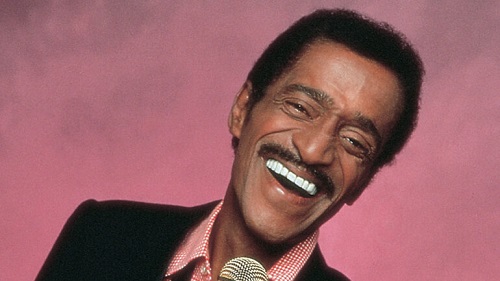
Happy 100th Birthday to the amazing Sammy Davis Jr.! There was really nothing that he could not do! He could play multiple instruments, he could dance, he could sing, he could act, he was an all around entertainer!
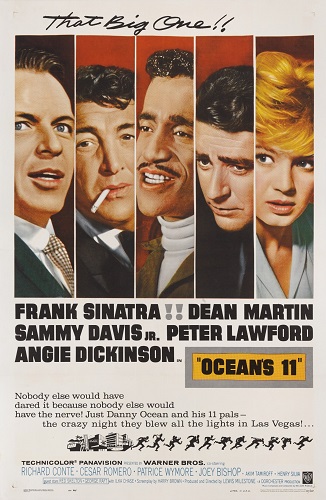
As a member of the Rat Pack, Sammy appeared on stage and in movies with Frank Sinatra, Dean Martin, Joey Bishop and Peter Lawford. One of those movies was Ocean’s 11.
That’s right, the Rat Pack did the original version of Ocean’s 11. It was one of the first Rat Pack movies I ever watched. I loved it.
In the movie, a group of military buddies have a plan to rob the five major casinos in Las Vegas on New Year’s Eve. Their plan to do so is reminiscent of an episode of Mission: Impossible. It is one of the best of the Rat Pack films.
The song “Eee O Eleven” is performed three times in the film. It is the film’s theme song. The title is a reference to the craps phrase “Yo-11,” a bet on the dice coming up eleven, used to avoid confusion with a roll of “7”. The song was written by Sammy Cahn and Jimmy Van Heusen and performed by Sammy.
You can hear it over the opening and end credits of the film, but Sammy also performs it in the movie itself.
Welcome to my submission for A Sound Day’s monthly feature – Turntable Talk, hosted by Dave Ruch. This is the 28th installment of this feature and I’ve had the pleasure of writing since for it since the beginning. His topics each month are always something that I look forward to writing about.
This month his instructions were to “unfold the Musical Road Map! The idea is to pick a song with a specific location in its title and write about it. Pick a song you like, even if it’s not a place that is high on your list of dream destinations. It could be a city, a country , a state or province, even some magical mystical place living in the imagination.”
As I thought about this topic, plenty of songs entered my head. The challenge I seem to face every month is to try to pick something that one of the other contributors hasn’t already picked. There were many hits that jumped right out at me (Sweet Home Alabama, I Left My Heart in San Francisco, Houston, etc…), so I started thinking about songs that would not be something too popular.
Arrivederci Roma and On An Evening in Roma, both by Dean Martin were the first songs to come to mind. Dean made me think of Frank Sinatra and New York, New York. Frank then got me thinking about Sammy Davis Jr. and I knew that the song I was going to write about would not only be something that the other bloggers wouldn’t pick, but a song that not many people have ever heard before.
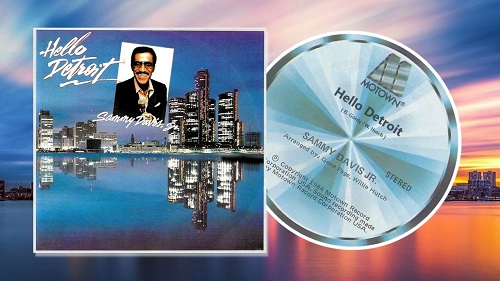
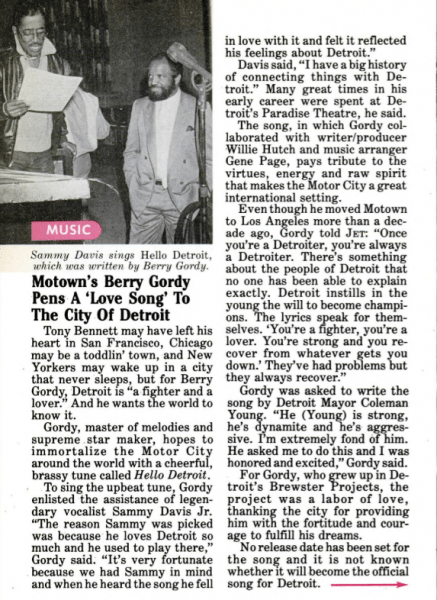
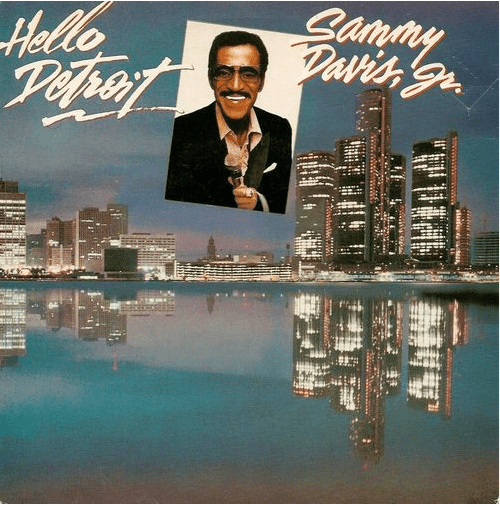
Yesterday, the City of Detroit celebrated its 323rd birthday! Back in 1984, Detroit’s Mayor (Coleman Young) reached out to Berry Gordy Jr. of Motown Records to write an anthem for the city. Berry wrote “Hello, Detroit” with Sammy Davis Jr. in mind to record it. When he showed Sammy the song, Gordy says that he “fell in love with it and felt it reflected his feelings on Detroit.”
“Hello, Detroit” is certainly not the best song to come out of Motown, and it wasn’t as big as Frank Sinatra or Tony Bennett’s love letters to their respected cities. However, you cannot help but hear the love for the city as Sammy begins to sing:
You’re a fighter, you’re a lover You’re strong and you recover From whatever gets you down
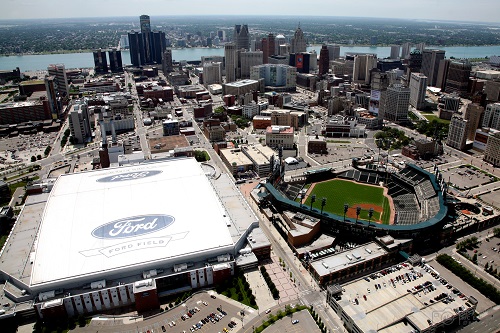
Those words certain have a lot of truth to them. The city of Detroit has really turned around over the past decade or so. Downtown is thriving. Ford Field (Lions) and Comerica Park (Tigers) are right across the street from each other, and from the street you can see that amazing Detroit skyline.
Comerica Park and Ford Field with The Downtown Detroit Skyline in the Background
There is so much more happening in the growing city, but as with any “dated” song, things change.
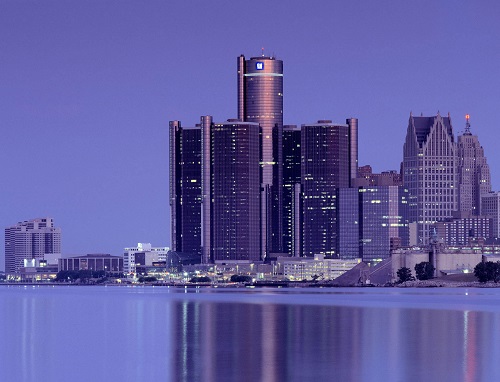
Hello Detroit, you’ve won my heart Your renaissance, and waterfronts Give you a flare of your own
The Renaissance Center has been a staple for years, but General Motors will move out next year and, looking to the future, CEO Mary Barra doesn’t rule out the demolition of the building. The company announced the move earlier this year — pulling out of the iconic skyline staple after 28 years in the name of downsizing.
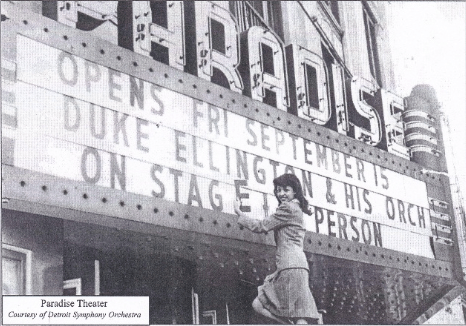
Sammy Davis Jr. said, “My home has always been show business” and Detroit was always hospitable. He said that he had “a big history of connecting things with Detroit,” as he often played the Paradise Theater in Detroit early in his career.
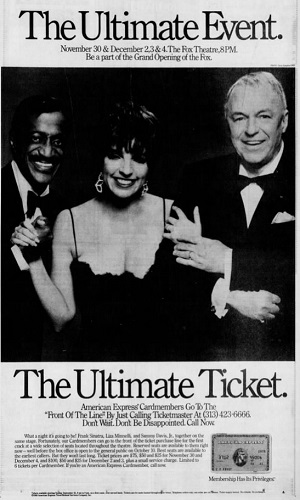
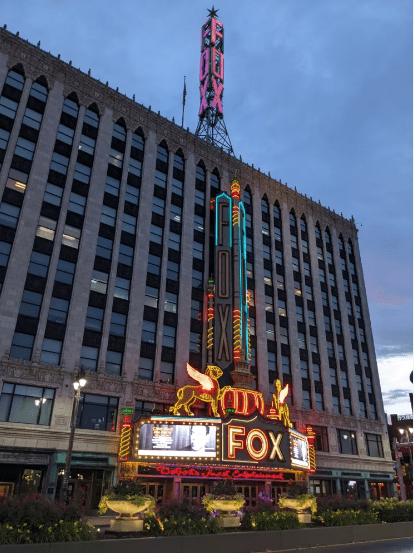
Toward the end of his career, he would take the stage at another theater. Sammy was there for the rebirth of the Fox Theater, along with Frank Sinatra and Liza Minelli.
Their five-night stand, complete with a 30-piece orchestra, kicked off a new era for the Fox Theatre. This kind of brought things full circle for Sammy. The Fox originally opened in 1928, and it was the same year a 3-year-old Sammy Davis Jr. performed for the first time.
Sammy performed “Hello, Detroit” on opening night at the Grand Reopening of the Fox Theater. The concert rebroadcast may have been the most dignified three hours of content to air on Showtime in all of 1989.
I remember the first time I heard “Hello, Detroit.” It gave me chills. I wish that I could perfectly sum up in my own words what the song means to me and the many folks who call Michigan home, but every time I wrote something, I wound up deleting it. Why? Because I found something online that truly expresses it better than I ever could. This is copied from lyricslayers.com:
Sammy Davis Jr.’s song ‘Hello Detroit’ is a heartfelt tribute to the city of Detroit, capturing its spirit, resilience, and unique charm. The lyrics paint a vivid picture of a city that has faced numerous challenges but continues to thrive and inspire. Davis Jr. describes Detroit as a ‘fighter’ and a ‘lover,’ emphasizing its strength and ability to recover from adversity. This portrayal resonates with the city’s history of economic struggles and its ongoing efforts to reinvent itself.
The song highlights various aspects of Detroit that make it special, from its renaissance and waterfronts to iconic locations like Belle Isle Park and Greektown. These references not only celebrate the city’s physical beauty but also its cultural and social vibrancy. The mention of Detroit’s influence on the young, encouraging them to become ‘stars and champions,’ underscores the city’s role in nurturing talent and ambition, particularly in the realms of music and sports.
Davis Jr.’s repeated affirmations of care and prayer for Detroit reflect a deep emotional connection and a sense of loyalty to the city. The song’s affectionate tone and personal touch make it more than just a tribute; it’s a love letter to a place that has profoundly impacted the artist. The references to ‘Big D,’ ‘Motor City,’ and the ‘Motown sound’ further anchor the song in Detroit’s rich musical heritage, celebrating its contributions to the world of music and its enduring legacy.
‘Hello Detroit’ is a celebration of the city’s indomitable spirit, its cultural richness, and its ability to inspire and uplift. Through his soulful performance, Sammy Davis Jr. captures the essence of Detroit, making listeners feel the same admiration and affection he holds for this remarkable city.
That sums up the song perfectly! It was used in countless promotional ads for television and radio for a few years. Some morning radio shows would play it at the beginning of their shifts every day. Sadly, it faded away and doesn’t get much play any more. That is reason enough for me to feature it here on Turntable Talk.
Hello Detroit
You’re a fighter, you’re a lover You’re strong and you recover From whatever gets you down And there’s so many, many reasons Any time, any season Is the right time to be with you
Hello, Detroit! You’ve won my heart Your renaissance and waterfronts Give you a flair of your own
Irresistible you Hug and kissable you You’re alive with so much feeling And I will always be there for you I will say a little prayer for you And I will always care for you Hello
Hello, Detroit! You’ve touched my soul Thanks for the memories I can reach so Winter, spring, summer and fall You’ve got it all Hello, hello, hello!
Hello, Detroit!
I must go through Belle Isle Park Greet town after dark You’re in still in the young of will To become stars and champions
Hello, my friend! How have you been? It’s every air It’s everywhere The magical touch of you
Irresistible you Hug and kissable you You’re alive with so much feeling And I will always be there for you I will say a little prayer for you And I will always care for you
Hello A big deep The motor city And the Motown song that’s got the whole world singing
And I will always be there for you I will always say a little prayer for you (I will say a little prayer for you) And I will always care for you Hello!
(Hello, Detroit!) (Detroit!)
(Irresistible you) (Hug and kissable you) (You’re alive with so much feeling) (And I will always be there for you) (I will say a little prayer for you) (And I will always care for you) (Hello!)
Hello, Detroit!
Thanks to Dave for allowing me to participate once again! I not only look forward to reading the other contributions, but to next month’s topic.
The amazing Bobby Darin was born May 14, 1936. Bobby was a phenomenal talent. He was a lot like Sammy Davis Jr. in that he was a songwriter, a singer, an actor, and played multiple instruments. He caught the attention of many, including George Burns, with whom he was good friends.
He began his career writing songs for Connie Francis, and eventually recorded his first song, “Splish Splash,” which was a hit in 1958. He followed it with many other hits including “Dream Lover,” “Beyond the Sea,” “If I Were a Carpenter”, “Clementine,” “Things,” and “Mack the Knife.” His music was such a big part of that early rock and roll, however, thanks to Mack the Knife, he also had great success with some pop standards.
With so many great songs to pick from, I decided on one that I just love. The song was not exclusive to Bobby Darin, but his version is one of the best. I am talking about “More.”
“More” was the Theme to a movie called Mondo Cane, which is a documentary. According to Wikipedia, the film “uses a variety of music to accompany various segments. Some melodies are used repeatedly, in different styles, each named for the part of the movie where the music is used. Of the 15 music tracks on the soundtrack album, one melody is presented 6 times, another melody 2 times. The melody which became known as ‘More’ is presented 4 times.”
The song was first heard in the US as a pop instrumental hit by jazz trombone player Kai Winding in 1963. The instrumental version went to #8 on Billboard’s Hot 100 Chart. Bobby cut his version of the song for his album “From Hello Dolly to Goodbye Charlie.”
The song works so well as a ballad, but Bobby’s take on it swings and is so good! I love the lyrics and dedicate this one to my wife …
More
More than the greatest love the world has known This is the love that I give to you alone More than the simple words I try to say I only live to love you more each day
More than you’ll ever know My arms long to hold you so My life will be in your keeping Waking sleeping laughing weeping
Longer than always is a long long time But far beyond forever you’ll be mine I know I’ve never lived before And my heart is very sure, no-one else could love you more
More than the greatest love the world has known This is the love that I give to you alone More than the simple words I try to say I only live to love you more each day
More than you’ll ever know My arms long to hold you so My life will be in your keeping Waking sleeping laughing weeping
Longer than always is a long long long time But far beyond forever you’ll be mine I know I’ve never lived before And my heart is very sure, no-one else could love you more
There are many biographies available about the life of Bobby Darin. His son, Dodd, wrote one entitled Dream Lovers which talks much about his dad and his mom (Sandra Dee). It’s an honest read.
Bobby had health issues throughout his life and his heart already had issues. In 1973, he neglected to take the antibiotics he was prescribed for his heart before a dentist visit. He ended up developing sepsis which spread throughout his body. This made him weak and affected one of the valves in his heart. He checked himself into the hospital for another open heart surgery (he had two heart valves replaced in 1971). After a six hour surgery, he died in the recovery room on December 20, 1973. He never regained consciousness. Bobby Darin was 37 years old.
They say “out with the old and in with the new,” but I’m glad that an old feature continues! I am, of course, talking about Turntable Talk hosted by Dave Ruch from A Sound Day. For 22 months, he has proposed various musical topics for our group of music lovers to write about. Not only do I love writing for it, but I love reading the other submissions.
This month we go “wordless.” Dave says, “…let’s look at INSTRUMENTAL IN THEIR SUCCESS.Share with us all an instrumental tune you like a lot, and a few words about why.”
I write this, knowing that I am one of the last contributors, so I have no idea what has already been featured by other writers. As far as the topic, there was no shortage of songs to choose from. I began a list of instrumentals on a post it note pad. Each song made me think of another. About 20 post it notes later, I knew I had to stop and pick one. The problem was, which one to choose.
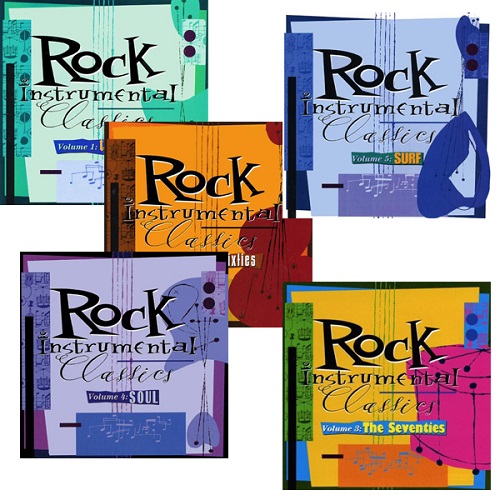
I LOVE instrumentals. I have countless CD collections featuring instrumental hits. One of the best was a series from Rhino Records called “Rock Instrumental Classics.” It was a 5 CD series that featured instrumental hits from the 50’s, the 60’s, the 70’s, surf hits, and soul hits.
Time Life Records had a series called “Your Hit Parade,” which featured music from the 1940’s all the way through the early 1960’s. That collection featured many instrumentals, too. There are SO many to pick from. My list included:
Green Onions – Booker T & the MG’s
Bumble Boogie – B. Bumble and the Stingers
One Mint Julep – Ray Charles
Kokomo – Asia Minor
Topsy Part 2 – Cozy Cole
Classical Gas – Mason Williams
Java – Al Hirt
Yakety Sax – Boots Randolph
Popcorn – Hot Butter
Axel F – Harold Faltermeyer
No Matter What Shape Your Stomach’s In – The T-Bones
The Theme From Sanford and Son – Quincy Jones.
That last one led me on a rabbit trail of TV Theme songs. There were plenty that were hits: Peter Gunn, Bonanza, Mission: Impossible, Theme from SWAT, Miami Vice, Route 66, Dragnet, The X-Files, The Rockford Files …. and finally, my pick for this month’s topic.
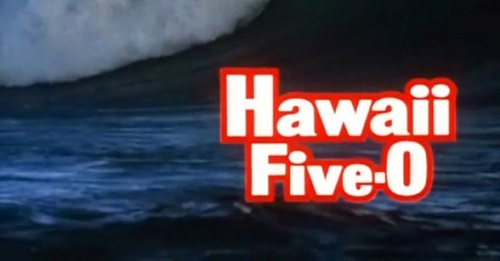
Hawaii Five-O was a long-running police procedural drama (1968-1980) about detectives Steve McGarrett (played by Jack Lord) and Dan “Danno” Williams (played by James MacArthur) who worked the Hawaiian islands beat. The theme was composed by Morton Stevens, who started out as an arranger/conductor for Sammy Davis Jr. and became director of music for CBS on the West Coast. The theme song won Stevens two Emmy Awards (in 1970 and 1974).
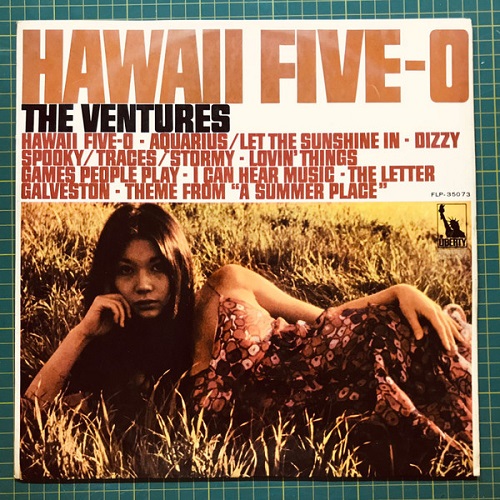
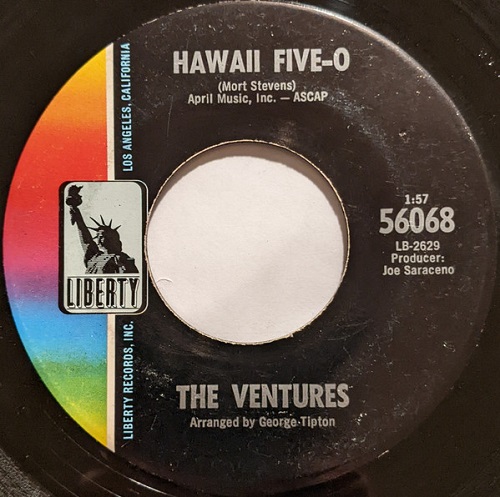
The song was recorded by the Ventures, who were instrumental (pun intended) in popularizing the electric guitar throughout the 1960’s. Their first hit was Walk, Don’t Run in 1960. The quartet charted 14 singles on the Billboard Hot 100 Chart and have sold over 100 million records making them the greatest instrumental band of all time.
The Venture’s version of the song was a Top 5 record, peaking at #4 spending 14 weeks on the chart. There were many session musicians who played along with the group including guitar player Tommy Tedesco of the famous Wrecking Crew.
I read somewhere that the Hawaii Five-O theme is the unofficial fight song for the University of Hawaii. This is one of those songs I wish we had played when I was in band. As a matter of fact, being a former band geek is probably why I love this song so much. I can listen to it 4 or 5 times in a row and focus on different things in the song. There are so many cool musical things in it. Allow me to illustrate with words and then listen to see if my wordy description makes sense.
Right from the get-go that drum crescendo into the tympany grabs me. (In one of my many listens to this song, I actually thought about making a list of great “tympany songs!”). Then you have the guitar and trumpets come in with the main theme doing a call and answer type thing with that flute-y instrument for the first verse. Another drum/horn crescendo to take you to the second verse with more guitar and now the flute answer is more of a counter melody.
A minute in and you get another drum/horn crescendo and a repeat of the melody. This time, you have some horns and trumpets on the answer. At 1:15, you get that fantastic staccato trumpet stings that take you to the final 30 seconds of the song. Now we’re at the big build to the grand finale. Here, you begin to hear what our band director used to call “pyramids.” You have one instrument, then another, and another and another building on each other until that final bit. There is a fast short pyramid from 1:27 to 1:30 between the horns and trumpets. Then at 1:35 the big build happens, followed by another bigger pyramid until the final trumpet stabs and guitar tympani ending. The song is an almost 2 minute masterpiece that always makes me feel good.
Ok, I know my description was a bit much. However, this is the perfect illustration of what I tend to do when listening to music. One listen I focus on the guitar and the next listen I check out the drum part. I tend to pick it apart and then appreciate how it all comes together.
It is interesting to know that there are actually a couple vocal versions of the song! I won’t post links here because we are focused on instrumentals. It should be no surprise that Don Ho did a vocal version. HIs version starts fast and turns into a ballad (“You Can Come With Me”). Then, Sammy Davis Jr, who composer Morton Stevens worked for at one time, did a version called “You Can Count on Me.” Both versions are on YouTube.
Thanks again to Dave for asking me to take part in this feature and for hosting it. I look forward to the next musical topic.
It’s time for another edition of Turntable Talk with Dave from A Sound Day. He continues to come up with interesting musical topics for his circle of “melodic” blogger friends. When he emailed each of us, he mentioned reading a book about a cafe’ where you could time travel (with restrictions). That got him to thinking about “how it would be cool to go back and see some historic concerts. So the next topic is … A Really Big Show ! If you could safely go back in time and move about for one day, what one concert or live performance would you choose to go to?“
There are so many great concerts I could choose from. I thought about the Beatles at Shea Stadium, Buddy Holly’s last concert, Elvis’ Aloha From Hawaii, Woodstock, Queen at Live Aid, just to name a few. I decided to go with a concert I have heard, but would have loved to experience it live.
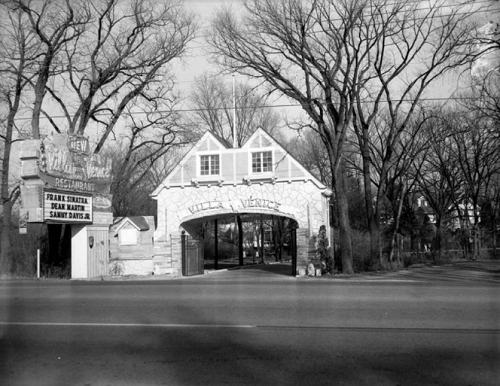
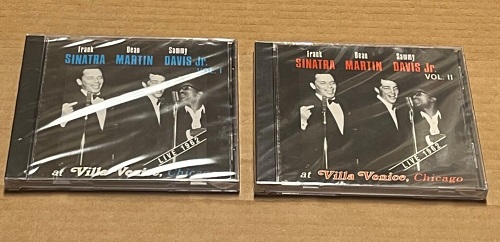
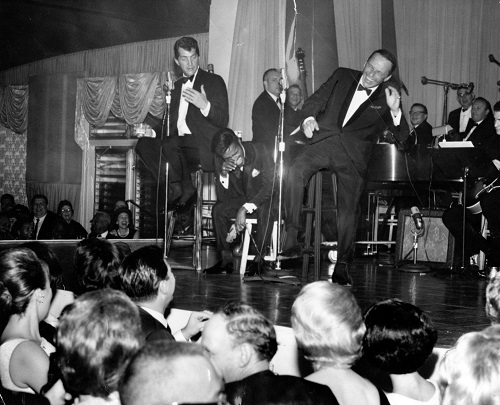
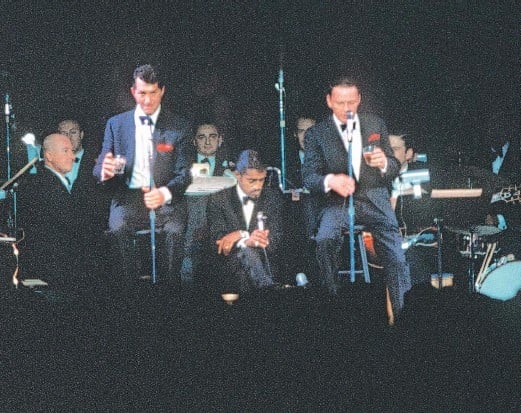
November 26, 1962. Villa Venice, Chicago. Dean Martin, Frank Sinatra, and Sammy Davis Jr.
A friend of mine knew that I was a Dean Martin fan and worked at a record store. He called me and told me he had an amazing CD set for me. At that time, I had heard plenty of Dean Martin recordings, but never a live one (and certainly not one with Frank and Sammy, too)! I can’t even begin to tell you what a thrill it was to hear the Rat Pack in their prime having a blast on stage together!
The concert itself starts with Dean warbling, “Drink to me only … that’s all I axe ….(correcting himself) ask. And I will drink to you.” The band begins to vamp an intro over and over. My first listen I wondered what was going on. What’s with the vamping? Then Dean says in all seriousness (and in character), “How long I been on?” Hilarious. After his first number (a parody medley of When You’re Smiling and The Lady is a Tramp), he does 5 minutes of comedy and I was belly laughing.
After Dean’s set, Frank comes on and does his set. He comes out swinging and sings a few tunes, then does a brief comedy set and wraps with more songs. Sammy comes out last and while he is on stage Dean and Frank are heckling him from back stage. It was evident just how much they loved hanging out together and how much fun they were having.
At some point in Sammy’s set, Dean and Frank come out and the three of them joke and sing and laugh. I know that for the most part the show is scripted, but as you listen, it sounds completely spontaneous and you are left to wonder what was ad-libbed and what was written.
The show is an absolute joy to listen to! The Chicago Tribune said Frank, Dean and Sammy, “croon, carol, caper and clown to the biggest cabaret audiences this town has seen in years.” I doubt they could get away with some of the stuff said on stage today, but it is a wonderful piece of entertainment history.
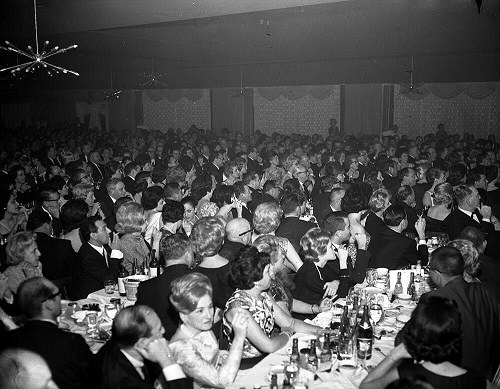
What I didn’t know was the circumstances of the show itself. The Villa Venice was an ailing nightclub where mafioso Sam Giancana had a piece of the action. The Villa Venice had been tricked out in a style imported from Las Vegas. Giancana reportedly spent upward of $250,000 to restore it and its canals plied by gondolas. The showroom seated 800, was furnished with satin ceilings, tapestries, and statuesque, lightly clothed showgirls. Nearby was the ultimate accouterment of a Vegas-like operation: a gambling casino in a Quonset hut a few blocks from the Villa. High rollers were whisked between the supper club and the dice and roulette tables in a shuttle.
The Chicago Tribune said, “Shortly before the Sinatra show closed, the casino shut down under belated pressure from law enforcement authorities who told the Tribune that the gambling operation had grossed $200,000 in two weeks. That threw a monkey wrench into Giancana’s business plan, which depended on recouping his investment by attracting gamblers with a parade of big-name acts. But how could he hope to book stars like Sinatra and his buddies into a scarcely known venue in the hinterlands of Chicago? What kind of money did he dangle in front of them? Wondering if there might have been a nonmonetary enticement, the FBI interviewed the Rat Pack during their engagement. Perhaps the feds took a clue from Dean Martin’s rewording of the old standard “The Lady is a Tramp“:
I love Chicago, it’s carefree and gay
I’d even work here without any pay.“
The Rat Pack’s Villa Venice appearances were wildly successful, as the Tribune reported: “It is now estimated that the total Villa loot for the seven-day Sinatra-Martin-Davis run will hit $275,000 to $300,000, a new night club record.”
Apparently, the Villa Venice never again hosted big-name stars after the Rat Pack shows. It continued operating thereafter as a catering hall, with a new management taking over in 1965. Two years later, it was destroyed by a spectacular, and mysterious, fire. The spot is now a Hilton hotel.
I have seen plenty of footage of Dean, Frank, and Sammy performing on various TV shows and in documentaries. I can only imagine just how amazing it would be to see their show live and in person. Each one of them was a talent in their own right and their solo shows would be a must see, but to have them all together on one stage – wow!
The CD’s of the show are available online if you search for them and are worth the money!
Thanks again to Dave for allowing me to take part in this feature. I cannot wait to see what the other participants are going to write about. I’m already looking forward to the next topic!
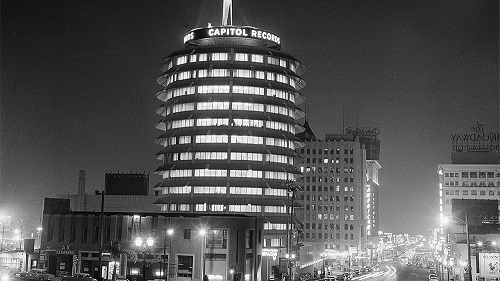
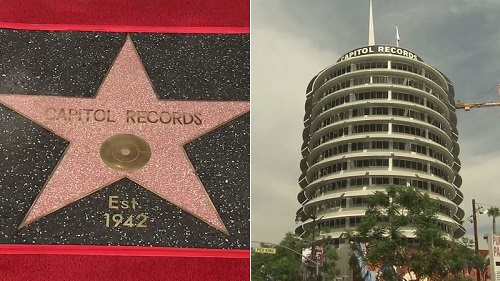
On this day in 1942, Johnny Mercer and Glenn Wallichs launched Capitol Records in the United States. Wallichs was the man who invented the art of record promotion by sending copies of new releases to disc jockeys. It wasn’t until 13 years later, in 1955, that the now famous Capitol Records building was built.
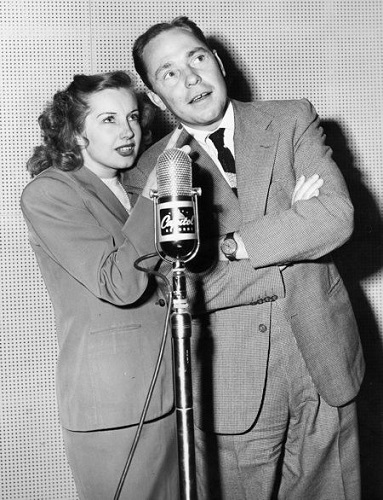
The first artist to record at Capitol was Martha Tilton in April of 1942. She recorded the song “Moon Dreams”
Capitol Records was home to some of the biggest musical artists in history! Here are just a few:
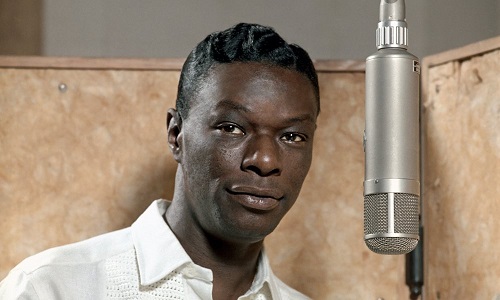
Nat King Cole –
(Mona Lisa, A Blossom Fell, Answer Me My Love, Unforgettable)
Louis Prima and Keely Smith –
(Just a Gigolo, Old Black Magic, Jump Jive & Wail, What is This Thing Called Love)
Peggy Lee –
(‘Deed I Do, Fever, Big Spender)
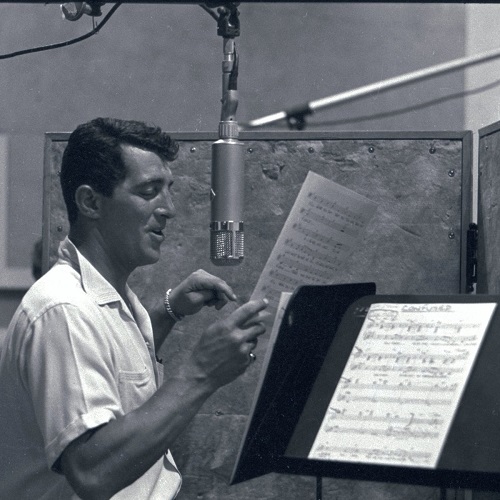
Dean Martin –
(That’s Amore, Return To Me, On An Evening in Roma)
Frank Sinatra –
(One For My Baby, I Get a Kick Out of You, Love & Marriage, All The Way, Young At Heart)
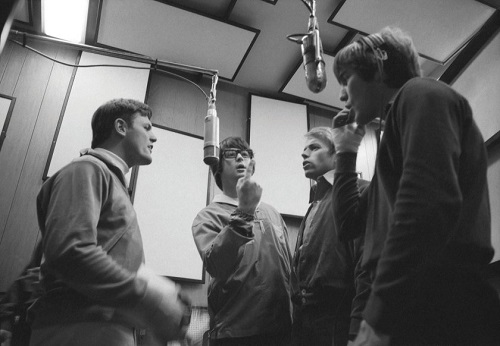
The Beach Boys –
(Help Me Rhonda, Fun Fun Fun, Surfin’ USA)
The Beatles, John Lennon, Paul McCartney –
(TOO many to list!)
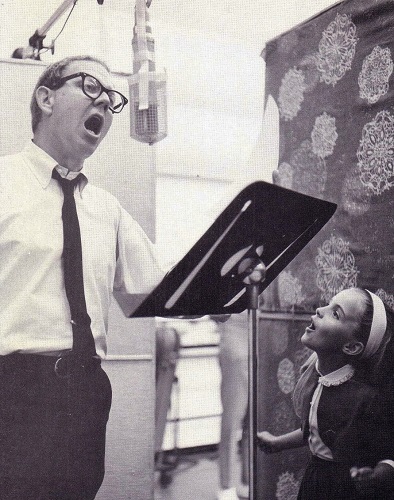
Stan Freberg –
St. George and the Dragonet, Yellow Rose of Texas, Heartbreak Hotel, The Great Pretender)
The Bee Gees, Garth Brooks, The Letterman, Jerry Lewis, Heart, Al Martino, Johnny Mercer, The Steve Miller Band, Katy Perry, Sammy Davis Jr., Tennessee Ernie Ford, Gene Vincent, Bob Seger …. The list goes on and on!
So many amazing singers and talents sang in the Capitol Records studios. Happy Birthday!!







 Various Ramblings of a Nostalgic Italian