Nine notes. Nine notes that are still recognizable today. Broken into two parts – 4 notes, then 5 notes. “Dum da dum dum” (Pause) “Dum da dum dum da.” Those notes were immediately followed by a stern narrator who informed listeners, “Ladies and gentlemen. The story you are about to hear is true. Only the names have been changed to protect the innocent.”
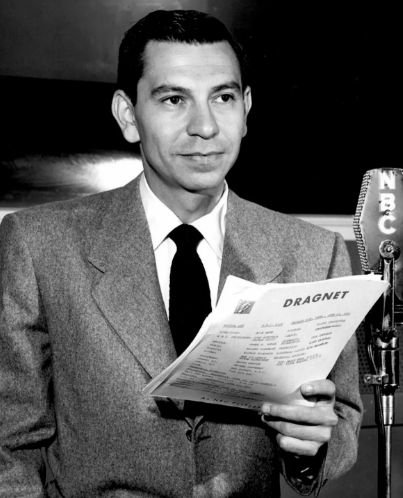
On this day in 1949, Jack Webb debuted on radio as Sergeant Joe Friday in Dragnet. He created and produced the show as well. Wiki states that “Dragnet is perhaps the most famous and influential police procedural crime drama in American media history. Webb’s aims in Dragnet were for unpretentious acting and a realistic depiction of policing. The series portrayed police work as dangerous and heroic, and helped shape public perception of law enforcement in the 20th century, improving the public’s opinion of police officers.”
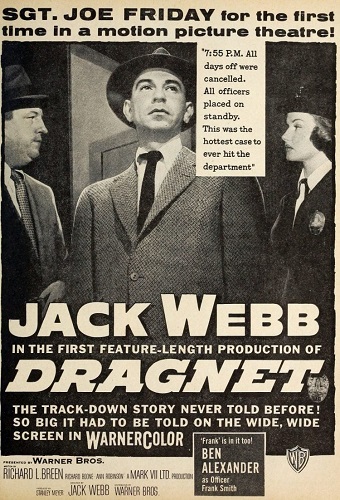
The radio show was so popular that it made the transition to television. It ran on NBC from 1951 to 1959. NBC brought the show back to television from 1967 to 1970. It first appeared as a feature film in 1954. It became the first theatrical film to be based on a TV show.
Check out this trailer!
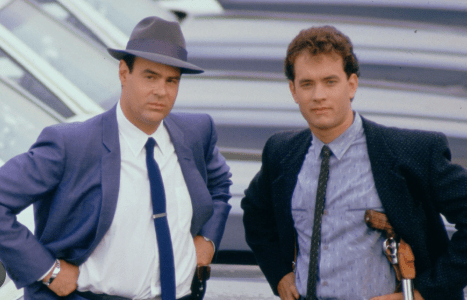
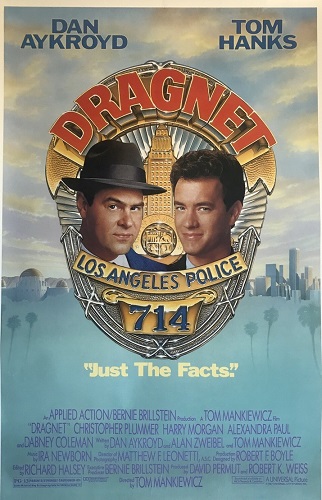
A TV movie was produced in 1966 with the intention of it launching the return of the show to TV. It didn’t air until 1969 for some reason. The final film version made Dragnet a comedy starring Dan Aykroyd and Tom Hanks.
Wiki says “The film contrasted the terse, clipped character of Friday, a hero from an earlier age, with the “real world” of Los Angeles in 1987 to broad comedic effect. Apart from Aykroyd’s spot-on imitation of Webb’s Joe Friday and Harry Morgan reprising his role of Bill Gannon (now Captain), the film version has few similarities with previous incarnations. This Dragnet parody was a hit with audiences.”
Dragnet was no stranger to parodies. It was parodied by Looney Tunes, Woody Woodpecker, Sesame Street, The Three Stooges, Rocky and Bullwinkle, and a series of audio parodies by Stan Freberg. Jack Webb loaned Stan the actual band/orchestra he used on radio for his parodies.
As I mentioned, the theme is instantly recognized today. For the 1987 film, producers got the British band The Art of Noise to perform it. The them is actually two songs merged together. The opening is entitled Danger Ahead, and what follows is the Dragnet March. The Art of Noise version is very …. 80’s.
The first “hit version” was done by Ray Anthony and His Orchestra in 1953. It starts very familiar and gets a bit “jazzy.”
And to start your Monday with a laugh or two, here are a couple of Stan Freberg’s Dragnet parodies. Notice how the music “stabs” were used to enhance the story, just like on the radio.
Welcome back to The Music of My Life, where I feature ten songs from each year of my life. In most cases, the ten songs I choose will be ones I like personally (unless I explain otherwise). The songs will be selected from Billboard’s Year-end Hot 100 Chart, Acclaimed Music, and will all be released in the featured year.
A brand new decade has dawned and I will turn 20 in 1990. It was a time of change for me, as well. I had been working at WKSG for a little over 2 years. I truly believed that I’d have that job for years, but had yet to learn how unstable radio jobs were. When I was fired, I called my old boss (now at another station in Detroit) and cried like a baby. He brought me in part time at WMXD.
As I looked through the music from 1990 and 1991, there were many songs that I played while at WMXD. When I started there, the music was a mix of Adult Contemporary and Urban songs. Eventually, they would go all Urban Contemporary and I was let go again.
One of the songs I played, I wrote about recently, but it still makes my list here. If you want to know more about Elton John’s Club at the End of the Street, you can read the earlier post here:
Next on the list is a song that was released on my 20th birthday, May 15, 1990. “Vision Of Love” was Mariah Carey’s first single. The song debuted at #73 in America, but two months later, in August, spent four weeks at the #1 spot. I remember playing this one on WMXD, as well. It was a song that really showcased her outrageous vocal range! The first time I heard her belt out that high note, I couldn’t believe it!
The original demo of the song was described as a 1950’s shuffle, but that didn’t matter. The song was good enough. Songfacts says, The original version was included on Mariah’s demo tape for Columbia. It was one of the songs that caught the ear of Tommy Mottola, her future husband and, more importantly, the head of the label’s parent company, CBS Records. At the time, Mariah was working as a backup singer for Brenda K. Starr, who invited her to a label party in Manhattan where the demo tape made its way into Mottola’s hands. After listening to the tape in his limo on the way home, he went back to the party to track down the singer. Mariah had already left and no one knew who she was. Days later, she found a message on her answering machine inviting her to sign with the label. Mottola then sent her to Los Angeles to re-record “Vision Of Love.”
Let me be honest right here. After her second album, there were not too many songs by Mariah that I cared for. I don’t know this for sure, but I feel the “business” changed her. There were a couple of songs later that were good. I felt, however, her strongest stuff was on those first two albums.
Vision of Love
The Godfather trilogy will always be my number one, but my second favorite trilogy would be Back to the Future. In 1990, Back to the Future Part III was released in theaters. I couldn’t wait to see how it all wrapped up.
ZZ Top released their Recycler album in 1990. The lead single from the album was a song from Back to the Future Part III called Doubleback. The group made a cameo appearance in the movie playing an acoustic version. That version is on the soundtrack of the movie.
Doubleback
But wait, there’s more! Consider this a Double Shot of ZZ Top. From the same album, My Head’s In Mississippi sounded like classic ZZ Top to me. I just loved the shuffle and the vocals. Billy Gibbons said:
“My buddy Walter Baldwin spoke in the most poetic way. Every sentence was a visual awakening. His dad was the editor of the Houston Post. We grew up in a neighborhood where the last thing you would say is, ‘These teenagers know what blues is.’ But our appreciation dragged us in. Years later, we were sitting in a tavern in Memphis called Sleep Out Louie’s — you could see the Mississippi River. Walter said, ‘We didn’t grow up pickin’ cotton. We weren’t field hands in Mississippi. But my head’s there.’ Our platform, in ZZ Top, was we’d be the Salvador Dalí of the Delta. It was a surrealist take. This song was not a big radio hit. But we still play it live, even if it’s just the opening bit.”
In 2008, Gibbons stated, “‘My Head’s in Mississippi,’ which was one of the first completed tracks on the album, is a great example of how we mixed the new with the old. Initially, it was a straight-ahead boogie-woogie. Then Frank stepped in and threw in those highly gated electronic drum fills, which modernized the track.”
My Head’s in Mississippi
I have never owned a pair of parachute pants. They do look comfortable, however, and it looks like you have a lot of freedom in them.
As much as I didn’t really want to include this one, I did play it a lot while DJing. It always got folks out dancing, then again, so did Super Freak by Rick James. Believe it or not, James did NOT give Hammer permission to use the song.
Songfacts explains: Rick James tried to keep rappers from sampling his music, turning down any requests. According to James, his lawyers authorized the “Super Freak” sample without his permission. He heard about it when a friend told him about “U Can’t Touch This” and the song came on the radio they were listening to in the car. James said he was irate, but somewhat appeased when he found out how much money it was making for him. Still, he claimed he wouldn’t have done the deal if he was asked.
James had another beef as well: he wanted to be listed as a songwriter on “U Can’t Touch This.” He sued MC Hammer for credit. The case was settled out of court, with James getting listed as a co-writer on the track along with Hammer and Alonzo Miller. Miller was a disc jockey who wrote some lyrics on “Super Freak.”
He recorded the song at Capitol Records, where Frank Sinatra, Nat King Cole, and Dean Martin recorded, The label ran an innovative marketing campaign to promote this song. They mailed out free cassette singles of the track to 100,000 kids. The cassettes came with a letter from Hammer asking them to call MTV and request the video. The ploy worked, and the video became the most-played of 1990 on the network.
U Can’t Touch This
I don’t remember when my ex-girlfriend had sent this song to me. It was probably after we broke up the first time. I say that because I believe that this song is what led us to getting back together eventually. I remember being pretty messed up after the break up. I did end up dating someone else.
I don’t recall how my ex and I began chatting again, but it led to her giving me this song. I really loved and cared about my ex. I broke it off with the gal I had been dating to get back together with my ex. It was really unfair to her, but I was 20, almost 21, and didn’t really know any better.
While we enjoyed some very good times the second time around, it didn’t last. She broke up with me again, which led to me always wondering what I did to cause he to leave. Anyway, I tell you all that to play Cuts Both Ways.
Cuts Both Ways
In 1967, Otis Redding wrote and recorded his version of Hard to Handle. He wrote it with Allen Jones and Al Bell and the track was produced by the legendary Steve Cropper. It was released in 1968 (after his death) as the B-side to his song “Amen.”
The song was first covered in 1968 by Patti Drew. The Black Crowes covered the song on their debut album, Shake Your Money Maker. Two versions of the song exist. First, the original album version and the hit single remixed with an overdubbed brass section. The latter is available on the 30th Anniversary edition of Shake Your Money Maker.
Songfacts says: This was The Black Crowes’ third single, following “Twice As Hard” and “Jealous Again.” It made #45 in the US in December 1990, as the group was rapidly gaining momentum. After “She Talks To Angels” hit #30 in May 1991 – over a year after the album was released – “Hard To Handle” was reissued, this time going to #26 and becoming the highest-charting single for the band on the Hot 100.
This has always been a song that I love to crank up. It’s funky and fun!
Hard To Handle
My next song is another one that I played while at WMXD. I was familiar with James Ingram before I worked there and always liked his voice. I Don’t Have The Heart was his only solo number one song. The song won him a Grammy Award for Best Male Pop Vocal Performance in 1991.
The song was written by the duo of Allan Rich and Jud Friedman. It was the first song they wrote together. Speaking about Rich’s lyrics, Friedman told Songwriting Magazine, “Allan says he’s not a poetic lyricist, and he’s not a flowery lyricist. He is very conversational, but in a good way, and that has its own poetry. It’s the poetry of reality and the poetry of life and interactions. And the thing about I Don’t Have The Heart, among many brilliant things about Allan’s idea for the song, is it’s an example of taking a phrase that’s very well known, ‘I don’t have the heart,’ and flipping it. ‘I don’t have the heart to hurt you but I don’t have the heart to love you.’ He used it in two different ways, and that was poetic. We’ve all been there, sometimes wearing one of the shoes and sometimes wearing the other.”
That was the thing that caught me, too. The flip. I love when a lyric does that.
I Don’t Have the Heart
Whitney Houston hadn’t been on the radio since 1988. While she had her fair share of uptempo songs, but I feel like radio played more of her ballads. So the first time I played I’m Your Baby Tonight, I was wowed by it.
According to Songfacts:
By the time Houston released her third album, I’m Your Baby Tonight, she was coming off of a three-year hiatus. Prior to this, she had a record-breaking string of seven consecutive #1 singles on the Billboard Hot 100. The problem was, her record label felt she was losing touch with her black audience. Houston balked at the claim, telling USA Today, “I don’t sing music thinking this is black, or this is white… I sing songs that everybody’s going to like.”
But producers L.A. Reid and Babyface agreed with the assertion. Reid told Billboard: “We wanted to come up with something that was different than anything Whitney had sung. So we approached it from that angle. We wanted to give her a new direction, and pick up where we felt she was lacking. We felt like she needed more of a black base.”
It definitely was a fresh sound for her, but I don’t know hear it as “more black” or “more white.” To me, it is just a great song!
The Julien Temple-directed music video shows Houston in the guise of different pop culture figures. They include silver screen siren Marlene Dietrich, Audrey Hepburn, and all three of The Supremes.
I’m Your Baby Tonight
Allow me just one more song from my WMXD days. Let me set this up for you. When I was at WKSG, these two sweet old ladies always called to request songs. They were sisters named Virginia and Dorothy. They always seemed to call toward the end of my overnight shift.
Virginia suffered with respiratory issues, so it took her a bit to say what she wanted. She would get a couple words out and have to take a breath. She had emphysema and really struggled to breathe.
Dorothy, on the other hand, was always on the go. She was always talking about where she was over the weekend. She was always at a party or something, even though she didn’t drive. She took a bus or Your Ride where she needed to go.
When I told them that I was leaving the station, Dorothy gave me her address to keep in touch. When I moved to Ludington, she and Virginia wrote me often. Eventually, communication was over the phone. When I moved back home, we actually ran into each other at a Weight Watchers. meeting.
I was closer to Dorothy, and she would invite me to stop by for coffee. She always had some sort of baked good ready. She was born the same day as Frank Sinatra. She was such a sweet friend. I am sure that I lost touch with her after I married my ex, and was sad to hear that she (and her sister) had passed away.
She once told me that she didn’t like all of the music we played at WMXD. One song she loved was The First Time by Surface. This song went to number one on the Billboard Hot 100. Whenever I hear it, I think about my friend and am grateful to have known her.
The First Time
Robert Palmer’s Don’t Explain album was very different. It contains 18 tracks and a variety of styles. There is R&B, Rock, Jazz, and more. It also includes some cover songs. I love the track “Top 40” because it swings a bit with a great sax line. It, however, wasn’t released as a single.
The song that is closest to what he had success with in the 80’s is You’re Amazing. I love the guitar line in the song. Billboard said, “Palmer’s reliably strong soul stylings added to headbanger guitar riffs and sweet background harmonies proves to be a quirky, but potent, combination.”
I don’t know that I would call the guitars “headbangers,” but I suppose they are a bit harder than Palmer usually presents. Now, the background harmonies – yeah, I dig those!
You’re Amazing
1990 Bonus Song
I just can’t pass up one song. It is a song that my best friend, Jeff, and I still laugh about. I can’t be sure who heard this first, but I know we laughed about it for years. The idea of taking the voice from a 1970’s instructional dance record and incorporating it into this is brilliant. The Bingo Boys did just that!
It is this vocal part from that record that makes us laugh so much. I cannot even being to picture a couple in their living room trying to learn a dance to that guy! It is so absurd that after a few of his lines, Princessa jumps in to shut him up. “Act like the end of a record and fade out …” is the lyric. I think that’s an awesome line.
The Bingo Boys were a trio from Austria. The song was actually released in the US first. It was released in the UK in 1991. It went to number one on the Hot Dance Club Play chart and reached number 25 on the Hot 100.
The song borrows heavily from a number of earlier recordings, including “Dance, Dance, Dance (Yowsah, Yowsah, Yowsah)” by Chic, “Dance (Disco Heat) by Sylvester, “Kiss” by the Art of Noise and Tom Jones, the popular James Brown “Yeah! Woo!” sample loop, the bassline motif from Mantronix’s single “Got to Have Your Love”, and a synth motif from The Whispers’ “And The Beat Goes On”. See if you can catch them all ….
How To Dance
That’s a wrap on 1990. Next week, we’ll check out 1991. That was the year I turned 21 and moved out for the first time. What kind of surprises will pop up?
Did I miss any big 1990 songs from your list?? Drop them in the comments!
Welcome back to The Music of My Life, where I feature ten songs from each year of my life. In most cases, the ten songs I choose will be ones I like personally (unless I explain otherwise). The songs will be selected from Billboard’s Year-end Hot 100 Chart, Acclaimed Music, and will all be released in the featured year.
1988 was a very big year for me. It was the year I graduated from high school. It was also the year that I landed my first radio job. As graduation day grew closer, I began counting all of the “lasts.” The last marching band performance. The last band concert. The last final exam. To say that I was an emotional wreck would be an understatement.
After graduation, I had a full time radio gig (making a whopping $12 an hour) and so I gave up thinking about doing anything else. I was that clueless to think that I’d have this radio gig until I retired. Can you imagine? Typical 18 year-old!
I mentioned last week that 1988’s list would present some songs that may or may not seem out of place. I suppose that those who know me well will not be surprised by the songs I picked, and there certainly is a variety! Well, I suppose I should get right into the tunes …
I have to remind myself that it is not Movie Music Monday, because my list includes not one, but two songs from the soundtrack to Tom Cruise’s film, Cocktail. My buddy Steve and I cruised a lot our senior year. He was always bringing new music for me to listen to. I am almost positive that he was the one who told me about the Georgia Satellites’ version of the Hippy Hippy Shake.
The version I was familiar with was done by the Swinging Blue Jeans, and was a song we played at my first radio station. I had no idea that the song was written and recorded first by Chan Romero in 1959. Anyway, when I hear the Satellites’ version really rocks and it was a great song to cruise to.
Hippy Hippy Shake
In 1987, the song La Bamba was a hit again. This time it was Los Lobos from the soundtrack to the hit movie starring Lou Diamond Phillips. It made for the perfect parody song for Weird Al Yankovic. His version was called, Lasagna. Now, what Italian wouldn’t like this song?!
It is on my list because when my dad booked my graduation party, he also gathered up a few of his band friends. He had the sax guy, keyboard guy, and bass guy come. It was either my cousin or my uncle who brought their drum kit, and my dad brought his guitar. No rehearsal, all they had was some lyric sheets with chords on them and they jammed through the whole party. It was awesome!
My dad played so many great blues songs. Everyone seemed to take turns singing something. My dad called me, and my friends Steve and Joe up to the stage and handed us the lyrics to Weird Al’s Lasagna. I’m guessing it didn’t take much coaxing for us to sing, and it was probably awful. However, it is a great memory of me and my pals.
Lasagna
If it ain’t broke, don’t fix it, they say. Robert Palmer had great success with his Addicted to Love video. So he brought back the models from the previous music video for this one. Only this time they’ve multiplied! Five of them do choreographed dance moves, but another eight stand behind Palmer looking bored. It worked, though, as Palmer won the 1988 Grammy Award for Best Rock Vocal Performance, Male for this song. It was the same award he won two years earlier for “Addicted To Love.”
Songfacts.com says: The big, sexy hook in this song is the pause after Palmer sings, “Now I find her.” After some drumbeats, he comes back with “…simply irresistible.” The song was in the works for three years before Palmer came up with this part, making the song complete. “A little thing like that makes the difference between an idea and the complete song,” he wrote in his Addictions: Volume 1 liner notes, adding, “I like the manic military rhythm and the strong counter melody.”
This was yet another song that made it to our “cruising cassettes.” It was another great sing along song for us.
Simply Irresistible
My next song is one that I always thought was very creative. I Hate Myself for Loving You is such a great line. I relate to in in a few ways. As a young punk, I kinda fell for gals pretty hard. I let many of them treat me bad and I just kept hanging on with them. I always felt that I would just keep on loving them through it all. Yeah, I was an idiot. Today, that title makes me smile and makes me think of young Keith, who just wanted to make someone happy.
Thanks to Songfacts, I learned that that wasn’t originally the title: Joan Jett’s producer Kenny Laguna told us that Joan came up with the guitar riff for this song and wrote it as “I Hate Myself Because I Can’t Get Laid.” She took it to the writer/producer Desmond Child, who thought the title would never fly and convinced Joan to change it to something with “Love” in the title. Child, who got a co-writing credit on the song.
I Hate Myself For Loving You
The next song is the only country song on my list. I am guessing that I never really heard this when it was released, and became familiar with it a year or so after when I had my first stint at a country station.
I was familiar with the Oak Ridge Boys, of course. I mean, who wasn’t? Elvira was all over the radio when it was out. They guys had great harmonies and when I first heard Gonna Take a Lot of River, that is what stood out to me. This would have been sometime in 1991, when my girlfriend had broken up with me.
That being said, the lyrics now really hit home. I spent a lot of time at the beach and on the pier watching the waves during that time. So the lines “Because my baby’s long gone and nothings going my way. I’m gonna let this muddy water just wash away my blues.” resonated with me.
Today, when I hear it I just love listening to the harmonies and fumble every time I try to say, “Monongahela.”
Gonna Take a Lot of River
The variety of songs continues …
1988 brought us the only acapella song to go to number one in the United States. It is the second song from the Cocktail soundtrack. Don’t Worry, Be Happy by Bobby McFerrin was unlike anything on the radio at the time. Bobby recorded it using only his body to make all the sounds. The simple message and unusual sound made it a surprise hit.
The inspiration for the song came from a poster that Bobby saw featuring the Indian guru Meher Baba. It simply said, “Don’t Worry, Be Happy.” Bobby says that when he saw it he thought it was “a pretty neat philosophy in four words.” If I had a dollar for every time I heard someone say, Don’t Worry, Be Happy in 1988 alone, I’d be financially set for life.
The video was a silly one and a received lots of airplay on MTV. It featured Robin Williams and the lesser-known comedian Bill Irwin (who plays Mr. Noodle on Sesame Street). It is interesting to note that the video is a bit shorter than the single.
I always think of my best friend, Jeff, when I hear this one. He would always say the line, “I’ll give you my phone number, when you worry, call me, I’ll make you happy.” We found that line hilarious for some reason.
Don’t Worry, Be Happy
The next song was something I heard while cruising with my girlfriend. I’m sure we were listening to that Love Song show (Pillow Talk). It grabbed me from the intro. It was a smooth groove that reminded me of some old Atlantic or Stax soul songs. I was surprised to learn it was Glenn Frey.
Glenn’s Soul Searching album was his third solo album. I picked up the album because of the song True Love. My feelings about the song were justified when I read the liner notes. Frey wrote of the song “For those of you who have my previous albums, I apologize. I just can’t shake my obsession with this Al Green-Memphis thing. Like Wilson Pickett says, ‘Don’t fight it’.” Cash Box magazine even called the song: “a classic R&B tune replete with hornbreaks and soul-tinged arrangement and production.”
My favorite part of the song is the fake ending. After a second or two, the drum kicks back in and the sax wails away at a solo. Love this song. I wish the video would have started with the song instead of the cheesy acting by the actors … LOL
True Love
Who would have thought that Tom Jones would have a career boost in 1988?! Tom enjoyed great success in the mid 60’s and the 1970’s. He never really stopped making records and was always on tour. In the early 1980s, Jones started to record country music. From 1980 to 1986, he had nine songs in the US country top 40, yet failed to crack the top 100 in the UK or the Billboard Hot 100.
Prince had recorded Kiss in 1986. The song was a big hit and continues to be played in a regular rotation on Adult Contemporary stations all over the country. I know that many will not agree with me when I say that Prince’s version sounds weak compared to the Tom Jones/Art of Noise version. Tom commands the song and I cannot love it more!
According to Songfacts, after his country songs, he “made a left-field decision to cover this song, and in doing so revived his career. He told the Observer Music Monthly December 2008 how this came about: “If I hear a song I like I’ll do it in the show, so when I heard this I sang it (Kiss) in an R&B style. Then I was due to go on Jonathan Ross’s program in 1987 to perform the ballad ‘A Boy From Nowhere,’ and he wanted something upbeat too. My philosophy has always been: when in doubt, do ‘Great Balls of Fire.’ But Jonathan asked if I had anything new. Art of Noise were watching and they asked if I’d do a version with them. When they sent me the finished version I thought: ‘If this isn’t a hit, I’ll bloody well pack it all in.’ It was a busting hit.”
Tom tells a great story about Prince. When he met Prince and thanked him for the song, but didn’t ask what his thought of his version, as he wasn’t sure he would like the answer. “I saw a movie once that Bette Midler did called The Rose,” Jones said in a Songfacts interview. “She goes to see Harry Dean Stanton, a country singer, because she’d recorded one of his songs. She says she’s a big fan of his, and just before she walks out the door he says, ‘Could I say one thing to you? Don’t you ever record one of my songs again. ‘That hit home. I thought, s–t, I’m never going to ask a songwriter what he or she thinks of my version. I’ll leave that to them. That always sticks in my mind. So I just thanked him for writing it.”
Fun fact: Prince and Tom Jones were both born on the same day, the 7th of June (Prince in 1958, Jones in 1940)
Kiss
I am sure that I have talked about the next song before. I am also sure that I talked about the album before. It was truly a monumental event!
From Songfacts: Handle With Care was the first single from The Traveling Wilburys, a supergroup created by George Harrison and Jeff Lynne. Initially an informal grouping with Roy Orbison and Tom Petty, they got together at Bob Dylan’s Santa Monica, California, studio to quickly record an additional track as a B-side for the single release of Harrison’s song “This Is Love.” “Handle With Care” was the song they came up with, which Harrison and his record company immediately realized was too good to be released as merely a B-side. The five superstars decided to form a band and make an entire album, recording nine more songs at Dave Stewart’s (of Eurythmics) house in Los Angeles in a 10-day window when they were all available.
This was the only video that included Roy Orbison. A short time after the album was released, he passed away of a heart attack. I was working at the radio station the morning that news of his passing came across the news wire. I will never forget that.
Handle With Care
When I was DJing parties and weddings, I would often find out about new dance songs from people who made requests. Many of the songs were line dances like the Cupid Shuffle or Cha Cha Slide. Over the years, I was introduced to The Biker Shuffle, The Turbo Hustle, The Dougie and many others that way. I was always surprised at how they would fill the dance floor.
I remember someone asking for a song called Da Butt and I laughed. It was from a Spike Lee movie, but I had never heard of it. That week, I stopped by a DJ supply store and there on one of the many compilation CD’s they made was Da Butt by a group called EU. I bought it, took it home and gave it a listen.
It certainly had a funkiness to it and I could see how this might be something that people could dance to. It didn’t take long to find out because I had a wedding the following weekend. Once I started the song, the crowd screamed and got on the dance floor. Before I knew it, everyone was shaking their rear end. I would use this song a lot over the years.
I always think of one of my college instructors when I hear this because I DJ’d a birthday party for one of her kids and SHE was the one who asked me to play it.
I would often get out on the dance floor with these poster board signs I had made for my gigs. I had one that said “Oh-We-Oh. Whoa-Oh” and I would hold it up for audience participation during that part of the song. While it is not the most family friendly song, it did give me a chance to have some fun at a lot of DJ gigs.
Da Butt
I couldn’t let this year pass without touching on one of the big controversies of the year. In June of 1988, Gail Brewer-Giorgio released a book called “Is Elvis Alive?” Along with the book, there was a cassette tape with alleged phone conversations that Elvis had with someone long after he was supposed to have died.
This played right into the rumor in the music industry was that Elvis had faked his death. In the years following his death, there were many sightings of him (including my home state of Michigan – at a Kalamazoo Burger King), and in late 1988 record label LS Records released “Spelling on the Stone” to capitalize on the popularity of the phenomenon. According to LS Records owner Lee Stoller, who produced the song, his daughter Tammy received the recording in August 1988 from an anonymous man who arrived at the label’s offices in a limousine. After obtaining distribution rights, LS Records released the song on radio by the end of 1988, with the single’s release not crediting an artist. The song’s title refers to the fact that Presley’s middle name, Aron, is misspelled as “Aaron” on his tombstone, which was a common argument against his death at the time. The song features an uncredited vocalist with a delivery similar to Presley’s; it tells a first-person narrative, purportedly from his perspective, to suggest that he had faked his death.
Some people claim that the impersonator is actually a guy named Dan Willis, who recorded at LS Records. Others think it really is Elvis. I say Balderdash …
Bonus Song: Spelling On the Stone
1988 had so many great songs. There have been times I wonder if I should pick 15 instead of 10. I know that in future years, I will struggle to pick 10, so I won’t. What one of your favorite 1988 hits did I miss? Mention it in the comments.
Next week we move to 1989. The list isn’t as all over the place like this one and includes some great songs. Join me next week and we’ll give them a listen….
Welcome back to The Music of My Life, where I feature ten songs from each year of my life. In most cases, the ten songs I choose will be ones I like personally (unless I explain otherwise). The songs will be selected from Billboard’s Year-end Hot 100 Chart, Acclaimed Music, and will all be released in the featured year.
I turned sweet sixteen in 1986. MTV was 5 years old and music videos were becoming more and more iconic. To make that point, we kick off my list with a video that is often listed as one of the best of the 1980’s.
Robert Palmer released Addicted to Love in January of 1986. It was accompanied by a video where he is singing in front of a “band” of beautiful women who look exactly alike. They wear lots of makeup and identical outfits as they pretend to play the instruments.
According to songfacts: the funny thing about the video is that the models posing as a band were selected precisely because they did NOT know how to play the instruments. As a result, each girl is keeping her own time and moving to a different beat. The video is constantly parodied, including in a Pepsi commercial with Britney Spears.
You might say the song came to Palmer in a dream. It all started with a guitar riff that came to him in a dream one night. He told Q magazine in 1988, “That noisy riff woke me up. I went downstairs, got out the tape recorder, then went back to bed. Next morning, I thought, Phew, caught one there!”
From the “What Might Have Been” file: Palmer wanted this song to be a duet with Chaka Khan, and he almost got his wish. He recorded it with her, but Chaka’s label, Warner Brothers Records, would not allow her voice to be used on the record, so Palmer had to erase her part and re-record her high notes before releasing it.
If you’re going to be addicted to something, love is a good thing, wouldn’t you say?
Addicted to Love
Next, we have a song whose video was like nothing that had been done before. Depending on the source, some say it was the 4th most played video on MTV. The video is so fun to watch, you may actually forget that the song is full of sexual innuendos.
Sledgehammer was a BIG number one song for Peter Gabriel. It was his first solo number one. It actually bumped his old band, Genesis, out of the number one spot.
The song was influenced by the ’60s soul music Gabriel listened to as a teenager, in particular Otis Redding, who Peter saw perform at the Ram Jam club in London in 1967. The horn section was typical of this sound. As a matter of fact, the horn section that he used was the legendary Memphis Horns, who played on several hits from Stax Records.
The wildly innovative video was directed by Stephen R. Johnson and featured stop-motion claymation techniques. It swept the MTV video music awards in 1987, and is considered a major breakthrough. It was a bit hard for Gabriel, though. He once remembered how he spent 16 hours lying beneath a heavy sheet of glass for the video, while each frame was shot, one after the other.
I’ve always felt that this song had at least some influence in the blues. It just sounds like a great blues song to me.
Sledgehammer
Songfacts says that this song has a lot of haters and has appeared on various “worst of” lists over the years. An example: it was listed #1 on VH1’s 40 Most Awesomely Bad Metal Songs. As a Michigan guy, I can tell you that they used this song as the Detroit Pistons theme song for years. Heck, they use this song at all kinds of sporting events.
Europe’s The Final Countdown is like an anthem. The iconic keyboard riff was composed by lead singer Joey Tempest five years before the song was recorded. The band’s keyboard player Mic Michaeli had lent him the instrument.
Despite writing the song, Tempest still cannot believe the success. He said, “It was quite a surprise that the song ‘The Final Countdown’ became such a big hit because it was written for the band, it was written for our concert, it was written to be the opening song in our concert. It was almost six-minutes long, it was never intended to be a short pop hit or anything, it was very much a surprise and its been used for all kinds of events, anything from Formula 1 to boxing. It’s been used a lot.”
I liked this song before Arrested Development aired on Fox, but came to love it even more because of the way they used it on the show. Will Arnett is a magician on the show and they often used the song as background music as he performed his “illusions.” The song only made a very funny scene, even funnier for me.
The Final Countdown
The next pick is not quite a duet, but it brought back a legendary voice and put her back in the spotlight. It almost didn’t happen, but Eddie Money stepped in and made it happen.
My favorite track on Eddie Money’s Can’t Hold Back album is Take Me Home Tonight. The song is based on The Ronettes’ 1963 hit “Be My Baby,” and features their lead singer, Ronnie Spector, on the chorus performing her famous line, “Be my little baby.”
At first, the song was going to be a duet with Martha Davis, lead singer of The Motels. Eddie, however, wanted “the real thing” (Ronnie) on the song, so he called her to ask, telling her, “This is a tribute to you. The song is all about you.” According to Spector, she got on board as soon as she heard the lyric, “Listen honey, just like Ronnie sang… be my little baby.”
“When they said that, I was sold,” she told Entertainment Weekly. Spector says Money was very excited when she showed up to record it. “He was a crazy person – freaking out in the studio, going, ‘I’ve got the real Ronnie Spector singing ‘Be My Baby’ on my record!,'” she said.
This cracks me up because I can see Eddie going crazy. He was a bundle of energy. Every time I interviewed him on the radio, it was hard to get a word in because he would just chat away with that “Eddie Money” energy!
Take Me Home Tonight
It must have been the summer of 1987 when our band took a trip to Cedar Point. I am not a ride person, so I hung out with guys who also didn’t ride them. As we walked the streets of the Point, we saw a “You Be The Star” booth. I suppose you would call it an early form of Karaoke.
There was a book that listed a bunch of songs that they had a music track from. They ushered you into this little recording booth with a microphone and headphones. I don’t remember if you got to rehearse the song first, but I thought that was the case. At the end of the session, they played your song on the speakers for all to hear and you got a cassette of the tune to take home. It cost a pretty penny to do and the music tracks were very cheap sounding.
I had some money and made a tape of Mack the Knife for my grandma (which was awful). I sounded so bad on it. Then, me and my three friends chose Hip To Be Square. I had heard the song before, but didn’t know it well enough to sing the lead. My buddy, Steve knew it and sang it like he had a record deal! Chris and I were satisfied enough to be the “Here, there and everywhere” guys.
The music video was directed by the team of Kevin Godley and Lol Creme, who made some of the most innovative videos of the ’80s. They got a distinctive look by using a medical camera – the kind doctors use to see inside the human body. They had the band perform the song a few times a few feet away from the camera, and did the heavy lifting in post production – the band loved it because it was so easy for them. The resulting video contained angles previously unseen on MTV, including one from the point of view of the drumsticks. It was nominated for Best Experimental Video at the 1987 Video Music Awards.
Hip To Be Square
The next pick is one that didn’t mean much to me in 1986, but two years later it sure did. I remember early in my senior year receiving a ballot in which I was to vote on our class song. Honestly, I don’t remember what songs we were picking from, but I do recall some of them being not very “class song-like.”
Our class chose Time to Remember by Billy Joel. It was the third single from his The Bridge album. The chorus is about looking back on the good times with appreciation and gratitude, making it a perfect song for proms, graduations, and just about any occasion where memories are shared:
This is the time to remember ‘Cause it will not last forever These are the days to hold on to ‘Cause we won’t, although we’ll want to
Our teachers told us that the high school years would fly by. We never really felt that, especially during some boring lecture. Of course, the senior years goes by the quickest. Those lyrics should have been posted somewhere for every one to see, because by the time I heard them, and the meaning sunk in, it was graduation day.
I’m reminded of a quote from Ed Helms’ character Andy on the final episode of NBC’s The Office:
“I wish there was a way to know you’re in the good old days before you’ve actually left them.”
I don’t have to tell you, especially if you are a regular reader, that those days are definitely a time I remember, and remember them fondly!
Time To Remember
The group Cameo was formed in 1974, however, it wasn’t until 12 years later that they had their first Top 40 Hit. Word Up was the title track from their 13th album! The song was written by band members Larry Blackmon and Tomi Jenkins.
“Word Up” is a saying that was popular in New York and other urban areas in the US that acted as an affirmation of what was said, kind of a hipper “you bet.” Blackmon said this about the song:
“It just sounded good, and it was before its time. You can play “Word Up” anyplace anywhere, and someone is going to be grooving and bobbing their head. Our sound was unique, as well. I haven’t heard another one like it, and we probably won’t hear another one like it in the future. It was that significant for us.“
This was one of those songs that everyone at school seemed to be singing as they walked down the hall to class. We all seemed to know the words.
It got a lot of radio airplay and MTV played the video a lot. I’ve seen the video many times before, but I had forgotten about a neat cameo. (LOL – a cameo in a Cameo video!) Watch for Star Trek: The Next Generation’s LeVar Burton as a policeman.
Word Up
I am almost 100% against remaking movies. I feel the same way about television shows. Music on the other hand is a bit different. When an artist covers a song, they bring to it their own interpretation of the song. Think of all the different versions of an old standard like “Georgia on My Mind.” Off the top of my head I can throw out 5-8 versions that I absolutely love.
I remember the first time I heard the Art of Noise doing Peter Gunn. I was in the car and I thought, “What in the world is this?” The more I listened the more intrigued I was. I was impressed with how close the guitar sounded like Duane Eddy. Of course, I was even more surprised to hear that it WAS Eddy!
It didn’t do much on the charts, but the sound was so different and unique that I had to go pick up the tune. The video was a private eye parody with comedian Rik Mayall as the detective. The song was a Grammy winner, as it took home the award for Best Rock Instrumental Performance.
Peter Gunn
I mentioned that Sledgehammer had a bit of a blues sound to it earlier, and so does this one. Take a little blues and mix in some rock and you get some good stuff from The Fabulous Thunderbirds.
The title track from their Tuff Enuff album was a top 10 record for the group in 1986. They are often considered to be a one hit wonder band, but their song Wrap It Up was a minor hit. Kim Wilson wrote it and sings lead on the song.
The song is about a guy who will do pretty much anything for his gal, including wrestling with a lion or a grizzly bear, swimming the sea, put out a fire, and fight Ali. He’d even walk ten miles on his hands and knees, which really isn’t walking I suppose, but walk sounds better than crawl.
There is so much I love about this song, the syncopated guitar lick, the lyrics and the attitude. It made for a perfect sing along driving song.
Tuff Enuff
My last pick is another cover song, and this one I think tops the original and most of the other versions. That is saying a lot, because I am not the biggest Beach Boys fan.
California Dreamin’ was a hit for the Mamas and the Papas. It was written by John and Michelle Phillips. Barry McGuire (who had a hit with Eve of Destruction in 1965) actually recorded it first with the Mamas and Papas singing backup. They, of course, recorded their own version of the song soon after.
The Beach Boys recorded it for their Greatest Hits album, Made in U.S.A. The song was produced by the great Terry Melcher and had Roger McGuinn of the Byrds playing the 12-string guitar on it. Naturally, there was a video which featured McGuinn along with every living member of The Beach Boys and the “California Dreamin'” songwriters, John and Michelle Phillips. This primed the group for a big comeback two years later with their #1 hit “Kokomo.”
There are so many things about this song that I just love. That opening 12-string is fantastic. With the opening line, you get it and an echo of it which I thought sounded cool. Even cooler, after the line “and the sky is grey” there is that rumble of thunder that makes you feel the chill of the wind and the anticipation of a storm. Then there is that fantastic harmony! It is perfect for this song. Finally, their version opts for a jamming sax solo and loses the wimpy flute solo used in the Mamas and Papas version. That sax aids in conveying a “haunted sounding ending” as the song begins to fade away.
The song never hit the Top 40 on the Hot 100 chart, but on the Adult Contemporary charts it went to number 8.
California Dreamin‘
Next week, we’ll take a look at 1987. I’ll feature two fantastic duets, we’ll shake, rock, and roll, and hear about 6 beautiful ladies … er, 5.
What was your favorite from 1986? Tell Me about it in the comments. See you next time….


 Various Ramblings of a Nostalgic Italian