

I have always been fascinated by the Titanic. I wrote many research reports on the ship while in school. With as many books that I have read on Titanic and other ships, I had never read about the Lusitania.
Dead Wake – The Last Crossing of the Lusitania came up on a book suggestion list. It was recommended because I had recently read The Demon of Unrest by the same author, Erik Larson.
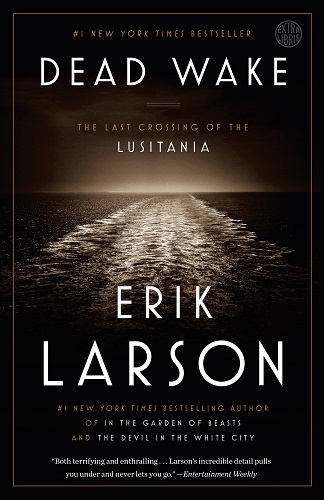
Prior to reading this, I really knew about Lusitania was that it was sunk by a torpedo. This book revealed so much more about the story. It was truly fascinating to read the stories of passengers. By getting to know them, the impact of the outcome became much more devastating.
Here is Goodreads Synopsis:
On May 1, 1915, a luxury ocean liner as richly appointed as an English country house sailed out of New York, bound for Liverpool, carrying a record number of children and infants. The passengers were anxious. Germany had declared the seas around Britain to be a war zone, and for months, its U-boats had brought terror to the North Atlantic. But the Lusitania was one of the era’s great transatlantic “Greyhounds” and her captain, William Thomas Turner, placed tremendous faith in the gentlemanly strictures of warfare that for a century had kept civilian ships safe from attack. He knew, moreover, that his ship – the fastest then in service – could outrun any threat.
Germany, however, was determined to change the rules of the game, and Walther Schwieger, the captain of Unterseeboot-20, was happy to oblige. Meanwhile, an ultra-secret British intelligence unit tracked Schwieger’s U-boat, but told no one. As U-20 and the Lusitania made their way toward Liverpool, an array of forces both grand and achingly small – hubris, a chance fog, a closely guarded secret, and more–all converged to produce one of the great disasters of history.
It is a story that many of us think we know but don’t, and Erik Larson tells it thrillingly, switching between hunter and hunted while painting a larger portrait of America at the height of the Progressive Era. Full of glamour, mystery, and real-life suspense, Dead Wake brings to life a cast of evocative characters, from famed Boston bookseller Charles Lauriat to pioneering female architect Theodate Pope Riddle to President Wilson, a man lost to grief, dreading the widening war but also captivated by the prospect of new love. Gripping and important, Dead Wake captures the sheer drama and emotional power of a disaster that helped place America on the road to war.
If you are into history or non-fiction, I cannot recommend this more highly. Larson masterfully tells the story of the time leading up to the disaster and the results that followed. I was totally engrossed in his account of the disaster itself. From the moment that the torpedo is spotted until the moment Lusitania sinks is presented in great detail.
He presents the stories of many passengers and what they did from the torpedo’s impact until the sinking. After you read all of those accounts and all the things that they did, you almost have to remind yourself that it all happened in the time it took Lusitania to sink – just 18 minutes!
Larson doesn’t sugarcoat anything. It is a tragedy and he is honest about the horrors that were brought about by the event. Despite it being a beautiful sunny day, the water was only 55 degrees. It was not as cold as the waters that Titanic sunk in, but it was still cold enough to cause people to pass of hypothermia. Not every ending was a happy one.
After reading this book, I had a clearer understanding of the events surrounding Lusitania and a better understanding of the way that the US entered World War I. It was truly one of the best books I’ve read this year.
5 out of 5 stars.

 Various Ramblings of a Nostalgic Italian