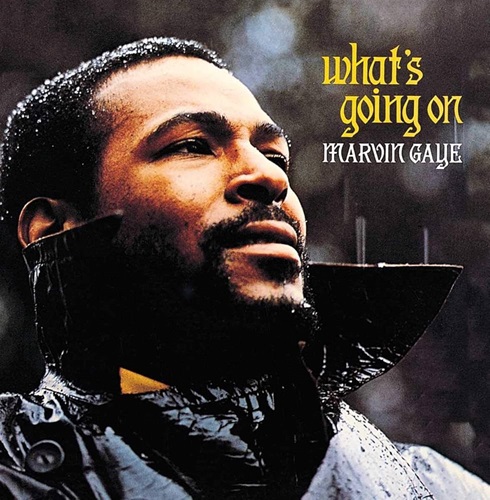
It was on this day in 1971 that Tamla Records (a division of Motown) released Marvin Gaye’s What’s Going On. According to many stories, it almost wasn’t released.
From songfacts.com:
According to the book Mercy, Mercy Me: The Art, Loves & Demons of Marvin Gaye, Motown head Berry Gordy initially refused to release this song, calling it the “worst record I ever heard in my life.” The song was slipped out by the man in charge while Gordy was on vacation and, of course, he was furious… until he found out the single sold 100,000 copies in the US upon its release. Needless to say, he soon changed his mind about this song.
Although Berry Gordy admits he had reservations about “What’s Going On,” he claims all of the stories surrounding his refusal to release the song are false. He explained to the Wall Street Journal: “For years, people have written that I stood in the way of this song’s release and that Marvin had threatened never to record for me again if I didn’t put it out,” he said. “That must make for great reading, but none of it is true.”
He went on to explain the potential ramifications of the song: “My reason for pushing back on Marvin wasn’t to stop the single, just to determine whether or not this was another one of his wild ideas,” Gordy said. “Motown was about music for all people – white and black, blue and green, cops and the robbers. I was reluctant to have our music alienate anyone. This was a big risk for his image.”
The song was written by songwriter Al Cleveland, Four Tops member Renaldo “Obie” Benson and Marvin Gaye. It was Marvin who added lyrics and worked on the arrangement. Marvin did not want to record the song, he wanted the Originals to record it. However, Benson and Cleveland persuaded Gaye to do it himself.
Songfacts.com says,
Until this song, Gaye rarely participated in the songwriting process. For this album, he took control of the production so he could make a statement as an artist. Motown management was skeptical, but Gaye was an established star and had enough power to pull it off, going so far as to use an orchestra on this track.
The song is one of Motown legend. James Jamerson, the bass player for the Funk Brothers, was apparently drunk when he arrived at the studio. Jamerson could not sit properly in his seat and, according to one of the members of the group, lay on the floor playing his bass riffs.
Fun Fact: At the beginning of the song, there are people chatting. Marvin wanted to give the song a laid back feel, so he, the Funk Brothers and Mel Farr and Lem Barney of the Detroit Lions are the ones having conversation as the song begins.
The song was one of the first Motown songs to make a political statement. Jackson Browne said in a 2008 interview with Rolling Stone: “No one was expecting an anti-war song from him. But it was a moment in time when people were willing to hear it from anybody, if it was heartfelt. And who better than the person who has talked to you about love and desire?”
It was nominated for two Grammy Awards in 1972, but did not win either category. It peaked at #2 on the Billboard Hot 100 chart and was ranked the fourth greatest song of all time by a 2004 Rolling Stone poll. It was also ranked the 2nd on the Detroit’s 100 Greatest Songs List by the Detroit Free Press.
Normally, I would steer clear of this song, but because it is his birthday, I will feature it today.
Happy 83rd Birthday to Bob Lind!
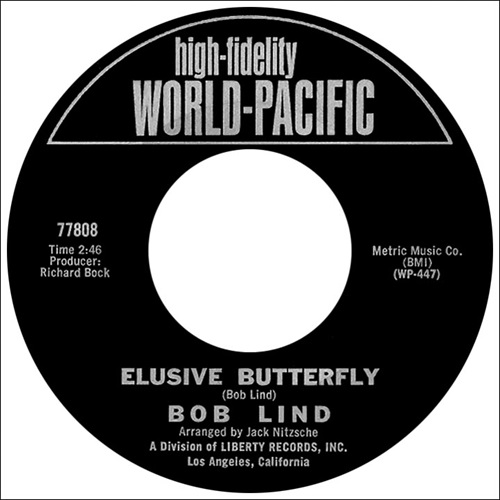
In 1965, Bob Lind signed a contract with World Pacific Records, which was a division of Liberty Records. It was there that he recorded his composition (and only hit) Elusive Butterfly.
From songfacts.com:
Bob Lind wrote this song, where he sees himself as a butterfly hunter. He is looking for romance, but he finds it as elusive as butterflies are to capture. It turned out to be the only hit for Lind, who did a lot of traveling as a kid and ended up playing folk music around Denver when he flunked out of Western State College. He wrote “Elusive Butterfly” as the sun was coming up after staying up all night. He says the song is about “The magic of the quest, the thrill of searching, even when that which is sought is hard to see.”
One of music’s greatest bass players, Carol Kaye, played on the song. She told songfacts.com:
“It was at Sunset Sound. It was kind of a boring tune. I think it was D-flat or something, and it stays a long time in that chord and then it moves in a funny way to the next chord, it’s like a sidebar phrase or something like that. I missed it and I went to go up to the G-flat or whatever and I missed it and I came right back down. I did a slide up and down. And they stopped and I thought, ‘Uh oh, he caught me.’ He said, ‘Do more of those!’ (laughing) So the slide was born, then. I’d stick that slide in here and there on the records I cut.”
I chuckled when I read her quote calling the song “boring.” When I was at WKSG in Detroit, this song would come up on the play list from time to time. Johnny Molson, who did the evening show before I came on the air, had the best description of the song. He told me that the song “sounds like someone ate a Hallmark card … and threw up.”
Happy Birthday to Johnny, by the way. Who knew he and Bob shared a birthday?
Plagued by drug and alcohol problems, Lind gained a reputation in the business for being “hard to work with.” He eventually left the music business for some time, but his music was recorded by over 200 artists. Those artists include: Cher, Glen Campbell, Dolly Parton, Eric Clapton, The Turtles, Johnny Mathis, Nancy Sinatra, The Four Tops, and Petula Clark!
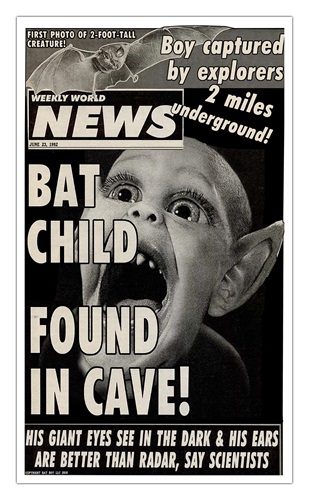
In 1988, he moved to Florida. He wrote five novels, an award-winning play, and a screenplay, Refuge, which won the Florida Screenwriters’ Competition in 1991. He also worked briefly for the Weekly World News and is credited with co-writing their famous “Bat Boy” story.
I’d say that he should stick to singing, but I’m not really keen on that either… So, Happy Birthday, Bob.
Welcome back to The Music of My Life, where I feature ten songs from each year of my life. In most cases, the ten songs I choose will be ones I like personally (unless I explain otherwise). The songs will be selected from Billboard’s Year-end Hot 100 Chart, Acclaimed Music, and will all be released in the featured year. I turned three in 1973, so let’s see what music had some influence on me ….
In January of 1973, The Four Tops released their second song on the ABC label. They had left Motown the year before and this song became their biggest post-Motown hit. Ain’t No Woman (Like The One I’ve Got) was originally recorded by Hamilton, Joe Frank, and Reynolds in 1972. It’s hard for me to hear anyone else but Levi Stubbs on the vocal. It reached #4 on the Billboard Hot 100.
Ain’t No Woman (Like The One I’ve Got)
In March of 1973, Elvis released one of my favorite live cuts – Steamroller Blues. I did a piece on the song for Tune Tuesday a few months back. You can read that here:
Elvis added the song to his concert set list and this recording was from his Aloha From Hawaii show. It reached #17 on the charts.
Steamroller Blues
In April of 1973, Gerry Rafferty and Joe Egan’s song about a music industry party was released by their band The Stealer’s Wheel. “Well, I don’t know why I came here tonight” is the opening line of Stuck in the Middle and it makes you want to hear the rest of the story.
It was a top ten hit for the group, reaching #6 on the charts. The band was surprised at the success of the song, especially since Gerry’s vocal was meant to sound like a funny Bob Dylan. Many people thought it actually was Bob Dylan singing!
Stuck in the Middle
Also released in April of 1973, the last Top 40 hit for a singing barber. This song actually seems out of place on my list, but I have a reason it’s here.
Don McLean wrote And I Love You So for his debut album in 1970. It was the B-side of his single Castles in the Air. Crooner Perry Como used it as the title song for his 1973 album. It would peak at #29 on the charts.
I include it here because when my old morning show partner and I would go out and sing karaoke, he used to sing this one. I had never heard it before then and I loved the lyrics and melody.
And I Love You So
Another great opening line for a song was from Paul Simon. “When I think back on all the crap I learned in high school….” Kodachrome was released in May of 1973. The song was originally written as “Going Home,” but he didn’t think it worked. Kodachrome sounded similar and he went with that.
It has been said that the song is a sort of admiration for all the things that brighten the world. After his lamenting about high school, his world becomes alive with memories.
Kodachrome
Also released in May of 1973, a song that is based on real events and has one of the greatest opening riffs of all time. Smoke on the Water is the story of how Deep Purple was getting to record in a mobile studio they rented from the Rolling Stones. The night before they were set to record, someone fired a flare gun during Frank Zappa’s song King Kong and set the casino venue on fire that destroyed it. Deep Purple watched the fire from their hotel room and the smoke from the fire across the water led to the song’s title.
The opening riff which was written by guitarist Richie Blackmore, was inspired by “an interpretation of inversion” of Beethoven’s Fifth Symphony. That intro remains something I love hearing, especially in headphones. The guitar riff by itself, then the hi-hat cymbal, snare drum kicks, bass guitar and finally the vocal. SO cool.
Smoke on the Water
The next song has an interesting story. It has it’s origins in a song that I almost picked for my list. From Songfacts.com: In February 1973, Stevenson released the song “Shambala” which was written by the composer Daniel Moore. Two weeks later, Three Dog Night released their version of the song, which became the much bigger hit, charting at US #3 while Stevenson’s version stalled at #66. Stevenson and Moore then got together and re-wrote “Shambala” as “My Maria,” changing the lyrics so the song became an ode to a beautiful woman. The ploy worked, and Stevenson had by far his biggest hit. (It went to #9 on the Billboard Hot 100.)
Brooks and Dunn enjoyed a number one country song with their cover of the song in 1996.
My Maria
Another song that was inspired by real events was from Jim Croce. In 1970, Jim Croce wrote Time in a Bottle the night that he found out his wife, Ingrid, was pregnant. Songfacts.com says: The couple had been married for five years, and Ingrid found out she was pregnant when she went to a fertility specialist. She recalls a mix of terror and delight in Jim’s reaction when she told him the news. The child was a boy named Adrian, who grew up to become the singer-songwriter A.J. Croce.
The song was released in November of 1973, and it hit #1 in America 14 weeks after Croce was killed in a plane crash in September.
For the record, I have never been to a whorehouse. The next song is a classic rock standard about the aforementioned establishment. The boys of ZZ Top based La Grange on John Lee Hooker’s Boogie Chillin’, and there is even a vocal tribute to Hooker as Billy Gibbons sings “Ho Ho Ho Ho!”
Again from Songfacts.com: The place in this song is the subject of the 1982 movie The Best Little Whorehouse In Texas, starring Dolly Parton and Burt Reynolds, which was adapted from a 1978 Broadway play.In a 1985 interview with Spin magazine, ZZ Top bass player Dusty Hill explained: “Did you ever see the movie, The Best Little Whorehouse in Texas? That’s what it’s about. I went there when I was 13. A lot of boys in Texas, when it’s time to be a guy, went there and had it done. Fathers took their sons there.
La Grange
We wrap 1973 with another great classic rock song. “I was cutting a rug down at a place called the Jug with a girl named Linda Lou…” the story begins and right from the get go trouble is brewing! Lynyrd Skynyrd released Gimme Three Steps in November of 1973.
From Songfacts.com: This song is based on a true story. As Skynyrd guitarist Gary Rossington tells it, lead singer Ronnie Van Zant, who was about 18 at the time, used a fake ID to get in a bar while his younger bandmates Rossington and Allen Collins waited for him in a truck. Van Zant danced with a girl named Linda, whose boyfriend, who was not too happy about it, came up to Ronnie and reached for something in his boot. Figuring he was going for a gun, Van Zant told him: “If you’re going to shoot me it’s going to be in the ass or the elbows… just gimme a few steps and I’ll be gone.” He ran to the truck, and he, Rossington, and Collins wrote this song that night.
This was one of the few songs Skynyrd released as a single. It was their first major-label release, and it didn’t chart, which simply amazes me. It is a song that has truly become a party classic. I think I got more requests for this one than Sweet Home Alabama at weddings. Maybe it wasn’t a hit, but I have certainly heard this a lot throughout my life, and I always sing along!
Gimme Three Steps
That wraps up 1973 for me. Did you have any favorites from that year? Next week, we move on to 1974. See you there!
It is time once again for another edition of Turntable Talk. This is a feature created by my friend Dave Ruch from the A Sound Day Blog. This is my 18th submission for this feature and it is something I look forward to writing each month.
This time around, Dave took us to the Land of Oz for inspiration. His instructions:
“Pay No Attention to That Man (Or Woman) Behind The Curtain” . Yep the famous phrase about the Wizard of Oz.
We’ve looked at a number of great artists – singers, groups, musicians – and their records. This time we’re switching it up just a little and are going to salute someone “behind the scenes” that was significant to music. All too often people do pay no attention to the people behind the curtain in music that are so important to the albums and groups we love. There are record producers, the record company bosses and talent scouts, the people on radio who used to make the hits happen, even unsung heroes like concert roadies. Pick one you feel is important and maybe a little un-noticed and tell us why!
As a former radio guy, I immediately thought I should write about a well known DJ. There are many of them who played a big part in the music industry. Dick Clark, Casey Kasem, Wolfman Jack and Alan Freed come to mind. However, I decided that I would feature a man who played on some of the biggest hits on the radio, yet until recently was relatively unknown.
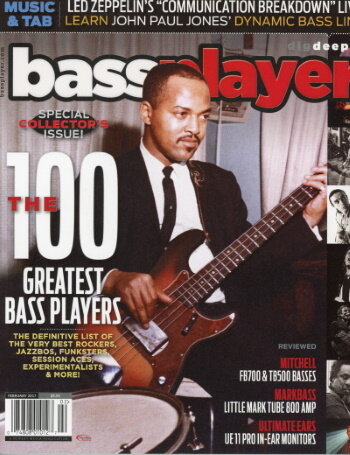
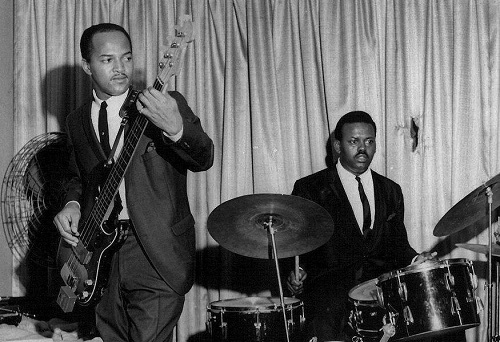
40 years ago, James Jamerson passed away at the young age of 47. At the time he passed away, no one really knew who he was, despite being one of the best (if not THE best) bass player of all time! As a matter of fact, he often tops the list of Best Bass Players of all time by numerous publications. It has been said that he single-handedly revolutionized bass playing. I agree. His creative contributions to music certainly makes him a good pick for a “man behind the curtain.”
James Jamerson was born on January 29, 1936 in Charleston, SC. When his parents divorced, his mother moved to Detroit to find work. He would spend time with his aunt, grandmother and cousin. His aunt sung at church while his grandmother and cousin played piano. He spent time listening to gospel, Jazz, and blues music and that influenced his own musical abilities.
In 1954, his mother sent for him and he attended Northwestern High School. In the music room of the high school, he saw a stand up bass lying on the floor. He picked it up and began to play with it. He had “found” his instrument. He began to play at many of the Detroit area blues and jazz clubs.
He began to get noticed and he began playing for dances, weddings, frat parties, and other events. He was quite a local celebrity. It was hard to miss him driving through town with his bass sticking out the window of his car! Because he was still a minor, the good folks at the Detroit Police Dept. gave him a permit so that he could play in clubs that served alcohol. This allowed him to get more work.
Believe it or not, Wayne State University offered him a full ride music scholarship which he turned down! He was playing so often, he figured he was already in the music field, so why would he need to go to college? Instead, after he graduated high school, he joined up with Washboard Willie and the Super Suds of Rhythm (How’s that for a group name?!). It was during this time that he began to drink alcohol (which would eventually lead to his death).
In 1958, someone from the Northern Records label heard him play and asked him to sit in on the session recordings for the label. The unique way he played caught the ear of other labels. He began to work for Fortune, Tri-Phi, Anna Records, and eventually Motown.
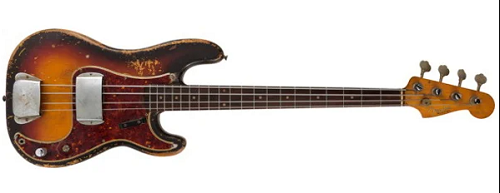
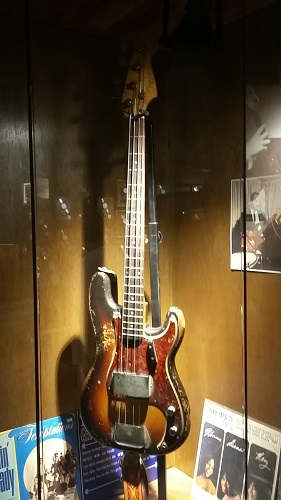
He and the Funk Brothers (pianist Earl Van Dyke, drummer Benny Benjamin, and guitarists Robert White and Joe Messina) spent the days recording in the “Snake Pit” (the Basement of Motown Records) and playing at Jazz clubs in the evenings. Jamerson had switched from an upright bass to a brand new creation – the electric Fender Precision Bass.
The switch really made his work stand out. On some songs, he’d play the stand up bass and then double it with the electric. What made his work on the electric so awesome is that he played the electric just like he played the stand up bass – with one finger (which many folks called “the claw”).
While he is known for playing on many of the Motown songs, he also played on Boom Boom by John Lee Hooker, Whispers Getting Louder and Higher and Higher by Jackie Wilson, Agent Double-O-Soul by Edwin Starr, Cool Jerk by the Capitols, Show and Tell by Al Wilson, Boogie Fever by the Sylvers, and so many other hits! What made the Motown stuff so good was he had some free reign to be “James Jamerson.”
Musician magazine interviewed him in 1983 and he stated that the Motown songwriting and productions teams “would give me the chord sheet, but they couldn’t write for me. When they did, it didn’t sound right. When they gave me that chord sheet, I’d look at it, but then start doing what I thought would fit. I’d hear the melody line from the lyrics and build the bass line around that.”
One of the coolest examples of how he listened and did his thing was on two separate recordings of the same song. To help illustrate this, I found some isolated bass lines on YouTube that are fascinating! Jamerson played on Marvin Gaye’s I Heard It Through the Grapevine – a Motown classic! Check out the soulful line here:
Now check out the same song – and a funkier bass line – on the Gladys Knight Version:
I find it amazing that the same man can take the same song and make them so different.
Speaking of Marvin Gaye, the Funk Brothers shared a story about how Marvin wanted Jamerson to play on What’s Going On. James was out drinking and Marvin went out looking for him. When he found him, he brought him back to the studio. Jamerson was so drunk that he couldn’t even stand up! It was no problem for him, though, he just laid on his back on the floor and played on the track!
Trivia Bit: What’s Going On is the first track that Jamerson is credited on a recording.
It is said that James Jamerson played on almost every Motown song between 1963 and 1968. That would include over 60 songs that hit #15 or better on the charts. He also performed on 23 # 1 songs on the pop charts and 56 #1 songs on the R&B charts! Berry Gordy called him an “incredible improvisor” and said “I, like the other producers, would not do a session unless at least two of the Funk Brothers were present, namely Benny Benjamin and James Jamerson.”
Some of the other Motown songs that feature Jamerson:
Ain’t No Mountain High Enough – Diana Ross and the Supremes
Ain’t That Peculiar – Marvin Gaye
Ain’t to Proud to Beg – The Temptations
Baby, I Need Your Loving – The Four Tops
Baby Love – The Supremes
Bernadette _ The Four Tops
Can I Get a Witness – Marvin Gaye
Dancing in the Streets – Martha and the Vandellas
Don’t Mess With Bill – The Marvelettes
Going to a Go Go – Smokey Robinson and the Miracles
Home Cooking – Jr. Walker and the All Stars
It Takes Two – Marvin Gaye and Tammy Terrell
My Cherie Amour – Stevie Wonder
My Girl – The Temptations
Pride and Joy – Marvin Gaye
Reach Out, I’ll Be There – The Four Tops
Shotgun – Jr. Walker and the All Stars
This Old Heart of Mine – The Isley Brothers
Two Lovers – Mary Wells
What Becomes of the Broken Hearted – Jimmy Ruffin
You can also hear him on :
The Theme from S.W.A.T. – Rhythm Heritage
The Theme from Starsky and Hutch
Just Like Romeo and Juliet – The Reflections
Rock the Boat – Hues Corporation
The list of people who were influenced by Jamerson’s playing is almost as long as the list of songs he played on! Saxophone and bass player Wilton Felder called him “The Godfather of the electric bass.”
Suzi Quatro says, “I grew up in Detroit, so I was weaned on James Jamerson and Motown music. It’s in my DNA. He is still the best and I took my style from him. It’s hard to improve on what he did, because you are talking perfection.”
Sir Paul McCartney says, “Jamerson was where I picked up a lot of my bass style. Because bass players normally have to follow: we follow chords, follow the drummer, follow the vocalist, we have a following role. Suddenly the bass had power! We could dictate the direction of the music and add excitement. James Jamerson became just my hero, really.”
James Jamerson Jr. says, “As for his sense of syncopation, that was his God-given gift. I couldn’t even explain that one. I put it like this: My dad liked to dance, so he just danced on the bass. He would occasionally polish his bass, but he’d never touch the gunk that built up on that fingerboard. he told me the ‘dirt keeps the funk’.”
Years of drinking finally caught up with Jamerson. On August 2, 1983, he died of complications from cirrhosis of the liver, heart failure and pneumonia.
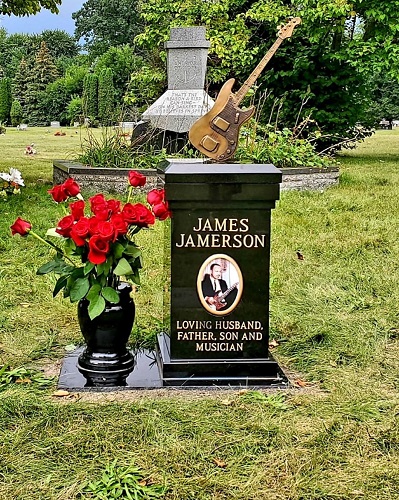
He was buried in Detroit’s Woodlawn Cemetery. A few years ago, Jamerson’s cousin saw a picture of his grave site. There was no headstone, only a grass marker. Eventually, the funds were raised and a proper headstone was set in place on August 27, 2021.
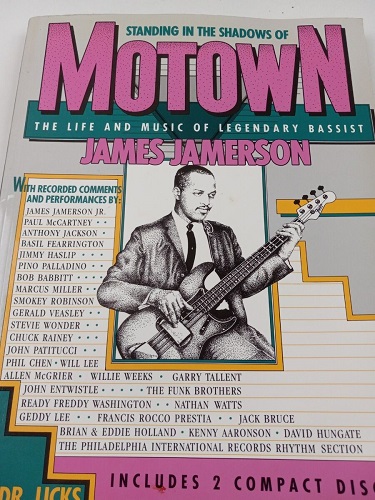
In 1989, Jamerson was the subject of a book loaded with great stuff – Standing in the Shadows of Motown. I think you can still get this on Amazon. A documentary of the same name was produced in 2002
He was posthumously inducted into the Rock and Roll Hall of Fame in 2000, received a Grammy Lifetime Achievement Award in 2004, and inducted into the Musicians Hall of Fame in 2007. Last month, in South Carolina, he was honored when a street was named for him.
It is a shame that it took so long for Jamerson and the Funk Brothers to get the recognition that they deserve.
As I prepared for this piece I found myself on YouTube listening to track after track of Motown stuff and listening with different ears. I focused on that bass line and really was blown away. These are songs I have heard countless times, yet focusing on that bass made them so fresh! As I said, the isolated tracks are an entirely different thing – it is so awesome to hear Jamerson “feel” and “drive” the tunes. It is no wonder that he is ranked the #1 bass player in the business by so many different sources, including Rolling Stone magazine.
Thanks again to Dave for allowing me to be a part of such a cool feature. I have already been impressed by the other blogger’s submissions. I am sure that they love taking part in this feature as much as I do.
Once again, Dave from A Sound Day has asked some of us music lovers to participate in another round of Turntable Talk. This time around was a bit of a challenge for me. Dave’s e-mail stated:
“Put your thinking caps on and go through your stacks of records (or scroll thru that I-pod) and … come up with what you think the best year for music was. A tough call of course, thankfully there have been more than a few good ones! I’m interested in what you pick and don’t worry if yours duplicates someone else’s , you still have your reasons which might be different.” He goes on to say, “I think I have a guess on a couple of years that might come up more than once, but we’ll wait and see.”
This particular blog will be one of the last ones to be featured and I do not know if my year will be or has been featured. I plan on writing this KNOWING that the year I have chosen very well may be one that comes up in another post. Before I tell you the year I picked, let me tell you that I had a very difficult time narrowing it down.
My first thought was to go with 1956/1957 because those years were always so unique. You had the birth of rock and roll mixing with pop standards. When I worked at Honey Radio, I loved doing the Top 12 at 12 show when those years popped up because there was such a big variety in what was played. You could go from Elvis or Jerry Lee Lewis to Pat Boone or Nelson Riddle. When I looked at the list of songs, however, were they really the BEST? No.
The same thing can be said for some of the years in the 70’s decades. I looked through many lists and while there were many great songs, there were also a lot of really crappy songs! I just couldn’t really come up with the conviction to pick a year in that decade as the BEST.
One year kept coming up every time I started thinking about it – 1964.
I want you to know before I continue that I was dead set AGAINST 1964 when I read Dave’s e-mail. Why? Well, I felt that it would just be too Beatle heavy and loaded with British Invasion stuff. And it is. On the Top 100 Chart, The Fab Four nabbed 9 spots. 18 spots were held by other British Invasion acts. In total 27% of the Top 100 were British acts. When I really looked at the chart, the more and more I felt like this WAS the year.
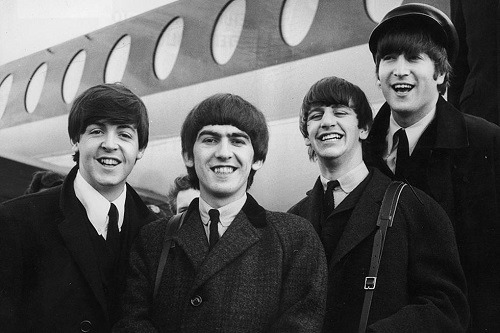
1964 really was the year of the Beatles, so let’s discuss them first. They were present almost right from the start as their “Introducing The Beatles” album was released in America on January 10th of that year.
This album preceded Capitol Records “Meet the Beatles” by 10 days and there was a lawsuit surrounding that whole issue. Capitol Records won an injunction and Vee-jay Records was not allowed to put out any more Beatles recordings.
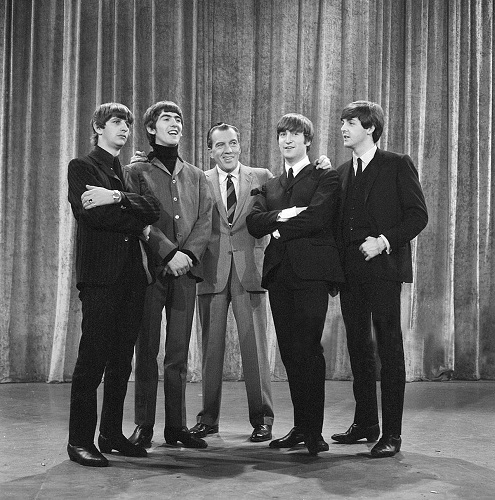
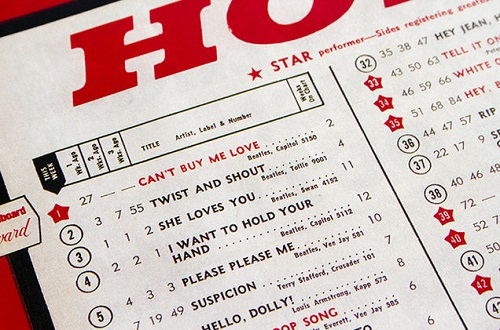
In February of 1964, the Beatles arrived in the US and appeared on Ed Sullivan’s show three times (2/9, 2/16, and 2/23). In March of 64, Billboard magazine stated that the Beatles were responsible for 60% of all single record sales! In a feat that has yet to be matched, on April 4, 1964, the Beatles held the Top 5 spots on the Billboard chart!
A week later, the boys held 14 spots on the Hot 100 Chart! That broke the previous record of 9 spots held by Elvis Presley in 1956.
In May, The Beatles Second Album was released and in July, they would release A Hard Day’s Night in theaters. “I Want to Hold Your Hand” wound up being the #1 song for the whole year of 64 (“She Loves You” was #2) To say that they played a small part in the music of 1964 would be a huge understatement.
Among the other artists that came over from “across the pond” in 64 were Manfred Mann (Do Wah Diddy Diddy), Billy J. Kramer and the Dakotas (Little Children and Bad to Me), The Dave Clark Five (Glad All Over, Because, Do You Love Me), Peter and Gordon (A World Without Love), The Animals (House of the Rising Son), The Honeycombs (Have I The Right), Dusty Springfield (Wishin’ and Hopin’), Gerry & The Pacemakers (Don’t Let the Sun Catch You Crying and How Do You Do It), Chad and Jeremy (A Summer Song), The Kinks (You Really Got Me), and the Searchers (Don’t Throw Your Love Away and Needles and Pins). It is interesting to note that the Rolling Stones debut album was released this year, but no songs appear in the Top 100 for the year.
Once you move away from the British artists, the chart has a nice variety of pop, rock, folk, country, soul, and even a few novelty songs. I think that is what made me ultimately choose this particular year.
It was nice to look over the Top 100 and see Motown represented with some classics. The Supremes hold two of the six Motown songs (Where Did Our Love Go and Baby Love), Motown was female heavy as Mary Wells (My Guy) and Martha and the Vandellas (Dancin’ In The Street) grabbed the next two spots, and the male gender was represented by The Four Tops (Baby I Need Your Loving) and The Temptations (The Way You Do The Things You Do).
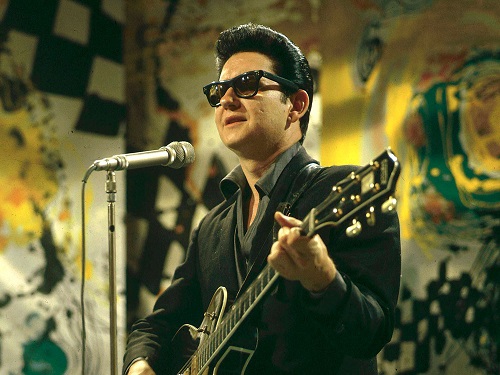
While they were not “oldies” at the time, there were some classic songs that are still in hot rotation today on the oldies stations across the country. Roy Orbison had a smash with Pretty Woman in 64, and also had a hit with It’s Over. Frankie Valli and the Four Seasons grabbed three of the Top 100 with Rag Doll, Dawn and Ronnie. The Beach Boys only entry in the Top 100 was I Get Around.
1964 brought us classics like The Drifters Under The Boardwalk, Chapel of Love by the Dixie Cups, Suspicion by Terry Stafford, It Hurts to Be In Love from gene Pitney and Come A Little Bit Closer by Jay and the Americans. Johnny Rivers had a hit with Chuck Berry’s Memphis, Bobby Freeman invited us to C’mon and Swim, Detroit’s Reflections offered up Just Like Romeo and Juliet and the Shangri-Las told us the story of the Leader of the Pack.
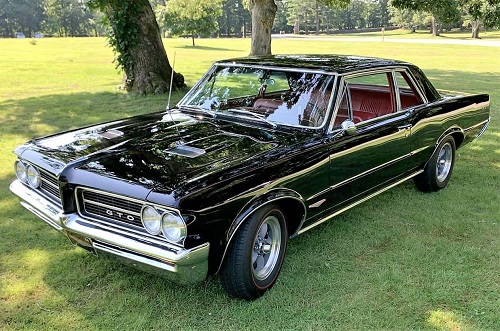
Car songs were well represented in 64! Ronny and the Daytonas had GTO, while the Rip Chords sang Hey Little Cobra, and the Hondells had Little Honda. Jan and Dean told us the stories of The Little Old Lady from Pasadena and Dead Man’s Curve, while J. Frank Wilson and the Cavaliers told us the tragic story of a Last Kiss.
Soul music is represented by The Impressions (I’m So Proud and Keep on Pushing), Joe Hinton (Funny How Time Slips Away), The Tams (What Kind of Fool Do You Think I Am), Jimmy Hughes (Steal Away) and Nancy Wilson (How Glad Am I). If you throw Blues into the “Soul” mix, the great Tommy Tucker song “Hi Heel Sneakers” was out in 1964.
Instrumentally, Al Hirt had a monster hit with Java, The Ventures had Walk Don’t Run 1964, The Marketts had The Outer Limits, and Robert Maxwell had the incredibly cheesy lounge version of Shangri-la. While novelty songs included Jumpin’ Gene Simmons (Haunted House), The Trashmen (Surfin’ Bird) and Roger Miller (Chug-a-Lug).
While Rock was dominant in 1964, there were still some pop (and even folk) songs that made the Top 100 – one of them, doing the “impossible.” Two of the biggest pop hits of the year couldn’t be more different from each other. The third biggest hit of the year belonged to Louis “Satchmo” Armstrong and his Dixieland hit “Hello, Dolly!” Barbra Streisand (who won Album of the year at the 1964 Grammy Awards) had the 11th biggest hit of the year with “People.”
Pop/Folk was also represented by Gale Garnett (We’ll Sing in the Sunshine), The Ray Charles Singers (Love Me With All Your Heart), Dionne Warwick (Walk On By), Al Martino (I Love You More and More Every Day), and Andy Williams (A Fool Never Learns). But the biggest surprise came from an artist who hadn’t had a top 40 record since 1958!
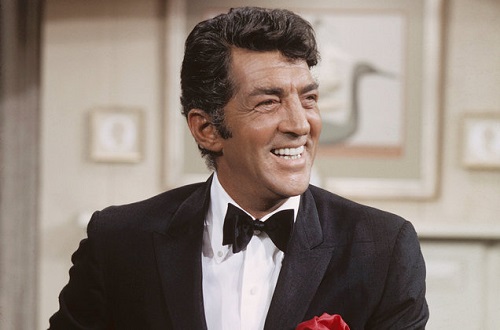
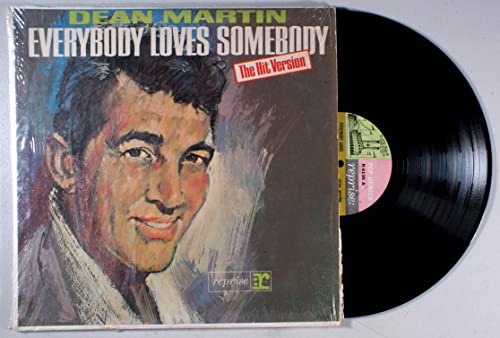
Dean Martin didn’t care for Rock and Roll. With the British Invasion in full swing, there was very little chance of him ever having another hit. His kids loved the new artists. His son, Dean Paul, loved the Beatles. Dean told his boy, “I’m gonna knock your pallies off the charts!” On August 15, 1964 – he did just that with a song that became his NEW theme song, “Everybody Loves Somebody.” (It replaced That’s Amore as his theme song)
The song knocked the beloved Beatles A Hard Day’s Night out of the number 1 spot! It went on to stay at #1 on the Pop Standards Singles Chart for 8 weeks. It also became the theme to his weekly television show in 1965.
I picked 1964 for a few reasons. Despite my initial worry about it being British act heavy, it was the year that introduced us to the Beatles (who changed the music scene forever!). It is also the year that one act held the top 5 spots on the charts (a record that remains in place). It is also the year that my favorite singer of all time bumped the biggest group in music out of the top spot.
It is also a year that encompasses such a vast variety of music. While there may be better songs that appeared before and after 1964, it truly represents a unique time in history. America was still recovering from the loss of a beloved president, there were still Civil Rights issues, and a war in Vietnam. The music of 1964 was a welcome escape from so many things.
Was it all good? No, and that is true of every year. However, as I look at the 100 biggest songs of the year, there are a lot of great songs that have gone on to become classics. There are so many songs that are still looked at as pivotal in the music scene. The fact that many of these songs are still getting airplay today is a statement to just how good they are.
Thanks again to Dave at a Sound Day for allowing me to be a part of this feature. I can only hope that my contribution is worthy of an invite to participate in the next round.














 Various Ramblings of a Nostalgic Italian