The Music of My Life – 1982

Welcome back to The Music of My Life, where I feature ten songs from each year of my life.  In most cases, the ten songs I choose will be ones I like personally (unless I explain otherwise). The songs will be selected from Billboard’s Year-end Hot 100 Chart, Acclaimed Music, and will all be released in the featured year.

Let’s jump right into 1982. We start with a song that was released in January of ’82 in the United States. Believe it or not, this song would go on to have a special meaning for me and many others from my high school. More on that in a minute.

The Go-Go’s were one of those bands who wrote most of their own songs. “We Got The Beat” was written by guitarist Charlotte Caffey, who drew inspiration from some Motown beats, specifically one that mentioned the name of her group. She explains, “I thought it would be very clever to do ‘Going to a Go Go’ (by the Miracles). I thought, Well, let’s try working this out as a cover song. Which is really funny when I think about it. I was listening to it a lot one day, and later that night, the song came to me within five minutes. I don’t even know if it has anything to do with listening to that song, but this whole idea came to me. It was one of those things that just went right through me and came out my hand; I wrote it down, recorded it a little bit, and then brought it into rehearsal a few days later.”

The Go-Go’s released an early version of “We Got The Beat” in the UK as their first single. It was issued on Stiff Records, which was home to The Specials and Madness, both groups The Go-Go’s toured with in England to promote it. Sadly, it flopped, but the group fared far better in America, where they were signed to IRS Records by Miles Copeland, who managed The Police.  In the US, “Our Lips Are Sealed” was released as their first single in the summer of 1981, followed by a new version of “We Got The Beat” in January 1982. This release was The Go-Go’s biggest hit, spending three weeks at #2. (I’ll include both versions below)

Band Camp – Summer 1985. We Got the Beat was a favorite of my high school marching band. I have no idea how long they had been playing it prior to my first year, but it was always played at pep assemblies and when our team won. It was a staple in the marching band music folder. It was the one song that we could play and just have fun. We danced, we jumped, we acted the fool while playing it. It was a celebratory song.

Our band director would say, “Let’s do the little Italian number” during rehearsals. We all knew what he was talking about because he’d often call it, “We Gotta Da Beat.” I want to say our alumni band was around for at least 10 or 12 years after I graduated and they were still playing it. We always joined it because we all had it memorized. I haven’t played my trumpet in years, but I can assure you that if I were to pick it up today, I could still play this song!

We Got the Beat

Real life once again inspired another big hit. Songwriter Wayne Carson, who wrote The Box Tops’ 1967 #1 hit “The Letter,” came up with “Always On My Mind” when he was working at a recording studio in Memphis. He lived with his wife in Springfield, Missouri, and the trip to Memphis had gone 10 days longer than expected.

When he called the missus to tell her he would be there even longer, she let him have it. He tried to assuage her by telling her that was thinking about her all the time – she was “always on my mind.” “It just struck me like someone had hit me with a hammer,” he told the LA Times, “I told her real fast I had to hang up because I had to put that into a song.”

Willie had never heard the song before the song’s co-writer, Johnny Christopher, brought it to him and Merle Haggard, who were busy recording the album Pancho & Lefty (Christopher was playing guitar on the session). “‘Always On My Mind,’ bowled me over the moment I heard it, which is one of the ways I pick songs to record,” Nelson recalled in his 1988 autobiography, Willie. “There are beautifully sad songs that bowl me over… haunting melodies you can’t get out of your mind, with lines that really stick.”

Nelson figured he and Haggard would do the song together, but Haggard didn’t care for it. After they finished recording their album, Nelson stayed in the studio and recorded the ballad solo, just to see what it would sound like. Of course, it sounded like a hit, but Nelson wondered, “We’ll never know what would have happened if Merle had really heard the song right.”

You may remember that Willie Nelson played a big part in my childhood. His Stardust album was played all the time by my grandfather. My grandfather passed away in 1981. Any song by Willie reminded me of my grandpa. My mom really struggled with his passing and I remember being in the car with her when Always on My Mind came on the radio. She had to pull over because it really hit her hard.

It hit me the same way. I know that it is far fetched to believe that grandpa sent a message from beyond the grave, but it felt that way. From Stardust to Always on My Mind and every Willie album that followed, there always seemed to be one song that fit into something that was going on in my life. This one helped me cope with the first death I ever experienced, even though it was more of a love/apology song.

Always on My Mind

One of the things that I noticed as I scanned over the list of singles released in the early eighties was the prominent use of the synthesizer. Rock bands like ZZ Top, Van Halen, and Yes added synthesizers to their mix in the ’80s and scored huge hits by adapting what songfacts.com called “the sound of the decade.” The Steve Miller Band started out as a blues band in the ’60s, evolving into a rock outfit in the ’70s. They often sprinkled electronic effects into their songs, so the keyboards and synth stabs in this song weren’t out of character.

“Abracadabra” was the last US Top 40 hit for the Steve Miller Band, and their third #1. The song was written by Miller and the lyrics were inspired by Diana Ross and the Supremes, whom he had met while performing together on NBC’s Hullabaloo in 1966. “‘Abracadabra’ started off as a great piece of music with really atrocious lyrics,” Miller explained to The Dallas Morning News. “One day I was out skiing in Sun Valley and, lo and behold, who did I see on the mountain but Diana Ross. I skied down off the mountain to go have lunch. I started thinking about the Supremes and I wrote the lyrics to ‘Abracadabra’ in 15 minutes.”

Honestly, I’m really not sure how the Supremes led to the song, but I remember it being a song that really stood out to me on the radio. I rushed out to buy the 45 and it was always a song that wound up on my “driving music” tapes.

Abracadabra

1981 was the year that many were introduced to Men at Work. Their debut single, “Who Can It Be Now” shot straight to #1 on the charts. The group started as an acoustic duo with singer Colin Hay and guitarist Ron Strykert. After a few years playing pubs in Australia, they were discovered by an American who worked for CBS records and signed them.

Colin Hay wrote the song and explained how it came about:

“I was up in the bush in Southern New South Wales with my girlfriend, just sitting outside at night. We had this little tree hut in the middle of the bush. It was a great place to kill the time, mess around with ideas. It was just an idea that popped out, it took about half and hour to write that song. I was living in St. Kilda in Melbourne, which is a great part of Melbourne. At that particular time it was a very interesting area, it was frequented by everybody from the high Jewish population, punks, drug movers, all kinds of different people. It was about six or seven hours drive away, sitting in the middle of the bush in New South Wales and that song just popped out. My girlfriend at the time said, ‘that will be your first hit, that song,’ and she was right.”

Their Business as Usual album was one that I played often.

Fun Fact: The famous saxophone part originally didn’t come in until the middle of the song, which suited when the band played it in bars. When they recorded it, producer Peter McIan identified the sax as a hook and moved it to the beginning of the song, also making it more prominent throughout. This opening sax riff made the song instantly identifiable.

Who Can It Be Now

Juice Newton had a few big hits between Queen of Hearts and Love’s Been a Little Bit Hard On Me. The latter is one of those fun sounding songs, even though it is about the hardships of a relationship. The song was released exactly one week after my 12th birthday.

Juice reminds me of Carlene Carter who had some jumpy, fun songs like this one. Even though she channels Neil Sedaka and sings harmony with herself on the song, that’s one of the reasons I love it. It’s nothing fancy, but it is just good harmony and it blends so well.

One of the things I have enjoyed while picking songs for this year was seeing the videos that were made for certain songs. Wiki describes the music video for this one perfectly. It says that it comically plays off the emotional hurt of love by showing Juice Newton being physically injured by her lover in a series of accidents. The final shot is of Newton singing in the hospital in a full-body cast with her broken leg in the air. The video was awarded Video of the Year by the American Video Association in 1982.

Love’s Been a Little Bit Hard On Me

There is an outdoor amphitheater in the Detroit area that packs in some fantastic shows every summer. I cannot tell you how many shows I have seen at Pine Knob (For some time DTE Energy paid to have the name and even though shows were at “DTE Energy Music Theater,” everyone still called it Pine Knob!). I’ve seen rock shows, comedy shows, country shows, and more there.

For many years, Eddie Money was ALWAYS the guy who played the first show there. He kicked off the summer concert season annually and it became a tradition. One year, I had the opportunity to interview Eddie on the air. It was the easiest interview in the world! Why? You never had to ask questions after he got on the phone. “Hey, Eddie! How are you?” Then Eddie would roll – he’d promote the show, promote an album, share some funny story, talk about the venue, and more. The “Money Man” was great!

I dated in high school who loved Eddie Money’s Music. She had the No Control album on cassette and we’d listen to it in the car. Think I’m in Love was on that album and I remember the first time I saw the video on MTV. Again, these early videos are fun to watch. Eddie plays a sort of vampire character in it. It was a very popular video.

Think I’m In Love

Growing up I listened to Elvis, Bill Haley, Carl Perkins, Eddie Cochran and other artists who played some rockabilly music. So when I heard the Stray Cats in 1982, it was like hearing stuff I was already familiar with. The Built For Speed album was one I played over and over.

Brian Setzer was born in New York and was exposed to a lot of genres of music. He learned to play the guitar at a young age, and when he was a teen, he formed a trio he called the Tomcats, That group would later change their name to the Stray Cats. They were influenced by all those artists I just mentioned and their group developed a fairly large following in the underground punk scene of New York City during the late ’70s. Their fan base expanded so quickly that they found themselves being courted by no less than a half dozen record labels in 1980.

Brian Setzer opted to record and produce the Stray Cats’ debut album in the UK Rock This Town was released there over a year before it was released in the US. Rock This Town was a Top 10 hit for the band. It’s crazy to watch the video and see Brian. He looks like a baby in it. Hard to believe he was only 23 when this video was shot.

Rock This Town

My dad and my uncle used to play old blues music on records and on the guitar. At my graduation party, they played stuff from Jimmy Reed, Bo Diddley, and other blues legends. Because of that, I’ve always loved the blues. Because of that, I was naturally a fan of George Thorogood.

Bad to the Bone is based on the Bo Diddley blues song “I’m a Man.” Bo Diddley was one of George’s heroes. His “version” has a much heavier guitar sound, which replaces the harmonica in Diddley’s recording. Songfacts.com says that “both songs are full of swagger, with the singers exuding lots of testosterone.”

Songfacts.com goes on to say, “With MTV coming on the air in 1981, Thorogood picked a good time to release a memorable video. The clip shows Thorogood playing pool against Bo Diddley in a place where there is no chance of a dance sequence breaking out. Pool champion Willie Mosconi also appears in the clip, which introduced Thorogood – and to some extent, Diddley – to the younger MTV crowd. Among the British New Wave acts that dominated MTV’s playlist at the time, Thorogood certainly stood out, and he created an image of a bad man. While Thorogood is a disciple of the blues, he was raised in a Delaware suburb and by most accounts is actually a pretty nice guy, despite what he claims in this song.”

I love the fact that Diddley is in this video! The song is one that has a life of it’s own. It is used as intro music for wrestlers, it has been used during the removal of the bride’s garter at weddings, and has been used in both movies and television in seriousness and for comedic effect. It is a classic.

Bad to the Bone

I love a great intro. Sometimes a great guitar riff or a neat drum thing is all it takes to hook me. The intro to Everybody Wants You was one of those intros. It appeared as the opening track of his multi-Platinum 1982 album Emotions in Motion.

The song itself didn’t do that great on the Hot 100 chart, as it only went to number 32. However, it was around this time that one of the radio formats that was big was called AOR – Album Oriented Rock. It had great success on these and rock stations. It reached number one on Billboard’s Top Rock Tracks chart. Naturally, the video did well on MTV, too. It remained in heavy rotation for quite some time.

The minute I hear this one, I think back to those nights of shooting pool with my buddies. It was always on the jukebox.

Everybody Wants You

The next song is one that is still applicable today. Perhaps even more so. What exactly is “news” today? Turn on any local news channel or entertainment news show – it is chock full of stories like the ones referenced in Don Henley’s first Top 40 hit as a solo artist – Dirty Laundry.

Again, the intro of this really stood out for me. The lyrics take it to an entirely new level. They are so good and perhaps that is because Henley had plenty of real life to draw from. This song is about unscrupulous news people doing anything for a story. Henley values his privacy, and hates it when reporters pry into his personal life. He had to deal with increased press attention when his girlfriend at the time, Maren Jensen, came down with Epstein-Barr Syndrome. She recovered, but they broke up soon after.

Songfacts.com states: “Henley sings from the standpoint of a news anchorman who “could have been an actor, but I wound up here”. The song’s theme is that TV news coverage focuses too much on negative and sensationalist news; in particular, deaths, disasters, and scandals, with little regard to the consequences or for what is important (“We all know that crap is king”). The song was inspired by the intrusive press coverage surrounding the deaths of John Belushi and Natalie Wood. It was also inspired by Henley’s own arrest in 1980 when he was charged with contributing to the delinquency of a minor and possession of marijuana, cocaine, and Quaaludes after a 16-year-old girl overdosed at his Los Angeles home”

While Don’s version is the best, Lisa Marie Presley (who had to deal with a lot of press intrusions on her personal life) also does a really neat version of Dirty Laundry.

Dirty Laundry

There were plenty of great songs in 1982, I’m sorry if I missed one of your favorites. Next week, we’ll move ahead to 1983 where there will be a good mix of rock, country, pop, soul and a movie song that will forever be associated with summer vacations ….

See you then!
Tune Tuesday – The Happening

Today is the 80th birthday of Diana Ross! She was born in Detroit, Michigan and naturally is one of the greatest artists to come out of our state! Fun fact: when she was born, she was named Diane, but a spelling error on the paperwork led to Diana.

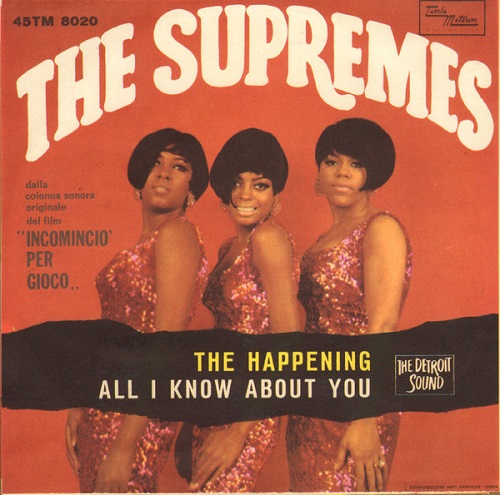
As a member of the Supremes, they enjoyed amazing success and a dozen number one records, including the song I picked to feature today. What’s the connection between the Supremes the Lee Marvin/Ernest Borgnine movie The Dirty Dozen, and the hit TV series The Brady Bunch? The answer is film and television composer Frank DeVol. He was behind those theme tunes among many others, and joined Holland, Dozier and Holland as the co-writer of the Motown trio’s tenth US pop No.1, “The Happening.”

The song was written for the Anthony Quinn film of the same name. The film flopped, but the song soared to the top of the charts in just 5 weeks! They have the honor of bumping Frank Sinatra out of the top spot (His duet with Nancy, “Something Stupid”). Admittedly, the song is a bit more “peppy” and less “soulful” than many Supreme songs, but I think that’s why I like it so much.

According to Songfacts.com:

This was a milestone song for The Supremes. It was:

1) Their last hit released under the name “The Supremes.” Later in 1967, they became “Diana Ross & the Supremes.” They reverted back to “The Supremes” in 1970 when Ross left the group.

2) The last of their 10 #1 hits written by the Holland-Dozier-Holland team. They left Motown a year later in a dispute over royalties.

3) Their last hit with Florence Ballard, who was fired soon after and replaced with Cindy Birdsong.

For you music lovers who like to hear things a bit differently, I will post two versions of the song. First, from the 20th Century Masters collection:

Now listen to the 2003 remix from “The Number 1’s” collection. What I love about this remix is that the background instruments are much more clear. You hear the playful call and answer between the vocals and the background in an entirely different way. If you can, listen in headphones.

Happy 80th Birthday, Diana Ross!!!

The Happening

Hey, life, look at me
I can see the reality
‘Cause when you shook me, took me out of my world
I woke up
Suddenly I just woke up to the happening
When you find that you left the future behind
‘Cause when you got a tender love
You don’t take care of
Then you better beware of the happening

One day you’re up, then you turn around
You find your world is tumbling down
It happened to me, and it can happen to you

I was sure, I felt secure
Until love took a detour
Yeah, riding high on top of the world
It happened, suddenly it just happened
I saw my dreams fall apart
When love walked away from my heart
And when you lose that precious love you need
To guide you
Something happens inside you, the happening

Now I see life for what it is
It’s not all dreams, ooh, it’s not all bliss
It happened to me and it can happen to you

Once
Ooh, and then it happened

Is it real, is it fake
Is this game of life a mistake?
‘Cause when I lost the love I thought was mine
For certain, suddenly I started hurting
I saw the light too late
When that fickle finger of fate
Yeah, came and broke my pretty balloon
I woke up
Suddenly I just woke up to the happening

So sure, I felt secure
Until love took a detour
‘Cause when you got a tender love you don’t
Take care of, then you better beware of the happening

Turntable Talk #18 – The Man (or Woman) Behind the Curtain

It is time once again for another edition of Turntable Talk. This is a feature created by my friend Dave Ruch from the A Sound Day Blog. This is my 18th submission for this feature and it is something I look forward to writing each month.

This time around, Dave took us to the Land of Oz for inspiration. His instructions:

 “Pay No Attention to That Man (Or Woman) Behind The Curtain” . Yep the famous phrase about the Wizard of Oz. 

We’ve looked at a number of great artists – singers, groups, musicians – and their records. This time we’re switching it up just a little and are going to salute someone “behind the scenes” that was significant to music. All too often people do pay no attention to the people behind the curtain in music that are so important to the albums and groups we love. There are record producers, the record company bosses and talent scouts, the people on radio who used to make the hits happen, even unsung heroes like concert roadies. Pick one you feel is important and maybe a little un-noticed and tell us why!

As a former radio guy, I immediately thought I should write about a well known DJ. There are many of them who played a big part in the music industry. Dick Clark, Casey Kasem, Wolfman Jack and Alan Freed come to mind. However, I decided that I would feature a man who played on some of the biggest hits on the radio, yet until recently was relatively unknown.

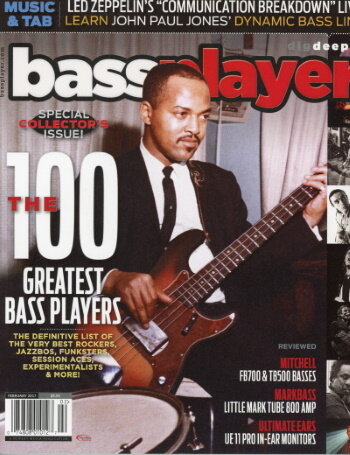
40 years ago, James Jamerson passed away at the young age of 47. At the time he passed away, no one really knew who he was, despite being one of the best (if not THE best) bass player of all time! As a matter of fact, he often tops the list of Best Bass Players of all time by numerous publications. It has been said that he single-handedly revolutionized bass playing. I agree. His creative contributions to music certainly makes him a good pick for a “man behind the curtain.”

James Jamerson was born on January 29, 1936 in Charleston, SC. When his parents divorced, his mother moved to Detroit to find work. He would spend time with his aunt, grandmother and cousin. His aunt sung at church while his grandmother and cousin played piano. He spent time listening to gospel, Jazz, and blues music and that influenced his own musical abilities.

In 1954, his mother sent for him and he attended Northwestern High School. In the music room of the high school, he saw a stand up bass lying on the floor. He picked it up and began to play with it. He had “found” his instrument. He began to play at many of the Detroit area blues and jazz clubs.

He began to get noticed and he began playing for dances, weddings, frat parties, and other events. He was quite a local celebrity. It was hard to miss him driving through town with his bass sticking out the window of his car! Because he was still a minor, the good folks at the Detroit Police Dept. gave him a permit so that he could play in clubs that served alcohol. This allowed him to get more work.

Believe it or not, Wayne State University offered him a full ride music scholarship which he turned down! He was playing so often, he figured he was already in the music field, so why would he need to go to college? Instead, after he graduated high school, he joined up with Washboard Willie and the Super Suds of Rhythm (How’s that for a group name?!). It was during this time that he began to drink alcohol (which would eventually lead to his death).
In 1958, someone from the Northern Records label heard him play and asked him to sit in on the session recordings for the label. The unique way he played caught the ear of other labels. He began to work for Fortune, Tri-Phi, Anna Records, and eventually Motown.

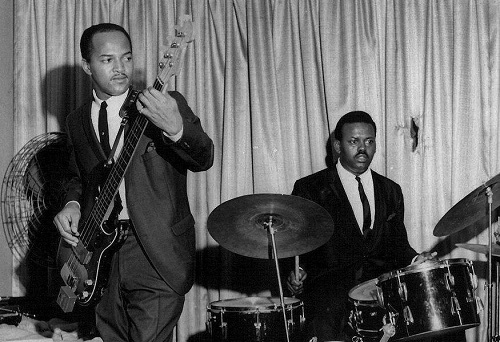
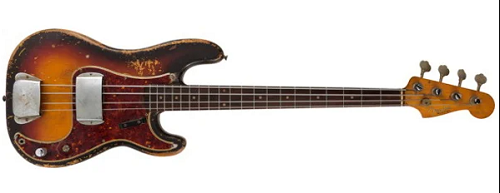
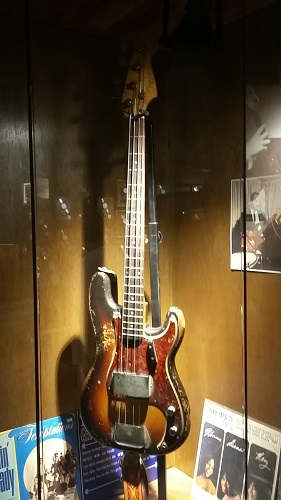
He and the Funk Brothers (pianist Earl Van Dyke, drummer Benny Benjamin, and guitarists Robert White and Joe Messina) spent the days recording in the “Snake Pit” (the Basement of Motown Records) and playing at Jazz clubs in the evenings. Jamerson had switched from an upright bass to a brand new creation – the electric Fender Precision Bass.

The switch really made his work stand out. On some songs, he’d play the stand up bass and then double it with the electric. What made his work on the electric so awesome is that he played the electric just like he played the stand up bass – with one finger (which many folks called “the claw”).

While he is known for playing on many of the Motown songs, he also played on Boom Boom by John Lee Hooker, Whispers Getting Louder and Higher and Higher by Jackie Wilson, Agent Double-O-Soul by Edwin Starr, Cool Jerk by the Capitols, Show and Tell by Al Wilson, Boogie Fever by the Sylvers, and so many other hits! What made the Motown stuff so good was he had some free reign to be “James Jamerson.”
Musician magazine interviewed him in 1983 and he stated that the Motown songwriting and productions teams “would give me the chord sheet, but they couldn’t write for me. When they did, it didn’t sound right. When they gave me that chord sheet, I’d look at it, but then start doing what I thought would fit. I’d hear the melody line from the lyrics and build the bass line around that.”

One of the coolest examples of how he listened and did his thing was on two separate recordings of the same song. To help illustrate this, I found some isolated bass lines on YouTube that are fascinating! Jamerson played on Marvin Gaye’s I Heard It Through the Grapevine – a Motown classic! Check out the soulful line here:

Now check out the same song – and a funkier bass line – on the Gladys Knight Version:

I find it amazing that the same man can take the same song and make them so different.

Speaking of Marvin Gaye, the Funk Brothers shared a story about how Marvin wanted Jamerson to play on What’s Going On. James was out drinking and Marvin went out looking for him. When he found him, he brought him back to the studio. Jamerson was so drunk that he couldn’t even stand up! It was no problem for him, though, he just laid on his back on the floor and played on the track!

Trivia Bit: What’s Going On is the first track that Jamerson is credited on a recording.

It is said that James Jamerson played on almost every Motown song between 1963 and 1968. That would include over 60 songs that hit #15 or better on the charts. He also performed on 23 # 1 songs on the pop charts and 56 #1 songs on the R&B charts! Berry Gordy called him an “incredible improvisor” and said “I, like the other producers, would not do a session unless at least two of the Funk Brothers were present, namely Benny Benjamin and James Jamerson.”

Some of the other Motown songs that feature Jamerson:

  • Ain’t No Mountain High Enough – Diana Ross and the Supremes
  • Ain’t That Peculiar – Marvin Gaye
  • Ain’t to Proud to Beg – The Temptations
  • Baby, I Need Your Loving – The Four Tops
  • Baby Love – The Supremes
  • Bernadette _ The Four Tops
  • Can I Get a Witness – Marvin Gaye
  • Dancing in the Streets – Martha and the Vandellas
  • Don’t Mess With Bill – The Marvelettes
  • Going to a Go Go – Smokey Robinson and the Miracles
  • Home Cooking – Jr. Walker and the All Stars
  • It Takes Two – Marvin Gaye and Tammy Terrell
  • My Cherie Amour – Stevie Wonder
  • My Girl – The Temptations
  • Pride and Joy – Marvin Gaye
  • Reach Out, I’ll Be There – The Four Tops
  • Shotgun – Jr. Walker and the All Stars
  • This Old Heart of Mine – The Isley Brothers
  • Two Lovers – Mary Wells
  • What Becomes of the Broken Hearted – Jimmy Ruffin

You can also hear him on :

  • The Theme from S.W.A.T. – Rhythm Heritage
  • The Theme from Starsky and Hutch
  • Just Like Romeo and Juliet – The Reflections
  • Rock the Boat – Hues Corporation

The list of people who were influenced by Jamerson’s playing is almost as long as the list of songs he played on! Saxophone and bass player Wilton Felder called him “The Godfather of the electric bass.”

Suzi Quatro says, “I grew up in Detroit, so I was weaned on James Jamerson and Motown music. It’s in my DNA. He is still the best and I took my style from him. It’s hard to improve on what he did, because you are talking perfection.”

Sir Paul McCartney says, “Jamerson was where I picked up a lot of my bass style. Because bass players normally have to follow: we follow chords, follow the drummer, follow the vocalist, we have a following role. Suddenly the bass had power! We could dictate the direction of the music and add excitement. James Jamerson became just my hero, really.”

James Jamerson Jr. says, “As for his sense of syncopation, that was his God-given gift. I couldn’t even explain that one. I put it like this: My dad liked to dance, so he just danced on the bass. He would occasionally polish his bass, but he’d never touch the gunk that built up on that fingerboard. he told me the ‘dirt keeps the funk’.”

Years of drinking finally caught up with Jamerson. On August 2, 1983, he died of complications from cirrhosis of the liver, heart failure and pneumonia.

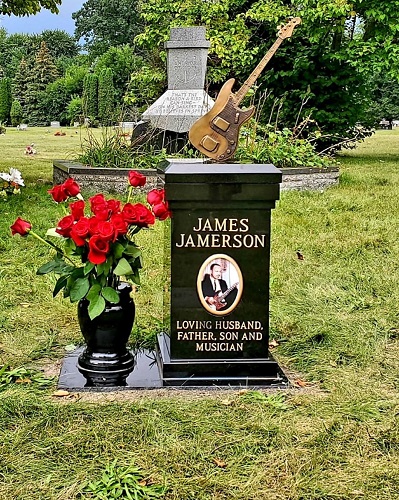
He was buried in Detroit’s Woodlawn Cemetery. A few years ago, Jamerson’s cousin saw a picture of his grave site. There was no headstone, only a grass marker. Eventually, the funds were raised and a proper headstone was set in place on August 27, 2021.

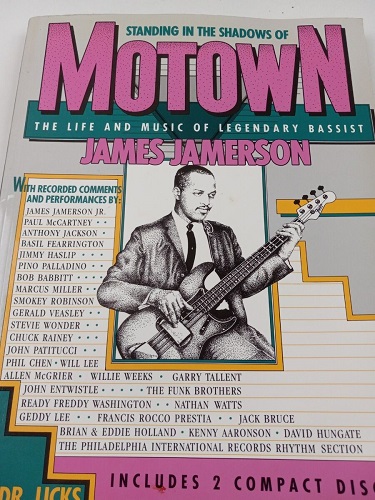
In 1989, Jamerson was the subject of a book loaded with great stuff – Standing in the Shadows of Motown. I think you can still get this on Amazon. A documentary of the same name was produced in 2002

He was posthumously inducted into the Rock and Roll Hall of Fame in 2000, received a Grammy Lifetime Achievement Award in 2004, and inducted into the Musicians Hall of Fame in 2007. Last month, in South Carolina, he was honored when a street was named for him.

It is a shame that it took so long for Jamerson and the Funk Brothers to get the recognition that they deserve.

As I prepared for this piece I found myself on YouTube listening to track after track of Motown stuff and listening with different ears. I focused on that bass line and really was blown away. These are songs I have heard countless times, yet focusing on that bass made them so fresh! As I said, the isolated tracks are an entirely different thing – it is so awesome to hear Jamerson “feel” and “drive” the tunes. It is no wonder that he is ranked the #1 bass player in the business by so many different sources, including Rolling Stone magazine.

Thanks again to Dave for allowing me to be a part of such a cool feature. I have already been impressed by the other blogger’s submissions. I am sure that they love taking part in this feature as much as I do.

Thanks for reading! Stay funky!

Turntable Talk #8 – Best Year In Music?

Once again, Dave from A Sound Day has asked some of us music lovers to participate in another round of Turntable Talk. This time around was a bit of a challenge for me. Dave’s e-mail stated:

Put your thinking caps on and go through your stacks of records (or scroll thru that I-pod) and … come up with what you think the best year for music was. A tough call of course, thankfully there have been more than a few good ones! I’m interested in what you pick and don’t worry if yours duplicates someone else’s , you still have your reasons which might be different.” He goes on to say, “I think I have a guess on a couple of years that might come up more than once, but we’ll wait and see.

This particular blog will be one of the last ones to be featured and I do not know if my year will be or has been featured. I plan on writing this KNOWING that the year I have chosen very well may be one that comes up in another post. Before I tell you the year I picked, let me tell you that I had a very difficult time narrowing it down.

My first thought was to go with 1956/1957 because those years were always so unique. You had the birth of rock and roll mixing with pop standards. When I worked at Honey Radio, I loved doing the Top 12 at 12 show when those years popped up because there was such a big variety in what was played. You could go from Elvis or Jerry Lee Lewis to Pat Boone or Nelson Riddle. When I looked at the list of songs, however, were they really the BEST? No.

The same thing can be said for some of the years in the 70’s decades. I looked through many lists and while there were many great songs, there were also a lot of really crappy songs! I just couldn’t really come up with the conviction to pick a year in that decade as the BEST.

One year kept coming up every time I started thinking about it – 1964.

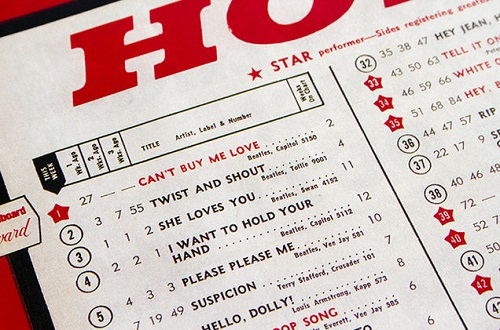
I want you to know before I continue that I was dead set AGAINST 1964 when I read Dave’s e-mail. Why? Well, I felt that it would just be too Beatle heavy and loaded with British Invasion stuff. And it is. On the Top 100 Chart, The Fab Four nabbed 9 spots. 18 spots were held by other British Invasion acts. In total 27% of the Top 100 were British acts. When I really looked at the chart, the more and more I felt like this WAS the year.

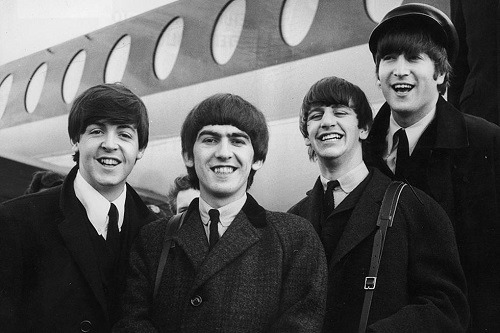
1964 really was the year of the Beatles, so let’s discuss them first. They were present almost right from the start as their “Introducing The Beatles” album was released in America on January 10th of that year.

This album preceded Capitol Records “Meet the Beatles” by 10 days and there was a lawsuit surrounding that whole issue. Capitol Records won an injunction and Vee-jay Records was not allowed to put out any more Beatles recordings.

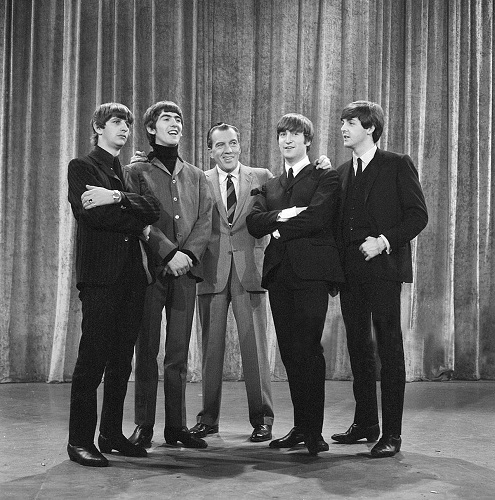
In February of 1964, the Beatles arrived in the US and appeared on Ed Sullivan’s show three times (2/9, 2/16, and 2/23). In March of 64, Billboard magazine stated that the Beatles were responsible for 60% of all single record sales! In a feat that has yet to be matched, on April 4, 1964, the Beatles held the Top 5 spots on the Billboard chart!

A week later, the boys held 14 spots on the Hot 100 Chart! That broke the previous record of 9 spots held by Elvis Presley in 1956.

In May, The Beatles Second Album was released and in July, they would release A Hard Day’s Night in theaters. “I Want to Hold Your Hand” wound up being the #1 song for the whole year of 64 (“She Loves You” was #2) To say that they played a small part in the music of 1964 would be a huge understatement.

Among the other artists that came over from “across the pond” in 64 were Manfred Mann (Do Wah Diddy Diddy), Billy J. Kramer and the Dakotas (Little Children and Bad to Me), The Dave Clark Five (Glad All Over, Because, Do You Love Me), Peter and Gordon (A World Without Love), The Animals (House of the Rising Son), The Honeycombs (Have I The Right), Dusty Springfield (Wishin’ and Hopin’), Gerry & The Pacemakers (Don’t Let the Sun Catch You Crying and How Do You Do It), Chad and Jeremy (A Summer Song), The Kinks (You Really Got Me), and the Searchers (Don’t Throw Your Love Away and Needles and Pins). It is interesting to note that the Rolling Stones debut album was released this year, but no songs appear in the Top 100 for the year.

Once you move away from the British artists, the chart has a nice variety of pop, rock, folk, country, soul, and even a few novelty songs. I think that is what made me ultimately choose this particular year.

It was nice to look over the Top 100 and see Motown represented with some classics. The Supremes hold two of the six Motown songs (Where Did Our Love Go and Baby Love), Motown was female heavy as Mary Wells (My Guy) and Martha and the Vandellas (Dancin’ In The Street) grabbed the next two spots, and the male gender was represented by The Four Tops (Baby I Need Your Loving) and The Temptations (The Way You Do The Things You Do).

While they were not “oldies” at the time, there were some classic songs that are still in hot rotation today on the oldies stations across the country. Roy Orbison had a smash with Pretty Woman in 64, and also had a hit with It’s Over. Frankie Valli and the Four Seasons grabbed three of the Top 100 with Rag Doll, Dawn and Ronnie. The Beach Boys only entry in the Top 100 was I Get Around.

1964 brought us classics like The Drifters Under The Boardwalk, Chapel of Love by the Dixie Cups, Suspicion by Terry Stafford, It Hurts to Be In Love from gene Pitney and Come A Little Bit Closer by Jay and the Americans. Johnny Rivers had a hit with Chuck Berry’s Memphis, Bobby Freeman invited us to C’mon and Swim, Detroit’s Reflections offered up Just Like Romeo and Juliet and the Shangri-Las told us the story of the Leader of the Pack.

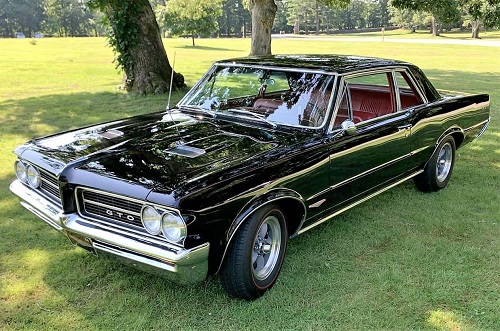
Car songs were well represented in 64! Ronny and the Daytonas had GTO, while the Rip Chords sang Hey Little Cobra, and the Hondells had Little Honda. Jan and Dean told us the stories of The Little Old Lady from Pasadena and Dead Man’s Curve, while J. Frank Wilson and the Cavaliers told us the tragic story of a Last Kiss.

Soul music is represented by The Impressions (I’m So Proud and Keep on Pushing), Joe Hinton (Funny How Time Slips Away), The Tams (What Kind of Fool Do You Think I Am), Jimmy Hughes (Steal Away) and Nancy Wilson (How Glad Am I). If you throw Blues into the “Soul” mix, the great Tommy Tucker song “Hi Heel Sneakers” was out in 1964.

Instrumentally, Al Hirt had a monster hit with Java, The Ventures had Walk Don’t Run 1964, The Marketts had The Outer Limits, and Robert Maxwell had the incredibly cheesy lounge version of Shangri-la. While novelty songs included Jumpin’ Gene Simmons (Haunted House), The Trashmen (Surfin’ Bird) and Roger Miller (Chug-a-Lug).

While Rock was dominant in 1964, there were still some pop (and even folk) songs that made the Top 100 – one of them, doing the “impossible.” Two of the biggest pop hits of the year couldn’t be more different from each other. The third biggest hit of the year belonged to Louis “Satchmo” Armstrong and his Dixieland hit “Hello, Dolly!” Barbra Streisand (who won Album of the year at the 1964 Grammy Awards) had the 11th biggest hit of the year with “People.”

Pop/Folk was also represented by Gale Garnett (We’ll Sing in the Sunshine), The Ray Charles Singers (Love Me With All Your Heart), Dionne Warwick (Walk On By), Al Martino (I Love You More and More Every Day), and Andy Williams (A Fool Never Learns). But the biggest surprise came from an artist who hadn’t had a top 40 record since 1958!

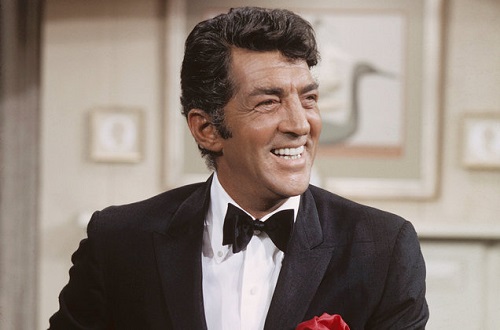
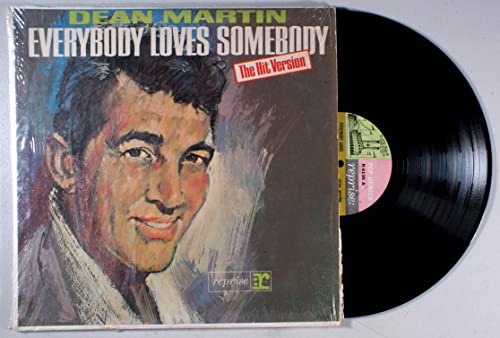
Dean Martin didn’t care for Rock and Roll. With the British Invasion in full swing, there was very little chance of him ever having another hit. His kids loved the new artists. His son, Dean Paul, loved the Beatles. Dean told his boy, “I’m gonna knock your pallies off the charts!” On August 15, 1964 – he did just that with a song that became his NEW theme song, “Everybody Loves Somebody.” (It replaced That’s Amore as his theme song)

The song knocked the beloved Beatles A Hard Day’s Night out of the number 1 spot! It went on to stay at #1 on the Pop Standards Singles Chart for 8 weeks. It also became the theme to his weekly television show in 1965.

I picked 1964 for a few reasons. Despite my initial worry about it being British act heavy, it was the year that introduced us to the Beatles (who changed the music scene forever!). It is also the year that one act held the top 5 spots on the charts (a record that remains in place). It is also the year that my favorite singer of all time bumped the biggest group in music out of the top spot.

It is also a year that encompasses such a vast variety of music. While there may be better songs that appeared before and after 1964, it truly represents a unique time in history. America was still recovering from the loss of a beloved president, there were still Civil Rights issues, and a war in Vietnam. The music of 1964 was a welcome escape from so many things.

Was it all good? No, and that is true of every year. However, as I look at the 100 biggest songs of the year, there are a lot of great songs that have gone on to become classics. There are so many songs that are still looked at as pivotal in the music scene. The fact that many of these songs are still getting airplay today is a statement to just how good they are.

Thanks again to Dave at a Sound Day for allowing me to be a part of this feature. I can only hope that my contribution is worthy of an invite to participate in the next round.

Song Draft 2021 – Pick 5 – I Heard It Through the Grapevine

As the Song Draft continues, we have come to my fifth pick. I have noticed that I have primarily leaned very “local”. In all honesty, I don’t think I did this intentionally. I have featured songs from my home state of Michigan, and primarily from the Detroit area. I would be remiss if I did not include a song from the Motown Label.

I thought long and hard about just which song to pick. As I looked through the LONG list of Motown groups, I saw The Four Tops, The Supremes, The Temptations, Edwin Starr, Marvin Gaye, The Marvelettes, Diana Ross, The Jackson 5, Gladys Knight and the Pips, The Isley Brothers, Mary Wells, Tammi Terrell, The Spinners and more! There were so many artists to chose from.

Now look at that list of artists again, and imagine the list of songs associated with them! The amount of hits (and non hits) produced out of Motown are plenty. However, as I looked through the list of songs, there was one stand out. I dare say that the song is THE BEST of all of the Motown songs. That song, and my fifth pick for the 2021 Song Draft, is I Heard It Through the Grapevine.

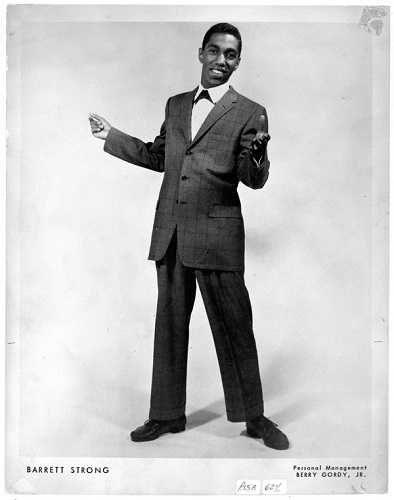
The song was written by another Motown artist, Barrett Strong.

Barrett is famous for his song Money (which was once covered by the Beatles) and for writing other songs like Papa Was a Rolling Stone. He got the idea for the song when he was living in Chicago and heard lots of people using the phrase “I heard it through the grapevine.” Barrett said, “Nobody wrote a song about it, so I sat at a piano and came up with the bass line.” 

From Song Facts:

The classic about a man who finds out his woman is cheating on him was written by Norman Whitfield and Barrett Strong. Strong came up with the idea and asked Motown writers Holland-Dozier-Holland to work on it with him. They refused to credit another writer, so Strong took it to Whitfield, who helped put it together. The song eventually became a Motown classic, but it had a rough start, as executives at the company thought it was too bluesy and lacked hit potential.

Smokey Robinson and the Miracles were the first to record the song, but their version wasn’t released until years later on an album called Special Occasion. The Isley Brothers then took a crack at it, but their version wasn’t released. Whitfield and Strong then had Marvin Gaye record the song but still no luck: Motown head Berry Gordy chose Holland-Dozier-Holland’s “Your Unchanging Love” over “Grapevine” as his next single. Finally, a new Motown act Gladys Knight and the Pips recorded the song as a gospel rocker. Their version was a hit, entering the Top 40 in November 1967 and going to #2 in America.

Marvin Gaye’s version was included on his 1968 album In The Groove (later re-titled I Heard It Through The Grapevine). After E. Rodney Jones, the Chicago disc jockey at WVON, started playing it on the air, Berry Gordy reconsidered and released Gaye’s version as a single, which became even more popular and known as the definitive version of the song. Gaye’s “Grapevine” pounded the charts about a year after Knight’s, going to #1 in America on December 14, 1968.

On the Motown Box Set, Gladys Knight’s version and Marvin’s version are included. If I had to chose which version I like more, I’d lean more Marvin. However, that being said, Gladys version is really cool too. Hers has a more uptempo feel to it, the bass line (played by James Jamerson in both versions) is extra funky and I love to listen to the drum work in it. Check it out here:

Then you get to Marvin’s version. Slower, groovier, and perfect.

What makes Marvin’s so special? According to Song Facts: Marvin Gaye wrung out the emotion in the song thanks to Norman Whitfield, who produced the track and gave him very specific instructions. Whitfield had Gaye sing slightly higher than his normal range, which created the strained vocal, and he made him do it over and over until he got it right. Gaye explained to NME: “I simply took direction, as I felt the direction he was expounding was a proper one. Had I done it myself I would not have sung it at all like that, but y’see there are many benefits in just singing other people’s material and taking directions. The job of interpreting is quite an important one, because when people are not able to express what is in their souls if there is an artist who can… then I think that is very valuable.”

With that in mind, one of the most amazing videos on YouTube is this version of Grapevine where Marvin’s vocal is isolated. I still get chills listening to the perfection in his voice.

WOW! Just WOW!!

Heard It Through The Grapevine – Lyrics

Ooh-ooh, bet you’re wond’ring how I knew
‘Bout your plans to make me blue
With some other guy that you knew before
Between the two of us guys, you know I love you more

It took me by surprise I must say
When I found out yesterday

Ooh-ooh I heard it through the grapevine
Not much longer would you be mine
Ooh-ooh I heard it through the grapevine
And I’m just about to lose my mind
Honey honey yeah

You know that a man ain’t supposed to cry
But these tears I can’t, hold inside
Losin’ you would end my life you see
‘Cause you mean that much to me

You could have told me yourself
That you found someone else

Instead I heard it through the grapevine
Not much longer would you be mine
Ooh-ooh I heard it through the grapevine
And I’m just about to lose my mind
Honey honey yeah

People say you have from what you see
And not not not from what you hear
I can’t help, bein’ confused
If it’s true, won’t you tell me dear

Do you plan to let me go
For the other guy that you knew before

Ooh-ooh I heard it through the grapevine
Not much longer would you be mine
Ooh-ooh I heard it through the grapevine
And I’m just about to lose my mind
Honey honey yeah

Ooh-ooh I heard it through the grapevine
Not much longer would you be mine
Ooh-ooh I heard it through the grapevine
And I’m just about to lose my mind

Ooh-ooh I heard it through the grapevine

“Cleveland Rocks!”

For our anniversary, my wife and I wanted to plan a little getaway to celebrate.  Neither one of us had too much PTO in our “banks” at work, so we decided on a weekend trip.  During the planning the destinations changed frequently.  Originally, we had hoped to head back for another trip to Florida, but due to the lack of time available, we decided on something a bit closer to home.

There was talk of going to Nashville and maybe catching a show at the Grand Ole Opry.  Then there was talk of Gatlinburg, where my mom so often talked about.  I think we even chatted about Pennsylvania, too.  Eventually, we decided that Chicago was where we wanted to go, but then realized that it was St. Patrick’s Day weekend, and we figured it might be just a tad crazy (although seeing the river turned green would have been cool.

Cleveland??

To be honest, I am not even sure how we decided on Cleveland, Ohio.  I had mentioned that my dad had gone to the Rock and Roll Hall of Fame and said it was cool.  I started to look at things in Cincinnati.  There was a lot to do there, but why wasn’t the Hall of Fame coming up in any of my searches?  I knew that Cincy was close to Louisville, KY and thought that we could maybe do something there, too.  I had gone as far as to drop a radio buddy a note to say we were gonna be down there and asked for good restaurants to eat at … only to then realize the Hall of Fame was in Cleveland!

Now that we had cleared that up, we were set for Cleveland.  Now, I will be the first to admit “Cleveland,Ohio” as the answer to “Where did you and your wife spend your first wedding anniversary?” is not at all romantic.  Many people laughed when I told them.  Here is the thing about my wife and I, the destination really didn’t matter – it was simply the fact that we were going to be together.  To me, this is just one of the reasons I love her.  We can be content with just having time with each other, no matter where we are, or what we are doing.

We have made it a tradition to go to restaurants that local wherever we go.  If we can go there at home, we’ll go there at home!  By doing this, we have really been treated to some amazing food.  We always try to find a good steak house or something very unique to the city we are in and we have yet to be disappointed.

The Hall of Fame

53788262_10161789933930195_6279189126726025216_n

Personally, I think Sam loves watching me get excited about stuff like this.  We both love museums, but I must have been like a little kid on his birthday during this trip!  I had, of course, seen pictures of the Hall of Fame, but it was something else to be standing in front of it.  The big red block letters that sit upon the sidewalk read “LONG LIVE ROCK”.  As I walked up the steps, there are phoney concert speakers erected by the hand rails. The excitement builds as you walk in.

As you enter, you walk into a huge foyer/lobby.  The gift shop is to your right, to the left a cafe/coffee shop, and in front of you there is an escalator to take you down to purchase tickets.  After buying our tickets, you get ready to enter and above the doors the perfect AC/DC quote to welcome you: “For those about to rock …”

54256262_10161789933790195_1768108344930729984_n

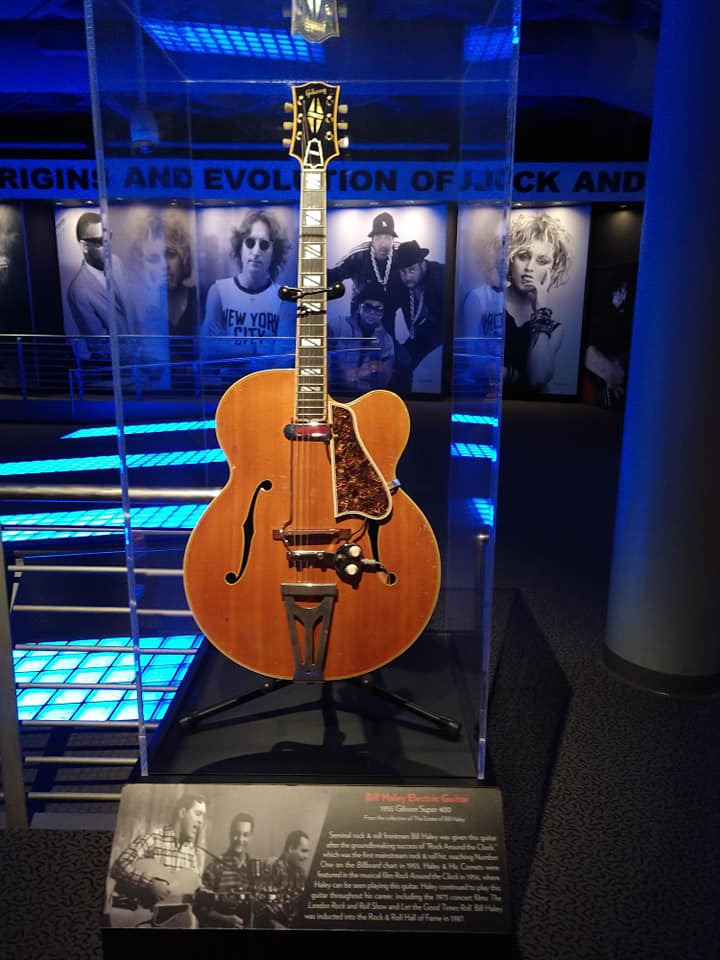
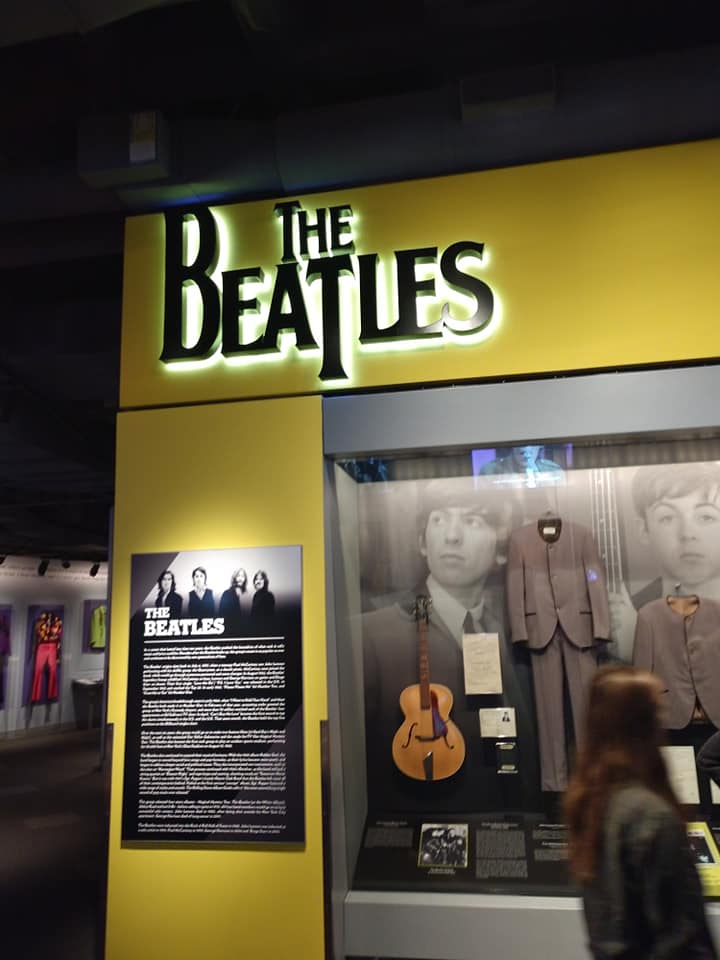
Walking into the main exhibition hall, the first thing I noticed were pictures of John Lennon and Ray Charles on the wall.  The first thing I am drawn to is a glass case containing Bill Haley’s guitar.  Bill is often credited as being the singer of the first “rock and roll” song – Rock Around the Clock.  There is a picture of him playing it in the case as well.  I am not sure why I was so taken in by it, but I was.

54213622_10161789934215195_4227743477200322560_n

The next thing we saw was a line of bass guitars that belong to Geddy Lee of Rush.  I didn’t count , but there had to be like a dozen of them.  The information said that this was only part of his massive collection.

The Roots

One thing I was thrilled to see here was the fact that the “roots” of Rock and Roll were well represented.  Rock really evolved from a combination of Gospel, R&B, Bluegrass, Country, Folk, and Blues music. Each of those genres was represented here.  Among my favorite things I saw:  a suite belonging to Hank Williams Sr.; Louis Jordan’s music folder with his music and cue sheets; stuff from Muddy Waters, BB King, and Mahalia Jackson; Ray Charles sunglasses; Carl Perkins Guitar; salutes to Johnny Otis, Big Joe Turner, and Sam Cooke and so much more.   The roots of rock were so well represented.  Without these people and the genres of music, there would be no rock and roll.

Elvis

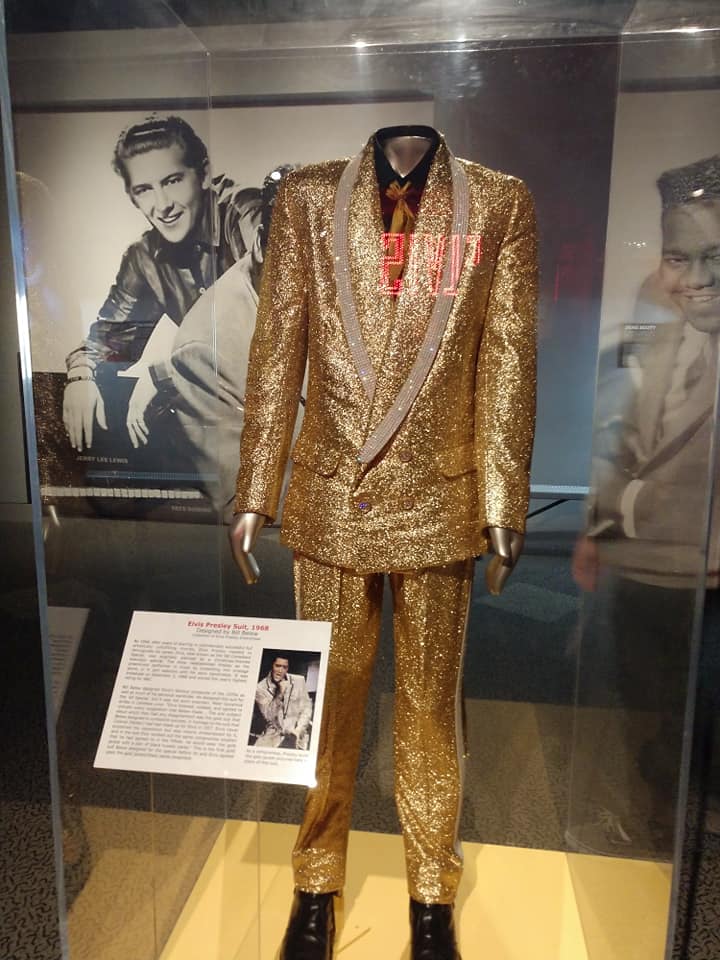
There is a pretty cool section devoted to Elvis, who was one of the first 10 artists inducted into the Hall of Fame.  The Hall has a standing agreement with Graceland in Memphis (which is a museum in itself) and they send memorabilia to them often, so the exhibit changes often.  There was a very cool motorcycle that was custom-built for Elvis.  His gold sequins suit is there, and a jukebox which was given to him as a gift from RCA Records – it contains only Elvis records.  Also on display was a double Gibson guitar which he played in his film Spinout.

53267005_10161789934925195_8610772824132419584_n

The Summer of Love

With the 50th anniversary of the “Summer of Love”, there were some very cool things here.  I saw groovy outfits from the Mama’s and the Papa’s, clothing from Jimi Hendrix, and the HUGE mixing board that was used to record some of Jimi’s music.

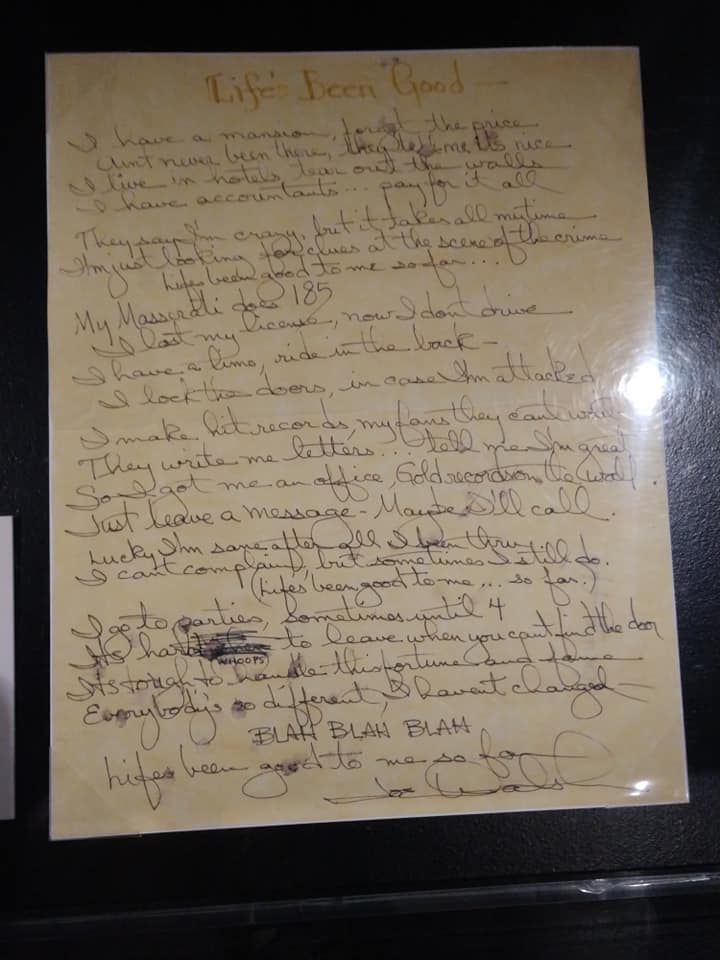
On thing I really liked to see was the various things that song lyrics were written on.  There were quite a few original pieces of paper where the beginnings of songs were scribbled.  There were also plenty of hotel pads of paper with lyrics on them.  Loved seeing where changes were made to lyrics.

54006188_10161789937395195_1572920777320169472_n

Cities and Sounds

I loved that there was a section of the hall that saluted cities and sounds.  There was a section devoted to Memphis, Los Angeles, San Francisco, London and Liverpool, Seattle, and of course, Detroit.

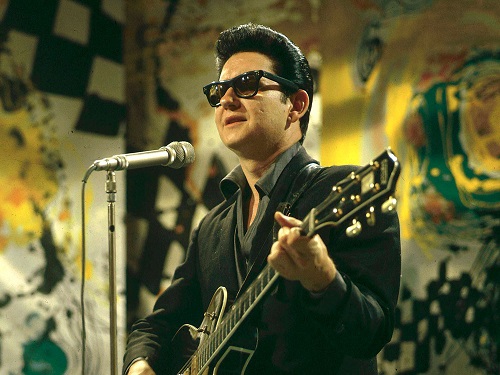
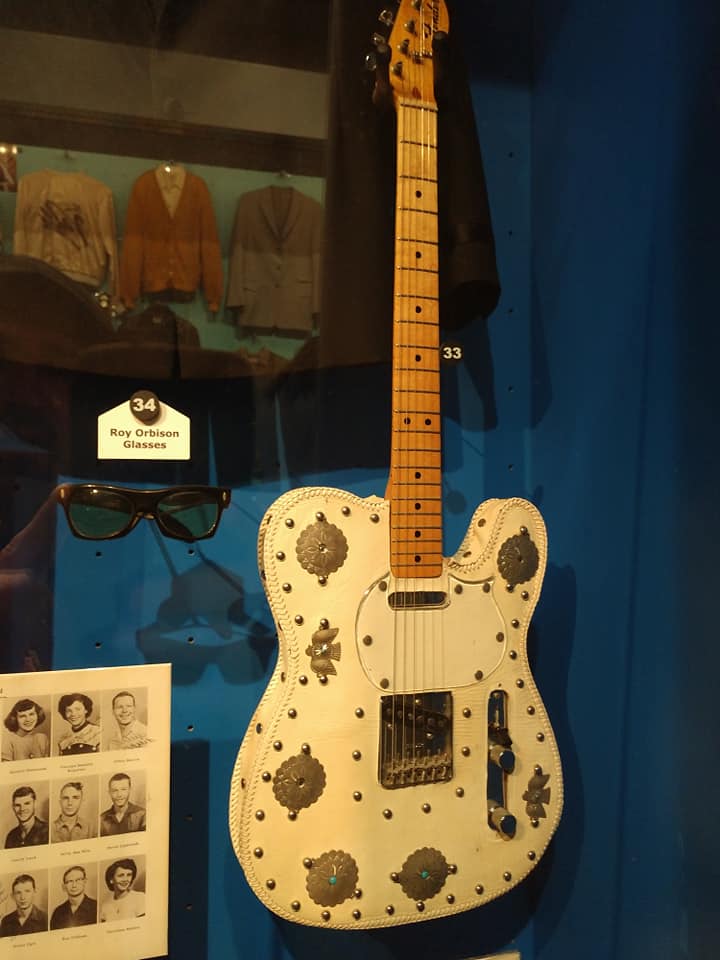
In the Memphis section, there were plenty of neat things from Sun Records.  Johnny Cash, Elvis, Jerry Lee Lewis, Carl Perkins and Roy Orbison all recorded there.  To stand in front of Roy Orbison’s glasses and guitar was pretty awesome.  My earliest musical memories are of my dad playing Roy’s music for me.

54519990_10161789935515195_6488254704332570624_n

A nice tribute to Motown is here with stuff from Barry Gordy, The Supremes (you can see some of their dresses), Smokey Robinson, and the Temptations are all here.  They were playing the episode of To Tell The Truth with Barry Gordy as we walked through this section.

The Beatles and the Rolling Stones each have a nice section at the Hall.  I thought Mick Jagger of the Stones was taller, but standing by some of his outfits, he’s shorter than I thought.  There is the Asher family piano that Paul McCartney donated, some of John Lennon’s outfits, and the handwritten lyrics to “In My Life”.  A very cool documentary was playing in their section as well.

54516932_10161789936490195_739523119886106624_n

I jumped ahead a bit because the next section was London and Liverpool.  There were some very neat things from the Yardbirds, Peter and Gordon, Herman’s Hermits and the Zombies too.  All in all a nice salute to the British Invasion.

San Fran featured stuff from The Grateful Dead and Janis Joplin, while LA featured stuff from The Eagles, Jackson Brown, Joni Mitchell and Neil Young.  One cool thing here was a duffle bag full of hotel keys.  I don’t recall, but I think it said it belonged to one of the Eagles.  They basically kept the hotel key (and keychain) from every place they stayed while on tour.  The bag was stuffed full of some very cool looking keychains!

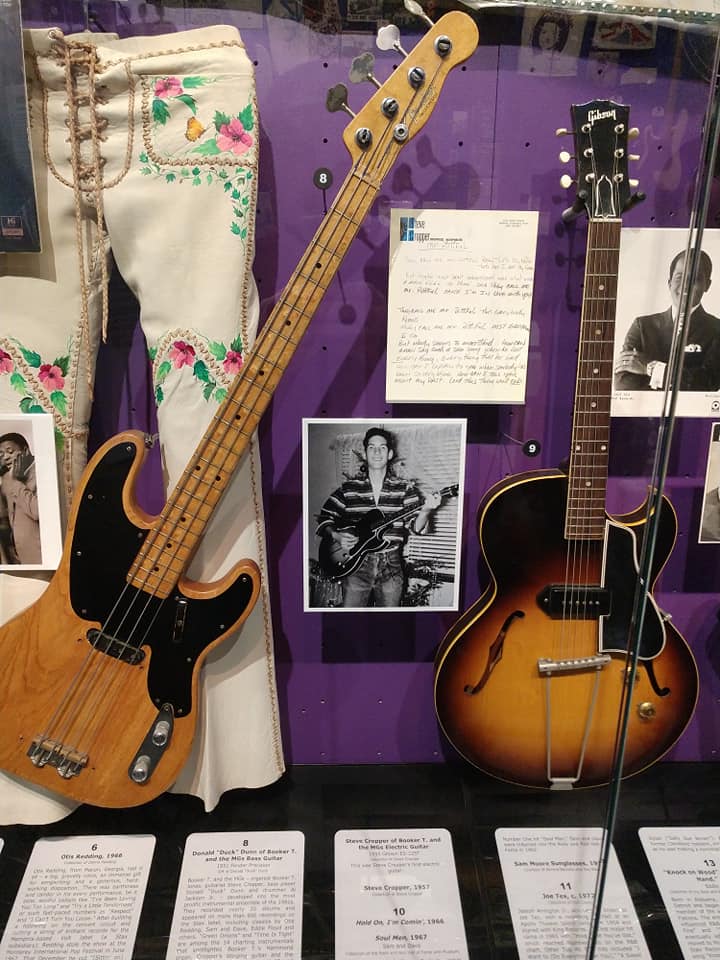
This section also had tributes to grunge music, punk music and a section called “Rave On” which focused on the “pioneers” of rock.  Those pioneers included Fats Domino, Chuck Berry, Little Richard, The Everly Brothers and Buddy Holly.  Soul Music was also spotlighted here with some awesome suits from James Brown, stuff from Aretha Franklin, pieces of the wreckage from Otis Redding’s plane crash, and Sam and Dave.  Featured in the soul section were two amazing things – guitars from Donald “Duck” Dunn and Steve “The Colonel” Cropper.  They played on almost every Atlantic and Stax record.  They were members of Booker T and the MG’s, and also played with the Blues Brothers.  Very cool to see!!!

53747468_10161789935785195_1917066331971125248_n

Don’t worry metal heads, there was a section for Heavy Metal too. Oh, and a section for Rap, as well.

Protests

When Rock and Roll started to make waves, it wasn’t too popular with folks.  We tend to forget the hatred toward the genre, but they had plenty of newscasts about burning records, and protests that happened.  It was weird to watch the hatred toward the Beatles and read hate mail to the Rolling Stones.  Other artists that were discussed in this section were Frank Zappa and ELO.

On the Radio

As a radio guy, it was cool to be able to walk up to an interactive touch screen and select a region of the US and then listen to old airchecks of DJ’s from different eras.  Naturally, I had to listen to some of the Detroit personalities:  Dick Purtain, Robin Seymour, and The Electrifying Mojo!  There were plenty of familiar names from all over the states and it was nice to get to listen to their stuff too.

The Power of Rock

On the third level, there was a wall with each “class” inducted into the Hall of Fame by year.  You could also go to a touch screen and search by class, by year, or by artist, and listen to their music.  SO many great songs!!!

The Power of Rock is a short film by Jonathan Demme which features many performances from past Hall of Fame inductions.  So many stars and so many great songs were in this film.  The theater had a light show and great sound for the film and it was almost like you were watching a concert live.  The film ends with Prince’s guitar solo on While My Guitar Gently Weeps – WOW!  Forgot how amazing that was!  They also had some of the great quotes on the walls of the hallway that you left the theater by.  Prince’s outfit from that show and other outfits were there as well.

54435305_10161789978740195_6405778795239833600_n

Rock on TV

It was also very cool to see some of the TV show memorabilia on this level.  You could go and record something about your favorite singer or album in special booths.  It was pretty cool to stand in front of Dick Clark’s American Bandstand podium!  His microphone was in a glass case with other things like the set design for the Beatles appearance on Ed Sullivan.  They had TV cameras there, Don Cornelius’ suit from Soul Train, outfits from the Jackson Five and Sonny & Cher and the coat worn by Davy Jones of the Monkees that he wore on The Brady Bunch.  There was also some cool musically related stuff from Saturday Night Live, and from various music videos we all watched on MTV.  It was neat to see Paul Shaffer’s keyboard that he played for so many years on the Late Show with David Letterman.

54517032_10161789977990195_3457675619351920640_n

On the Radio – LIVE

One thing I didn’t realize was that Sirius XM broadcasts their “Classic Vinyl” station out of the Hall of Fame.  Rachel Steele was on air when we went through.  There is a glass window that allows you to look into the studio and watch them broadcast.  I actually felt bad for her.  One thing radio people like is the fact that they can go in to work without really worrying about what to wear, because….who is going to see you!?  Whoever is on the air here, really has to “doll up” every day.

Over all, I loved every second of my visit here!  Any music lover would enjoy themselves!!  If you have never been …. you have to!

Christmas in March

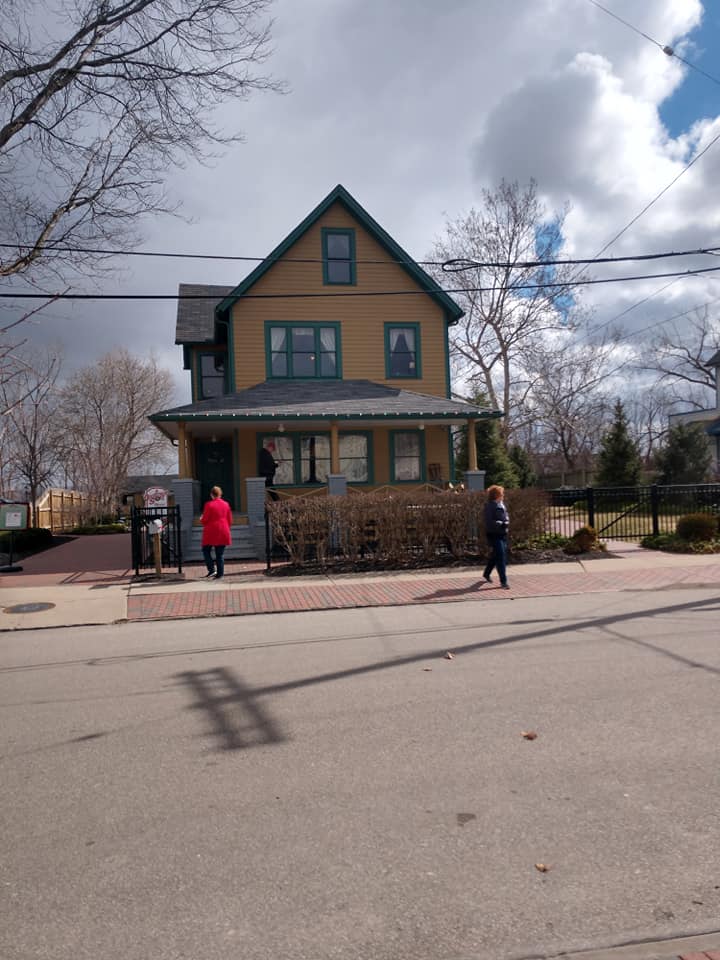
The final stop on the trip was The Christmas Story House.  It is the house featured in the holiday classic.  They renamed the street “Cleveland Street” in honor of the movie.  The Leg Lamp proudly sits in the front window and the Bumpass House is next door.

53831202_10161795223795195_7413545351728070656_n

This is such an inexpensive treat!  The house looks a little different on the inside, but they have restored much of it to be exactly like it looks in the film, which took a bit because there were a few owners since the movie.

We were allowed to take as many pictures as we liked.  There was a guide who took us through the house and told some stories.  You can see the bathroom where Ralphie solves Little Orphan Annie’s secret message, you can see the many plugs the tree was plugged into, pick up the phone that Mrs. Parker calls Flick’s mom on, see the boy’s room, and see the damper in the kitchen that billows black smoke because of the “clinker” furnace.

54516017_10161795228065195_6911558146926313472_n

From the backyard you can see the steel mill (still in operation), which helped Jean Sheppard (the author) pick that particular house for the film.  Across the street is a museum with the actual Red Rider BB gun used in the film, outfits from the cast, Darren McGavin’s plaster life mask (used for make up and such), plenty of behind the scenes pictures, and the Old Man’s car.  The gift shop is full of great items and yes, you can purchase a pink bunny suit or a leg lamp (in various sizes).

Sam told me she’d buy me a bunny suit, but only if I wore it every Christmas!  Incidentally, if you have the $$, you can spend the night in the house or next door at the Bumpass house.

The trip was short, but full of good memories.  I love that we were able to do it and I love that we got to spend time with each other. It was the perfect anniversary trip.

Cleveland, does indeed, ROCK!