Dave just wrapped up another chapter of Turntable Talk. This was my contribution:
It is time once again for Turntable Talk hosted by Dave at A Sound Day. For over three years now, he has offered up a musical topic each month for me (and other participants) to write about. This month’s topic is “It’s About Time.”
Dave’s instructions are simple. “Tell us about a song about “time.” It could be one using the word “time” in the title … and there’s no shortage of them… or one that actually somehow explores the passage of, or idea of time.” While this is a topic that is fairly easy, I can’t help but wonder if there will be duplicate submissions.
For example, right off the top of my head I came up with Time in a Bottle from Jim Croce (which I have written about before. Then Time After Time from Cyndi Lauper came to mind. This was followed by Cher’s If I Could Turn Back Time and Huey Lewis’ Back in Time. Before I could shut my mind off Styx Too Much Time on My Hands and Semisonic’s Closing Time entered my mind.
I immediately discarded those, because I am sure that the other participants would choose one of those. So I dug a little deeper and tried to think of a song that might not be someone’s choice. I narrowed it down to No Time by the Guess Who, Just in Time by Dean Martin, Crying Time from Ray Charles, Time is Tight by Booker T and the MG’s, and my choice.
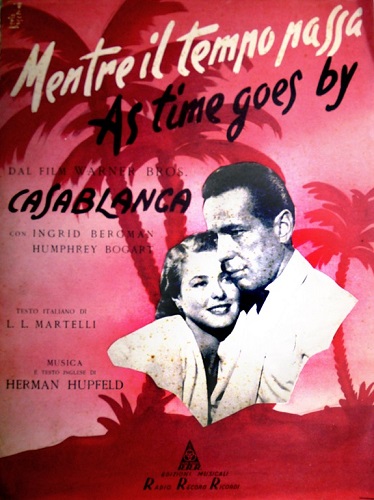
I chose a song written by Herman Hupfeld! Now everyone knows Herman, right? No. Not really, but I am sure you will know the song. It is a song that was written in 1931 for the Broadway show “Everybody’s Welcome.” It was first recorded by Rudy Vallee in July of 1931. It would be covered by Billie Holiday, Louis Armstrong, Frank and Nancy Sinatra, Natalie Cole, Carly Simon and Bob Dylan (Just to name a few).
While the song was recorded a few times after Vallee’s version, it was 11 years later when it would really get noticed. In 1942, the song was sung by the character “Sam” (portrayed by Dooley Wilson) in the classic film – Casablanca. As Time Goes by is heard throughout the film in short musical breaks.
RCA Victor wanted Dooley to record a version of it to be released to the public. However, a musician’s strike happened between 1942 and 1944, so he was not allowed to do so. Instead, the record label re-released the Rudy Vallee version, which went on to become a number one record (11 years after the original release).
Wiki states: Like many later singers, Wilson in Casablanca starts with “You must remember this, a kiss is still a kiss…”, singing only the verses and refrain (“As time goes by”). He entirely omits the intro that put those “fundamental things” into context: “This day and age we’re living in gives cause for apprehension, With speed and new invention and things like third dimension. Yet, we get a trifle weary with Mister Einsten’s theory, So we must get down to earth, at times relax, relieve the tension. No matter what the progress or what may yet be proved, The simple facts of life are such they cannot be removed.”
The song was voted No. 2 on the AFI’s 100 Years… 100 Songs special. The show commemorated the best songs in film.
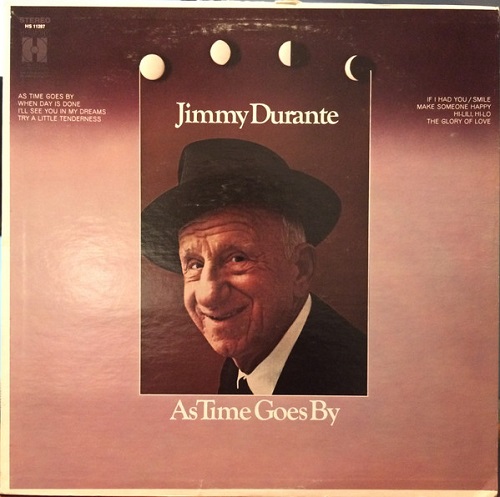
The version I chose to feature is by a multi-talented comedian, actor, pianist and singer. His voice was instantly recognizable on radio. He was a guest on many television shows and had some success as a singer. He is, however, probably best known for … his nose. His nickname was “the schnozzola.” I am, of course, talking about the great Jimmy Durante.
The song itself is beautiful. Every artist who has covered it brings their own special take on it. There is something that really hits me when I hear Durante’s version. Despite that raspy voice, there is a sincerity that makes it just a bit better than the other versions. I’m not trying to diss the other versions, but none of them give me goosebumps when I hear them. Jimmy’s version does. For some reason, his voice blends so well with the string arrangement.
Before I post the song, you know I have to say it – “Play it again, Sam!”
In a live version, Jimmy adds the intro that many leave out.
Thanks again to Dave for asking me to participate and for hosting this feature. I’m excited to see the choices of the other writers!
This is sort of a continuation of the Music of My Life feature. It focused on music from 1970-2025. It featured tunes that have special meaning to me, brought back a certain memory or a tune that I just really like. I found that with the first three decades, there were songs that I didn’t feature. So I sat down with my original lists and selected some songs that “bubbled under,” so to speak.
I figured a good way to present them was to focus on a decade. 10 years = 1 song per year = 10 songs. Last week I featured the 80’s. This week 10 more 80’s tunes before we move on to the 90’s. So, let’s check out a few “Decade Extras.”
1980
While I was never a truck driver, we certainly listened to Eddie Rabbitt’s Drivin’ My Life Away a lot while driving my my folks. I’m sure it was one of the songs my dad had recorded on 8-track to listen to on our drives up north.
This song was the first song that really made Eddie a crossover artist. The song went to number 5 on the Billboard Hot 100 charts. I Love A Rainy Night followed and hit #1 on the Hot 100, Country and Adult Contemporary Charts. Step By Step and You and I followed in 1981 and 1982 as crossover hits.
It is one of many Eddie Rabbitt songs I love.
Driving My Life Away
1981
Originally done by Tommy James and the Shondells, Mony Mony was covered by Billy Idol. Billy first released his version as a single in 1981, his first as a solo artist after leaving the band Generation X. His live version of the song went to #1 in 1987.
It was a big song at weddings and schools dances. However, it quickly made many school’s “Do Not Play” list. Why? It became popular for kids to shout “hey, hey, what, get laid, get f–ked” during the instrumental break in the chorus. I found this out the hard way at a school prom. I had a lot of requests for the song and when I played it the kids went crazy. When they shouted out the vulgar chant, it only took seconds for a teacher to come up and tell me to turn it off. Apparently, the chant is still shouted at Billy’s concerts.
Weird Al Yankovic did a parody of Billy’s version called “Alimony” on his Even Worse album in 1988.
Mony Mony
1982
It took two releases for the next song to get noticed. I can still remember going to the record store and buying Built For Speed by the Stray Cats. Rock This Town was such a cool thing to hear on the radio for me. My dad played a lot of Rockabilly stuff for me growing up, so I had to go get this album.
When Stray Cat Strut was first released in August of 1982, it didn’t even crack the Hot 100. I think it stopped at #109. Then Rock This Town was released and the band got noticed. The record company decided to re-release Stray Cat Strut and this time it debuted at #43 and went all the way to #3.
Michigan Trivia: Detroiters may remember that WRIF’s (101 FM) JJ and the Morning Crew a parody of this called “Fat Cat Strut.”
Stray Cat Strut
1983
The Eurythmics are Annie Lennox and Dave Stewart who actually dated for a while. Lennox said in an interview that they wrote this song after the two had a huge fight. Dave came up with a beat, Annie improvised the synthesizer riff, and suddenly they realized they had a potential hit.
In an interview with songfacts.com, Stewart said “We thought we’d made something really special but we had no idea, really, the impact it would have. Neither did the record label, which didn’t even think it was a single.”
Three other songs from the album were released as singles in the UK before their label, RCA, finally issued “Sweet Dreams.” When they did, it took off, climbing to #2.
Songfacts says about the video:
The video presented Lennox with close-cropped orange hair and a tailored black suit, making it the first popular video presenting an androgynous female. The cow in the video was Dave Stewart’s idea – he was a big fan of surreal artists Salvador Dali and Luis Bunuel. Said Stewart: “A few people were saying, ‘Dave, why the cow? Annie is so good looking.’ Those people should go buy a copy of Purple Cow by Seth Dogin, about how to make your business remarkable. It was written 20 years after I had the purple cow in our video – which certainly did the trick and made my whole life remarkable.”
The cow, while very eye-catching, posed a logistical problem because most studios can’t accommodate them. Eurythmics found a basement studio in London with an elevator big enough to transport the animal. Lennox recalls the shoot with the bovine walking around as being one of the more surreal experiences of her life.
This song used to drive my former sister-in-law crazy. I’m not sure why, but whenever I DJ’s a family party or an event that she was at, I always played this song.
Sweet Dreams Are Made of This
1984
The next song got it’s title from a 1979 movie. Time After Time is the name of a 1979 science fiction movie starring Malcolm McDowell as H.G. Wells, whose time machine is stolen by Jack The Ripper, who uses it to travel from 1893 to 1979. Wells follows him into the future and goes on a quest to stop him from killing.
Cyndi Lauper wrote the song with Rob Hyman of The Hooters. Hyman told Songfacts: “When she saw Time After Time, something clicked. She said, ‘I think I have a title.'”
Once the title was in place, they set about writing the song. Hyman explained: “I was sitting at the piano and just started banging out what would eventually be the chorus, hook, and the way we sing it. It almost had like a reggae feel, it was a little bouncier and a little more upbeat. We started getting off on that chorus, then the verse melodies started to appear.
It’s a deceptively simple song. The verses are just a little repeating three-note motif – almost like a nursery rhyme, a very simple song. Then we started to realize we were on to something. The mood of the lyrics came from both of us. I think Cyndi came in and really started the lyric flow, then all of the sudden we realized it wasn’t such a bouncy song, but it was a little more bittersweet and a little deeper in its feeling and a little more poignant, so the music started to change. We wrote a little bridge section and I think the last thing we really wrote was the chorus. We had ‘Time After Time,’ we just had to get the words that would surround it.”
This song surprised me. Compared to Girls Just Wanna Have Fun and She Bop, this song was kind of deep. This one and True Colors really made me appreciate her talent.
Time After Time
1985
My Detroit Tigers are doing very well so far this season. I hope they keep it up! From 1985, here is a song that I have written about in the past Centerfield.
Centerfield
1986
My dad always played me classics from Elvis, Roy Orbison, Buddy Holly and Little Richard. I remember my dad coming home and saying, “Keith, you gotta hear this Little Richard song.” It was a song that was featured in the movie Down and Out in Beverly Hills with Richard Dreyfus.
Honestly, it sounded like something he could have done in the 50’s. Great Gosh A’Mighty must have been the cleaned up version for the film, because Little Richard also recorded a Great God Almighty version, too.
The song is always one I play on repeat on the iPod.
Great Gosh A’Mighty
1987
Randy Travis was one of the coolest country stars I’ve had the chance to meet. He was so down to earth and friendly. We talked about music, family and faith. It was like talking to an old friend.
I feel Forever and Ever, Amen is right up in the Top 10 best country songs of all time. It was written by two of the best songwriters in Nashville – Paul Overstreet and Don Schlitz. The two had already wrote Randy’s hit “On the Other Hand,” and I love the story of how this one came to be.
Overstreet told Songfacts:
“I had played about 36 holes of golf that day, and Don says, ‘I’ve got this idea we have to write.’ His new fiancée’s little boy was learning the Lord’s Prayer, and he was going around saying ‘forever and ever amen’ after everything. He would say, ‘Mommy, I love you. Forever and ever, amen.’ So Don said, ‘We’ve got to write this.’ I said, ‘How about tomorrow?’ He says, ‘No, now.'”
They got together on Overstreet’s front porch that night and composed the song by candlelight. Confident it was a hit, they recorded a demo the next day and sent it to Travis, who made it the lead single to his second album, Always & Forever. It was indeed a hit, spending three weeks at the top of the Country chart, longer than any other song in 1987.
Forever and Ever, Amen
1988
Another cover song on the list – this time, a cover of Elvis Presley. I remember hearing Cheap Trick’s version of Don’t Be Cruel and loving it! I remember really digging the spots in the song where that running bass line can be heard. The key change was something that stood out for me.
I hate to diss on the King, but I almost love the Cheap Trick version a bit more. There is so much going on that really takes the song to another level – that drum beat, the fake cold ending, the guitar solo and so much more. I played the heck out of this 45
Don’t Be Cruel
1989
The final pick comes from the movie UHF from Weird Al Yankovic. In a recent Turntable Talk feature, I talked about the David Lee Roth video for Just a Gigolo. At the end of it, I wondered if Dave borrowed from the music video for UHF’s title song.
While the video for the song is hilarious and brilliant, the song itself is one of my favorites from Al. It is not a parody, rather an original. It is a song that sounds like something you would hear on the radio in ’89. It has an alternative rock feel to it.
It’s an underrated and often forgotten Al song
UHF
What a way to wrap up the 80’s! I hope you heard some tunes you liked, too. Next week we’ll move on to the 1990’s and see what songs bubbled under my original list. See you then!


 Various Ramblings of a Nostalgic Italian