Turntable Talk #38 – It’s About Time

Dave just wrapped up another chapter of Turntable Talk. This was my contribution:

It is time once again for Turntable Talk hosted by Dave at A Sound Day. For over three years now, he has offered up a musical topic each month for me (and other participants) to write about. This month’s topic is “It’s About Time.”

Dave’s instructions are simple. “Tell us about a song about “time.” It could be one using the word “time” in the title … and there’s no shortage of them… or one that actually somehow explores the passage of, or idea of time.” While this is a topic that is fairly easy, I can’t help but wonder if there will be duplicate submissions.

For example, right off the top of my head I came up with Time in a Bottle from Jim Croce (which I have written about before. Then Time After Time from Cyndi Lauper came to mind. This was followed by Cher’s If I Could Turn Back Time and Huey Lewis’ Back in Time. Before I could shut my mind off Styx Too Much Time on My Hands and Semisonic’s Closing Time entered my mind.

I immediately discarded those, because I am sure that the other participants would choose one of those. So I dug a little deeper and tried to think of a song that might not be someone’s choice. I narrowed it down to No Time by the Guess Who, Just in Time by Dean Martin, Crying Time from Ray Charles, Time is Tight by Booker T and the MG’s, and my choice.

I chose a song written by Herman Hupfeld! Now everyone knows Herman, right? No. Not really, but I am sure you will know the song. It is a song that was written in 1931 for the Broadway show “Everybody’s Welcome.” It was first recorded by Rudy Vallee in July of 1931. It would be covered by Billie Holiday, Louis Armstrong, Frank and Nancy Sinatra, Natalie Cole, Carly Simon and Bob Dylan (Just to name a few).

While the song was recorded a few times after Vallee’s version, it was 11 years later when it would really get noticed. In 1942, the song was sung by the character “Sam” (portrayed by Dooley Wilson) in the classic film – Casablanca. As Time Goes by is heard throughout the film in short musical breaks.
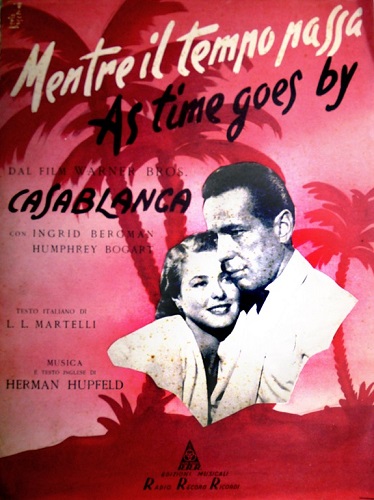
RCA Victor wanted Dooley to record a version of it to be released to the public. However, a musician’s strike happened between 1942 and 1944, so he was not allowed to do so. Instead, the record label re-released the Rudy Vallee version, which went on to become a number one record (11 years after the original release).

Wiki states: Like many later singers, Wilson in Casablanca starts with “You must remember this, a kiss is still a kiss…”, singing only the verses and refrain (“As time goes by”). He entirely omits the intro that put those “fundamental things” into context: “This day and age we’re living in gives cause for apprehension, With speed and new invention and things like third dimension. Yet, we get a trifle weary with Mister Einsten’s theory, So we must get down to earth, at times relax, relieve the tension. No matter what the progress or what may yet be proved, The simple facts of life are such they cannot be removed.”

The song was voted No. 2 on the AFI’s 100 Years… 100 Songs special. The show commemorated the best songs in film.

The version I chose to feature is by a multi-talented comedian, actor, pianist and singer. His voice was instantly recognizable on radio. He was a guest on many television shows and had some success as a singer. He is, however, probably best known for … his nose. His nickname was “the schnozzola.” I am, of course, talking about the great Jimmy Durante.
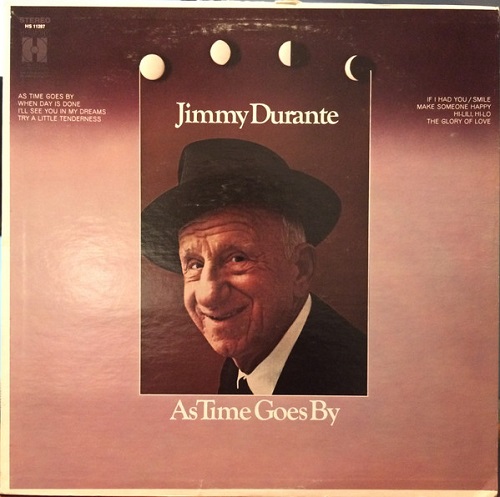
The song itself is beautiful. Every artist who has covered it brings their own special take on it. There is something that really hits me when I hear Durante’s version. Despite that raspy voice, there is a sincerity that makes it just a bit better than the other versions. I’m not trying to diss the other versions, but none of them give me goosebumps when I hear them. Jimmy’s version does. For some reason, his voice blends so well with the string arrangement.

Before I post the song, you know I have to say it – “Play it again, Sam!”

In a live version, Jimmy adds the intro that many leave out.

Thanks again to Dave for asking me to participate and for hosting this feature. I’m excited to see the choices of the other writers!

Thanks for reading and for listening!

The Music of My Life – 1973

Welcome back to The Music of My Life, where I feature ten songs from each year of my life.  In most cases, the ten songs I choose will be ones I like personally (unless I explain otherwise). The songs will be selected from Billboard’s Year-end Hot 100 Chart, Acclaimed Music, and will all be released in the featured year.  I turned three in 1973, so let’s see what music had some influence on me ….

In January of 1973, The Four Tops released their second song on the ABC label.  They had left Motown the year before and this song became their biggest post-Motown hit.  Ain’t No Woman (Like The One I’ve Got) was originally recorded by Hamilton, Joe Frank, and Reynolds in 1972. It’s hard for me to hear anyone else but Levi Stubbs on the vocal.  It reached #4 on the Billboard Hot 100.

Ain’t No Woman (Like The One I’ve Got)

In March of 1973, Elvis released one of my favorite live cuts – Steamroller Blues.  I did a piece on the song for Tune Tuesday a few months back.  You can read that here:

https://nostalgicitalian.com/2024/03/12/tune-tuesday-steamroller/

Elvis added the song to his concert set list and this recording was from his Aloha From Hawaii show. It reached #17 on the charts.

Steamroller Blues

In April of 1973, Gerry Rafferty and Joe Egan’s song about a music industry party was released by their band The Stealer’s Wheel. “Well, I don’t know why I came here tonight” is the opening line of Stuck in the Middle and it makes you want to hear the rest of the story. 

It was a top ten hit for the group, reaching #6 on the charts.  The band was surprised at the success of the song, especially since Gerry’s vocal was meant to sound like a funny Bob Dylan. Many people thought it actually was Bob Dylan singing!

Stuck in the Middle

Also released in April of 1973, the last Top 40 hit for a singing barber.  This song actually seems out of place on my list, but I have a reason it’s here.

Don McLean wrote And I Love You So for his debut album in 1970.  It was the B-side of his single Castles in the Air. Crooner Perry Como used it as the title song for his 1973 album. It would peak at #29 on the charts.

I include it here because when my old morning show partner and I would go out and sing karaoke, he used to sing this one.  I had never heard it before then and I loved the lyrics and melody.

And I Love You So

Another great opening line for a song was from Paul Simon.  “When I think back on all the crap I learned in high school….” Kodachrome was released in May of 1973.  The song was originally written as “Going Home,” but he didn’t think it worked.  Kodachrome sounded similar and he went with that.

It has been said that the song is a sort of admiration for all the things that brighten the world.  After his lamenting about high school,  his world becomes alive with memories.

Kodachrome

Also released in May of 1973, a song that is based on real events and has one of the greatest opening riffs of all time. Smoke on the Water is the story of how Deep Purple was getting to record in a mobile studio they rented from the Rolling Stones.  The night before they were set to record, someone fired a flare gun during Frank Zappa’s song King Kong and set the casino venue on fire that destroyed it.  Deep Purple watched the fire from their hotel room and the smoke from the fire across the water led to the song’s title.

The opening riff which was written by guitarist Richie Blackmore, was inspired by “an interpretation of inversion” of Beethoven’s Fifth Symphony.  That intro remains something I love hearing, especially in headphones.  The guitar riff by itself, then the hi-hat cymbal, snare drum kicks, bass guitar and finally the vocal.  SO cool.

Smoke on the Water

The next song has an interesting story. It has it’s origins in a song that I almost picked for my list. From Songfacts.com: In February 1973, Stevenson released the song “Shambala” which was written by the composer Daniel Moore. Two weeks later, Three Dog Night released their version of the song, which became the much bigger hit, charting at US #3 while Stevenson’s version stalled at #66. Stevenson and Moore then got together and re-wrote “Shambala” as “My Maria,” changing the lyrics so the song became an ode to a beautiful woman. The ploy worked, and Stevenson had by far his biggest hit. (It went to #9 on the Billboard Hot 100.)

Brooks and Dunn enjoyed a number one country song with their cover of the song in 1996.

My Maria

Another song that was inspired by real events was from Jim Croce. In 1970, Jim Croce wrote Time in a Bottle the night that he found out his wife, Ingrid, was pregnant. Songfacts.com says: The couple had been married for five years, and Ingrid found out she was pregnant when she went to a fertility specialist. She recalls a mix of terror and delight in Jim’s reaction when she told him the news. The child was a boy named Adrian, who grew up to become the singer-songwriter A.J. Croce.

The song was released in November of 1973, and it hit #1 in America 14 weeks after Croce was killed in a plane crash in September.

For the record, I have never been to a whorehouse. The next song is a classic rock standard about the aforementioned establishment. The boys of ZZ Top based La Grange on John Lee Hooker’s Boogie Chillin’, and there is even a vocal tribute to Hooker as Billy Gibbons sings “Ho Ho Ho Ho!”

Again from Songfacts.com: The place in this song is the subject of the 1982 movie The Best Little Whorehouse In Texas, starring Dolly Parton and Burt Reynolds, which was adapted from a 1978 Broadway play. In a 1985 interview with Spin magazine, ZZ Top bass player Dusty Hill explained: “Did you ever see the movie, The Best Little Whorehouse in Texas? That’s what it’s about. I went there when I was 13. A lot of boys in Texas, when it’s time to be a guy, went there and had it done. Fathers took their sons there.

La Grange

We wrap 1973 with another great classic rock song. “I was cutting a rug down at a place called the Jug with a girl named Linda Lou…” the story begins and right from the get go trouble is brewing!  Lynyrd Skynyrd released Gimme Three Steps in November of 1973.

From Songfacts.com: This song is based on a true story. As Skynyrd guitarist Gary Rossington tells it, lead singer Ronnie Van Zant, who was about 18 at the time, used a fake ID to get in a bar while his younger bandmates Rossington and Allen Collins waited for him in a truck. Van Zant danced with a girl named Linda, whose boyfriend, who was not too happy about it, came up to Ronnie and reached for something in his boot. Figuring he was going for a gun, Van Zant told him: “If you’re going to shoot me it’s going to be in the ass or the elbows… just gimme a few steps and I’ll be gone.” He ran to the truck, and he, Rossington, and Collins wrote this song that night.

This was one of the few songs Skynyrd released as a single. It was their first major-label release, and it didn’t chart, which simply amazes me. It is a song that has truly become a party classic. I think I got more requests for this one than Sweet Home Alabama at weddings. Maybe it wasn’t a hit, but I have certainly heard this a lot throughout my life, and I always sing along!

Gimme Three Steps

That wraps up 1973 for me. Did you have any favorites from that year? Next week, we move on to 1974. See you there!

Tune Tuesday – Time in a Bottle

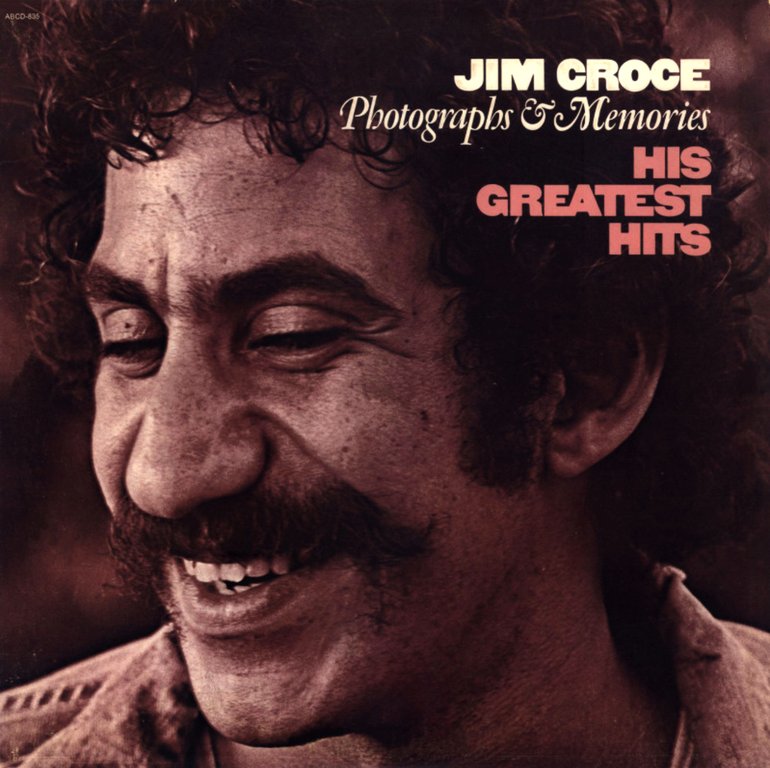
One of the albums I picked up on vinyl to play on the record player my wife bought me for my birthday was Jim Croce Photographs and Memories – His Greatest Hits.

croce

This song hit #1 about 14 weeks after he died in a plane crash in 1973. He wrote this song on the night that he found out his wife was pregnant. They had been married 5 years and while visiting a fertility specialist, she found out she was pregnant. His wife said she will always remember the “mix of terror and delight” in his reaction when she told him. (Side note: They had a son named Adrian, who went on to achieve success as a songwriter. He was AJ Croce.)

The song appeared on his 1972 album – You Don’t Mess Around With Jim. The song was never intended to be released as a single. It was used in a TV movie about a woman with cancer entitled She Lives (starring Desi Arnaz Jr. and Season Hubley). The movie aired a few weeks before his death. TV stations were getting hundreds of calls wanting to know who sang the song and where they could buy it! The following day, the record label got orders for 50,000 copies of the album. The song became the 3rd posthumous #1 song of the rock era. The first was Otis Redding’s Dock of the Bay, and the second was Janis Joplin’s Me and Bobby McGee.

I always loved the simple guitar work in this song, as well as the use of a harpsichord. The harpsichord was kind of an experiment according to producer Tommy West in an article for Mixonline:

“The night before we were going to mix, I was watching a horror movie on TV, and something must have lodged in my brain because when I walked into the studio the next day, I saw this harpsichord sitting in a corner and got an idea. A jingle company had used it on a session and in walked a couple of guys from SIR [Studio Instruments Rental] to haul it away. I asked them to take a lunch break and told Bruce to put a couple of mics on it. He was whining that it was out of tune, but I asked him to let me try something. I added two tracks of harpsichord, told the movers they could remove it, walked into Jerry’s office and asked if I could borrow the electric bass that was sitting on his couch, played that on just the second verse and the outro, and that was that! Radio compression worked in our favor on that record. It made the harpsichord blend with the two guitars in an unusual way. But we thought this record would only be an album cut.”

I love the way it sounds and it really makes the song more haunting and lovely. For me personally, I completely understand how Jim feels. I want to bottle up every minute and spend it with my wife. Even when time is over, I want to have that extra bit bottled up to continue sharing special moments with her. She is the answer to my every wish, just like the song says. Yes, she is the one I want to go through time with – forever. This weekend, this song took on a whole new meaning to me … for reasons I will keep to myself for now.

“Time In A Bottle”

If I could save time in a bottle
The first thing that I’d like to do
Is to save every day till eternity passes away
Just to spend them with you

If I could make days last forever
If words could make wishes come true
I’d save every day like a treasure and then
Again, I would spend them with you

But there never seems to be enough time
To do the things you want to do, once you find them
I’ve looked around enough to know
That you’re the one I want to go through time with

If I had a box just for wishes
And dreams that had never come true
The box would be empty, except for the memory of how
They were answered by you

But there never seems to be enough time
To do the things you want to do, once you find them
I’ve looked around enough to know
That you’re the one I want to go through the time with