Turntable Talk #44 – That’s What Christmas Means to Me

It is time once again for Turntable Talk, our monthly feature hosted by Dave at A Sound Day. This is round #44 and with it being December, his topic is “That’s What Christmas Means to Me”.  Our instructions this month: This time, just think about Yule time and pick a song – Christmas-themed or not – that sums up your feelings for the day and season. Happy, loving, hopeful, stressful, over-commercialized, religious reflection… you pick it and give it a mini-soundtrack!

I had a hand full of songs that I thought about choosing. Ultimately, I always felt that there was something in the lyric that really didn’t fit the theme. At one point, I almost went through and picked a set of lyrics from one song and more lyrics from another thinking I could piecemeal something together. So I went back through my hard drive of Christmas songs….

Christmas has always been my favorite holiday. If you go back over the many blogs I have written for my page, I think you will find the majority of them are Christmas related. There is something magical about Christmas especially if you are a child. That’s why I almost picked 364 Days To Go from Brad Paisley who sang:

Don’t you get the sense tonight
That for now the world is right
And as another Christmas ends
My mind drifts and once again
I’m thinking like a six year old
Only 364 days to go

Another song I almost chose is one that I wrote about a couple of years ago. At that time, Frank Sinatra’s Christmas Memories really hit home for me. As he ends the song with the line, “Funny, but comes December, And I remember every Christmas I’ve known.” It hits home. As the Nostalgic Italian, I find myself looking back at pictures of Christmases gone by and can remember bits and pieces about each one.

Instead, I chose another Sinatra song to explain part of what Christmas means to me. Before I go into the details, let me be clear that Christmas remains a very special day for me. I enjoy watching the kids ripping open their presents and shouting with excitement. I love our tradition of having homemade cinnamon rolls for breakfast. There is an energy and feeling like no other on Christmas morning.

But all too often, I will find myself drifting off in memories of what Christmas used to be like for me. Those old feelings that I attempt to capture, but cannot because the “cast” has changed or disappeared. That is where Frank Sinatra’s “Whatever Happened to Christmas?” comes in.

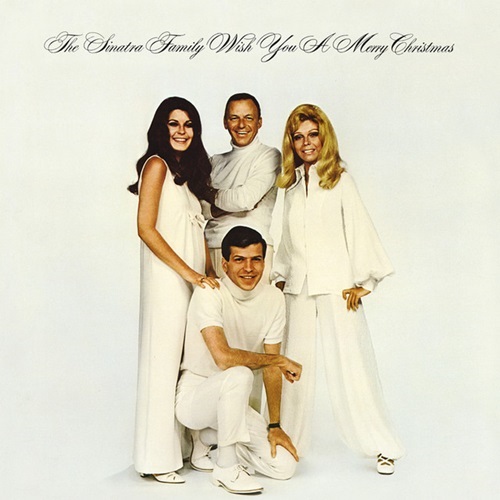
Whatever Happened to Christmas can be found on the 1968 album, “The Sinatra Family Wish You a Merry Christmas.” The song was actually released as a single and became a Top 10 record, peaking at number 7 on the Hot 100 Chart.

I must say that the song is deep and reflective. It is far from the “jolliness” of Jingle Bells or Let It Snow. But there is a sort of lesson there. I’ll post the song in a paragraph or so, but for now, look at the lyrics:

Whatever happened to Christmas? It’s gone and left no traces,
Whatever happened to the faces or the glow,
Whatever happened to Christmas, to Christmas way of living?
Whatever happened to the giving, the magic in the snow?

Remember the sight and the smell and the sound,
And remember hearing the call,
Remember how love was all around, whatever happened to it all?
Whatever happened to Christmas, bells in the streets were ringing,

Whatever happened to the singing, the songs we used to know.
Whatever happened to this Christmas, and when did it disappeared from view,
Where was I, and whatever happened to you?
Whatever happened to Christmas and you?

The song is about loss. It is also about change as we get older. “The Christmas way of living” from our youth is very different from it today. The snow was magical then, but a pain to shovel now. Just walking around town or in a store, there was the happiness and love that was felt by every one. When did the bells stop ringing? When did the singing stop? Where is the Christmas that was “just like the ones I used to know” (to quote Bing Crosby)?

This song connects to a reflective time long after Christmas morning is over and I get a moment to myself. There is a sense of sadness as I think back to my childhood and the innocence of it. I think about the possibilities and creativity that new toys brought my way. I think about the people who were key players in those special Christmas memories who are no longer here. And yet, while there is sadness, there is the lesson.

The lesson can be summed up in a quote attributed to Dr. Seuss: “Don’t cry because it’s over. Smile because it happened.”

So let me try to take this “downer” and bring it up a bit. When it comes to Christmas, there was (in the past) and is (in the present) a wonder to it all. That wonder, that magic, and that feeling is something that was worth celebrating then, and is worth celebrating now. When you celebrate, remember the past, but don’t let it control the present.

Thanks again to Dave for asking me to participate. I hope that this contribution doesn’t stop him from asking me to take part in next month’s topic.

To those of you who celebrate Christmas, I wish you and yours a very Merry and Blessed Christmas. For those who do not celebrate, I wish you a very happy holiday season. I thank you for reading and hope to see you next year!

Turntable Talk #43 – Spooky Tunes

It’s time once again for Turntable Talk. This is the 43rd round and since it will begin around Halloween, Dave from A Sound Day asked us to “pick a song that you like that is either about a scary story or person, or just sounds kind of spooky or scary to you.” What do you choose?

There are many songs that come to mind. Because my piece will be toward the end of the contributions, I am avoiding the obvious ones: Monster Mash, Werewolves of London, Purple People Eater, Witch Doctor, Thriller, Ghostbusters, etc… I am sure by the time this publishes, at least one or two of these will have been chosen.

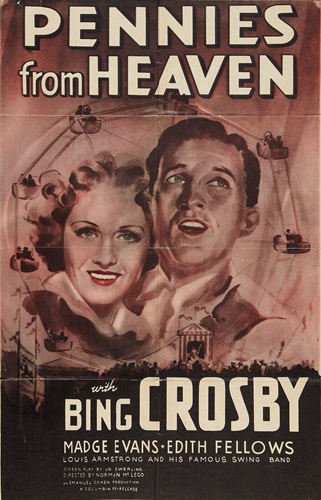
I have chosen to go with an odd tune that you may not be familiar with. It was actually a movie song from the 1936 film, Pennies From Heaven. The film starred Bing Crosby and Louis Armstrong. He was hired for the film at the insistence of Bing Crosby, Bing was a lifelong student, friend, collaborator and admirer of Armstrong. When the film came out, Armstrong got his own credit during the main titles, making him the first African-American to get featured billing alongside white actors. 

According to the Wonderful World of Louis Armstrong, Louis was “playing a bandleader who is hired by Crosby to perform at his nightclub, Armstrong’s “role, as written, makes one cringe,” according to Lawrence Bergreen. Bergreen quotes an exchange between Armstrong and Crosby in the film, comedically playing on the ignorance of Armstrong’s character, who asks for seven percent instead of accepting Bing’s offering of ten percent because his is a seven-piece band, “And none of us knows how to divide ten percent up by seven.

Bergreen writes that this banter dwells “on black inferiority and subservience” but what he doesn’t mention is that Pops (Armstrong) legitimately loved this scene, quoting it in front of friends on one of his later private tapes. One of his last television appearances was made with Crosby on the David Frost Show from February 10, 1971. During the interview portion, Armstrong talks about how much fun they had making the film and though 35 years had gone by. Armstrong quotes the entire “percent” scene, line by line, as it originally appeared in the film. Thus, it’s easy for a white critic to “cringe” while watching Pennies From Heaven but for Pops, funny was funny and he cherished the gags he was asked to deliver.

The lone song that Armstrong has to himself in the film is called “The Skeleton in the Closet.” As you watch this clip, I hope you appreciate the story telling and acting by Armstrong. I love watching him in this. He is completely enjoying himself while performing this. That is why I want you to see the movie scene first. The recording is good, but you certainly lose out by not being able to watch him.

The Wonderful World of Louis Armstrong says this about the recorded version: “The “spookiness” of the record gave the arranger the license to use all sorts of unusual harmonies and nonchord tones, things that would sound pretty modern ten years later, but just convey a haunted house spirit when used as they are on this record. ” Give it a listen.

Here are the lyrics:


There’s an old deserted mansion on an old forgotten road
Where the better ghosts and goblins always hang out
One night they threw a party in a manner a la mode
And they cordially invited all the gang out

At a dark, bewitchin’ hour when the fun was loud and hearty
A notorious wall flower became the life of the party
Mmm, the spooks were havin’ their midnight fling
The merry makin’ was in full swing
They shrieked themselves into a cheerful trance
When the skeleton in the closet started to dance


Now a goblin giggled with fiendish glee
A shout rang out from a big banshee
Amazement was in every ghostly glance
When the skeleton in the closet started to dance

All the witches were in stitches while his steps made rhythmic thumps
And they nearly dropped their broomsticks when he tried to do the bumps
You never heard such unearthly laughter, or such hilarious groans
When the skeleton in the closet rattled his bones

A Halloween classic? Probably not. However, it is a fun song that fits right in with Dave’s topic this month. I really hope that you enjoyed it and aren’t upset that I passed on “the usual” hits. The thing I love about Dave’s feature is being exposed to songs that are new to me.

Thanks again to Dave for hosting my favorite monthly feature to write for. I look forward to the next topic.

Thanks for reading!

Halloween Repost

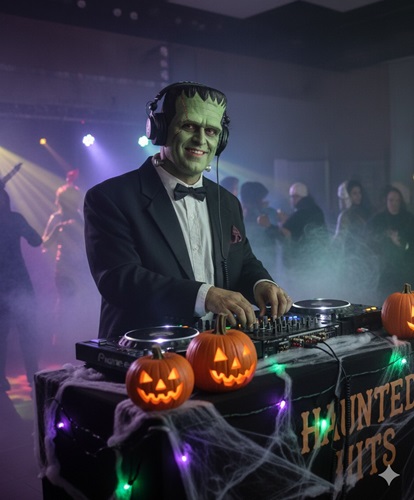
I know that this may step on the toes of Dave over at A Sound Day as his feature Turntable Talk this month will feature write ups about “Spooky Hits.” What follows is a piece I wrote about DJing Halloween Parties and the “must have” songs.

It shouldn’t ruin Dave’s feature much, as all I am doing is listing songs. So be sure to be on the lookout for Dave’s Spooky edition of Turntable Talk starting today.

(This post was originally from October of 2022.)

I have DJ’d countless Halloween parties. This year I had to turn down one of my favorite ones. For the past few years a local daycare throws a big party and kids and their parents dress up in costumes and it is always a blast. Due to my current work schedule, I was just not able to be there this year.

I always had to have a variety of “haunted” hits to play at these parties. In case you are looking for musical ideas for your Halloween party, here is a starter list.

As much as I hate this record, you have to play Bobby “Boris” Pickett

You’ve also gotta play Michael Jackson’s Thriller. (Love Vincent Price’s narration in this!)

A personal favorite is from the Classics IV – Spooky

I always loved Jumpin’ Gene Simmons version of Haunted House

A favorite of the kids – This Is Halloween from The Nightmare Before Christmas

Speaking of nightmares, DJ Jazzy Jeff and The Fresh Prince offer up Nightmare on My Street

A great one from The Eagles – Witchy Woman

Kid Rock sampled this one for All Summer Long – Werewolves of London from Warren Zevon

You gotta play Clap for the Wolfman from the Guess Who

How about the silly song called The Blob by The Five Blobs?

The Hocus Pocus movie brought this one back, but the original is the best version – I Put a Spell On You by Screaming Jay Hawkins

How about some Rockwell? Somebody’s Watching Me

Be careful who you run around with …. Van Halen – Runnin’ With the Devil

Another favorite of mine – Santana – Black Magic Woman

It’s a very rare occurrence to have a full moon on Halloween, but this song works all year round. Bad Moon Rising – CCR

The moon causes the Shadows in the Night – Pat Benatar

Beware of the walking dead …. Zombie by the Cranberries

Another overplayed Halloween Song – The Purple People Eater – Sheb Wooley

I suppose you have to play Ray Parker Jr. – Ghostbusters

Going back to the 50’s for a couple crazy songs …

The Mummy from Bob McFadden and Dor

From Chipmunk creator David Seville – The Witch Doctor

Grab a bite with a vampire – Dinner With Drac from John Zacherle

Three Devilish songs now –

Devil with the Blue Dress – Mitch Ryder and the Detroit Wheels

Sympathy for the Devil – The Rolling Stones

A classic from The Charlie Daniels Band – The Devil Went Down to Georgia

Alice Cooper did this one in Wayne’s World – Feed My Frankenstein

Speaking of Frankenstein – how about the Edgar Winter classic instrumental..

Need some cowbell?? Don’t Fear The Reaper – Blue Oyster Cult

A song I have blogged about in the past – Superstition – Stevie Wonder

Demons – Imagine Dragons

Trick or Treat … I Want Candy – Bow Wow Wow

Another 80’s flashback … Dead Man’s Party – Oingo Boingo

Lots of requests for Enter Sandman – Metallica

All good lists need a cut from Frank Sinatra – Witchcraft

I’ve never really understood how this is a Halloween song, but everyone wants to do the Time Warp from the Rocky Horror Picture Show

From another film (Rain Man) The Delta Rhythm Boys -sing about Dem Bones

Now, some kid favorites which had me searching YouTube a lot ….

Spooky Scary Skeletons

I sang this in music class when I was in elementary school and kids are still singing it today – Witches Brew

Then you can fill in with various Theme songs from films and TV …

Scooby Doo

Tales From The Crypt

The Twilight Zone

The Munsters

The Addams Family

The X-Files

Whew!!

Watch for my Turntable Talk pick in the days ahead on Dave’s sight (and eventually here). It is a song that I don’t mention in this blog!

Turntable Talk #42 – Going Out on a High Note

It is time once again for a new Turntable Talk topic from Dave at A Sound Day. Each month he offers up a musical topic for us to write about. This month we are Going out on a High Note. Dave’s instructions to us:

We all have seen artists (not to mention athletes, politicians…) who stick around long after they should have exited gracefully. For this round, pick a musical artist who you think ended their career on a high note, a great final album, or triumphant concert tour before they grew stale.

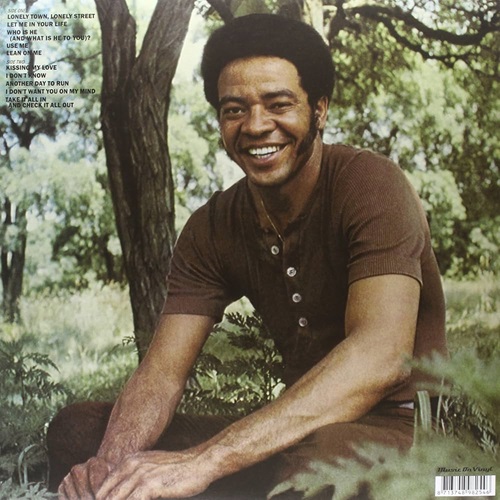
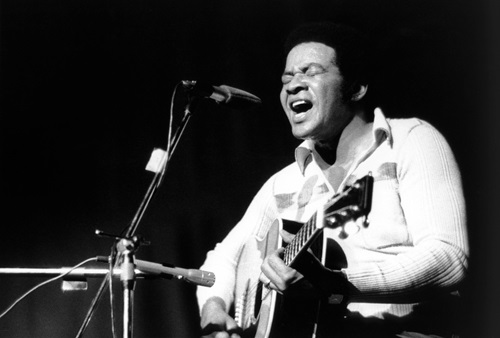
I had a difficult time with this one. As I began to think of artists, I kept coming up with artists who are still recording and touring. Willie Nelson, for example, is still making music and hitting the stage. Has he stayed around “too long?” Some say yes, while other say no. So my search continued. Then I remembered Bill Withers.

Bill served in the US Navy for almost 10 years. It was while he served our country that he began writing songs and became interested in singing. After he left the Navy, he decided to relocate to California in hopes of starting a career in music.

He found work as a mechanical assembler for several different companies including IBM, Ford, and the Douglas Aircraft Corporation. He used the money from his job to record demo tracks that he could take to record companies. He also began to play his songs in nightclubs in the area, hoping someone might discover him.

In 1967, he had his first official release – “Three Nights and a Morning.” It was a song that got little recognition. Three years later, he was signed to Sussex Records and Booker T Jones was assigned to produce Bill’s first album. That album, Just As I Am, included his first hit – “Ain’t No Sunshine.”

The album was a huge success and Withers rounded up a band and went out on tour. “Ain’t No Sunshine” was a Top 10 song and went on to win the Grammy for Best R&B Song in 1972. It also got him noticed by Johnny Carson’s Tonight Show, who sent him a letter inviting him to appear on the show.

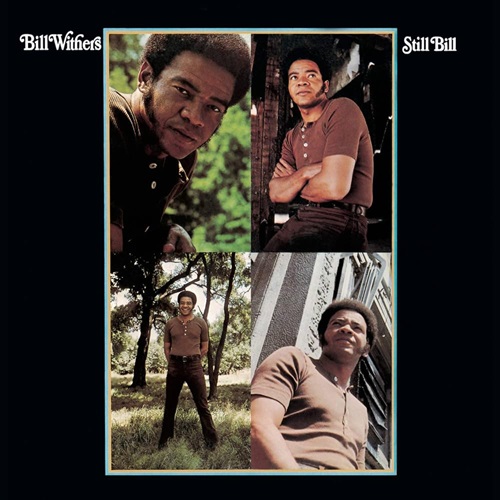
When his tour wrapped up, he used the time off to write and record songs for his second album entitled Still Bill. This album included Bill’s first #1 song – “Lean On Me,” which hit the top of the charts in July of 1972. This was followed up with his third million selling record – “Use Me.”

Bill’s relationship with Sussex record eventually went sour. He said of Sussex Records “They weren’t paying me.” He claims to have erased an entire album that he had recorded for the label in a fit of pique. “I could probably have handled that differently,” he said. There was an ongoing legal dispute with the Sussex company, and because of that Withers was unable to record for some time thereafter.

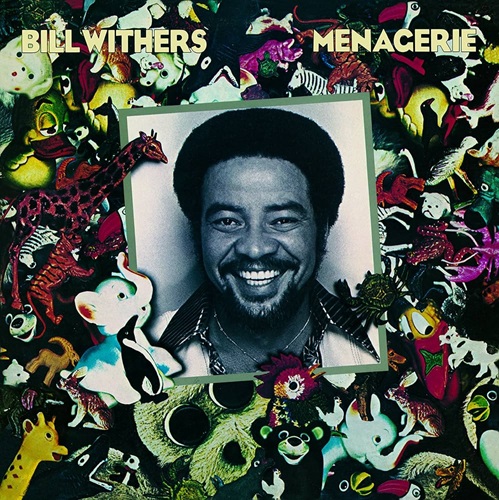
Sussex Records eventually went out of business and Bill had to find a new label. He wound up at Columbia Records in 1975. His first album on Columbia included the song “She’s Lonely,” which was featured in the movie Looking For Mr. Goodbar (which starred Richard Gere and Diane Keaton). He released an album every year afterward, including the 1977 album Menagerie which contained the hit “Lovely Day.”

Bill began to have trouble with Columbia. Apparently he was unable to get songs approved for his album. The label kept passing on the songs he wanted to record. Because of this, he decided to focus on joint projects beginning in 1977. He worked with the Crusaders, percussionist Ralph MacDonald, and jazz saxophonist Grover Washington Jr.

“Just The Two of Us” appeared on Washington’s 1980 album Winelight. It was released as a single in February of 1981 and went on to win a Grammy for Best R&B Song. In 1985, Withers released his final studio album, Watching You, Watching me. It was at this point that Bill decided to “go out on a high note.”

Withers was quoted in interviews that “a lot of the songs approved for the album—in particular, two of the first three singles released—were the same songs that had been rejected in 1982.” This played a big part in the eight-year hiatus between albums. Bill also stated how frustrating it was to see his record label release an album by actor Mr. T, when they were preventing him, an actual songwriter, from releasing his own.

With Columbia trying to exert control over his sound to sell more albums played a part in his decision to not record or re-sign with a record label after 1985. I would imagine the Mr. T thing played a part, too. This effectively ended his performing career, though remixes of his previously recorded music were released well after his “retirement.”

Withers was an artist who found musical success later in life. He was in his early 30’s when he began his career. Now at 47, he said he was socialized as a “regular guy” who had “a life before the music, so he did not feel an inherent need to keep recording once he fell out of love with the industry.” Bill felt he made the right decision. After leaving the music industry, he said that he did not miss touring and performing live and did not regret leaving music behind.

Accolades continued after his “retirement.” In 1988, he won another Grammy, this time as a songwriter for the cover of his “Lean on Me” by Club Nouveau. It won the Grammy for Best Rhythm and Blues Song. In 2005 he was inducted into the Songwriters Hall of Fame, followed in 2015 with his induction into the Rock and Roll Hall of Fame. He said:

“What few songs I wrote during my brief career, there ain’t a genre that somebody didn’t record them in. I’m not a virtuoso, but I was able to write songs that people could identify with. I don’t think I’ve done bad for a guy from Slab Fork, West Virginia.”

Bill passed away in March of 2020 in a Los Angeles hospital due to cardiac complications.

He is still receiving accolades in 2025. Last month, he was selected to be inducted into the National Rhythm and Blues Hall of Fame. The induction ceremony usually takes place in October.

Thanks to Dave for once again hosting Turntable Talk. I am already looking forward to what next month’s topic will be.

Tune Tuesday

Linda Ronstadt turns 79 today!

I have written about Linda a couple times on this blog. Both times were in connection with Dave Ruch’s music feature, Turntable Talk. The first one can be found here. The second one is here.

I have always loved her voice and was devastated when I heard she could no longer sing. It seems like her music has always ben a part of my life. Until I looked at a list of her songs, I didn’t realize just how many covers she did. Blue Bayou, When Will I Be Loved, It’s So Easy, Just One Look, Tracks of My Tears, Poor Poor Pitiful Me, That’ll Be The Day, Desperado, and so many others were all cover songs!

Her albums with Nelson Riddle are among my favorites. She had hoped to do one more album with him, but he passed away. So she took those songs and made the album, Hummin’ To Myself. One of my favorite cuts from that album is, I’ll Be Seeing You. It’s a beautiful song by a beautiful lady.

Happy Birthday, Linda!

Turntable Talk #39 – Bands? We Don’t Need No Stinkin’ Bands!

Dave at A Sound Day just wrapped up his monthly feature Turntable Talk. It was an interesting topic this time around and there were a lot of surprises as to who everyone chose to write about. This was my entry to the feature, which originally posted on Dave’s site on Monday:

It is time once again for Dave’s feature Turntable Talk. Dave features this every month on his site A Sound Day. This is the 39th edition, and he continues to come up with fantastic topics. This month is a fun one: Bands? We Don’t Need No Stinkin’ Bands!  Dave’s instructions were simple: This time around, we’re looking for artists who left popular bands to go solo and did well (either commercially or else in your own critical assessment.)

I am sure that I did exactly what the other participants did when the topic was presented – I Googled. I was actually surprised at just how many artists moved from a group to become a solo artist. Off the top of my head I can list Diana Ross, Sting, Lionel Richie, Eric Clapton, Gwen Stefani, Ricky Martin, Peter Gabriel, Rob Thomas, Steve Perry, Lou Gramm, and Justin Timberlake. There are SO many.

In all honesty, I had my choice almost immediately. However, as I began to write about him, there was another artist connected with him that became more interesting to me. It was an artist who had solo success for a short time, and then a sad ending.

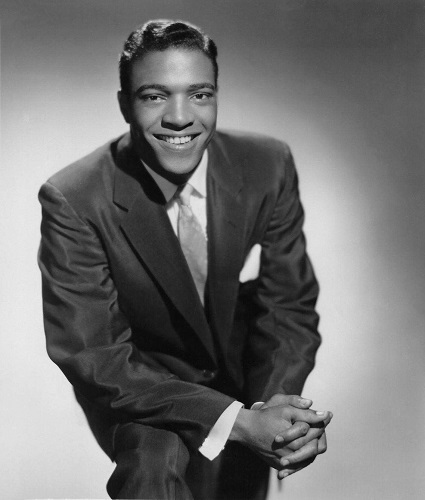
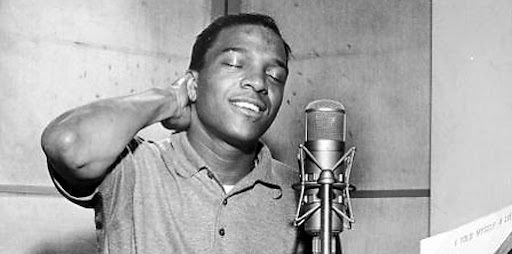
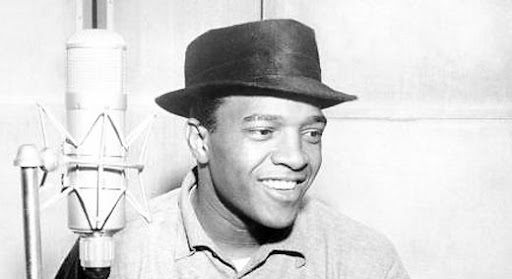
If I mention The Drifters I am sure you can name a few of their big hits. Under The Boardwalk, This Magic Moment, and Up On The Roof are just some of them. The Drifters were formed by my choice artist in 1953. His name was Clyde McPhatter. Let’s go back a couple years to see how it all came together.

Like many artists, Clyde McPhatter began singing in the church choir at his father’s church. In 1950, he was working at a grocery store. He entered the Amateur Night contest at Harlem’s Apollo Theater – and won! Afterward, he went back to working in the store.

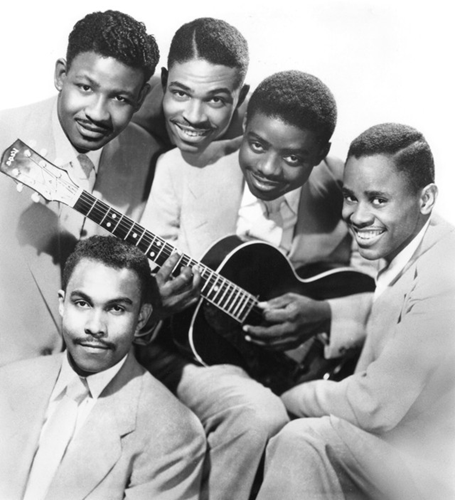
One Sunday, Billy Ward of Billy Ward and the Dominoes heard Clyde singing in the choir of Holiness Baptist Church of New York City. He was immediately recruited to join the group. Clyde was there for the recording of their hit “Sixty Minute Man,” which was a number one song on the R&B chart for 14 weeks in 1951.

My original pick for this round was Jackie Wilson. Jackie was hired by Billy Ward in 1953 to join The Dominoes. That same year, Clyde left the group. He coached Wilson while they were out touring together. Wilson would leave in 1957. Apparently, Ward was not pleasant to work with. Wilson said, “Billy Ward was not an easy man to work for. He played piano and organ, could arrange, and he was a fine director and coach. He knew what he wanted, and you had to give it to him. And he was a strict disciplinarian. You better believe it! You paid a fine if you stepped out of line.”

Atlantic Records saw a Dominoes show and noticed that Clyde was not with the group, so they searched for him, found him and wanted to sign him to a record deal. Clyde agreed to sign on one condition – they allow him to form his own group. That group was the Drifters. While known as Clyde McPhatter and the Drifters, they released songs like Money Honey.

Elvis Presley covered Money Honey in 1956. In researching for this piece I was surprised to find that McPhatter and the Drifters did the original of another Elvis hit – Such a Night.

In late 1954, McPhatter was inducted into the U.S. Army. He assigned to Special Services in the continental United States. This allowed him to continue recording. After his tour of duty, he left the Drifters and launched a solo career. The Drifters continued as a successful group, but with many changes in personnel, and the group assembled by McPhatter was long gone by the time their greatest successes were released after he left the group.

It would take two years, but Clyde would finally get his first solo #1 R&B hit when he released “Treasure of Love” in 1956. It would top out at #16 on the US Pop Chart. I love his vocal on this one.

His biggest solo hit would come in 1958 when he recorded and released a song written by Brook Benton. A Lover’s Question would reach #6 on the Pop Chart. If I had to pick my favorite Clyde song, it would be this one. There is so much to love about this song. That acapella bass line being sung throughout the song is very catchy.

McPhatter would leave Atlantic Records and bounce from label to label recording many songs, but not having much success. His last top ten record would come in 1962 with a song written by Billy Swan. Lover Please was first recorded by the Rhythm Steppers in 1960. It was the title track from Clyde’s 1962 album of the same name. It would reach #7 on the Pop Chart.

Clyde did manage to have a top 30 hit in 1964 with “Crying Won’t Help You Now,” but when it fell of the chart, he turned to alcohol for comfort. He would record every so often, but nothing ever really did well on the charts. He always had a decent following in the UK, so in 1968 he moved to England.

He wouldn’t return to the US until 1970. Outside of performing on a few Rock and Roll Revival shows, he lived a very private and reclusive life. In 1972, Decca Records signed him and they were planning a a big comeback. That never materialized as Clyde passed away on June 13, 1972 of complications from liver, heart and kidney disease. This was brought on by his alcohol abuse years earlier. He was only 39 years old.

His legacy consists of over 22 years of recording history. Clyde was the first artist to be inducted twice into the Rock and Roll Hall of Fame, first as a solo artist and later as a member of the Drifters.

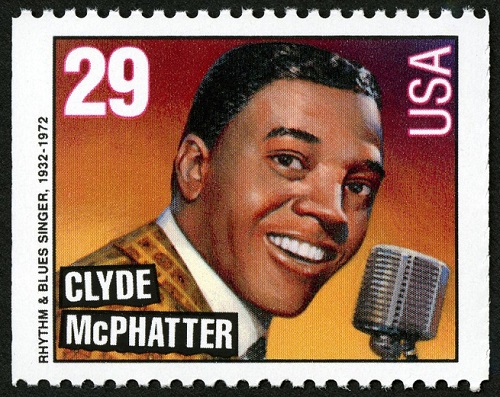
In 1993, Clyde was honored with his own stamp by the US Postal Service.

His career had ups and downs, and his hit songs were an important part of Rock and Roll history. Vocalists like Marv Johnson, Smokey Robinson and Ben E. King are all said to have patterned their vocal styles on Clyde’s. Others have cited him as a major influence as well. In the book “The Drifters” by Bill Millar, he says:

“McPhatter took hold of the Ink Spots’ simple major chord harmonies, drenched them in call-and-response patterns, and sang as if he were back in church. In doing so, he created a revolutionary musical style from which—thankfully—popular music will never recover.”

Thanks again to Dave for hosting another great round of Turntable Talk. I cannot wait to see who the other writers have picked and look forward to Round #40 next month.

Thanks for reading and thanks for listening!

Turntable Talk #38 – It’s About Time

Dave just wrapped up another chapter of Turntable Talk. This was my contribution:

It is time once again for Turntable Talk hosted by Dave at A Sound Day. For over three years now, he has offered up a musical topic each month for me (and other participants) to write about. This month’s topic is “It’s About Time.”

Dave’s instructions are simple. “Tell us about a song about “time.” It could be one using the word “time” in the title … and there’s no shortage of them… or one that actually somehow explores the passage of, or idea of time.” While this is a topic that is fairly easy, I can’t help but wonder if there will be duplicate submissions.

For example, right off the top of my head I came up with Time in a Bottle from Jim Croce (which I have written about before. Then Time After Time from Cyndi Lauper came to mind. This was followed by Cher’s If I Could Turn Back Time and Huey Lewis’ Back in Time. Before I could shut my mind off Styx Too Much Time on My Hands and Semisonic’s Closing Time entered my mind.

I immediately discarded those, because I am sure that the other participants would choose one of those. So I dug a little deeper and tried to think of a song that might not be someone’s choice. I narrowed it down to No Time by the Guess Who, Just in Time by Dean Martin, Crying Time from Ray Charles, Time is Tight by Booker T and the MG’s, and my choice.

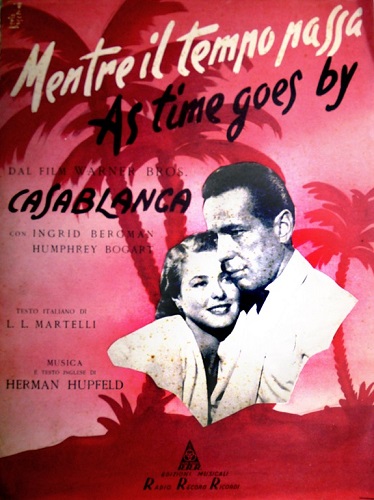
I chose a song written by Herman Hupfeld! Now everyone knows Herman, right? No. Not really, but I am sure you will know the song. It is a song that was written in 1931 for the Broadway show “Everybody’s Welcome.” It was first recorded by Rudy Vallee in July of 1931. It would be covered by Billie Holiday, Louis Armstrong, Frank and Nancy Sinatra, Natalie Cole, Carly Simon and Bob Dylan (Just to name a few).

While the song was recorded a few times after Vallee’s version, it was 11 years later when it would really get noticed. In 1942, the song was sung by the character “Sam” (portrayed by Dooley Wilson) in the classic film – Casablanca. As Time Goes by is heard throughout the film in short musical breaks.

RCA Victor wanted Dooley to record a version of it to be released to the public. However, a musician’s strike happened between 1942 and 1944, so he was not allowed to do so. Instead, the record label re-released the Rudy Vallee version, which went on to become a number one record (11 years after the original release).

Wiki states: Like many later singers, Wilson in Casablanca starts with “You must remember this, a kiss is still a kiss…”, singing only the verses and refrain (“As time goes by”). He entirely omits the intro that put those “fundamental things” into context: “This day and age we’re living in gives cause for apprehension, With speed and new invention and things like third dimension. Yet, we get a trifle weary with Mister Einsten’s theory, So we must get down to earth, at times relax, relieve the tension. No matter what the progress or what may yet be proved, The simple facts of life are such they cannot be removed.”

The song was voted No. 2 on the AFI’s 100 Years… 100 Songs special. The show commemorated the best songs in film.

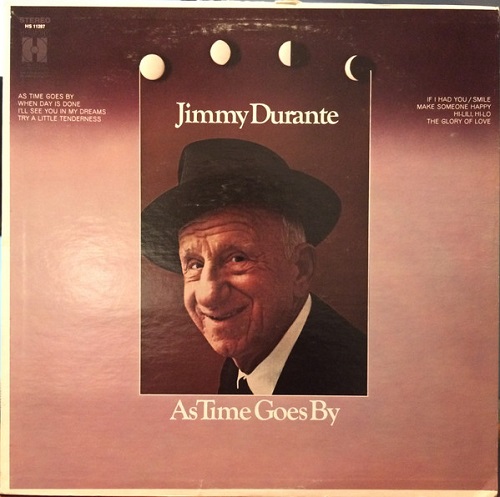
The version I chose to feature is by a multi-talented comedian, actor, pianist and singer. His voice was instantly recognizable on radio. He was a guest on many television shows and had some success as a singer. He is, however, probably best known for … his nose. His nickname was “the schnozzola.” I am, of course, talking about the great Jimmy Durante.

The song itself is beautiful. Every artist who has covered it brings their own special take on it. There is something that really hits me when I hear Durante’s version. Despite that raspy voice, there is a sincerity that makes it just a bit better than the other versions. I’m not trying to diss the other versions, but none of them give me goosebumps when I hear them. Jimmy’s version does. For some reason, his voice blends so well with the string arrangement.

Before I post the song, you know I have to say it – “Play it again, Sam!”

In a live version, Jimmy adds the intro that many leave out.

Thanks again to Dave for asking me to participate and for hosting this feature. I’m excited to see the choices of the other writers!

Thanks for reading and for listening!

Turntable Talk #37 – Turn It On Again

This was first posted on the A Sound Day blog hosted by Dave Ruch:

Once again, Dave from A Sound Day has invited me to participate in his month Turntable Talk feature. I truly appreciate the fact that he always comes up with great topics. Some of those topics are a bit more difficult to write (like last month), and some are quite easy. This month’s topic falls into the latter category.

Dave is calling this month’s round –Turn it on Again!  His instructions are very easy: “tell us about your favorite music video, or the one which impresses you most, and why you love it.” As a child who grew up with MTV, I had many that came to mind.

At this writing, I don’t know what the other contributors have chosen to write about. Has someone picked Michael Jackson’s Thriller? What about Take on Me from A-Ha or Buddy Holly by Weezer? I also wonder about Fatboy Slim’s Weapon of Choice, Peter Gabriel’s Sledgehammer and Nirvana’s Smells Like Teen Spirit. Each and every one of them stands out and have appeared on many “Best Music Video” lists.

I’m not sure that my pick would be considered my “favorite.” I also wouldn’t say it “impresses” me most, but I do enjoy watching the craziness of it. I suppose readers may be surprised at my choice, as I don’t really write about many “rock” songs. I suppose that this song wouldn’t fit into that category, but the singer qualifies as a rocker (at least most people think so).

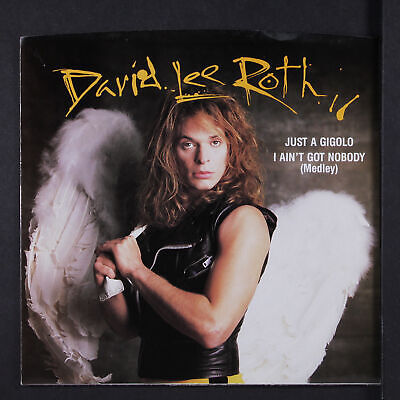
“The band as you know it is over!” That is what Eddie Van Halen told Rolling Stone in mid-August 1985. This confirmed the rumors of division in the band with David Lee Roth. Eddie also made sure to add that “Dave left to be a movie star.” With that, Dave went on to explore a solo career. In late 1984, Dave released a cover of the Beach Boy’s California Girls. He followed that with another cover song (medley actually) from the great Louis Prima.

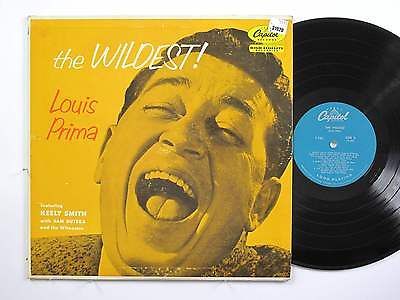
In 1956, Prima took the song Just a Gigolo and paired it up with I Ain’t Got Nobody. He used the song in his 1950’s Las Vegas act with Sam Butera and Keely Smith. The success of that act gained Prima a recording deal with Capitol Record, which hoped to capture on record the atmosphere of his shows. The first album, titled The Wildest! was released in November 1956, and opened with “Just a Gigolo”/”I Ain’t Got Nobody.” It became Prima’s signature number and helped relaunch his career.

Roth’s version is really almost a note for not copy of Prima’s record. By itself, it’s just an ok cover song. However, with an entertaining video that features celebrity look-alikes, beautiful women, and Dave being … Dave, it becomes something much much more.

The video for the song begins with Dave asleep at a news desk as his video for “California Girls” plays behind him on the monitor. The crew calls his name and he wakes up. After his talk, the freaky crew members begin to speak to him. They are right in the camera, so the viewer sees this from Dave’s perspective in this sequence. It’s actually kind of disturbing. The intro to the video is almost two minutes long before the song actually begins.

When it does, Dave is off dancing through the studio. We see him showing up at a talk show, walking through the backstage area among Vegas showgirls, astronauts, pimps, pirates, monsters, cheerleaders, hula dancers, and the police. All of this happens before you really get to the “meat and potatoes” of the video.

It is there that Dave begins parodying videos from Michael Jackson, Cyndi Lauper, Billy Idol, Richard Simmons’s “Sweatin’ to the Oldies” videos (Davercize!), Willie Nelson, and Boy George. As he appears in each of the videos, he winds up wrecking them. It is almost like watching a cartoon. It’s utter chaos, but a fun chaos (unless you count the priest who has a heart attack because of Dave’s dancing.)

The video is like a snapshot of the 80’s. It’s funny to imagine Dave crashing into a Willie Nelson or Cyndi Lauper video. As the “Nostalgic Italian,” I appreciate the nostalgia that the video presents. It is more powerful now than it was in 1985.

Eventually, MTV edited the 2 minute intro out, and just played the song portion of the video in rotation. I think that is how I first saw the video. When I searched for it to post in this blog, I found the full video. I honestly had forgotten all about the intro, but seeing it again was a hoot. Watching Dave do his “over the top” announcer made me think of so many of those DJ’s on the radio who literally puke every thing they say.

Back in one of our first rounds of Turntable Talk, we discussed music videos and whether they hurt radio. To me, I love the fact that a music video can convey the story of a sad song or add a whole lot of fun to another. With this video, Dave pokes fun at other videos, which only makes his more enjoyable to see.

I could be wrong, but it is possible that Weird Al Yankovic looked back to this video as inspiration for his UFH video. In Al’s Video, (in between clips from the movie) he pokes fun at Guns and Roses, Prince, George Michael, Peter Gabriel, ZZ Top, Billy Idol, The Beatles, INXS and the Talking Heads!

Thanks again, Dave for asking me to take part in this feature. I know that I really look forward to your topics and enjoy writing my response to them. I am already looking forward to next month.

Thanks for reading!

Turntable Talk #36 – One More For The Road

I want to thank Dave from A Sound Day once again for the invitation to participate in Turntable Talk. He continues to come up with great monthly topics for this feature. This round brings us to the three year mark for this feature. It continues to be one of the features that I love to write for.

This time around, Dave found inspiration for our topic from the reunion tour that Oasis announced recently. Our instructions were to “pick an inactive act, solo or group, that you’d like to see back. Tell us who, why and what…one last tour? New album? Both?” There were some limitations – you could not resurrect someone who passed away for example. I wanted a bit more clarification and asked it health issues would rule out a choice. In other words, if an artist is not active because of some health problem, are they available? He said that would be ok.

That was important to my choice, as they currently are unable to sing. However, I would love for her to be able to do one more thing. I am talking about Linda Ronstadt.

It was 2011 when Linda announced her retirement. Two year’s later, she announced that she had Parkinson’s and could “no longer sing a note.” According to the Washington Post, her diagnosis was subsequently re-evaluated as progressive supranuclear palsy. The illness brought about the end of her singing career.

Linda was one of those artists who could do almost any genre. She made her mark in rock, country, Latin, pop, adult contemporary, and even opera! Her music is not limited to a specific genre and she has had great success with all of them.

She has won eleven Grammy Awards, three American Music Awards, two Academy of Country Music Awards, an ALMA Award and an Emmy Award. In 2014, Linda was inducted into the Rock and Roll Hall of Fame. That same year, she she was awarded the National Medal of Arts and Humanities. She also won the Grammy Lifetime Achievement Award in 2016.

So to answer Dave’s question, I would love to hear another new album from her. At 78, I doubt a tour would be feasible. If I am allowed to ignore her voice issues and allow her the ability to sing again, I think an album that is a combination of all of her different styles would be an amazing send off.

The album could contain cover songs or originals. There have been some amazing songs that I could easily hear her singing. She could record some sweet ballads or songs with a little country flavor. I would love to hear a couple more from the Great American Songbook or a nice jazz piece. And if her voice is up to it, a few pop/rock songs.

If you have a problem with me healing her voice, I still think an album would be possible. She’s recorded over 30 albums. There has got to be some songs that she recorded that didn’t make the cut for them. I can only imagine the songs that are locked away in a vault somewhere just itching to be heard. The album could be like the one they did of Stevie Ray Vaughn’s “vault” music after he passed away.

When I listen to Linda’s recordings, I find myself getting lost in that voice. It could be angelic, sultry, fun, seductive, gentle, hypnotic and mellow. That voice remains one that forever captivates me. It saddens me that her voice has been silenced and I would love to hear just one more album from her.

Singer Linda Ronstadt.

Thanks again, Dave, for asking me to participate. I look forward to reading the other writer’s contributions. Until next month, I will quote Linda from her Cry Like a Rainstorm, Howl Like the Wind Album – “Adios.”

Turntable Talk #35 – Sans Sophomore Slump

It is time for another edition of Turntable Talk hosted by Dave from A Sound Day. This is round #35, which means next month I’ll have been contributing to this feature for 3 years! Wow. As long as Dave keeps coming up with interesting topics, I’ll keep writing.

This time around, Dave says that “we’re going Sans Sophomore Slump. We all remember the triumphant debuts to the scene by The Knack, Meat Loaf, the Ramones…but how many recall, let alone listen to ‘But the Little Girls Understand’, ‘Dead Ringer’s or ‘Leave Home’… the follow-ups for them? This month, pick a SECOND album by a group or singer you thought was a standout and at least as good as the first.

When I worked in country radio we often referred to the “Class of ’89.” This was a group of four guys who all stormed onto the scene in 1989. Those guys were Clint Black, Travis Tritt, Alan Jackson, and Garth Brooks.

The four of them were so popular that the brought an entire new group of listeners to the genre. Much of their music focused on storytelling, which also made for some amazing music videos. They helped to make Country music more popular than ever.

Garth Brooks’ self titled album was released in April of 1989. It peaked at #13 on the Billboard 200 and went to #2 on the Top Country Albums chart. From the album, there were four singles, two of them went on to become number 1 hits.

Much To Young (To Feel This Damn Old) went to #8 on the charts for Garth. Not Counting You also went top 10, and was the first hit that Garth completely wrote himself. The Dance and If Tomorrow Never Comes were both #1 smashes! Today, they have reached “classic” status. If Tomorrow Never Comes was so big that it won the Academy of Country Music’s Song of the Year in 1990.

So how do you follow that kind of success? If you are Garth Brooks, you release your sophomore album and watch in amazement.

Like the other members of the class of 1989, fans wanted more of their music! Garth released No Fences in August of 1990 and it was just HUGE! It went to #1 on the Billboard Top Country Albums chart. It went to #3 on the Billboard 200 and stayed in the top 40 on that chart for a whopping 126 weeks!

As for the singles from the album, they have gone on to become Garth classics (just like the ones from album #1). All four singles from the album went to #1 on the Country chart!

The Thunder Rolls not only went to #1, but won the CMA Video of the Year for 1991. The video is a powerful one. When Garth plays the song at live shows he adds another verse where the cheater gets what’s coming to him.

Two of a Kind, Working On a Full House, Unanswered Prayers, and Friends in Low Places also all reached #1. Friends in Low Places also won the Academy of Country Music’s Single of the Year for 1990.

That song is familiar to country music fans and non-fans alike. It still plays everywhere. It was always on the Mobile Beat Top 200 songs for mobile DJs. It plays at parties, weddings and even sporting events. I’d love to see the money that this one song alone makes for Garth Brooks.

Garth’s Sophomore album, No Fences, helped to pave the way into super stardom for him. A simple search of “Awards won by Garth Brooks” will show you just how popular and successful Garth went on to be. One has to wonder what might have happened if No Fences bombed.

Thanks again to Dave for hosting this edition of Turntable Talk. I appreciate him reaching out and including me in such an amazing feature. As always, I look forward to the next topic.

Thanks for reading!