
Back in November, I did a feature I called “Share Your Nostalgia.” I asked some of my blogger friends to write up a piece that focused on their favorite toy from childhood. The response was positive and it was suggested to do another round. So this time around, I asked for them to tell us about their Favorite Childhood Book.
Their book could be something that was read to them by their parents or grandparents. It could also be a book that was read to them in school at story time. I also suggested that their book might be one that they read to their own children. I wanted each of them to have as much freedom as necessary.
Today’s guest blogger is responsible for my continuing this feature. Dave from A Sound Day hosts Turntable Talk every month, which many of the participants and I take part in. It’s a wonderful music feature that we all enjoy taking part in. When I decided to try my feature, Dave was very supportive of the idea and felt it was worthy of doing again with a change in topic.
Dave has been one of those bloggers that I followed early on. His musical pieces are worth a read daily. Will his books have a musical theme to them? Let’s find out together…
Thanks Keith, for running this interesting feature and inviting me to be a part of it. Last time, we talked about toys we loved as a kid which brought me back a lot of nice memories, as it likely did to most of the readers I would bet. This time we’re remembering something that was as important as the toys to me growing up – books.
I feel fortunate I grew up in a household of readers, book-lovers. My Mom was a school teacher (although she pretty much gave that up to be a stay-at-home mom as my brother and I grew up) and loved books, read quite a bit. Even in her old age, she loved romance novels and Diana Galbadon fantasy books. She even read the hefty Harry Potter series by JK Rowling. My dad was more surprising to many. He dropped out of school at 14, more due to his family’s financial reasons than a disdain for education. He grew up speaking German but learned English when he came over here and taught himself a great deal reading. He built nice bookcases in our living room and filled them with books, fiction and non-fiction alike. He read anything from history epics to James Bond thrillers to ones of philosophy to books theorizing about extraterrestrials; probably where I got my fascination for UFOs from. There were series of books on foreign lands and even some novels that were considered on the “racy” side I’d eventually find out. He was walking proof that formal education isn’t necessarily equal to intelligence. Both of them had their flaws (we all do) but both loved reading and would often take me to the library or bookstores and for that I’m grateful.
Not surprisingly then, my parents got me reading pretty young. I can’t remember the exact dates or details, but most definitely I could read some basic things before I was near school age.
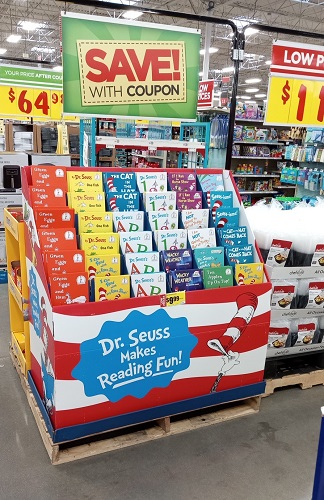
Like most kids my age, I would guess, the first books I remember having and learning to read (first having my mom read it and after awhile being able to myself) were various ones from the great, delightful Dr. Seuss. He had to have done more to promote literacy in young people than any other individual in the 1950s through ’70s. We had pretty much all of the “classic” titles in his collection; I’m thrilled when I go to my town supermarket now and see a big display featuring most of them, even in the same format and with the same covers I remember. Green Eggs & Ham was a real fave of mine, and I liked that rascally Cat in the Hat but of course the prize in that set was The Grinch. Of course I loved the TV version of it (still do) but it was amazingly fun to me back then to be able to read the words and see the still pictures Ted Geisel (aka, Dr Seuss) drew for them. I nearly picked those books collectively to feature but decided to go for something a little more unusual perhaps that were hugely important to me later, when I was … maybe eight to ten years old. The little Golden books, and in particular Weather : A Guide to Phenomena and Forecasts, and Birds : A Guide to Familiar American Birds. Both were small, pocket-sized ( just a shade smaller than a Reader’s Digest magazine as a reference point), had 160 pages and were published in the mid-’50s. And both let me develop a couple of interests I already had into real passions.
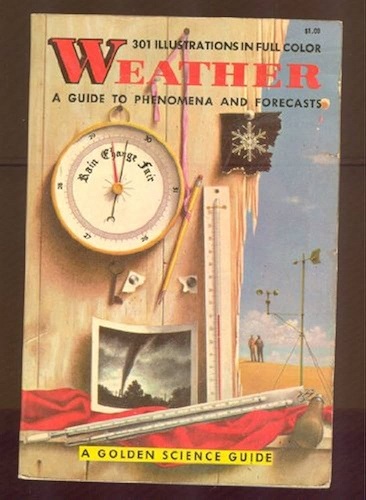
Ever since I was little, the changes in the weather, and especially storms always fascinated me. When the thunder rolled or snow blizzarded so hard you could barely see across the street, I ran to the window, not for cover. By the time I was about 10, I had a little weather set and kept records of the temperature, the barometer, the amount of rain we got day-by-day. I was quite the nerd apparently! But I loved that stuff and the Golden book was the one that made me understand it all. It described air masses, cold and warm fronts, how storms developed, tornadoes and hurricanes and how professionals measured it all and came up with forecasts. All explained with a lot of pictures and maps and in terms simple enough for a kid my age to understand, but not totally dumbed down. I swear that an average person who read through it twice might well have a better understanding of how weather works than a number of TV “weathermen” or “weatherwomen” I’ve seen on TV. It was a trusty reference book for me for years, probably until my parents split up and my Mom and I moved, when I was a teen. In no small part thanks to it, I even thought about becoming a meteorolgist. The amount of advanced schooling required for the degree and the probability of being sent to work in some remote northern locale ended up deterring me from that but to this day, I note the weather and try to see the weather maps online. I even took a training course a few years back offered by the Weather Service to be an informed weather spotter… basically if I see a wall cloud that’s rotating or nickel-sized hail falling, I can call into the weather office and report it and they won’t think I’m some total bozo without a clue.
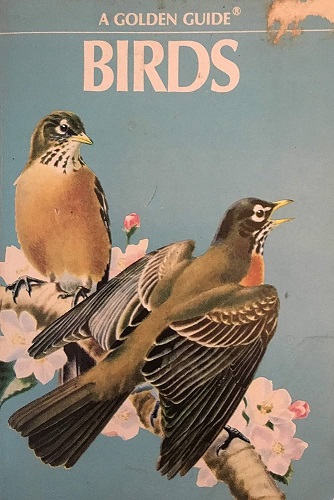
The birds book had a similar effect on me, and I probably got it around the same age. I’d always loved nature, and back then our family often watched shows like Wild Kingdom . I was fascinated. When my Mom put out a bird feeder in the birch tree in our front yard, near the living room window, I soon became enthralled by the creatures. The color, the vibrancy, the variety… I’d spend hours at times in winter adoring the tiny, busy chickadees, admiring the occasional neon-red Cardinal that dropped by, seeing the goldfinches and being amazed how the dazzling yellow June ones and the more subdued olive-and-brown January ones were the same birds! All the while, I thought the bold, loud and ultra-colorful Blue Jays were just about the best. How great for me my favorite baseball team chose them as their name and symbol!
Anyway, when something unfamiliar showed up in the yard, I was always wondering what it was. What it ate, where it came from, that sort of thing. The Golden book helped me do that. Now, it was only 160 pages, so it probably only covered about 140 or so species; a small sampling of the over 700 types that inhabit the U.S. and Canada. But most of the ones I saw regularly were in there, or if not, were close to ones that were shown. Soon I knew a Slate-colored Junco was that little blackish sparrow eating seeds on the ground and those green-headed ducks I’d see on every pond and creek were Mallards. The book showed them, told a bit about them in a paragraph or two, and even had a little map to show where you should expect to see them. It also made me see birds that I wanted to see but hadn’t – man, who can look at a Pileated Woodpecker, the one the cartoonist based Woody on, the size of a crow with a flaming red crest on top of its head, and not be in awe? I would venture out to parks and woods to look for some of those magic creatures, and in time saw most of them. Soon of course, I wanted to know more and got a full field guide (as it happens, also a Golden one, but a much more scientific and complete one, over 400 pages with pretty much every bird on the continent shown) that could tell me all those species and how to tell them apart, but it was the little beginners one that got me to that point. I found one in a used store not many years ago, and of course bought it. Why wouldn’t I?
If I wasn’t nostalgic for my childhood, I wouldn’t be writing this for Keith… and if you weren’t for your own childhood, you wouldn’t be reading it.
My brother at those ages liked the Hardy Boys. Nothing wrong with that, but I guess I was always more fascinated by what really was than what could be in a pretend world. Thanks to the creators of that Golden series for helping me understand the basics and become even more fascinated with every bit I learned.
 Various Ramblings of a Nostalgic Italian