

I am a man of faith. I am not here to start a theological debate. I debated turning off the ability to comment on this post, but I didn’t. If you are a person of faith, too, you may enjoy a little history lesson.
Yesterday was Bring Your Bible Day. The idea is, that whether you were going to work or school, you have your Bible with you. I have my Bible in my cubby at work, so mine was already there. Coincidentally, today is another important biblical day.
On this day in 1535, the first complete English language Bible (that included both Old and New Testaments) was printed. The Photo Flashback is the title page from that Bible.
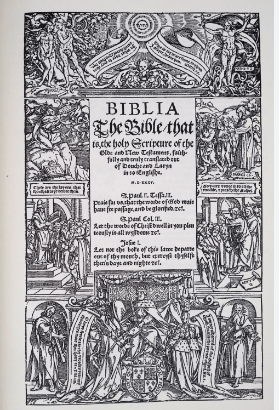
The Coverdale Bible, as it became known, was translated by William Tyndale and Miles Coverdale. It is part of a line of Bibles referred to as the “Textus Receptus.” The phrase is Latin for the “Received Text.”
Here is a bit of history for you:
The Coverdale Bible, compiled by Myles Coverdale and published in 1535, was the first complete English translation of the Bible to contain both the Old and New Testament and translated from the original Hebrew and Greek. The later editions (folio and quarto) published in 1539 were the first complete Bibles printed in England. The 1539 folio edition carried the royal license and was, therefore, the first officially approved Bible translation in English.
Tyndale never had the satisfaction of completing his English Bible; but during his imprisonment, he may have learned that a complete translation, based largely upon his own, had actually been produced. The credit for this achievement, the first complete printed English Bible, is due to Miles Coverdale (1488-1569), afterward bishop of Exeter (1551-1553).
The details of its production are obscure. Coverdale met Tyndale in Hamburg, Germany in 1529, and is said to have assisted him in the translation of the Pentateuch. His own work was done under the patronage of Oliver Cromwell, who was anxious for the publication of an English Bible; and it was no doubt forwarded by the action of Convocation, which, under Archbishop Cranmer’s leading, had petitioned in 1534 for the undertaking of such a work.
Coverdale’s Bible was probably printed by Froschover in Zurich, Switzerland and was published at the end of 1535, with a dedication to Henry VIII. By this time, the conditions were more favorable to a Protestant Bible than they had been in 1525. Henry had finally broken with the Pope and had committed himself to the principle of an English Bible. Coverdale’s work was accordingly tolerated by authority, and when the second edition of it appeared in 1537 (printed by an English printer, Nycolson of Southwark), it bore on its title-page the words, “Set forth with the King’s most gracious license.” In licensing Coverdale’s translation, King Henry probably did not know how far he was sanctioning the work of Tyndale, which he had previously condemned.
In the New Testament, in particular, Tyndale’s version is the basis of Coverdale’s, and to a somewhat less extent this is also the case in the Pentateuch and Jonah; but Coverdale revised the work of his predecessor with the help of the Zurich German Bible of Zwingli and others (1524-1529), a Latin version by Pagninus, the Vulgate, and Luther. In his preface, he explicitly disclaims originality as a translator, and there is no sign that he made any noticeable use of the Greek and Hebrew; but he used the available Latin, German, and English versions with judgment. In the parts of the Old Testament which Tyndale had not published he appears to have translated mainly from the Zurich Bible. [Coverdale’s Bible of 1535 was reprinted by Bagster, 1838.]
In one respect Coverdale’s Bible was groundbreaking, namely, in the arrangement of the books of the. It is to Tyndale’s example, no doubt, that the action of Coverdale is due. His Bible is divided into six parts — (1) Pentateuch; (2) Joshua — Esther; (3) Job — “Solomon’s Balettes” (i.e. Canticles); (4) Prophets; (5) “Apocrypha, the books and treatises which among the fathers of old are not reckoned to be of like authority with the other books of the Bible, neither are they found in the canon of the Hebrew”; (6) the New Testament. This represents the view generally taken by the Reformers, both in Germany and in England, and so far as concerns the English Bible, Coverdale’s example was decisive.
You can see more of the Coverdale Bible here:
https://publicdomainreview.org/collection/the-coverdale-bible-1535/
One of the first classes I took in my Bible studies was a Manuscript Evidence class. Manuscript Evidence means you examine the manuscript for evidence about something. There is a line through history, down to the present time where God has preserved His Word. It looks like this:
HISTORY (After the Crucifixion)
| 100 AD | 500-1000 AD | 1000-1500 AD | 1500-2000 AD |
| Original Text Written | Dark Ages | Dark Ages | Reformation |
The Bible history and God’s preservation has a straight line flow through history:
- The original text is written and collected;
- The Bible is copied and sent out;
- Bible Believers preach and teach from it.
This is called the Textus Receptus (TR), a Latin expression that is used around 1624 AD for this Greek Text, that goes back to 100 AD. TR means received text that is used commonly among the people. This text is written in Greek and most people do not speak Greek. Therefore in:
- Syria there is a Syriac Bible Version made (150 AD)
- Egypt there is a Coptic Bible Version made
- Rome there is an Old Latin Bible Version made
This process has continued on throughout history whereby Bible versions were translated into the language of the various countries from the Greek Text, for the people.
Around 1522 AD Luther translates from the TR into German for the people he ministered to. After this came:
- Tyndale 1525
- Coverdale 1535
- Matthews 1537
- Great Bible 1539
- Geneva Bible 1560
- Bishop Bible 1568
After these, in 1611 you have the King James Bible. The various translations were gathered together from all the above versions and the final outcome was the King James Version.
My Manuscript Evidence class was a wealth of information and made my believe in God’s Word stronger.
It is hard to imagine the things that guys like Tyndale and Coverdale experienced as they worked. They wanted to get a Bible into the hands of anyone who wanted one. The quest to have a Bible written in the holders own language was very important to them. What did they get for their dedication? Torture. Ridicule. Prison. Death. What faith they must have had. I can only wish to have an ounce of that faith.
Thanks for reading such a deep post today.
 Various Ramblings of a Nostalgic Italian