

It’s time for another edition of Turntable Talk, hosted by Dave from A Sound Day. Again, I thank Dave for the invite to contribute to this feature. This month’s topic is an interesting one that had a lot of possible songs to choose from. This month it is History Lesson Or Music Class? We were instructed to “pick a song you like that’s based on reality- either a real event or a real life person, famous or otherwise, and tell us a bit about it. Musicians have found some incredible subjects based on history – either world or their own – to make great music from.”
I could come up with a few songs based on real events that I have already written about in the past. The Wreck of the Edmund Fitzgerald and Smoke on the Water were both inspired by real events. Please, Mr. Columbus and Nightshift were both about real people. I was unsure about what to choose.
Naturally, I went to Google and did a search on songs inspired by real events or people. There are songs about the Kennedy assassination, the sinking of the Titanic, the bomb that dropped on Hiroshima, and just about everything else. As I read through the list, one song popped into my head that wasn’t even on the list. So I chose that one.
By the time this post goes live, all of the other contributor’s submissions will have already been published. The song I have chosen is one that is very fitting for the upcoming holiday season. It is based on an event that took place 110 years ago and is one of the amazing stories of World War I.
When World War I began, many thought that it would be over by Christmas. However, five months after the war began, it was still going strong despite many peace initiatives. On December 7, 1914, the Pope begged both the German and British governments for a truce. He asked “that the guns may fall silent at least upon the night the angels sang”, which was refused by both sides.
A major combat tactic in World War I was trench warfare. This is where the opposing armies dig trenches in order to protect themselves from enemy gunfire and gain an advantage. Trenches are usually built close together and can be miles long and up to 12 feet deep. I many cases the trenches of both sides were close enough that they could converse with each other. This was referred to as Fraternization (peaceful and sometimes friendly interactions between opposing forces) and was a regular feature in quiet sectors of the Western Front.
On Christmas Day, 1914, roughly 100,000 British and German troops were involved in the informal cessations of hostility along the Western Front. German soldiers placed candles on their trenches and on Christmas trees. They then continued the celebration by singing Christmas carols. The British responded to this by singing carols of their own.
The shared experience of Christmas led to the two sides shouting Christmas greetings to each other from their trenches. Soon thereafter, there were excursions across No Man’s Land, where small gifts were exchanged, such as food, tobacco, alcohol, and souvenirs such as buttons and hats. During this time, weapons were laid down and there was no artillery fire.
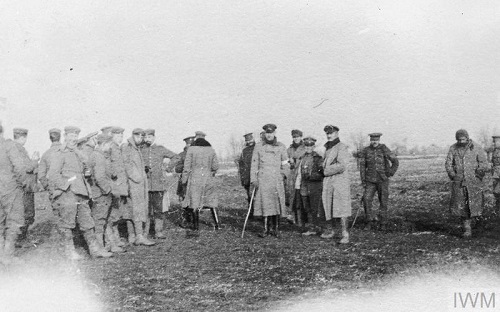
On Christmas Day Brigadier-General Walter Congreve of Brittian wrote that the Germans declared a truce for the day. One of his men bravely lifted his head above the parapet and others from both sides walked onto no man’s land. Officers and men shook hands and exchanged cigarettes and cigars; one of his captains “smoked a cigar with the best shot in the German army”, the latter no more than 18 years old. Congreve admitted he was reluctant to witness the truce for fear of German snipers.
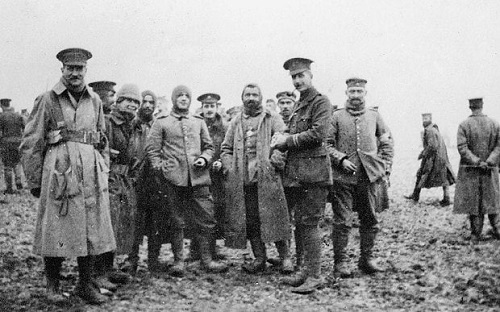
On December 26, 1914, British Private Henry Williamson wrote the following to his mother:
“Dear Mother, I am writing from the trenches. It is 11 o’clock in the morning. Beside me is a coke fire, opposite me a ‘dug-out’ (wet) with straw in it. The ground is sloppy in the actual trench, but frozen elsewhere. In my mouth is a pipe presented by the Princess Mary. In the pipe is tobacco. Of course, you say. But wait. In the pipe is German tobacco. Haha, you say, from a prisoner or found in a captured trench. Oh dear, no! From a German soldier. Yes a live German soldier from his own trench. Yesterday the British & Germans met & shook hands in the Ground between the trenches, & exchanged souvenirs, & shook hands. Yes, all day Xmas day, & as I write. Marvelous, isn’t it?”
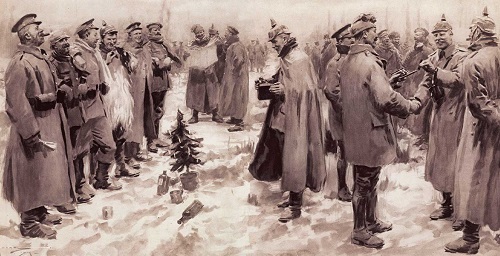
The truces were not reported for a week, eventually being publicized to the masses when an unofficial press embargo was broken by the New York Times on New Year’s Eve. (The US was neutral at this time). English newspapers soon began printing numerous first-hand accounts from soldiers in the field, taken from letters home to their families and editorials on “one of the greatest surprises of a surprising war”. By January 8, 1915, pictures had made their way to the press.
As word spread of this truce, and as the war went on, officers on both sides sternly prohibited similar truces in the future!
I give you all of that detail for a reason. My song is Belleau Wood by Garth Brooks. It was released on his Sevens album. As you listen to it, notice how he is able to tell this story and convey all of the emotions involved in just 3 and a half minutes. It is beautiful, heartwarming, and sad at various points in the song.
The one line in the song that always gets me is: “Here’s hoping we both live
to see us find a better way.” Here we are 110 years after this event and we are all still searching for “a better way.” Sigh.
As I researched this event and this song, I read a very good piece about the song by Sierra Smith, It was written in 2015 and can be found here:
Thanks again, Dave for hosting and for asking me to join in this month’s Turntable Talk. I know that I always enjoy writing for it and reading the other contributions. I’m already looking forward to next month’s topic!
Thanks for reading. Class dismissed.
 Various Ramblings of a Nostalgic Italian
I love this history and that it happened and that his song immortalizes it
LikeLiked by 1 person
thanks again Keith, a great story that deserves retelling and a fine song. I knew of the one day truce, a story that gives both hope and is tragic (as it only lasted one day) but the song was brand new to me
LikeLiked by 1 person
As I commented when your great post first appeared on Dave’s blog, it’s an incredible background story illustrating the madness of war.
LikeLiked by 1 person
Great story and song Keith….glad you introduced it to me.
LikeLiked by 1 person