

(Note: This blog was originally posted earlier this month as part of Turntable Talk, a monthly feature hosted by Dave at A Sound Day)
I’d like to thank Dave for inviting me back to participate in his Turntable Talk feature. This month’s topic is a really good one. Dave says: “…this month’s topic is ‘DON’T AXE ME’. I challenge you to pick your favorite guitarist, and tell us a bit about why they appeal to you. …This is the time to give props to your favorite ‘axe man’…or ‘axe woman’!”
Honestly, there are so many great guitar players to choose from. When I read Dave’s email, I began to jot down guitarists that came to mind. The list I came up with included Steve Cropper, Chet Atkins, Albert Collins, Billy Gibbons, Bryan May, Buddy Guy, Eric Clapton, Scotty Moore, Wes Montgomery, Les Paul, Jerry Reed, Stevie Ray Vaughn, Prince, BB King, Jeff Beck, Jimi Hendrix, Willie Nelson, George Harrison, Eddie Van Halen and quite a few more. Each one of them is fantastic in their own way. Each of them were also influenced by another guitar player. How do you choose one? Who do you choose? That was the dilemma I found myself in.
I then began to think about the guitar playing itself. You know, solos or instrumentals. That lead me to remember a day back in 1994 when I was working at Honey Radio. My old morning show partner, Rob, handed me a cart with a song on it. The label read, “Wash Out” by Freddie King. I asked him if this was the same Freddie King who did Hide Away and he told me that it was. We were doing an hour of all instrumentals, so we slipped it on the air. It was just a cool tune. The guitar work in it was really nothing to over the top or mind blowing, but it did lead me to discover more of Freddie’s tunes.
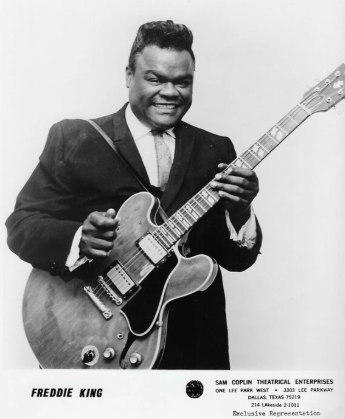
Freddie King was born in 1934 and began playing guitar at age six. The King family moved to Chicago in 1949. When he was about sixteen, he would sneak into the Chicago blues clubs and sometimes even sit in with the house band. Freddie took the music of Louis Jordan, BB King, T-Bone Walker, Lightnin’ Hopkins and others and developed his own style. That style was a mix of Texas and Chicago blues. He also incorporated Country, Swing and Rock and Roll elements. This would soon be referred to as “blues-rock” and it was a big influence on electric blues. His sound felt more contemporary than other Chicago bands who still played with a 1950’s style.
In 1959, he signed with King Records and then was signed to their subsidiary Federal Records. It was during this time that Hide Away and Have You Ever Loved a Woman were released. Hide Away shot up to number five on the R&B Chart and crossed over to the Pop Chart, too, reaching number twenty nine. That was a pretty big deal at the time because the blues genre was pretty much unknown to white audiences. He stayed with Federal Records until 1966. During that time, he went out and toured with Sam Cooke, James Brown, and Jackie Wilson.
Sonny Thompson was a producer and promoter for King Records. He also played piano. It was obvious that Freddie could play the guitar, but Sonny wanted the world to know that he could sing, too. In one recording session he cut “I’m Tore Down.” This became a top ten record on the R&B Charts, but it was ignored by the Pop Charts. The only other time that one of his songs would chart was a Christmas song, and that only was on the chart for one week.
In 1968, King would return to the recording studio. This time at Cotillion Records, which was one of Atlantic’s labels. It was here that he recorded two albums – Freddie King is a Blues Master and Texas Cannonball. (Texas Cannonball features Freddie’s take on Bill Withers’ Ain’t No Sunshine.) Sadly, neither album did much. He would move from label to label through the 1970’s.
King toured a lot. He was playing around 300 shows a year. It didn’t take long for the stress and pressures of touring took its toll. Be began having stomach ulcers. In 1976, during a show in New Orleans, he passed out on stage during a solo. On Christmas of 1976, he played a show in New York. He was supposed to play the next night, but he cancelled that show and went home to Texas. There he checked into the hospital, where he died on December 28 at the young age of 42.
Eric Clapton has been very vocal about Freddie’s influence on him. In 1985 he said that Freddie’s 1961 song “I Love the Woman” was “the first time I heard that electric lead guitar style, with bent notes … (it) started me on my path.” Without Freddie King, there may not have been a “Slow Hand.”
Fun Fact: Along with BB King and Albert King, Freddie is known as one of the “Three Kings of the Blues Guitar.” Interestingly, none of them are related to each other.
One of the things that I love about his playing is that when you listen to it, it almost matches up with the way he sings. The phrasing of his playing really is no different from his vocals. If you jump back and forth between an instrumental and a vocal song from him, you can’t help but notice the similarities.
In preparing to write this piece, I made my way through quite a few of Freddie’s albums. They sounded as fresh as when I first heard them. I found myself getting lost in his solos and feeling the emotions as he sang. I love that despite the age of the music, it can still do something deep within the listener’s soul.
I don’t play guitar, but I have an acoustic that my dad gave me at home. Maybe one day I will just go for it and get lessons. I won’t ever be a Freddie King, but that’s ok. The world was lucky enough to have the real thing for 42 years.
Thanks again, Dave for hosting Turntable Talk. I’ll be waiting for the next topic.
Thanks for reading.


Thanks again Keith! He was a name I had heard of before but knew nothing about as he is an obvious talent. Good job on showcasing that
LikeLiked by 1 person
i didn’t know freddie king by name, but wow
LikeLiked by 1 person
An underrated talent for sure
LikeLike