
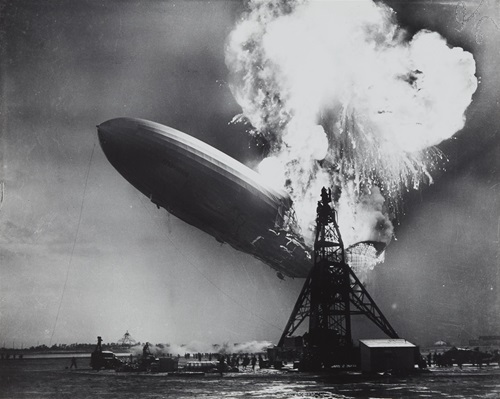
It was on this day in 1937, that the LZ 129 Hindenburg disaster happened in Lakehurst, New Jersey. The Hindenburg was a German passenger carrying airship (Zeppelin) that had been in operation since 1928. The airship had made ten trips to the United States in the past, each without incident. The Hindenburg was full of hydrogen,
The airship left Germany on the third of May in what was to be the first of many trips between the United States and Europe. The ship was only carrying only 36 passengers (it could carry 70) and 61 crewmen (21 of which were trainees). The Hindenburg was fully booked for its return flight.
The airship was running behind, and due to weather in New Jersey, they thought there would be a bigger delay. The Captain instead decided to change course, which would take them over Manhattan. While they waited for the weather to clear, the captain took his passengers on a tour over the seashore of New Jersey. At 6:22 p.m. he was told that the storms had passed. It was at this time that he turned the ship back toward Lakehurst for landing.
The ship was going to make a “high landing.” This would involve dropping their landing ropes and their mooring cable from the ship. Crews on the ground would then attach them to the mooring mast. Apparently, this was a very common type of landing for American airships, but the Hindenburg had only done this a couple of times. When it was finally in position (at about 7:21 pm), the ropes and cables were dropped, and the port cable was connected to the post.
Accounts of what happened next varied by the witnesses. In one account, a witness said they saw fabric above the upper fin flapping in the wind, looking like there was a gas leak. Some said they saw a blue flame. Witnesses also could not seem to agree on where the fire started. Once the fire started, the ship was consumed quickly by flames, as the hydrogen fueled them. The time that it took, from the beginning of disaster to the bow crashing to the ground, is reported as 32, 34, or 37 seconds.
Herbert Morrison was on the scene for Chicago’s radio station WLS. His live description of the events leading up to the disaster and during the disaster is one of the most recognizable pieces of audio in history.
This video is paired with the WLS radio broadcast:
This has much more of the lead in by Morrison:
There were a total of 35 deaths out of the 97 people on the airship, including 13 of the 36 passengers and 22 of the 61 crew; most survivors were severely burned. The last survivor of the disaster was Werner Doehner. He was eight years old at the time. His mother threw him and his brother out of the airship and then jumped out herself. They survived, but their father and sister were killed in the disaster. Werner died in November of 2019.
There are many theories about what caused the disaster – static electricity, lightening, a puncture, fuel leak, structural failure, and even sabotage. Whatever the cause, it was one of the most horrific accidents in history.
 Various Ramblings of a Nostalgic Italian
so horrible –
LikeLike
Hard to believe anyone survived, so terrible.
LikeLike